Losing Weight with Insulin Resistance: What Actually Helps
Losing weight with insulin resistance is harder for a reason. Here are evidence-based food, exercise, sleep, and medication strategies that actually help.

In this article(11)
If you have been eating less, moving more, and watching the scale refuse to budge, we want you to know something important first. Losing weight with insulin resistance is genuinely harder than losing weight without it, and the frustration you feel is not a character flaw. Your body is operating in a metabolic environment that resists fat loss in measurable, biological ways, and conventional advice often ignores that.
Once you understand what is happening under the hood, the strategies that actually move the needle become a lot clearer. We will walk through why insulin resistance complicates weight loss, then get into the food, movement, sleep, and medical approaches that research and lived experience both support.
Why Losing Weight with Insulin Resistance Is Harder
Insulin is a storage hormone. When your cells become resistant to it, your pancreas pumps out more and more insulin to do the same job, and that elevated insulin level signals fat cells to hold onto stored energy rather than release it. According to the NIDDK's overview of insulin resistance, this state often produces high circulating insulin years before blood sugar numbers ever budge into the diabetes range. So you can be metabolically primed for weight gain without anything showing up on a standard fasting glucose test.
There is also a vicious cycle at play. Excess body fat, especially around the abdomen, releases inflammatory signals that worsen insulin resistance, which keeps insulin levels elevated, which encourages more fat storage. Studies in journals like Diabetes Care show that visceral fat is metabolically active in ways subcutaneous fat is not, and reducing it produces outsized improvements in insulin sensitivity. Calorie counting alone often falls short because the math of weight loss assumes a body willing to release stored fat, and an insulin-resistant body is reluctant to do that.
The question is not just how many calories, but what kind of food, when you eat it, and what your insulin is doing in response. Two people can eat the exact same number of calories and have very different outcomes depending on their insulin response. That explains why generic advice often fails people who need it most.
Dietary Strategies That Support Weight Loss
The single biggest dietary lever for insulin resistance is food quality, not just food quantity. Whole, minimally processed foods, the kind that look roughly like they did when they came out of the ground or off the plant, tend to produce much smaller insulin spikes than refined carbohydrates and added sugars. Building meals around non-starchy vegetables, lean proteins, healthy fats, and modest portions of whole grains or legumes is a pattern that consistently shows up in research on improving insulin sensitivity. Our insulin resistance diet guide goes deeper on the specific food choices, but the framework above gets you most of the way there.
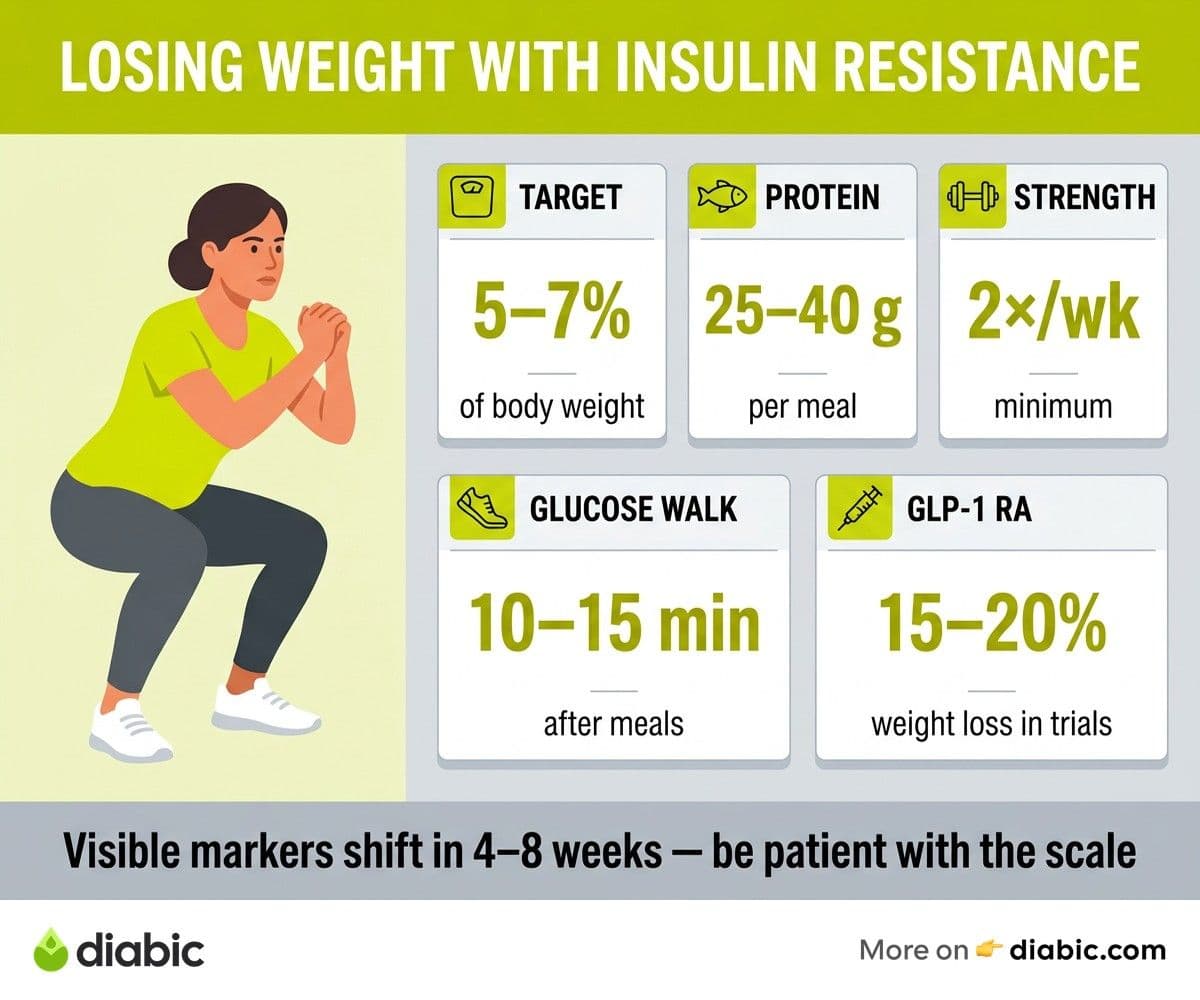
Protein deserves special attention. Adequate protein at each meal, generally 25 to 40 grams depending on your size and activity, helps preserve muscle mass during weight loss and increases satiety so you eat less without feeling deprived. Fiber matters for similar reasons, slowing digestion and blunting blood sugar spikes. The CDC's National Diabetes Prevention Program has shown that participants who shifted toward higher-fiber, higher-protein patterns lost more weight and improved insulin sensitivity more than those who simply cut calories.
Reducing refined carbohydrates and added sugars often matters more than absolute calorie count, especially in the first few months. We are not telling you to eliminate any food group. But pulling back on sweetened drinks, white bread, pastries, and ultra-processed snacks gives your insulin levels a chance to come down, which is the metabolic shift that unlocks fat loss. Some people also find that time-restricted eating, where meals are confined to an 8 to 10 hour window, helps reduce overall insulin exposure. Talk with your provider before trying intermittent fasting if you take any glucose-lowering medication.
Exercise Approaches That Move the Needle
Exercise improves insulin sensitivity in two distinct ways, and you want both of them working for you. The first is acute. A single session of moderate exercise increases how much glucose your muscles pull out of your bloodstream for hours afterward, independent of any weight change. A 10 to 15 minute walk after meals, sometimes called a "glucose walk," can meaningfully lower the post-meal blood sugar spike. This is one of the most underrated tools we know of, and it costs nothing.
The second mechanism is structural. Resistance training, meaning weight lifting, bodyweight exercises, or resistance bands, builds muscle tissue, and muscle is the largest site of glucose disposal in the body. More muscle means more places to store and burn glucose, which lowers the insulin demand at every meal. Research published in Diabetes Care and the ADA's exercise position statement strongly supports combining aerobic and resistance training for insulin-resistant adults, with at least two strength sessions per week alongside 150 minutes of moderate aerobic activity.
If you are starting from sedentary, do not launch into a five-day-a-week program. Start with two short walks a day and one strength session per week, and build from there. Consistency over months matters far more than intensity in any single workout. The fanciest program you cannot stick with is worse than the modest one you actually do.
The Role of Sleep and Stress
Sleep deprivation is an underdiscussed driver of insulin resistance. Even one week of sleeping fewer than six hours a night measurably worsens glucose tolerance in healthy adults, and chronic short sleep is associated with weight gain, increased appetite, and higher insulin resistance scores. If your weight loss has stalled and you are sleeping five hours a night, addressing sleep may unlock more progress than yet another diet tweak.
Chronic stress contributes through cortisol, which raises blood sugar and encourages abdominal fat storage. We will not pretend that "manage your stress" is a simple prescription. But small, consistent practices like a 10 minute walk outdoors, brief breathing exercises, or protected time without screens before bed are realistic places to start. Sleep and stress sit upstream of nearly every other lever you can pull, and when nothing else is working, this is often where the real problem lives.
When Medication May Help
Lifestyle changes are foundational, and for many people they are also not enough on their own, particularly if insulin resistance has been building for years or there is a strong family history. Metformin is the most studied medication for insulin sensitivity. It does not directly cause weight loss in most people, but it improves how your body uses insulin and modestly supports weight management for some. Our piece on metformin for insulin resistance covers what to expect, and a separate explainer on does metformin cause weight loss digs into the actual evidence.
GLP-1 receptor agonists, including semaglutide (Ozempic, Wegovy) and tirzepatide (Mounjaro, Zepbound), have changed what is possible for people with insulin resistance and obesity. Clinical trials published in the New England Journal of Medicine show average weight loss of 15 to 20 percent of body weight on these medications, with significant improvements in insulin sensitivity. They have side effects, they are expensive, and access is uneven, but they work best alongside food and movement strategies rather than in place of them.
There is no moral hierarchy where lifestyle-only is virtuous and medication is a shortcut. Both are legitimate tools, and the ADA Standards of Care treat them as complementary rather than competing. Ask your doctor what your options are and what the realistic timeline is with and without pharmacological support.
Setting Realistic Expectations
The scale is a stubborn measurement. You can be losing fat and gaining muscle and see no movement for weeks, or retain water in response to changes in carbohydrate intake or exercise. We strongly recommend tracking other markers alongside weight: how your clothes fit, your energy levels, sleep quality, fasting blood sugar, and how you feel walking up stairs.
Meaningful improvements in insulin sensitivity typically show up within 4 to 8 weeks of consistent lifestyle changes, but visible weight loss often lags behind. A 5 to 7 percent reduction in body weight is the threshold most strongly associated with meaningful metabolic improvement, and that target is far more achievable than the dramatic transformations social media features. Our piece on reversing insulin resistance gets into what is and is not realistic over a longer horizon.
From my experience: Living with type 1 for 14 years, the years I added consistent strength training (started small with bodyweight in 2020 during lockdown) cut my daily insulin needs by close to 20 percent without any other major change. That was not a weight number on a scale. It was a quiet drop in basal rates over a few months, and watching the same meal need a smaller bolus is the kind of feedback that keeps you showing up. The people I see get traction are the ones who pick two or three changes, do them imperfectly for six months, and let the cumulative effect compound.
Frequently Asked Questions
Why is it so hard to lose weight with insulin resistance?
Insulin resistance causes your body to produce excess insulin, which signals fat cells to store more energy and makes it harder to access stored fat for fuel. This creates a metabolic environment where weight loss becomes significantly more difficult than it would be for someone with normal insulin function. It is not about willpower. It is about hormones doing exactly what they are designed to do in a state your body has shifted into over time.
What is the best exercise for weight loss with insulin resistance?
Research suggests that combining resistance training with moderate aerobic activity is most effective. Resistance training builds muscle, which improves how your body uses glucose, while aerobic exercise lowers insulin levels and burns calories. Aim for at least two strength sessions per week and 150 minutes of moderate aerobic activity, but start smaller if needed. Talk to your healthcare provider before beginning a new program.
How long does it take to see results when losing weight with insulin resistance?
Most people start seeing improvements in blood sugar and energy within 4 to 8 weeks of consistent lifestyle changes, though visible weight loss may take longer. A 5 to 7 percent reduction in body weight, sustained over time, is the threshold most strongly associated with meaningful improvement in insulin sensitivity.
Should I cut carbs completely to lose weight with insulin resistance?
Not necessarily. Reducing refined carbohydrates and added sugars is generally helpful, but cutting all carbohydrates is rarely sustainable and can crowd out fiber-rich foods like vegetables, legumes, and whole grains that actually support insulin sensitivity. A moderate approach focused on food quality usually outperforms an extreme one over the long run.
If you take one thing from this, let it be that losing weight with insulin resistance is a different problem than weight loss in general, and it deserves a different playbook. Work the levers that actually move insulin: food quality, strength, sleep, and where appropriate, medication. Be patient with the timeline. Your body is not broken, and it is not your enemy.
Shahriar P. Shuvo is the founder of Diabic. He has lived with diabetes for over 14 years, and built Diabic to deliver the practical, evidence-based self-management tools he wished existed when he was first diagnosed. By trade, Shahriar is a senior design and frontend engineer with 6+ years shipping products at Agora, Timescale (now Tiger Data), and ShareTrip. He writes from the intersection of lived diabetes experience and product craft, focused on what works in daily management rather than what sounds good in a textbook.
Medically reviewed by
Dr. Rezwana Parvin Rumpa is an obstetrics and gynaecology specialist with clinical focus on gestational diabetes, PCOS, and fertility. She holds the MRCOG (Final Part) from the Royal College of Obstetricians and Gynaecologists in London, the MRCPI (Final Part) from the Royal College of Physicians of Ireland, and an MBBS from Shaheed Monsur Ali Medical College under Dhaka University. Dr. Rumpa serves as a Senior Medical Officer in the Obs and Gynae department at BRB Hospitals Ltd, where she has spent three years managing prenatal care, emergency obstetric cases, and women's-health surgery. On Diabic, she medically reviews content for women living with diabetes, with particular attention to pregnancy, PCOS, and reproductive-health intersections.
More from Treatment & Medication
View all
Recognizing Diabetic Coma Warning Signs Early
Learn to spot diabetic coma warning signs early. We cover DKA, HHS, and severe hypoglycemia symptoms, plus when to call 911 for immediate help.

Switching to Injectable Diabetes Medication: What to Expect
Switching to injectable diabetes medication can feel daunting. Learn what to expect, how to manage side effects, and why this step is progression, not.

Hyperglycemic Hyperosmolar Syndrome: Warning Signs to Know
Hyperglycemic hyperosmolar syndrome is a serious type 2 diabetes emergency. Learn the warning signs, triggers, and when to call 911 for HHS care.
Clinician-reviewed habits, plain-language guides, and honest answers - the small shifts that make living with diabetes feel lighter, every day.