Metformin for PCOS: Benefits and Side Effects to Know
Metformin for PCOS may improve cycles, ovulation, and insulin resistance. Here is what to expect, common side effects, and questions to ask.

In this article(20)
You left the appointment with a prescription you never expected. Your doctor talked about polycystic ovary syndrome, said the word "insulin" a few times, and handed you a slip for a diabetes medication you do not have diabetes for. If that scenario sounds familiar, you are far from alone, and the questions running through your head deserve real answers.
Metformin for PCOS is one of the most widely used off-label treatments in reproductive endocrinology, and for many people it becomes a quiet workhorse in their care plan. It does not fix everything, and it is not the right choice for everyone. What it can do, when paired with the right lifestyle support, is take pressure off a metabolic system that has been stuck in overdrive.
In this article we will walk through how metformin actually works for PCOS, what benefits research supports, what side effects to prepare for, and how to have a productive conversation with your provider. We will keep the medical jargon to a minimum and link out to the sources we trust most.
Why Metformin Is Used for PCOS
PCOS is often described as a hormonal condition, but at its core it is also a metabolic one. According to Endocrine Society clinical practice guidelines, a large share of people with PCOS have some degree of insulin resistance, meaning their cells do not respond efficiently to insulin. The pancreas compensates by pumping out more, and that excess insulin nudges the ovaries to produce extra androgens like testosterone.
Those extra androgens are what drive many of the symptoms that bring people to a doctor in the first place: irregular periods, acne that does not respond to the usual treatments, hair growth in unwanted places, and difficulty getting pregnant. So even though PCOS is a reproductive diagnosis, the engine running underneath it often looks a lot like the early stages of type 2 diabetes risk. We dig deeper into that overlap in our piece on diabetes symptoms women often overlook.
Metformin works by reducing how much glucose your liver releases and by helping muscle cells take in glucose more efficiently. The result is that less insulin is needed to keep blood sugar steady, which can quiet down the cascade that pushes androgen levels up. It is the same mechanism that makes metformin for insulin resistance a common conversation in primary care. Importantly, metformin is not a cure for PCOS, and it does not replace lifestyle work. It is one tool in a strategy that usually includes nutrition, movement, sleep, and stress management.
Benefits of Metformin for PCOS
Researchers have spent more than two decades studying what is metformin used for outside of diabetes, and PCOS has been one of the most active areas. The benefits are real, though they are usually moderate rather than dramatic, and they show up over months rather than days.
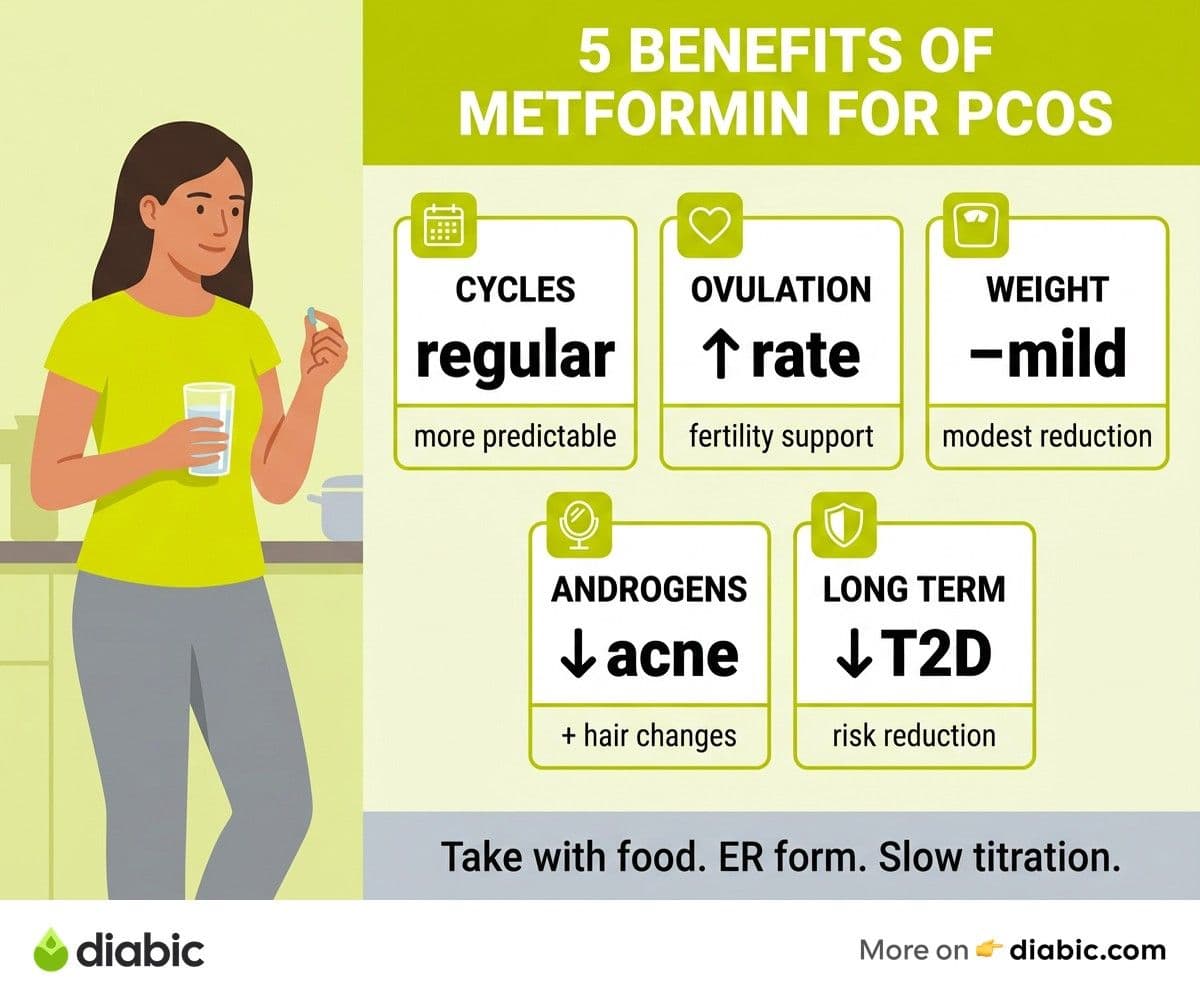
More predictable menstrual cycles
For people whose periods come every few months or not at all, metformin can help cycles become more regular over time. By improving insulin sensitivity, it indirectly lowers the androgen pressure on the ovaries, which can let normal ovulation patterns return. A Cochrane systematic review on metformin in PCOS found consistent improvements in menstrual frequency across multiple trials.
Improved ovulation for those trying to conceive
Metformin has a long history in fertility care, often used alongside or before other ovulation induction medications. Studies published in Fertility and Sterility suggest it can improve ovulation rates, particularly in people with insulin resistance. If pregnancy is on your radar, this is a conversation to have with a reproductive endocrinologist who can weigh metformin against other options.
Modest weight changes
Many people ask whether metformin is a weight loss drug. The honest answer is that it is not, but small reductions are common when insulin sensitivity improves. The American Diabetes Association Standards of Care note that metformin tends to produce modest weight effects that are most noticeable when combined with dietary changes. We unpack the details in our explainer on does metformin cause weight loss.
Lower androgen-related symptoms
Acne, scalp hair thinning, and unwanted body hair are often the most distressing parts of PCOS. As insulin levels drop, ovarian androgen output frequently follows, and over six to twelve months some people see meaningful skin and hair changes. Effects vary widely, and dermatologic treatments are often used in parallel.
Reduced long-term metabolic risk
People with PCOS face a higher lifetime risk of type 2 diabetes and cardiovascular disease. By addressing insulin resistance early, metformin may help shift that trajectory. This benefit alone is why some endocrinologists recommend it even when fertility is not on the table.
Common Side Effects to Prepare For
The biggest reason people stop taking metformin has nothing to do with how well it works. It is the gastrointestinal side effects that show up in the first few weeks. Knowing what to expect, and how to soften the landing, makes a real difference in whether you stick with it.
Most people experience some combination of nausea, loose stools, bloating, gas, and stomach cramping when starting. These symptoms tend to be worst in the first two weeks and usually settle as your body adjusts. We cover the patterns in detail in our guide to metformin side effects in detail, including which ones are normal and which warrant a call to your provider.
How to make the start easier
Taking metformin with a meal, rather than on an empty stomach, is the single most useful thing most people can do. Food slows absorption and gives the gut a buffer. The extended-release version, which dissolves more gradually, is often much better tolerated than the immediate-release tablet, and many doctors will switch you over if standard metformin is rough.
Starting low and increasing slowly is the standard approach for a reason. Your body needs time to adapt, and most prescribers will spend several weeks gradually building up to the full target dose. Talk to your doctor about a titration plan that fits your tolerance rather than rushing.
Vitamin B12 and long-term use
The FDA prescribing information notes that long-term metformin use can lower vitamin B12 levels in some people. This matters because B12 deficiency can cause fatigue, mood changes, and nerve symptoms that mimic other PCOS issues. Annual B12 checks are reasonable to discuss with your provider once you have been on metformin for a year or more.
When to call your provider
Severe or persistent vomiting, signs of dehydration, unusual muscle pain, trouble breathing, or feeling unusually weak are not part of the normal adjustment period. They warrant a same-day call. Lactic acidosis is rare but serious, and any provider would rather hear from you early than late.
Dosing and What to Discuss
We will not list specific milligram targets here, because the right dose depends on your kidney function, body size, tolerance, and goals. What we can say is that PCOS dosing often looks similar to diabetes dosing, but the ramp-up may be slower because gut side effects can be more limiting. Talk to your doctor about a starting dose, a step-up schedule, and clear criteria for when you would increase, hold, or switch formulations.
Never adjust your dose on your own based on how you feel that week. Metformin works best at steady levels, and bouncing around can both worsen side effects and reduce benefits. If something is not working, that is a conversation, not a solo decision.
Who Is a Good Candidate for Metformin with PCOS
Metformin is most useful when insulin resistance is part of the picture. If your labs show elevated fasting insulin, an abnormal glucose tolerance test, prediabetic A1C, or features like acanthosis nigricans, the case is stronger. People who have already tried meaningful lifestyle changes without seeing cycle or symptom improvements are often good candidates as well.
For people actively trying to conceive, metformin is sometimes used alongside ovulation induction medications, and the decision is usually shared between a primary provider and a reproductive endocrinologist. People who want to lower long-term metabolic risk, even without fertility goals, may also benefit. Talk to your doctor about whether your specific labs and history fit the typical profile.
There are situations where metformin is not the best fit. People with significantly reduced kidney function, certain liver conditions, or a history of severe lactic acidosis usually need different options. Severe gut side effects that do not improve with dose changes or formulation switches can also push the decision toward alternatives.
Alternatives and Complementary Approaches
Metformin rarely works in isolation, and it is not the only option. The strongest results in PCOS care almost always come from combining approaches.
Lifestyle changes do heavy lifting that no medication can replicate. Reducing refined carbohydrates, eating enough protein and fiber, building consistent strength and aerobic activity, and protecting sleep all directly improve insulin sensitivity. The CDC's National Diabetes Prevention Program shows just how powerful these changes can be for insulin resistance broadly.
Inositol supplements, particularly the myo-inositol and D-chiro-inositol combination, have growing evidence in PCOS for cycle regularity and ovulation. Some people use them alongside metformin, others as a standalone for milder cases. Birth control pills serve a different purpose, regulating cycles and lowering androgens through hormonal mechanisms rather than insulin pathways. They do not address insulin resistance, so they often pair with rather than replace metformin.
GLP-1 receptor agonists, originally developed for type 2 diabetes, are being actively studied for PCOS, particularly when weight and metabolic risk are central concerns. They are not yet first-line for PCOS in most guidelines, but the conversation is moving quickly. If you are curious, ask your provider what the current evidence looks like.
Frequently Asked Questions
How long does it take for metformin to work for PCOS?
Most people notice cycle changes within three to six months, though some see shifts sooner. Insulin sensitivity and blood sugar effects start within weeks, but the downstream impact on ovulation, skin, and hair takes longer because hormone systems adjust slowly. Your provider will usually check labs and symptoms at three and six month intervals to see whether the plan is working.
Does metformin help with PCOS weight loss?
Some people lose a small amount of weight on metformin, often a few pounds over several months, mostly through better insulin sensitivity and slightly reduced appetite. Metformin alone is unlikely to produce significant weight loss without changes to eating patterns and physical activity. If weight is a primary goal, talk to your doctor about whether a combination strategy makes sense for you.
Can I take metformin if I do not have diabetes?
Yes. Metformin is approved for type 2 diabetes, but using it for PCOS is a well-established off-label practice supported by years of clinical research. Your doctor can explain why it is appropriate for your specific situation and what monitoring looks like.
Will I need to take metformin forever?
Not necessarily. Some people use it for a defined period, such as while trying to conceive, and then stop. Others stay on it long term to manage insulin resistance and lower diabetes risk. The decision is ongoing and should be revisited at every annual visit.
A Practical Next Step
If you are starting metformin this week, write down three things before your next appointment: how your gut tolerated it, any cycle or symptom changes you noticed, and questions about timing or dose. That short list turns a rushed visit into a useful one. Metformin for PCOS works best when you and your care team treat it as part of an evolving plan rather than a one-time fix, and the more honestly you track what is happening, the better the plan gets.
Dr. Rezwana Parvin Rumpa is an obstetrics and gynaecology specialist with clinical focus on gestational diabetes, PCOS, and fertility. She holds the MRCOG (Final Part) from the Royal College of Obstetricians and Gynaecologists in London, the MRCPI (Final Part) from the Royal College of Physicians of Ireland, and an MBBS from Shaheed Monsur Ali Medical College under Dhaka University. Dr. Rumpa serves as a Senior Medical Officer in the Obs and Gynae department at BRB Hospitals Ltd, where she has spent three years managing prenatal care, emergency obstetric cases, and women's-health surgery. On Diabic, she medically reviews content for women living with diabetes, with particular attention to pregnancy, PCOS, and reproductive-health intersections.
Medically reviewed by
Dr. Shanto Arian is an internal medicine physician now specializing in clinical and aesthetic dermatology, with a parallel academic focus on epidemiology and public health. He holds an MBBS, MPH, MSc (UK), MRCP (UK), MRCPI (Ireland), Diploma in Dermatology (UK), and Diploma in Aesthetic Medicine (USA). Dr. Arian trained in internal medicine, including hospital work on hematology cases such as graft-versus-host disease, before moving toward dermatology. Skin is one of the earliest places diabetes shows itself, from acanthosis nigricans and diabetic dermopathy to slow foot wound healing, and that intersection is where his clinical and Diabic-review work meet. On Diabic, Dr. Arian medically reviews content on diabetes diagnosis, complications, dermatologic manifestations, and pharmacotherapy, ensuring every claim aligns with current ADA, NICE, and peer-reviewed literature.
More from Treatment & Medication
View all
Recognizing Diabetic Coma Warning Signs Early
Learn to spot diabetic coma warning signs early. We cover DKA, HHS, and severe hypoglycemia symptoms, plus when to call 911 for immediate help.

Switching to Injectable Diabetes Medication: What to Expect
Switching to injectable diabetes medication can feel daunting. Learn what to expect, how to manage side effects, and why this step is progression, not.

Hyperglycemic Hyperosmolar Syndrome: Warning Signs to Know
Hyperglycemic hyperosmolar syndrome is a serious type 2 diabetes emergency. Learn the warning signs, triggers, and when to call 911 for HHS care.
Clinician-reviewed habits, plain-language guides, and honest answers - the small shifts that make living with diabetes feel lighter, every day.