Diabetes Kidney Disease Treatment Options Explained
Diabetes kidney disease treatment options explained, including blood sugar and blood pressure medications, SGLT2 inhibitors, finerenone, diet, and.

In this article(15)
When you are navigating diabetes kidney disease treatment, having a clear picture of your options makes the process far less daunting. Treatment has advanced significantly in recent years, with newer medications offering kidney protection that was not available a decade ago. Here is a thorough look at what is available and how each approach works.
The choices you and your care team make today shape long-term kidney function in ways that earlier generations could only hope for. Drugs like SGLT2 inhibitors and finerenone, alongside well-established treatments like ACE inhibitors, have rewritten what is possible. We will go through each layer of treatment in plain language so you can have informed conversations at your next appointment.
The Goals of Diabetes Kidney Disease Treatment
Treatment in diabetic kidney disease is built around four practical goals. Each one matters individually, and together they form a coherent plan that adjusts as your situation changes.
The first goal is slowing the rate of kidney function decline. eGFR drops a small amount each year for almost everyone with age, but in diabetic kidney disease, the rate can be much faster. The right medications and lifestyle changes can bring that rate close to baseline aging in many people.
The second is managing blood sugar without overloading the kidneys. Some diabetes medications stress the kidneys or accumulate when filtering slows down. Choosing drugs that are safe at your CKD stage protects the kidneys while still keeping blood sugar in range. Our diabetes with kidney disease guide covers the broader picture.
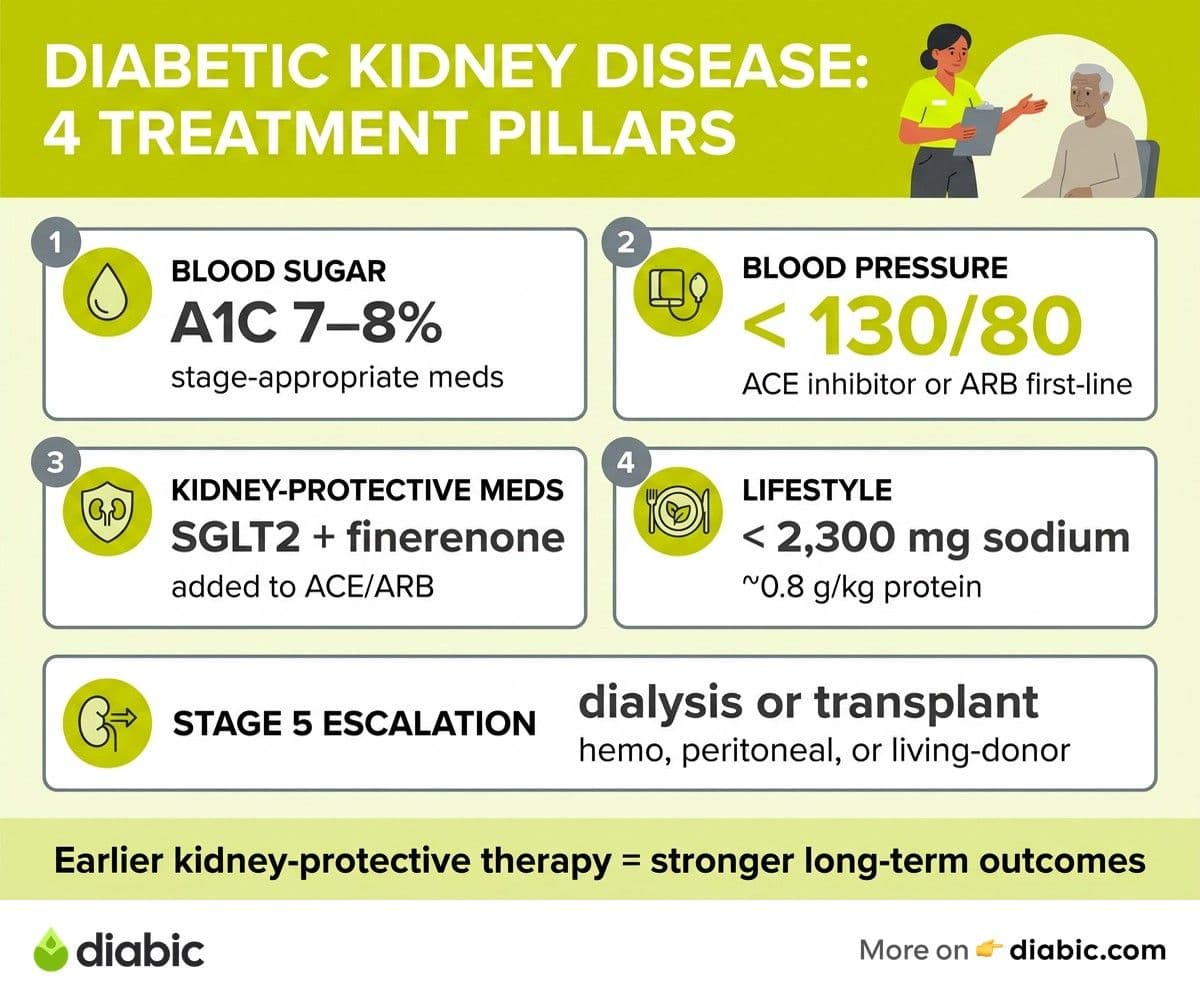
The third is controlling blood pressure to reduce additional kidney stress. The American Diabetes Association recommends blood pressure under 130/80 for most adults with diabetes and CKD. Lower pressure inside the glomerulus protects the filtering vessels.
The fourth is preventing complications that often travel with kidney disease. Cardiovascular disease, anemia, bone disease, and electrolyte imbalances become more common as CKD progresses. Many treatment decisions take all of these into account at once.
Blood Sugar Management for Kidney Protection
A1C targets often shift once kidney disease is in the picture. The standard "below 7%" guideline still applies for many people in early CKD, but later stages may use a slightly higher target (between 7% and 8%) to reduce hypoglycemia risk. The kidneys clear insulin, and as they slow, low blood sugars become more common. The right target is the one that fits your stage, age, and health goals.
Diabetes medication choice depends heavily on CKD stage. Here is the practical map:
- Metformin: safe in stages 1 and 2, dose adjustment in stage 3, generally avoided below eGFR 30
- DPP-4 inhibitors: mostly safe across stages, with dose adjustments needed for some
- GLP-1 receptor agonists: safe at most stages and have growing kidney benefit data
- SGLT2 inhibitors: typically used at eGFR above 20 for kidney benefits
- Sulfonylureas: higher hypoglycemia risk in advanced CKD, often avoided
Insulin remains an option at every stage but usually requires dose changes as kidney function drops. Many people with stage 4 or stage 5 CKD shift to insulin as their primary treatment because it can be titrated precisely.
If you are on metformin and your eGFR has changed recently, ask your provider whether your dose is still appropriate. The NIDDK keeps clear guidelines on metformin dosing across CKD stages, and small adjustments can prevent rare but serious side effects.
Blood Pressure Medications That Protect the Kidneys
ACE inhibitors and ARBs (angiotensin receptor blockers) are first-line drugs for kidney protection in diabetes. They have been used for decades and remain foundational even with newer drugs available.
These medications work by reducing pressure inside the glomerulus, the kidney's filtering unit. Lower internal pressure means less stress on the small blood vessels and reduced protein leakage. They are often started even when blood pressure is normal, particularly when there is any sign of protein in the urine.
Common ACE inhibitors include lisinopril, enalapril, and ramipril. Common ARBs include losartan, valsartan, and irbesartan. ACE inhibitors and ARBs do similar work, but ARBs tend to have fewer side effects, particularly the dry cough that some people develop on ACE inhibitors.
Side effects to watch for include elevated potassium (especially in advanced CKD), reduced kidney function in the first weeks (which is usually expected and manageable), and rarely, swelling of the face or tongue. Your provider will check labs after starting these medications to make sure they are working safely.
Why blood pressure control is as important as blood sugar control comes down to the math. Multiple long-term studies have shown that blood pressure reduction often produces a larger slowdown in kidney decline than blood sugar reduction in established diabetic kidney disease. Both matter, but the contribution of blood pressure is sometimes underestimated. Our piece on what to ask about blood pressure medication and diabetes covers the conversation in more depth.
Newer Medications with Kidney Benefits
The last decade has seen a wave of new medications with measurable kidney benefits. These have shifted what is possible in diabetic kidney disease treatment.
SGLT2 inhibitors
Empagliflozin, dapagliflozin, and canagliflozin make up the SGLT2 inhibitor class. They lower blood sugar by blocking glucose reabsorption in the kidneys, but their kidney protection goes beyond that mechanism. The CREDENCE trial (canagliflozin), DAPA-CKD trial (dapagliflozin), and EMPA-KIDNEY trial (empagliflozin), all published in or referenced by Diabetes Care, showed substantial reductions in kidney decline, kidney failure, and cardiovascular events.
These drugs are now recommended for many people with type 2 diabetes and CKD, regardless of A1C. They are usually started at eGFR 20 or higher and continued even as kidney function drops. Side effects can include genital yeast infections and a small risk of dehydration, but most people tolerate them well.
Finerenone
Finerenone is a non-steroidal mineralocorticoid receptor antagonist approved for type 2 diabetes with CKD. The FIDELIO-DKD and FIGARO-DKD trials, published in The Lancet Diabetes & Endocrinology, showed slower kidney disease progression and reduced cardiovascular events.
Finerenone works on a different pathway than SGLT2 inhibitors and is often added on top of an ACE inhibitor or ARB. The main thing to monitor is potassium levels, which can rise with this class.
GLP-1 receptor agonists
Semaglutide, liraglutide, and dulaglutide were originally developed for blood sugar and weight management, but emerging data shows kidney benefits as well. The FLOW trial of semaglutide showed reduced kidney disease progression in type 2 diabetes with CKD. These medications are usually safe at most CKD stages and can be combined with SGLT2 inhibitors and finerenone.
What this means for treatment today
Diabetic kidney disease treatment now often involves a combination of an ACE inhibitor or ARB, an SGLT2 inhibitor, and (where appropriate) finerenone or a GLP-1 receptor agonist. Our best diabetes medication for kidney disease post compares these options in more detail. The right combination depends on your stage, other conditions, and how you tolerate each drug.
From my experience: I started an SGLT2 inhibitor about three years ago, primarily for kidney protection. The first two weeks brought some adjustment (more frequent urination, watching hydration), but my eGFR has stayed stable since, and my endocrinologist credits the medication for that consistency. The science is genuinely promising, and the practical experience matched it for me.
Lifestyle and Dietary Treatment
Medications do a lot of the heavy lifting, but lifestyle changes still matter, particularly diet and exercise. The good news is that the same habits that help blood sugar usually help the kidneys too.
A renal dietitian is one of the most underused resources in diabetic kidney disease care. They can build a personalized plan that balances diabetes goals with kidney-friendly principles, and they understand how your stage shifts those priorities. Most insurance plans cover renal dietitian visits when you have a CKD diagnosis. Our kidney friendly diet for diabetes post covers the food-side details.
Sodium reduction supports both blood pressure and kidney function. Most people benefit from staying under 2,300 mg per day, and some doctors recommend closer to 1,500 mg in advanced CKD. Reading labels and cooking at home are the highest-yield habits.
Potassium and phosphorus matter more in later stages. In stages 1 and 2, you usually do not need to limit either. In stages 3 and 4, your doctor may run blood tests and ask you to adjust based on results. These restrictions are individualized.
Protein is the trickiest piece. Most adults with CKD aim for around 0.8 grams per kilogram of body weight per day, but the right amount depends on stage and dialysis status. Too little protein leads to muscle loss; too much stresses the kidneys.
Exercise also helps. Walking, light strength training, and gentle cardio support blood sugar, blood pressure, and overall well-being. People with CKD do not need a special exercise program in most cases, though anyone in advanced stages should check in with their nephrologist before significantly increasing intensity.
Smoking and heavy alcohol both worsen kidney decline. Quitting smoking is one of the highest-impact changes anyone with diabetic kidney disease can make. Reducing alcohol to moderate levels (or none) protects both liver and kidney health.
When Treatment Escalates: Dialysis and Transplant
If kidney disease progresses to stage 5 (eGFR below 15), dialysis or a kidney transplant becomes part of the conversation. We cover this transition in our CKD stages with diabetes post, but here is the practical view.
Dialysis is the process of filtering blood when the kidneys can no longer do it. There are two main types:
- Hemodialysis: Blood is filtered through a machine, usually three sessions per week at a clinic. Home hemodialysis is also available.
- Peritoneal dialysis: A solution is cycled through the abdomen, which uses the abdominal lining as a natural filter. Done at home, often overnight.
Each option has trade-offs in lifestyle, time commitment, and adjustment. The National Kidney Foundation has detailed comparisons that can help you and your care team weigh choices.
Kidney transplant offers the best long-term outcomes for many people. The evaluation process involves a thorough review of cardiovascular health, infection risk, and other factors. Diabetes does not disqualify you, but it does shape risk assessment. Living-donor transplants generally have better outcomes than deceased-donor transplants, and both are common. Living-donor wait times are typically much shorter, which can be a meaningful difference.
Outcomes with diabetes after transplant are generally good, especially when blood sugar is well managed. Some people with type 1 diabetes also pursue a simultaneous pancreas-kidney transplant in select centers.
Building a Treatment Plan That Fits You
Diabetes kidney disease treatment is no longer a one-size-fits-all process. The combination of medications, lifestyle changes, and specialists you work with should reflect your stage, your other health conditions, and your priorities.
If you take one action from this post, ask your provider whether you are on the kidney-protective medications that fit your situation. If you have type 2 diabetes and any sign of CKD, an SGLT2 inhibitor and an ACE inhibitor or ARB are worth a conversation. The earlier you start protective therapies, the more they tend to help over the long run.
Frequently Asked Questions
What are the treatment options for diabetic kidney disease?
Treatment usually combines blood sugar management (with medications safe for your CKD stage), blood pressure control with ACE inhibitors or ARBs, kidney-protective drugs like SGLT2 inhibitors and finerenone, dietary adjustments, and exercise. In stage 5, dialysis or kidney transplant becomes necessary. Most people benefit from a coordinated team that includes an endocrinologist, nephrologist, and renal dietitian.
Can diabetic kidney disease be treated effectively?
In many cases, yes. Modern combinations of ACE inhibitors or ARBs, SGLT2 inhibitors, and finerenone have substantially slowed kidney disease progression in clinical trials. Early treatment produces the strongest results, but even later-stage CKD can be stabilized for years with the right approach. Talk to your doctor about which treatments fit your situation.
What medications protect the kidneys in diabetes?
Three main classes anchor most diabetes kidney disease treatment plans: ACE inhibitors and ARBs (lisinopril, losartan, and others), SGLT2 inhibitors (empagliflozin, dapagliflozin, canagliflozin), and finerenone. GLP-1 receptor agonists like semaglutide also have emerging kidney benefit data. The right combination depends on your CKD stage and other health conditions.
Shahriar P. Shuvo is the founder of Diabic. He has lived with diabetes for over 14 years, and built Diabic to deliver the practical, evidence-based self-management tools he wished existed when he was first diagnosed. By trade, Shahriar is a senior design and frontend engineer with 6+ years shipping products at Agora, Timescale (now Tiger Data), and ShareTrip. He writes from the intersection of lived diabetes experience and product craft, focused on what works in daily management rather than what sounds good in a textbook.
Medically reviewed by
Dr. Rezwana Parvin Rumpa is an obstetrics and gynaecology specialist with clinical focus on gestational diabetes, PCOS, and fertility. She holds the MRCOG (Final Part) from the Royal College of Obstetricians and Gynaecologists in London, the MRCPI (Final Part) from the Royal College of Physicians of Ireland, and an MBBS from Shaheed Monsur Ali Medical College under Dhaka University. Dr. Rumpa serves as a Senior Medical Officer in the Obs and Gynae department at BRB Hospitals Ltd, where she has spent three years managing prenatal care, emergency obstetric cases, and women's-health surgery. On Diabic, she medically reviews content for women living with diabetes, with particular attention to pregnancy, PCOS, and reproductive-health intersections.
More from Health & Complications
View all
Diabetes and Dental Implants: What to Know First
Diabetes dental implants guide covering safety, A1C targets, recovery expectations, gum health prep, and what to ask your oral surgeon before surgery.

Burning Mouth Syndrome and Diabetes Explained
Burning mouth syndrome diabetes link explained, including neuropathy, dry mouth, and thrush causes plus treatment options that may bring real relief.

Dental Care for people with diabetes: Tips That Help
Practical dental care diabetics need, with real tips for protecting teeth and gums when diabetes raises your risk for oral health problems.
Clinician-reviewed habits, plain-language guides, and honest answers - the small shifts that make living with diabetes feel lighter, every day.