Diabetes with Kidney Disease: A Practical Guide
A practical guide to managing diabetes with kidney disease, from early signs and CKD stages to treatment, diet, and daily habits that protect kidney.

In this article(17)
Managing diabetes with kidney disease means balancing two interconnected conditions, and that can feel like a lot to handle at once. The encouraging truth is that with the right information and a coordinated care plan, you can manage both effectively. This practical guide covers what you need to know, from understanding the connection to building daily habits that protect your kidneys.
The good news is that kidney disease in diabetes rarely progresses overnight. There is real time to act when you catch it early, adjust your routine, and bring the right specialists into your circle. We will walk through the science, the screening tests, the treatment options, and the small daily decisions that add up to better long-term outcomes.
How Diabetes and Kidney Disease Are Connected
Diabetes is the leading cause of kidney disease in the United States, accounting for roughly 1 in 3 cases of kidney failure according to the CDC. When blood sugar runs high for years, the tiny filtering units inside the kidneys, called nephrons, take the brunt of the damage. Each kidney holds about a million of these microscopic filters, and they are surprisingly delicate when faced with chronic glucose spikes.
High blood sugar damages the small blood vessels that supply the nephrons. Over time, those vessels thicken, scar, and leak, which means the kidneys cannot filter waste as efficiently. You can read more about how diabetes affects the kidney over time for a closer look at this gradual process. The takeaway is that the damage builds quietly long before symptoms ever show up.
Blood pressure makes the picture more complicated. Diabetes and high blood pressure often travel together, and high pressure inside the kidney's filtering vessels accelerates the wear and tear. The NIDDK notes that controlling blood pressure can be just as important as managing blood sugar when it comes to protecting kidney function.
About 1 in 3 adults with diabetes develops some degree of kidney disease, but progression varies widely from person to person. Some people stay stable for decades. Others move through the stages more quickly. Genetics, blood pressure history, and how long someone has lived with diabetes all influence the trajectory.
Recognizing Diabetes with Kidney Disease Early
Early kidney disease is sneaky. In the first stages, almost everyone feels completely fine, which is exactly why screening matters. By the time you notice swelling in your ankles or persistent fatigue, the damage has usually been building for years.
As kidney function drops further, signs may include:
- Swelling in the feet, ankles, or around the eyes
- Persistent fatigue or trouble concentrating
- Foamy urine, which can indicate protein leakage
- Changes in how often you urinate, especially at night
- Loss of appetite or a metallic taste in the mouth
Two lab tests do the heavy lifting for early detection. The first is eGFR, or estimated glomerular filtration rate, calculated from a blood creatinine test. It tells your provider how well your kidneys are filtering. The second is UACR, the urine albumin-to-creatinine ratio, which detects small amounts of protein leaking into the urine. Protein in the urine is one of the earliest red flags for diabetic kidney disease.
The American Diabetes Association recommends annual kidney screening for everyone with type 2 diabetes and for people with type 1 diabetes who have had the condition for at least five years. Annual screening is one of the simplest, highest-value habits in diabetes care, yet many people miss it. If you are not sure when your last eGFR or UACR was drawn, that is a great question for your next appointment.
Understanding CKD Stages in Diabetes
Chronic kidney disease is divided into five stages based on eGFR. Stage 1 means kidney damage with normal filtering function (eGFR of 90 or higher). Stage 5 is kidney failure, where eGFR drops below 15 and dialysis or transplant becomes necessary. The middle stages, especially stage 3, are where most people first hear the words "kidney disease" from their doctor.
Each stage shifts what your management plan looks like. Earlier stages focus on prevention: tight blood sugar control, blood pressure management, and protective medications. Later stages bring dietary adjustments, more frequent monitoring, and conversations about what comes next. We have a deeper breakdown of the CKD stages with diabetes if you want to see what each stage looks like in practice.
Knowing your stage helps you plan ahead instead of reacting in crisis. The National Kidney Foundation emphasizes that staging is not a verdict, it is a roadmap. People at stage 3 today can stay at stage 3 for many years with the right approach.
From my experience: when I was first told my kidney numbers had shifted slightly into stage 2 territory, my first reaction was panic. After 14 years with type 1 diabetes, I thought I had been doing everything right. What helped was sitting with my endocrinologist and mapping out the next 12 months of monitoring and small adjustments. Knowing the plan was the difference between dread and action.
Treatment Approaches at Every Stage
Treatment in diabetic kidney disease has improved dramatically in the last decade. The medications and approaches available today were not standard a generation ago, and they are changing what is possible. We have a fuller breakdown of the best diabetes medication for kidney disease, but here is the high-level view.
Blood sugar management
A1C targets are typically individualized once kidney disease enters the picture. Many people aim for an A1C between 7% and 8%, depending on their stage, age, and risk of low blood sugars. Some diabetes medications need dose adjustments as eGFR drops, and a few become unsafe at advanced stages. Metformin, for example, is generally fine in early CKD but is not used once eGFR falls below 30.
Blood pressure management
ACE inhibitors and ARBs (angiotensin receptor blockers) are first-line drugs for kidney protection in diabetes. They reduce pressure inside the nephron's filters and slow protein leakage. Most people with diabetes and any sign of kidney disease are placed on one of these classes, even if blood pressure looks normal.
Kidney-protective medications
SGLT2 inhibitors (empagliflozin, dapagliflozin, canagliflozin) have become a major shift in care for diabetic kidney disease. Trials published in Diabetes Care have shown they slow kidney decline and reduce cardiovascular events. Finerenone, a newer non-steroidal medication, also offers kidney protection in people with type 2 diabetes and CKD.
When to see a nephrologist
A nephrologist is a kidney specialist who joins your care team usually around stage 3. Earlier referral is sometimes recommended if protein leakage is high or kidney function is declining quickly. The transition can feel intimidating, but a nephrologist is there to help you slow progression, not to deliver bad news.
Dialysis and transplant
If kidney disease progresses to stage 5, dialysis or a kidney transplant becomes the conversation. Dialysis can be done at a clinic (hemodialysis) or at home (peritoneal or home hemodialysis). Transplant offers the best long-term outcomes for many people. Many people live full, active lives on dialysis, and starting early planning at stage 4 makes the transition smoother.
Dietary Adjustments for Diabetes and Kidney Health
Eating with both diabetes and kidney disease can feel like a moving target. The carbohydrate-aware approach you may already follow needs to balance with kidney-friendly principles, and the priorities can shift as your stage changes. We cover this in detail in our kidney friendly diet for diabetes guide.
Sodium is usually the first focus. Reducing sodium helps with both blood pressure and fluid balance, which protects the kidneys. Most people benefit from staying under 2,300 mg per day, with some doctors recommending closer to 1,500 mg in advanced CKD.
Potassium and phosphorus matter more in later stages. In stages 1 and 2, you usually do not need to limit either. By stages 3 and 4, your provider may run blood tests and ask you to reduce potassium-rich foods (oranges, potatoes, tomatoes) or phosphorus-rich foods (dairy, processed foods, dark colas) if levels run high. These restrictions are not one-size-fits-all, which is why a renal dietitian is so valuable.
Protein is the most nuanced piece. Too little can cause muscle loss and malnutrition. Too much can stress the kidneys. The ADA suggests roughly 0.8 grams of protein per kilogram of body weight per day for many people with CKD, but this varies based on stage, dialysis status, and individual needs. A registered dietitian who understands both diabetes and CKD can help you hit the right balance without making mealtimes miserable.
Daily Habits That Protect Your Kidneys
Daily habits are where management actually happens. They are also where most people feel they have real agency, which is the part that tends to keep them going.
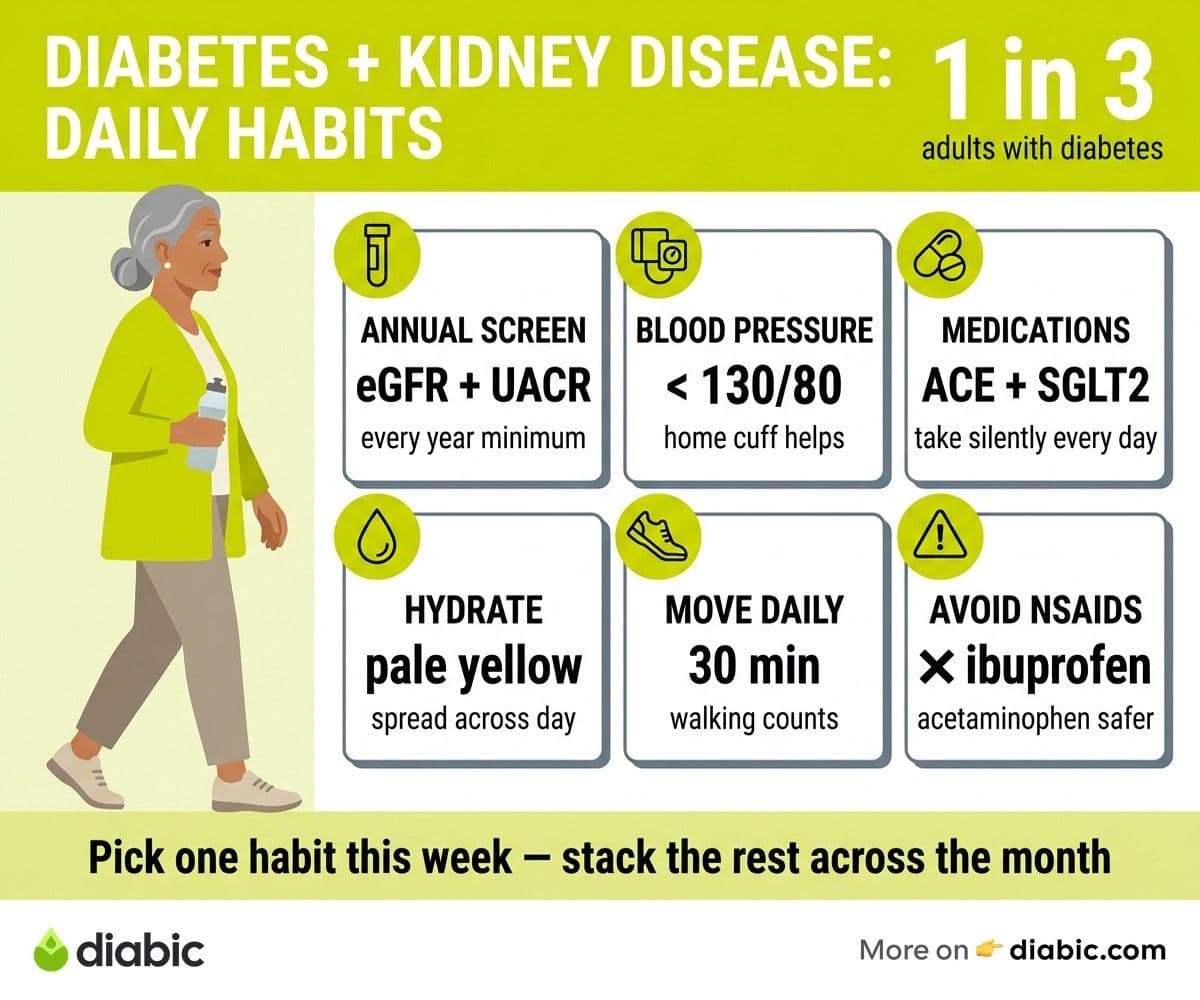
Hydration is often misunderstood. You want to drink enough to stay hydrated, but unless your doctor has told you to restrict fluids, you do not need to force gallons. Pale yellow urine is a reasonable target for people without fluid restrictions.
Home blood pressure monitoring is one of the highest-impact habits in diabetic kidney disease. A simple upper-arm cuff lets you spot trends and bring real data to appointments. Most people with diabetes aim for under 130/80, but your target depends on your situation. Our piece on the blood pressure and diabetes connection breaks this down further.
Take medications as prescribed, even when you feel fine. ACE inhibitors and SGLT2 inhibitors do not produce a noticeable feeling, but the kidney protection happens silently in the background. Skipping doses removes that protection.
Avoid frequent NSAID use (ibuprofen, naproxen) when possible, especially in higher stages of CKD. The Mayo Clinic notes these drugs can stress already-vulnerable kidneys. Acetaminophen is generally a safer choice for occasional pain, though always check with your provider.
Regular exercise adapted to your energy levels supports kidney health, blood sugar, and blood pressure all at once. You do not need to run marathons. Even 30 minutes of walking most days has measurable benefits. On lower-energy days, gentle movement still counts.
Building Your Care Team
Diabetic kidney disease is a team sport. The people on that team usually include your primary care provider, your endocrinologist (or whoever manages your diabetes), and your nephrologist once you reach the stage where they are involved. A registered dietitian, a pharmacist, and a diabetes care and education specialist round out the picture for many people.
Coordination is the missing piece in a lot of patients' care. Specialists do not always talk to each other, which means you sometimes have to be the bridge. Bringing a printed medication list, recent lab values, and a short list of questions to each appointment makes a real difference. Ask your providers if they can share notes through your patient portal so everyone is working from the same information.
Good questions to ask at each appointment include:
- What is my eGFR and UACR today, and how does it compare to last time?
- Are any of my medications safe at my current kidney function?
- Do I need a referral to a nephrologist or dietitian yet?
- What is my next screening date?
Patient advocacy resources can fill gaps in support. The National Kidney Foundation offers patient education, peer mentoring, and financial resources. The ADA has similar programs for diabetes-specific support. Online communities, including Diabic's own community, can help you feel less alone in the day-to-day.
Putting It All Together
Living with diabetes with kidney disease is not about achieving perfection on any given day. It is about steady, repeatable habits and a care team that helps you adjust as your needs change. Annual screening, blood pressure awareness, the right medications, and a sustainable eating pattern do most of the work over time.
If you take one thing from this guide, let it be this: the earlier you know where your kidneys stand, the more options you have. Schedule your next eGFR and UACR if it has been more than a year, and talk to your doctor about whether an SGLT2 inhibitor or ACE inhibitor makes sense for you. Small steps, consistently, are what protect kidney function in diabetes with kidney disease.
Frequently Asked Questions
How to manage diabetes with kidney disease?
Management combines three pillars: blood sugar within your individualized target range, blood pressure under 130/80 for most people, and kidney-protective medications like ACE inhibitors, ARBs, or SGLT2 inhibitors when appropriate. Annual screening with eGFR and UACR, dietary adjustments tailored to your CKD stage, and a coordinated care team round out a practical plan. Talk to your doctor about which medications and targets fit your specific situation.
What happens when diabetes causes kidney disease?
High blood sugar damages the small blood vessels in the kidneys' nephrons over time. The earliest sign is usually small amounts of protein in the urine, followed by gradual decline in eGFR. Without intervention, kidney function continues to drop through the five stages of CKD, eventually reaching a point where dialysis or transplant becomes necessary. Early detection and treatment can slow or stop this progression.
What tests should people with diabetes get for kidney health?
The two key tests are eGFR (estimated glomerular filtration rate), measured from a blood creatinine sample, and UACR (urine albumin-to-creatinine ratio), which detects early protein leakage. The ADA recommends both annually for adults with type 2 diabetes and for people with type 1 diabetes who have had the condition for at least five years.
Living with diabetes with kidney disease is rarely a single decision; it is a long string of small ones. The labs you keep up with, the medications you take on the dull weeks as well as the busy ones, the meals you slowly learn to enjoy at lower sodium, the questions you bring to appointments instead of leaving for next time. None of those choices feel dramatic on a Tuesday afternoon. Stacked across years, they are the difference between stable function and a steeper decline. Pick one habit from this guide to start with this week, and let the rest follow on a schedule that works for your life.
Shahriar P. Shuvo is the founder of Diabic. He has lived with diabetes for over 14 years, and built Diabic to deliver the practical, evidence-based self-management tools he wished existed when he was first diagnosed. By trade, Shahriar is a senior design and frontend engineer with 6+ years shipping products at Agora, Timescale (now Tiger Data), and ShareTrip. He writes from the intersection of lived diabetes experience and product craft, focused on what works in daily management rather than what sounds good in a textbook.
Medically reviewed by
Dr. Shanto Arian is an internal medicine physician now specializing in clinical and aesthetic dermatology, with a parallel academic focus on epidemiology and public health. He holds an MBBS, MPH, MSc (UK), MRCP (UK), MRCPI (Ireland), Diploma in Dermatology (UK), and Diploma in Aesthetic Medicine (USA). Dr. Arian trained in internal medicine, including hospital work on hematology cases such as graft-versus-host disease, before moving toward dermatology. Skin is one of the earliest places diabetes shows itself, from acanthosis nigricans and diabetic dermopathy to slow foot wound healing, and that intersection is where his clinical and Diabic-review work meet. On Diabic, Dr. Arian medically reviews content on diabetes diagnosis, complications, dermatologic manifestations, and pharmacotherapy, ensuring every claim aligns with current ADA, NICE, and peer-reviewed literature.
More from Health & Complications
View all
Diabetes and Dental Implants: What to Know First
Diabetes dental implants guide covering safety, A1C targets, recovery expectations, gum health prep, and what to ask your oral surgeon before surgery.

Burning Mouth Syndrome and Diabetes Explained
Burning mouth syndrome diabetes link explained, including neuropathy, dry mouth, and thrush causes plus treatment options that may bring real relief.

Dental Care for people with diabetes: Tips That Help
Practical dental care diabetics need, with real tips for protecting teeth and gums when diabetes raises your risk for oral health problems.
Clinician-reviewed habits, plain-language guides, and honest answers - the small shifts that make living with diabetes feel lighter, every day.