How Diabetes Affects the Kidney Over Time
Learn how diabetes affects the kidney over time, the stages of damage, why high blood sugar harms nephrons, warning signs, and what protects kidney.

In this article(15)
Understanding how diabetes affects the kidney over time gives you the knowledge to take protective steps early. The damage happens gradually, often over years, which means there is a real window of opportunity to slow or prevent progression. Here is what actually happens inside your kidneys, and what you can do about it.
The slow nature of this process is both the challenge and the opportunity. The challenge is that you cannot feel kidney damage in its early stages, so it is easy to miss. The opportunity is that small, consistent habits and the right medications can change the trajectory in a meaningful way. We will walk through the biology, the warning signs that eventually appear, and the protective strategies backed by current research.
How Your Kidneys Work (A Quick Overview)
Your kidneys filter about 200 liters of blood every day. That is an extraordinary amount of work for two organs the size of your fists. They sit just below the rib cage on either side of your spine, quietly sorting waste, balancing fluid, and regulating blood pressure while you go about your life.
The filtering happens inside microscopic units called nephrons. Each kidney holds roughly one million of them, and each nephron contains a tuft of tiny blood vessels called a glomerulus. Blood flows through the glomerulus at high pressure, and the vessel walls act as a precise filter, letting waste and excess fluid through while keeping protein and blood cells in circulation. The NIDDK has a detailed walkthrough of this process if you want a closer look.
Beyond filtering, kidneys do a lot of behind-the-scenes work. They activate vitamin D, produce a hormone (erythropoietin) that helps your body make red blood cells, and adjust electrolytes like sodium and potassium. They also play a major role in blood pressure regulation through a system called the renin-angiotensin-aldosterone pathway.
This intricate machinery is exactly why kidneys are vulnerable to high blood sugar. The small blood vessels of the glomerulus depend on consistent flow and gentle pressure. When glucose stays elevated, those vessels are exposed to chemical and mechanical stress they were never built to handle.
The Stages of Kidney Damage from Diabetes
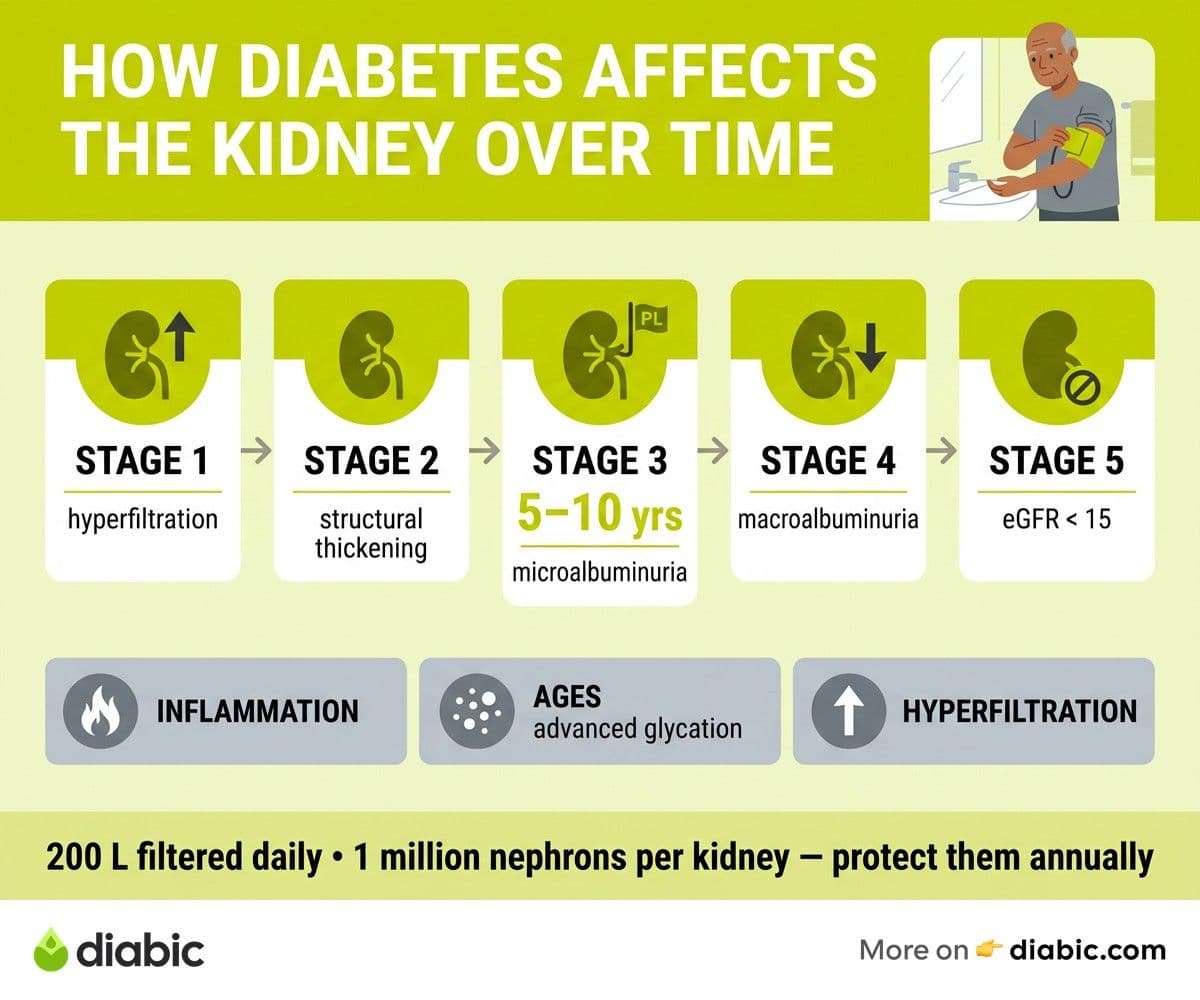
Damage from diabetes follows a predictable progression. Researchers have mapped it into five stages that describe how the kidneys change over years or decades. We have a fuller breakdown in our CKD stages with diabetes post, but here is the short version of what happens.
Stage 1: Hyperfiltration. In the earliest phase, kidneys actually overwork to compensate for high blood sugar. eGFR may be higher than normal. The glomeruli are pushing harder, and that extra work is the first sign of stress.
Stage 2: Early structural changes. The walls of the filtering vessels begin to thicken. There may be no symptoms and no protein in the urine, but if you took a microscope to the tissue, you would see the beginnings of structural change.
Stage 3: Microalbuminuria. Small amounts of albumin (a blood protein) start leaking into the urine. The UACR test detects this. This is one of the earliest measurable warning signs and often appears 5 to 10 years into diabetes for those who develop kidney involvement.
Stage 4: Macroalbuminuria. Larger amounts of protein leak through, eGFR begins to decline more clearly, and the structural damage is visible on biopsy. Most people are diagnosed with diabetic kidney disease at this stage if not earlier.
Stage 5: Kidney failure. eGFR drops below 15, and the kidneys can no longer keep up with daily demands. Dialysis or transplant becomes necessary. You can read our diabetes with kidney disease guide for the full management picture.
These stages do not happen on a fixed timeline. Some people progress quickly, others stay stable for decades, and many never reach the later stages. Genetics, blood pressure history, and how long someone has had diabetes all influence the path.
How Diabetes Affects the Kidney at the Cellular Level
The mechanism behind this damage is well understood. Excess glucose in the blood triggers several harmful processes that build over time.
The first is direct chemical stress. Elevated glucose causes inflammation in the small blood vessels of the nephrons. The cells that line those vessels (endothelial cells) become less responsive and start signaling for repair, which leads to scar tissue when the stress continues for years.
The second is the formation of advanced glycation end products, or AGEs. AGEs form when sugar molecules attach to proteins and lipids in the body. They build up in tissues like the kidneys and stiffen the structures they touch. The American Diabetes Association journal has published research showing AGE accumulation correlates with the severity of diabetic kidney disease.
The third is hyperfiltration. To deal with elevated glucose, the kidneys filter more aggressively at first. This sounds helpful, but the constant high-pressure work damages the glomeruli over time. It is similar to running an engine at maximum RPM for years and expecting no wear.
High blood pressure compounds all three of these processes. Diabetes and high blood pressure often coexist, and high pressure inside the glomerulus accelerates structural damage. Our piece on the blood pressure and diabetes connection goes deeper into why both numbers matter so much together.
The interaction between high blood sugar and high blood pressure is why the Mayo Clinic lists both as the primary risk factors for diabetic kidney disease. Managing one without the other leaves a major piece of protection on the table.
From my experience: in my 14 years with type 1 diabetes, the single biggest shift in protecting my kidneys came when I started monitoring blood pressure at home. I had assumed my numbers were fine, and they mostly were, but the daily data caught a slow upward drift before any clinic visit would have. Catching that early let me adjust before it became a problem.
Warning Signs as Damage Progresses
Early kidney damage almost never produces symptoms. This is the hardest part of the disease for many people, because by the time something feels wrong, the damage has typically been building for years. We cover this in more depth in our spotting diabetes kidney problems early post.
In the early stages, the only warning signs come from lab tests. eGFR captures filtering capacity and UACR detects protein leakage. Together, they catch issues long before symptoms develop.
As damage progresses into mid-stages, symptoms may include:
- Persistent fatigue or low energy
- Swelling in the ankles, feet, or around the eyes
- Foamy urine, which can indicate protein leakage
- Changes in how often or how much you urinate, especially at night
- Mild itching or dry skin
In advanced stages, symptoms become harder to ignore. Nausea, loss of appetite, difficulty concentrating, a metallic taste in the mouth, and significant fluid retention can all appear. By this point, eGFR is usually well below 30 and a nephrologist is involved in care.
Waiting for symptoms means catching damage late. This is why annual screening with eGFR and UACR is recommended for everyone with diabetes. The American Diabetes Association recommends screening starting at diagnosis for type 2 diabetes and after five years for type 1.
What Protects Your Kidneys
The protective strategies for diabetic kidney disease have improved a lot in the last decade. There is real reason for optimism, even if you are already showing signs of kidney involvement.
Blood sugar within target
Keeping A1C in your individualized target range matters most in the years before damage accumulates. Targets vary by person, age, and other conditions, but for most adults with diabetes, an A1C below 7% is reasonable. Talk to your doctor about what fits your situation.
Blood pressure control
For most people with diabetes, the blood pressure target is under 130/80. Home monitoring helps because clinic readings often miss daily patterns. Even small reductions in average blood pressure can meaningfully slow kidney decline.
Kidney-protective medications
Three drug classes do real work in protecting kidneys:
- ACE inhibitors and ARBs reduce pressure inside the glomerulus and lower protein leakage
- SGLT2 inhibitors (empagliflozin, dapagliflozin, canagliflozin) slow kidney decline and reduce cardiovascular events
- Finerenone offers additional kidney protection in type 2 diabetes with CKD
Trials published in Diabetes Care have shown SGLT2 inhibitors slow eGFR decline even in people without diabetes. They are now standard of care for many people with diabetic kidney disease.
Avoid nephrotoxic substances
Frequent NSAID use (ibuprofen, naproxen, especially over many years) can stress the kidneys, particularly when other risk factors are present. The National Kidney Foundation suggests being thoughtful about long-term NSAID use, especially in established kidney disease. Acetaminophen is generally a safer choice for occasional pain. Some herbal supplements, contrast dyes, and certain antibiotics also need caution; your provider and pharmacist can help you sort out what is safe.
Annual kidney screening
Annual eGFR and UACR catch issues at the earliest possible point. If you have not had both tests in the last 12 months, asking for them is one of the highest-value steps you can take.
What This Means for You
Diabetes does affect the kidneys over time, but "over time" is key. The damage builds gradually, which means almost everyone has a window to slow or prevent progression. Annual screening, blood pressure awareness, the right medications, and consistent blood sugar management all stack the odds in your favor.
If you take one action from this post, schedule your next eGFR and UACR if it has been more than a year, and bring up SGLT2 inhibitors with your doctor if you have not already discussed them. Small steps now make the biggest difference later.
Frequently Asked Questions
How does diabetes damage the kidneys?
High blood sugar damages the small blood vessels in the kidneys' nephrons through inflammation, advanced glycation end products (AGEs), and hyperfiltration. Over time, these processes scar the filtering vessels and reduce kidney function. High blood pressure, which often coexists with diabetes, accelerates the damage.
At what stage does diabetes affect kidney function?
Subtle changes can begin within a few years of high blood sugar exposure, but measurable damage often takes 5 to 15 years to appear on lab tests. Stage 1 (hyperfiltration) and stage 2 (early structural changes) usually produce no symptoms. Most people are diagnosed at stage 3 (microalbuminuria) when small amounts of protein appear in the urine.
Can kidney damage from diabetes be prevented?
In many cases, yes, or at least slowed significantly. Tight blood sugar and blood pressure control, kidney-protective medications like ACE inhibitors and SGLT2 inhibitors, and annual screening can prevent or delay progression. Research suggests that catching kidney involvement at stage 1 or 2 gives the best chance of preventing further damage. Talk to your doctor about which protective strategies fit your situation.
The honest summary on how diabetes affects the kidney is that the damage is real but rarely sudden, and the protective tools available now are stronger than they were even a decade ago. Annual labs, daily blood pressure awareness, and a candid conversation about SGLT2 inhibitors put most of the leverage in your hands.
Shahriar P. Shuvo is the founder of Diabic. He has lived with diabetes for over 14 years, and built Diabic to deliver the practical, evidence-based self-management tools he wished existed when he was first diagnosed. By trade, Shahriar is a senior design and frontend engineer with 6+ years shipping products at Agora, Timescale (now Tiger Data), and ShareTrip. He writes from the intersection of lived diabetes experience and product craft, focused on what works in daily management rather than what sounds good in a textbook.
Medically reviewed by
Dr. Shanto Arian is an internal medicine physician now specializing in clinical and aesthetic dermatology, with a parallel academic focus on epidemiology and public health. He holds an MBBS, MPH, MSc (UK), MRCP (UK), MRCPI (Ireland), Diploma in Dermatology (UK), and Diploma in Aesthetic Medicine (USA). Dr. Arian trained in internal medicine, including hospital work on hematology cases such as graft-versus-host disease, before moving toward dermatology. Skin is one of the earliest places diabetes shows itself, from acanthosis nigricans and diabetic dermopathy to slow foot wound healing, and that intersection is where his clinical and Diabic-review work meet. On Diabic, Dr. Arian medically reviews content on diabetes diagnosis, complications, dermatologic manifestations, and pharmacotherapy, ensuring every claim aligns with current ADA, NICE, and peer-reviewed literature.
More from Health & Complications
View all
Diabetes and Dental Implants: What to Know First
Diabetes dental implants guide covering safety, A1C targets, recovery expectations, gum health prep, and what to ask your oral surgeon before surgery.

Burning Mouth Syndrome and Diabetes Explained
Burning mouth syndrome diabetes link explained, including neuropathy, dry mouth, and thrush causes plus treatment options that may bring real relief.

Dental Care for people with diabetes: Tips That Help
Practical dental care diabetics need, with real tips for protecting teeth and gums when diabetes raises your risk for oral health problems.
Clinician-reviewed habits, plain-language guides, and honest answers - the small shifts that make living with diabetes feel lighter, every day.