Diabetes and Obesity Myths: What's True and What's Not
Diabetes and obesity myths shape stigma and miss real risk factors. Here is what research actually shows about weight, body size, and diabetes risk.

In this article(13)
- The Biggest Diabetes and Obesity Myths Explained
- Does Being Overweight Always Cause Diabetes
- Can Thin People Get Type 2 Diabetes
- Type 1 vs Type 2 Diabetes and Where Weight Fits In
- What Is Diabetes Beyond the Weight Conversation
- How Weight Stigma Affects Diabetes Care
- A More Accurate Picture of Diabetes Risk
The connection between diabetes and obesity myths runs deep, and sorting fact from fiction matters whether you are managing your health or worrying about a future diagnosis. Not everyone with diabetes is overweight, and not everyone who is overweight develops diabetes. The relationship is real, but it is far more nuanced than popular conversation suggests.
Body size has become the shorthand you may reach for when thinking about diabetes risk, partly because public health campaigns have leaned on it for decades. That shorthand misses important risk factors and quietly fuels stigma that can keep you from seeking care.
This article walks through what the research actually supports, without the shame and without the oversimplification.
The Biggest Diabetes and Obesity Myths Explained
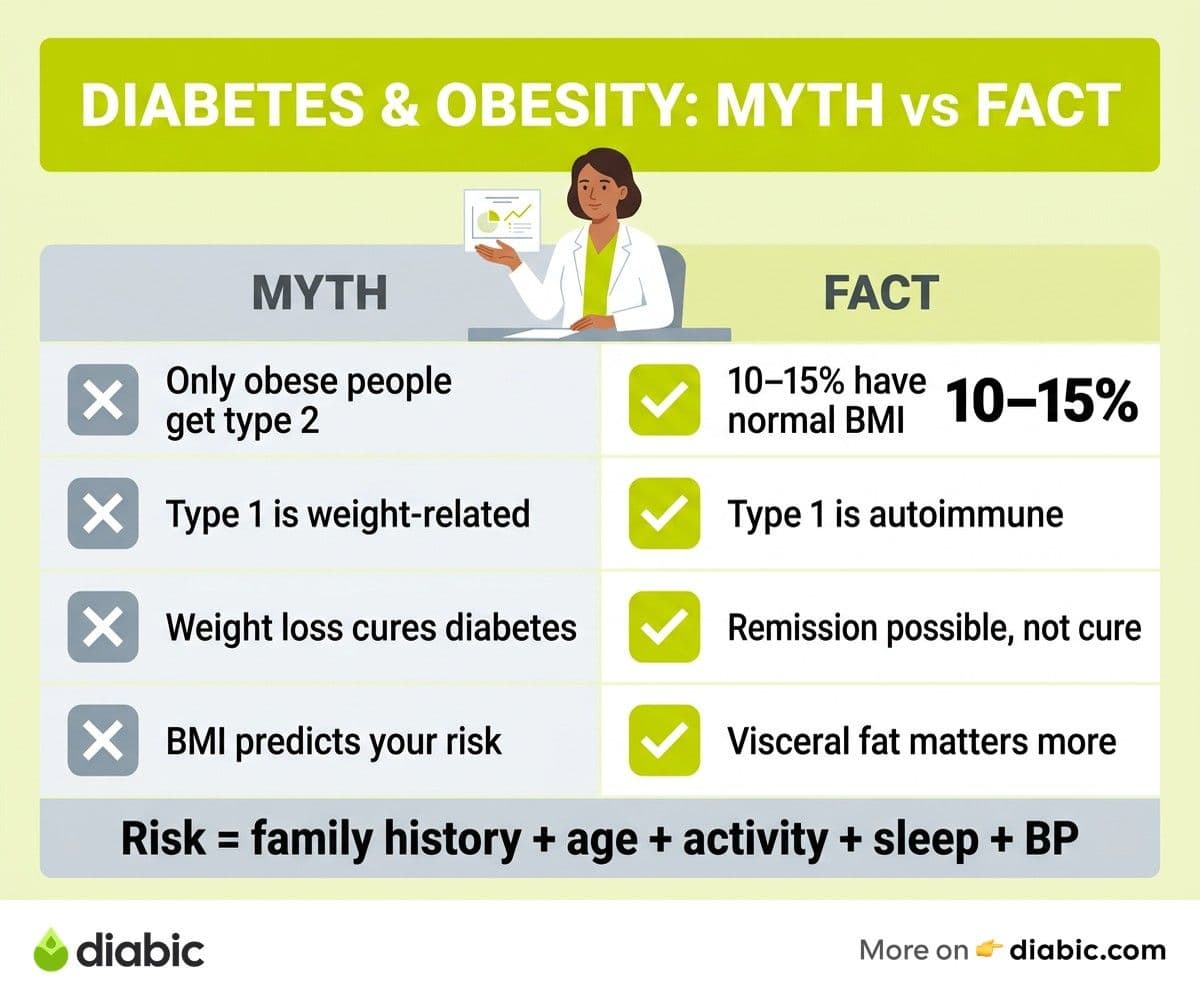
Several diabetes and obesity myths show up again and again in everyday conversation, and each one deserves careful unpacking. The first is that only overweight people get diabetes. The second is that losing weight will reliably cure diabetes. The third is that obesity always leads to type 2 diabetes. The fourth, less obvious but equally common, is that thin people are safe from concern.
None of these holds up under careful review. According to the CDC's diabetes risk factor data, weight is one risk factor among many, alongside age, family history, ethnicity, physical activity, blood pressure, and a history of gestational diabetes. Treating weight as the only signal misses a lot of people who would benefit from screening.
These myths persist for several reasons. Public health messages often emphasize weight because it is visible and measurable. Media coverage of diabetes tends to feature stock photos of larger bodies, reinforcing the association. Insurance and clinical guidelines have historically used BMI as a screening shortcut. The result is a cultural narrative that overstates the role of weight while underplaying everything else.
Our explainer on whether sugar actually causes diabetes addresses a related set of myths about diet and diabetes risk. The two topics often get tangled together in the same conversations, and untangling them helps clarify both.
Does Being Overweight Always Cause Diabetes
No, being overweight does not always cause diabetes. Obesity is a meaningful risk factor for type 2 diabetes, particularly when excess weight is concentrated around the abdomen, but plenty of people with higher BMI never develop the condition. The relationship is statistical, not deterministic.
Studies tracking large populations over time consistently find that many people with obesity remain metabolically healthy for decades. Their blood glucose, blood pressure, and lipid profiles stay in normal ranges despite their weight. Researchers have given this group the label "metabolically healthy obesity," and it represents perhaps 10 to 30 percent of people in the obese BMI category, depending on how the term is defined.
Other factors interact with weight to determine whether diabetes develops. Genetics, ethnicity, age, fitness level, sleep quality, and stress all play meaningful roles. The American Diabetes Association lists more than a dozen factors that influence type 2 diabetes risk, and weight is only one of them.
The takeaway is not that weight does not matter. It often does. The takeaway is that weight alone is a poor predictor for you as an individual, and treating it as the whole story leads to bad clinical decisions and unnecessary anxiety.
Can Thin People Get Type 2 Diabetes
Yes, thin people can get type 2 diabetes, and the phenomenon is more common than most casual observers realize. Approximately 10 to 15 percent of people with type 2 diabetes have a normal BMI at diagnosis. In some populations, particularly people of South Asian, East Asian, and Hispanic descent, that number is even higher.
The reason has to do with how fat is distributed in the body, not just how much there is. Visceral fat, which surrounds the organs in the abdominal cavity, is metabolically active in ways that subcutaneous fat (the kind you can pinch) is not. People with high visceral fat but normal overall weight can still have significant insulin resistance and elevated diabetes risk. This pattern has earned the nickname "TOFI," short for thin outside, fat inside.
Research published in the Lancet Diabetes & Endocrinology has repeatedly shown that ethnicity-specific BMI thresholds may be more accurate for identifying diabetes risk than the universal cutoffs many guidelines use. A South Asian person with a BMI of 23 may have similar metabolic risk to a person of European descent with a BMI of 28.
If you are thin, your risk often gets missed because providers do not think to screen. Your family history, ethnicity, and any unusual symptoms (like fatigue, frequent urination, or slow-healing cuts) should prompt a conversation with your doctor regardless of what the scale says. Type 2 diabetes is increasingly recognized as a metabolic condition that does not respect body-size stereotypes.
Type 1 vs Type 2 Diabetes and Where Weight Fits In
Looking at type 1 vs type 2 diabetes makes it clear why weight-based assumptions cause so much confusion. The two conditions have very different relationships with body size, and conflating them fuels stigma that affects both groups.
Type 1 diabetes is an autoimmune condition. The immune system destroys the beta cells in the pancreas, leaving the body unable to produce insulin. Body weight has essentially nothing to do with whether type 1 develops. Children, teenagers, and adults of every body size develop type 1, and weight gain is sometimes a result of treatment rather than a cause of the disease.
Type 2 diabetes is a metabolic condition where the body becomes resistant to insulin and beta cell function gradually declines. Excess weight, especially abdominal weight, increases the risk, but it is one factor among many. Genetics, age, and lifestyle all interact to shape outcomes.
When you see a thin child with type 1 and a heavier adult with type 2, you may assume the heavier person "caused" their diabetes through choices. That framing is both wrong and harmful. The two conditions arise through completely different mechanisms, and even type 2 has strong genetic and physiological drivers that have nothing to do with personal effort. Our guide to the differences between type 1 and type 2 lays out the full picture.
The shorthand "diabetes is caused by being overweight" collapses these distinctions into a single, misleading story. Both groups deserve more accurate messaging.
What Is Diabetes Beyond the Weight Conversation
What is diabetes when we look past the weight conversation entirely? It is a condition where the body cannot keep blood glucose in a healthy range, due to problems with insulin production, insulin function, or both. The mechanism is the same regardless of body size.
Insulin is a hormone made by the pancreas. It helps glucose move from the bloodstream into cells, where it gets used for energy. In type 1, the immune system destroys the cells that make insulin. In type 2, cells become resistant to insulin's signal, and beta cells eventually struggle to keep up. In both cases, glucose builds up in the blood instead of getting used.
This is why reducing diabetes to a weight issue is both inaccurate and harmful. It misses the underlying biology. It misses you if you do not fit the visual stereotype. It pushes some people away from screening because they do not see themselves in the public messaging, and it pushes others toward shame that does nothing to improve their health.
A growing body of research argues that body composition, fitness, sleep, stress management, and metabolic markers like waist circumference and triglyceride levels predict diabetes risk better than BMI alone. Doctors are increasingly using these measures, especially for patients who fall outside the conventional categories.
From my experience: I was diagnosed with type 1 diabetes at twelve, and I was a thin, active kid who played soccer year-round. The number of strangers who have asked over the past fourteen years whether I "got it from eating too much sugar" has been remarkable. The assumption is that diabetes always traces back to weight or food choices. It does not, and that misconception affects how people with diabetes get treated in restaurants, at work, and even in some doctor's offices.
How Weight Stigma Affects Diabetes Care
Weight stigma changes outcomes, and not for the better. Studies have consistently shown that people who experience weight bias in healthcare settings are less likely to seek preventive care, more likely to delay screening, and more likely to disengage from treatment over time. For diabetes specifically, this has measurable consequences on diagnosis timing and long-term complications.
Patients sometimes describe being told to lose weight before their other concerns will be taken seriously, even when those concerns have nothing to do with weight. They describe receiving prescriptions for lifestyle change without any practical support or follow-up. They describe feeling watched or judged at every appointment. Over time, many simply stop going.
The clinical impact is real. Late diagnosis of type 2 diabetes means more time spent with undetected high blood glucose, which raises the risk of nerve damage, kidney problems, and cardiovascular complications. Late diagnosis of type 1 in adults, who often get misdiagnosed as having type 2 because of stigma-driven assumptions, can be even more dangerous.
A health-focused approach without body shaming is possible. It looks like asking about sleep, stress, food access, and physical activity rather than just weight. It looks like setting goals around behaviors and lab values rather than the scale. It looks like supporting realistic weight loss for prediabetes when that is the patient's goal, while recognizing that not everyone needs to lose weight to improve metabolic health.
If you have felt judged about your weight at the doctor's office, you are not imagining it, and you are not alone. Finding a provider who treats you as a whole person, not a number on a chart, is worth the effort.
A More Accurate Picture of Diabetes Risk
Putting all of this together, diabetes risk depends on a constellation of factors that includes but does not center on weight. Family history matters. Ethnicity matters. Age matters. Physical activity, sleep, stress, blood pressure, lipid levels, gestational diabetes history, and certain medications all play meaningful roles.
If you want to assess your own risk, tools like the ADA's diabetes risk test or a conversation with your primary care provider give a more complete picture than weight alone. Routine A1c testing every few years catches changes early, when lifestyle adjustments are most effective.
If you are already living with diabetes, the conversation can shift away from weight as the central marker of your success. Blood glucose patterns, A1c trends, energy levels, sleep quality, and cardiovascular markers all give you meaningful feedback. You may lose weight as part of managing your diabetes well, or you may not, and that is also fine.
The goal is health, not adherence to a stereotype.
FAQ
Does being overweight always cause diabetes?
No. While higher body weight increases the risk of type 2 diabetes, many other factors contribute, including genetics, ethnicity, age, physical activity, and metabolic health. Plenty of people with higher BMI never develop diabetes, and many people develop diabetes despite having a normal BMI. Weight is one piece of a much bigger picture.
Can thin people get type 2 diabetes?
Yes. Approximately 10 to 15 percent of people with type 2 diabetes have a normal BMI at diagnosis, and the percentage is even higher in some ethnic groups. Visceral fat distribution, family history, and genetics all play significant roles independent of overall body size.
Will losing weight cure my diabetes?
For some people with type 2 diabetes, significant weight loss may put the condition into remission, especially when achieved early after diagnosis. Research suggests this is most common in people who lose 10 to 15 percent of body weight relatively soon after diagnosis. Type 1 diabetes is not affected by weight loss in the same way. Talk to your doctor about realistic expectations for your situation.
Why do people with diabetes face weight stigma?
Diabetes has been associated with weight in public messaging for decades, often inaccurately. This has fueled assumptions that diabetes is always a personal failing rather than a medical condition with multiple causes. Weight stigma in healthcare settings can delay diagnosis and treatment, which is one reason advocacy groups are pushing for more nuanced messaging.
Is BMI a reliable measure of diabetes risk?
BMI is a useful population-level tool but a poor individual predictor. Waist circumference, body composition, fitness level, and metabolic markers like fasting glucose and triglycerides give a more accurate picture of diabetes risk for any specific person. Ethnicity-specific BMI thresholds may also be more accurate than universal cutoffs.
The diabetes and obesity myths that dominate everyday conversation make for simple stories, but simple stories miss real people. Accurate information, compassionate clinical care, and a wider lens on what causes diabetes serve everyone better than reducing risk to a number on a scale.
Shahriar P. Shuvo is the founder of Diabic. He has lived with diabetes for over 14 years, and built Diabic to deliver the practical, evidence-based self-management tools he wished existed when he was first diagnosed. By trade, Shahriar is a senior design and frontend engineer with 6+ years shipping products at Agora, Timescale (now Tiger Data), and ShareTrip. He writes from the intersection of lived diabetes experience and product craft, focused on what works in daily management rather than what sounds good in a textbook.
Medically reviewed by
Dr. Shanto Arian is an internal medicine physician now specializing in clinical and aesthetic dermatology, with a parallel academic focus on epidemiology and public health. He holds an MBBS, MPH, MSc (UK), MRCP (UK), MRCPI (Ireland), Diploma in Dermatology (UK), and Diploma in Aesthetic Medicine (USA). Dr. Arian trained in internal medicine, including hospital work on hematology cases such as graft-versus-host disease, before moving toward dermatology. Skin is one of the earliest places diabetes shows itself, from acanthosis nigricans and diabetic dermopathy to slow foot wound healing, and that intersection is where his clinical and Diabic-review work meet. On Diabic, Dr. Arian medically reviews content on diabetes diagnosis, complications, dermatologic manifestations, and pharmacotherapy, ensuring every claim aligns with current ADA, NICE, and peer-reviewed literature.
More from Diabetes Knowledge
View all
6 Safe Dessert for Gestational Diabetes Recipes You Can
Six dessert for gestational diabetes recipes that satisfy your sweet tooth without spiking blood sugar, with carb counts and pairing tips you can use.

8 High Fiber Foods That Help with Prediabetes
Add these 8 high fiber foods for prediabetes to slow glucose absorption, support steady blood sugar, and meet the daily fiber target most people miss.

Mediterranean Diet for Prediabetes: A Practical Guide
The mediterranean diet for prediabetes is one of the best-studied eating patterns for prevention. Here is what to eat, what to avoid, and how to start.
Clinician-reviewed habits, plain-language guides, and honest answers - the small shifts that make living with diabetes feel lighter, every day.