Hormonal Changes from Diabetes: How It Affects Men and Women
Hormonal changes diabetes triggers can affect testosterone, estrogen, libido, and energy. Here is what men and women should know and what to ask your.

In this article(10)
Living with diabetes shapes far more than the numbers on your meter. The hormonal changes diabetes can cause ripple through your energy, mood, weight, sleep, and sexual health in ways that often go unnamed for years. Many people sit across from a doctor describing low libido, stubborn fatigue, or unpredictable cycles without anyone connecting those dots back to insulin resistance or long-term blood sugar swings.
We hear this often from our community, and the frustration is real. You are doing the work of logging meals, dosing insulin, walking after dinner, and somehow your body still feels off. Part of the answer lives in your endocrine system, the network of glands that produces and regulates hormones. Diabetes is itself an endocrine condition, so it makes sense that other hormones get pulled into the conversation.
From my experience: I am a man in my mid-30s living with type 1 for 14 years, and the year I finally asked my endocrinologist for a morning testosterone draw was the year a few quiet symptoms (flatter mood, longer recovery between gym sessions, an energy curve that just sat lower than I remembered) finally got named. The number came back on the low end of normal, not clinically deficient, but the conversation it opened up about sleep and resistance training mattered more than the lab value itself. It is the kind of ask I wish I had made a few years earlier.
How Diabetes Disrupts Hormonal Balance
Insulin is a hormone, and when your body either does not make enough of it or cannot use it well, the entire endocrine system feels the strain. Insulin resistance interferes with how the ovaries, testes, and adrenal glands produce sex hormones. The pancreas, liver, and even fat tissue all play roles in converting and storing these hormones, so when metabolism is off, hormone signaling tends to follow.
Chronic low-grade inflammation is another piece of the picture. Persistent high blood sugar drives oxidative stress and inflammation, which over time disrupts the hypothalamic-pituitary axis. That axis is essentially the control tower for cortisol, thyroid hormones, growth hormone, and the sex hormones. When the tower is noisy, downstream signals get garbled, and you feel it as fatigue, brain fog, or a libido that has gone quiet.
Medications add another layer to consider. Insulin itself, metformin, sulfonylureas, and GLP-1 agonists each interact with hormone pathways in different ways. Some are neutral, some are helpful for related conditions like polycystic ovary syndrome, and a few can shift thyroid function or appetite hormones. None of this is a reason to stop a medication, but it is worth raising at appointments. Reviewing the broader landscape of sex and diabetes with your care team can help you piece together what is driving what. The Endocrine Society publishes clinical guidelines that many endocrinologists use to evaluate these connections.
Thyroid health deserves a quick mention. People with type 1 diabetes have a higher risk of autoimmune thyroid conditions, and people with type 2 diabetes show elevated rates of subclinical hypothyroidism. If you feel persistently cold, sluggish, or notice hair changes, ask for a thyroid panel alongside your usual labs.
Hormonal Effects in Men
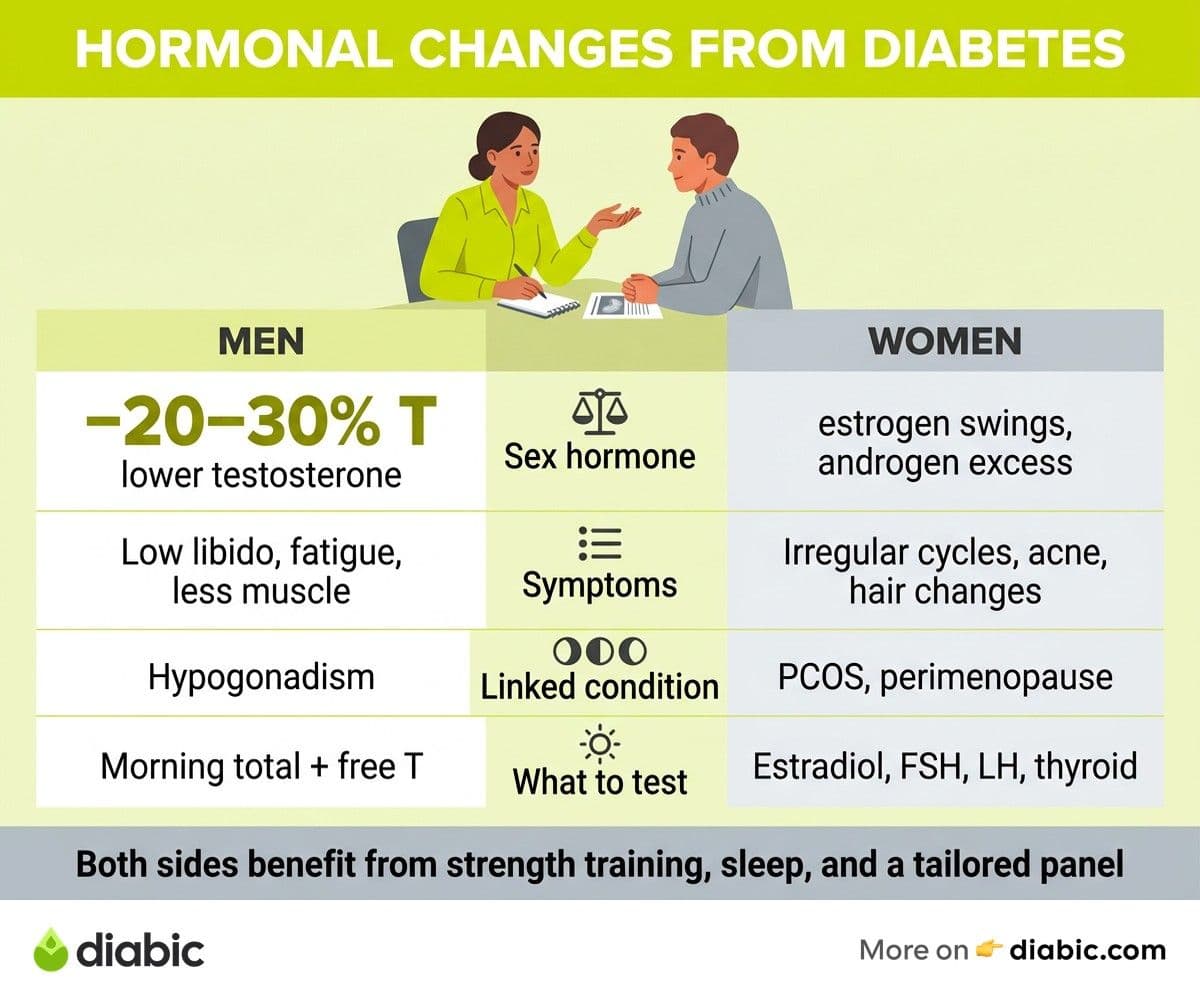
Testosterone tends to be the headline hormone for men with diabetes, and for good reason. Research published in Diabetes Care has repeatedly shown that men with type 2 diabetes carry roughly 20 to 30 percent lower testosterone levels than men of the same age without diabetes. The condition is sometimes called hypogonadism, and it shows up in symptoms many men dismiss as stress or aging.
The signs often cluster together. Reduced libido, persistent fatigue that does not lift with sleep, lower muscle mass despite regular activity, irritability, and a flatter mood are common. Erectile dysfunction frequently sits at the center of this constellation, since both vascular health and hormonal balance influence sexual function. We cover this in more depth in our guide to erectile dysfunction and what tends to actually help.
There is a frustrating loop at play here. Excess body fat, especially around the abdomen, contains an enzyme called aromatase that converts testosterone into estrogen. Higher fat mass therefore lowers testosterone, and lower testosterone makes it harder to build muscle and easier to gain fat. Insulin resistance worsens, blood sugar climbs, and the cycle reinforces itself. Breaking it usually takes more than willpower, and that is not a personal failing.
Talk to your doctor about checking morning total and free testosterone if you suspect low levels. The Urology Care Foundation outlines what testing and treatment look like, and testosterone replacement therapy is one option when levels are clinically low and symptoms are present. Many men also see meaningful improvement from weight loss, resistance training, better sleep, and tighter blood sugar management before any prescription enters the picture.
Hormonal Effects in Women
For women, the hormonal story tends to be more layered because cycles, pregnancy, and menopause all add their own dimensions. Polycystic ovary syndrome is the most well-known overlap. PCOS is closely tied to insulin resistance, and according to the American College of Obstetricians and Gynecologists, women with PCOS face significantly higher risk of developing type 2 diabetes. Irregular periods, acne, hair changes, and trouble losing weight often bring women in for testing where insulin resistance turns out to be the underlying driver.
Menstrual cycles can become a moving target when blood sugar runs high or hormones swing widely. Many women notice that estrogen and progesterone shifts across the cycle change how their body responds to insulin. The week before a period often brings higher insulin needs and stickier numbers, while the days right after may feel easier. Tracking your cycle alongside glucose patterns, which a continuous glucose monitor can make easier, helps you anticipate these shifts rather than react to them.
Fertility is another area where the connection matters. Insulin resistance can interfere with ovulation, and unmanaged blood sugar before and during early pregnancy raises risks for both parent and baby. If you are thinking ahead, our guide on pregnancy with diabetes walks through what to put in place. The conversation about libido and blood sugar also belongs here, since hormonal shifts, vaginal dryness, and fatigue all influence desire and comfort.
Menopause adds yet another layer. Falling estrogen can worsen insulin sensitivity, increase belly fat, and make blood sugar harder to predict. Hot flashes and disrupted sleep further nudge cortisol upward, which raises glucose. Some women benefit from hormone therapy under medical guidance, while others find that strength training, fiber-rich meals, and stress practices carry them through. There is no single right path, only the one that fits your health profile.
What You Can Do About Hormonal Changes Diabetes Triggers
The most useful first step is naming what you are noticing. Write down the symptoms that bother you most, when they started, and how they connect to your cycle, sleep, or stress if relevant. Bring that list to your next visit and ask for hormone panels that match your concerns. For men, that often means testosterone, sex hormone-binding globulin, and sometimes prolactin. For women, it might include estradiol, progesterone, FSH, LH, and thyroid markers. The American Diabetes Association supports a whole-person approach to diabetes care, and hormonal health falls squarely inside that.
Lifestyle still does heavy lifting here, even when it feels unfair to hear that again. Consistent strength training builds muscle that improves insulin sensitivity and supports testosterone in men and metabolic health in women. Sleeping seven to nine hours protects cortisol, growth hormone, and appetite signals. Cutting back on ultra-processed foods and adding more fiber and protein helps stabilize both blood sugar and the hormones that follow it. None of this is glamorous, and none of it has to be perfect.
Medication and hormone therapy are real tools when lifestyle alone is not enough. Talk to your doctor about whether testosterone replacement, hormonal contraception, hormone replacement therapy for menopause, or PCOS-specific treatments fit your situation. According to the NIDDK, improving A1C tends to partially restore hormonal balance, so the work you are already doing on glucose is doing more than you might realize. Pair that with the right specialist, often an endocrinologist, and you have a real plan rather than a list of complaints.
Frequently Asked Questions
What hormonal changes does diabetes cause?
Diabetes can lower testosterone in men, disrupt menstrual cycles and worsen PCOS in women, raise cortisol from stress and disrupted sleep, and shift thyroid function over time. The exact picture depends on diabetes type, duration, body composition, age, and individual genetics. Many of these changes are partially reversible when blood sugar improves and underlying causes are addressed.
How does diabetes affect hormones in women?
In women, diabetes and insulin resistance commonly drive PCOS, irregular cycles, fertility challenges, and stronger menopause symptoms. Estrogen fluctuations across the menstrual cycle also change insulin sensitivity, which means blood sugar can feel less predictable in the second half of the cycle. Tracking patterns and discussing them with a gynecologist or endocrinologist can help.
Libido and blood sugar: what is the connection?
Libido depends on hormones, mood, energy, and circulation, and diabetes can affect all four. High glucose contributes to fatigue and nerve changes, while low testosterone or estrogen reduces desire directly. Improving blood sugar, sleep, and stress often lifts libido without any prescription, and when it does not, hormone testing is the right next step.
Hormonal effects in women with type 1 versus type 2 diabetes?
Both types influence hormones, but the patterns differ. Type 1 diabetes carries higher risk of autoimmune thyroid disease and can affect cycle regularity if blood sugar runs very high or very low. Type 2 diabetes is more often tied to PCOS and insulin resistance from earlier ages. Either way, a tailored conversation with your care team beats generic advice.
When should I ask for a hormone panel?
If you have noticed persistent low libido, fatigue that sleep does not fix, mood changes, weight that will not budge, irregular cycles, or sexual function changes, those are reasonable reasons to ask. Hormone testing is most accurate when timed correctly, so your doctor may schedule blood draws at specific points in your cycle or in the morning for testosterone.
If you found this useful, our community at Diabic regularly shares experiences around the intersection of hormones, mood, and daily diabetes management. The hormonal changes diabetes can drive are real, and naming them is often the most useful first step toward a care plan that actually fits your body. You are not alone in this, and the patterns you are noticing matter.
Shahriar P. Shuvo is the founder of Diabic. He has lived with diabetes for over 14 years, and built Diabic to deliver the practical, evidence-based self-management tools he wished existed when he was first diagnosed. By trade, Shahriar is a senior design and frontend engineer with 6+ years shipping products at Agora, Timescale (now Tiger Data), and ShareTrip. He writes from the intersection of lived diabetes experience and product craft, focused on what works in daily management rather than what sounds good in a textbook.
Medically reviewed by
Dr. Shanto Arian is an internal medicine physician now specializing in clinical and aesthetic dermatology, with a parallel academic focus on epidemiology and public health. He holds an MBBS, MPH, MSc (UK), MRCP (UK), MRCPI (Ireland), Diploma in Dermatology (UK), and Diploma in Aesthetic Medicine (USA). Dr. Arian trained in internal medicine, including hospital work on hematology cases such as graft-versus-host disease, before moving toward dermatology. Skin is one of the earliest places diabetes shows itself, from acanthosis nigricans and diabetic dermopathy to slow foot wound healing, and that intersection is where his clinical and Diabic-review work meet. On Diabic, Dr. Arian medically reviews content on diabetes diagnosis, complications, dermatologic manifestations, and pharmacotherapy, ensuring every claim aligns with current ADA, NICE, and peer-reviewed literature.
More from Living with Diabetes
View all
A Gentle Chair Yoga Routine for people with diabetes
A gentle chair yoga for people with diabetes routine with safe poses, modifications for neuropathy, retinopathy, and joint pain, plus tips for older.

Shift Work and Diabetes: Managing Irregular Hours
Shift work and diabetes is a tough combination. Learn how to manage meals, sleep, medication, and blood sugar when your hours rotate or flip overnight.

Dating with Diabetes: When to Tell a New Partner
Dating with diabetes brings unique disclosure questions. Here is when to tell a new partner, what to say, and how to handle the conversation with.
Clinician-reviewed habits, plain-language guides, and honest answers - the small shifts that make living with diabetes feel lighter, every day.