Switching to Injectable Diabetes Medication: What to Expect
Switching to injectable diabetes medication can feel daunting. Learn what to expect, how to manage side effects, and why this step is progression, not.

In this article(9)
If your healthcare provider recently brought up switching to injectable diabetes medication, you might be feeling a mix of emotions right now. Maybe there is anxiety about needles, frustration that pills are no longer enough, and possibly a quiet worry that you have somehow let yourself down. We want to start by saying clearly that none of those feelings mean anything is wrong with you, and the transition is far more manageable than it probably feels right now.
Type 2 diabetes is progressive, and medications that work well at one stage may need to evolve as your body changes. Adding an injectable, or moving to one entirely, is simply the next chapter of treatment that fits where you are now. Knowing what is coming can replace much of the uncertainty with steadiness.
Why Your Doctor Might Recommend the Switch
The most common reason providers suggest moving from pills to injectables is that your A1C has been climbing, even when you have been taking your oral medications exactly as prescribed. According to the American Diabetes Association's Standards of Care, treatment intensification is recommended when blood sugar targets are no longer being met after a period of consistent oral therapy. This is not a verdict on your effort, it is a recognition that your pancreas may be producing less insulin than before or your insulin resistance has shifted.
There are also situations where injectables are recommended for reasons beyond glucose alone. GLP-1 receptor agonists, for example, can support weight loss, lower cardiovascular risk, and offer kidney protection in people with type 2 diabetes. If you have a history of heart disease or chronic kidney issues, your provider may consider these benefits when discussing your options. Our type 2 diabetes treatment overview walks through how these decisions get layered together.
Another factor is how your current oral medication for type 2 diabetes is being tolerated. Some people experience GI side effects from metformin, kidney concerns with certain drug classes, or weight gain with others. An injectable might fit your health profile better, even if oral pills technically still work. Your doctor weighs your A1C trend, your other conditions, your lifestyle, and your preferences before making a recommendation, and you are part of that conversation, not just the recipient of it.
We want to address something important here. Many people describe feeling like they "failed" when their care team suggests this change, as if they did not eat or exercise hard enough. That framing does not match the biology. Type 2 diabetes naturally progresses for most people over time, and needing more support is the rule, not the exception. Choosing to advance your care is an act of taking your health seriously, not a sign you fell short.
What Switching Actually Looks Like
The transition rarely happens overnight, and it almost never means throwing out everything you were doing before. In most cases, your provider will continue your metformin, since it remains a foundational therapy, and add an injectable on top. Other oral medications might be reduced or stopped depending on the injectable you start, particularly if you are moving to insulin or combining with a sulfonylurea where hypoglycemia risk increases.
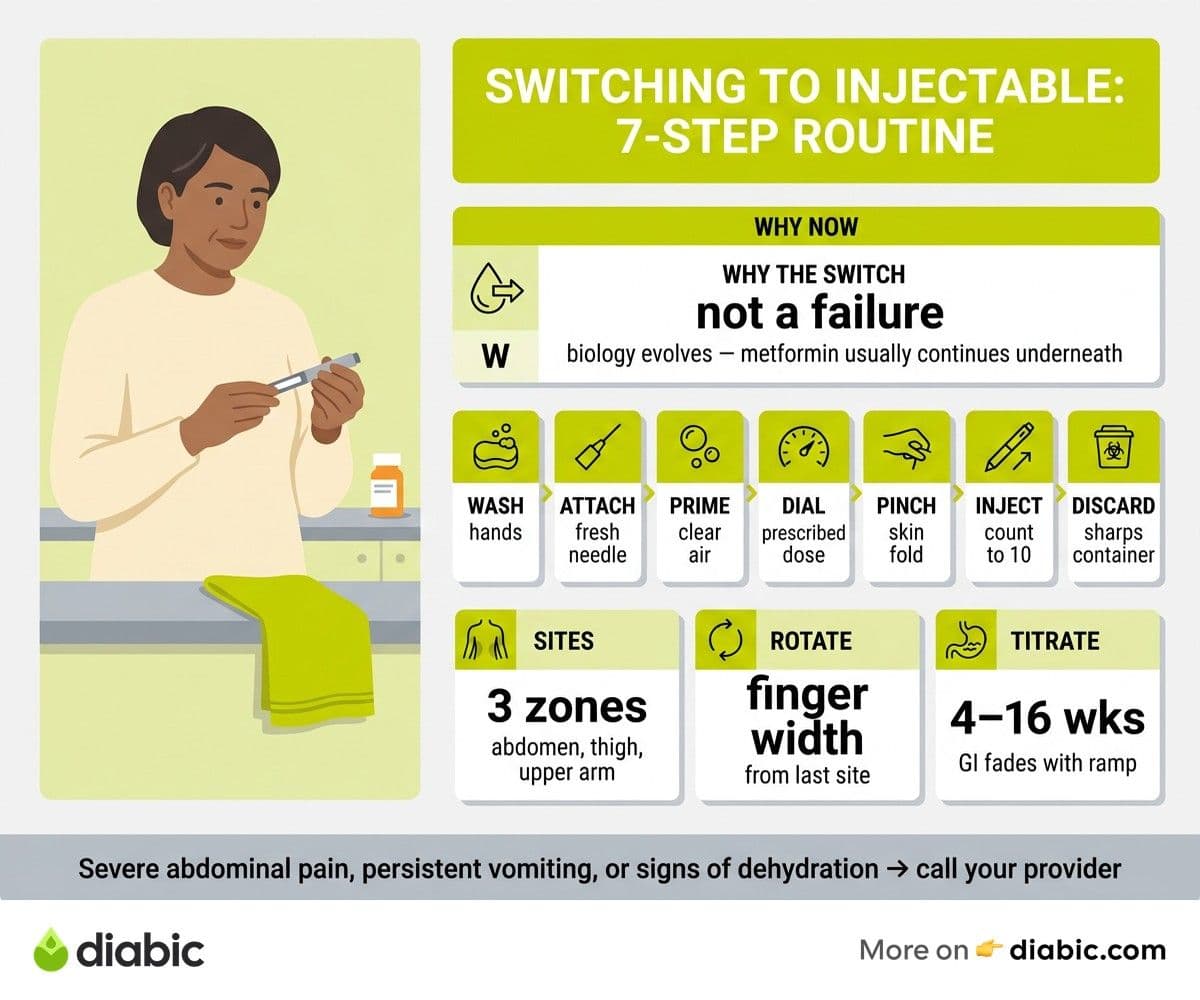
If you are starting a GLP-1 medication like semaglutide, dulaglutide, or tirzepatide, your doctor will begin you at the lowest available dose and titrate up over weeks. This slow ramp is intentional, designed to let your digestive system adjust and to keep nausea or other side effects manageable. The full therapeutic dose is usually reached somewhere between four and sixteen weeks after the first injection, depending on the medication and how your body responds. Talk to your doctor about what timeline they expect for you specifically.
If you are starting basal insulin, the titration looks different. Your provider will give you a starting unit count, often based on your weight, and then guide you through gradually increasing it based on your fasting readings. Home glucose monitoring becomes especially useful here, because the small daily adjustments are what get you to your target. The insulin vs GLP-1 injections comparison breaks down how these two paths feel different in practice.
Throughout this period, expect more frequent check-ins than usual. Your provider may want labs at six or twelve weeks and an A1C check after about three months. The UK's NICE guidelines on type 2 diabetes management similarly emphasize structured monitoring during treatment escalation. This is the part where you become an active partner, reporting back honestly about how you feel and what is working.
Getting Comfortable with Self-Injection
The first time we hold an injection pen, it usually looks bigger and more intimidating than it actually is. Modern pens are designed with the user experience as a priority, and the needles are remarkably thin and short, often around 4 millimeters in length. The FDA's guidance on pen injectors includes safety standards and instructions for use that pen manufacturers must meet. Most people are surprised at how little they feel the actual injection.
Here is what a typical injection looks like. You wash your hands, attach a fresh needle, prime it with a small test dose to clear air, dial the prescribed amount, pinch a small fold of skin, insert the needle straight in, press the plunger, count to ten, and remove the needle. Then you discard the needle in a sharps container. Once you have done it three or four times, the sequence becomes second nature.
The areas you can use are your abdomen (a couple inches from your navel), the front or outer thigh, and the back of your upper arm if you can reach comfortably. Rotating sites matters because injecting in the same spot repeatedly can cause lumps of fatty tissue called lipohypertrophy, which can affect absorption. Becton Dickinson's injection technique recommendations suggest moving at least a finger's width from your last injection each time.
If you would feel better with hands-on guidance before your first dose at home, ask. Most pharmacies will shows the device when you pick up your prescription, and a certified diabetes care and education specialist can walk you through the technique in one appointment. The first injection is the hardest, and from there your confidence builds quickly.
From my experience: I have been on insulin for more than a decade, and I still remember staring at the first Lantus pen on my kitchen counter for ten minutes before I actually used it. The 4mm pen needles available now feel nothing like the syringes I started with, and on most days the injection itself is the least memorable part of the routine. The thing that actually helps over the years is rotating sites religiously, because lipohypertrophy was a real lesson I learned the hard way around year three.
Managing Side Effects During the Transition
GLP-1 medications are well known for causing GI side effects in the early weeks, including nausea, occasional vomiting, diarrhea, constipation, and a noticeably reduced appetite. These symptoms tend to be most prominent in the first few days after a dose increase and usually settle within a week or two as your body adapts. The slow titration schedule we mentioned earlier exists specifically to keep these effects mild and manageable for most people.
A few practical changes can soften the adjustment period considerably. Eating smaller portions more often, avoiding very fatty or fried foods, staying well hydrated, and stopping when you feel comfortably full rather than stuffed all help reduce nausea. If you are using insulin, the side effects look different, with the main one being the risk of low blood sugar, especially if you skip a meal or exercise more than usual. Knowing the early signs of hypoglycemia, including shakiness, sweating, and confusion, becomes part of your daily awareness.
Injection site reactions can also happen, and they show up as redness, mild swelling, itching, or a small bruise where you injected. These reactions are usually harmless and resolve on their own within a day or two. Our injection site reactions guide covers when a reaction is normal, what soothes irritation, and which signs deserve a call to your provider. Rotating sites and letting the medication reach room temperature before injecting both help minimize discomfort.
Some side effects warrant a quicker conversation with your care team. Severe abdominal pain that does not pass, persistent vomiting that prevents you from keeping fluids down, signs of dehydration, or any symptoms suggesting an allergic reaction should prompt a call right away. Talk to your doctor about what specific warning signs apply to your medication, since the list varies between drug classes. Most people complete the transition without serious problems, but knowing where the line is gives you peace of mind.
Emotional Aspects of the Switch
We come back to the emotional weight of this transition because it is real and worth talking about, even when the medical side is going well. Many people describe a quiet grief when starting injections, a sense that diabetes has become more present in their daily life. Those feelings are valid, and they tend to soften with time.
The "I failed" narrative deserves one more direct push back. A peer-reviewed study published in Diabetes Care on patient perceptions found that psychological insulin resistance, which is the reluctance and self-blame people often feel about starting injections, is widespread and rarely matches the clinical reality. Your A1C creeping up does not mean you ate the wrong things or skipped the gym. It means a progressive condition progressed, exactly as the disease does, and your treatment is keeping pace.
Talking to family and friends about the change can also feel awkward, especially if they have well-meaning but uninformed opinions about diabetes. We have found it helps to keep the explanation simple and matter of fact: "My doctor and I decided the next step in my treatment includes a daily injection. It is more effective for where I am now." You do not owe anyone a longer justification, and the people who love you usually take their cue from how you frame it.
Connecting with others who use injectable medications can take a surprising amount of weight off your shoulders. Online communities, in-person diabetes support groups, and even brief conversations in your provider's waiting room can normalize what you are doing. Hearing someone else say "I was nervous too, and now I barely think about it" tends to land differently than reading the same line in a brochure. Accepting support from your care team and people who get it makes the transition feel less like something you are carrying alone.
Frequently Asked Questions
When should you switch from pills to injections for diabetes?
Your healthcare provider may recommend switching to injectable medications when oral medications are no longer bringing your A1C to target, or when you would benefit from the additional advantages injectables offer, such as weight loss support or cardiovascular protection. The exact timing depends on your individual blood sugar trends, your other health goals, and how your body has responded to current medications. Looking at an injectable diabetes medication list and comparison alongside your provider can help clarify which option suits your situation best.
How to overcome fear of diabetes injections?
The fear is common, valid, and usually fades faster than people expect. Modern injection pens use very thin, short needles that cause minimal discomfort, and many people are genuinely surprised at how little they feel the injection. Practicing with a diabetes educator, watching the device demonstration at your pharmacy, doing a few "dry runs" with the pen before your first real dose, and reminding yourself that the sensation is brief can all reduce anticipatory anxiety. Most people find that within the first week or two, the injection becomes a quick, unremarkable part of their routine.
A Final Note on Switching to Injectable Diabetes Medication
Choosing to advance your treatment by switching to injectable diabetes medication is a step toward better numbers and often better daily energy, even when it does not feel that way on day one. Give yourself the same patience you would give a friend starting something new, and remember that the first week is the steepest part of the climb. From there, this becomes one more thing you handle with the quiet capability you already bring to managing your health.
Shahriar P. Shuvo is the founder of Diabic. He has lived with diabetes for over 14 years, and built Diabic to deliver the practical, evidence-based self-management tools he wished existed when he was first diagnosed. By trade, Shahriar is a senior design and frontend engineer with 6+ years shipping products at Agora, Timescale (now Tiger Data), and ShareTrip. He writes from the intersection of lived diabetes experience and product craft, focused on what works in daily management rather than what sounds good in a textbook.
Medically reviewed by
Dr. Shanto Arian is an internal medicine physician now specializing in clinical and aesthetic dermatology, with a parallel academic focus on epidemiology and public health. He holds an MBBS, MPH, MSc (UK), MRCP (UK), MRCPI (Ireland), Diploma in Dermatology (UK), and Diploma in Aesthetic Medicine (USA). Dr. Arian trained in internal medicine, including hospital work on hematology cases such as graft-versus-host disease, before moving toward dermatology. Skin is one of the earliest places diabetes shows itself, from acanthosis nigricans and diabetic dermopathy to slow foot wound healing, and that intersection is where his clinical and Diabic-review work meet. On Diabic, Dr. Arian medically reviews content on diabetes diagnosis, complications, dermatologic manifestations, and pharmacotherapy, ensuring every claim aligns with current ADA, NICE, and peer-reviewed literature.
More from Treatment & Medication
View all
Recognizing Diabetic Coma Warning Signs Early
Learn to spot diabetic coma warning signs early. We cover DKA, HHS, and severe hypoglycemia symptoms, plus when to call 911 for immediate help.

Hyperglycemic Hyperosmolar Syndrome: Warning Signs to Know
Hyperglycemic hyperosmolar syndrome is a serious type 2 diabetes emergency. Learn the warning signs, triggers, and when to call 911 for HHS care.

Semaglutide vs Tirzepatide: Key Differences You Should Know
Semaglutide vs tirzepatide explained: how they work, A1C and weight results, side effects, costs, and how to choose the right injectable with your doctor.
Clinician-reviewed habits, plain-language guides, and honest answers - the small shifts that make living with diabetes feel lighter, every day.