Your Diabetes Emergency Plan Checklist for Home and Work
Build a diabetes emergency plan checklist covering supplies, low and high blood sugar steps, school, work, and travel response in one place.

In this article(11)
- Why Every Person With Diabetes Needs an Emergency Plan
- Your Emergency Supply Kit: What to Keep on Hand
- Diabetes Management Steps for a Low Blood Sugar Emergency
- High Blood Sugar Emergency Steps
- Creating an Emergency Plan for School or Work
- Emergency Planning for Travel and Time Away From Home
- Reviewing and Updating Your Diabetes Emergency Plan Checklist
A diabetes emergency plan checklist is one of those projects most of us push to "next weekend" until the day a real emergency makes us wish we had built it months ago. When blood sugar swings dangerously high or low, the people around you need a simple set of written instructions that tells them exactly what to do, in order, without guessing. We put this guide together so you can sit down once, pull together a plan that fits your life, and share it with the people who matter.
Diabetes care happens in a hundred small decisions a day, but emergencies happen in seconds. A written plan is not about being paranoid, it is about giving your family, coworkers, school staff, and travel companions a script when they need it most. The best plans are short enough to read in a panic, specific enough to be useful, and updated often enough to match your current routine.
From my experience: A few years into my T1D diagnosis my partner watched me come back from a 41 mg/dL low and asked where the glucagon was. I had to admit I did not know if our kit had expired. We sat down that weekend and made a one-page sheet that lives on the fridge, and I still rotate the Gvoke HypoPen every spring. The plan was less work than I expected, and the calm it bought us afterward was worth a lot more.
Why Every Person With Diabetes Needs an Emergency Plan
Severe low blood sugar can drop someone from chatty to unresponsive in less than ten minutes. Diabetic ketoacidosis can turn a stomach bug into a hospital admission overnight. In both situations, the first responders are usually whoever is closest to you, and clear thinking is the first thing to disappear when adrenaline hits. The American Diabetes Association emergency preparedness resources make a strong case that pre-written instructions consistently improve outcomes during crises.
Caregivers, coworkers, and school staff rarely live with diabetes themselves, and they should not be expected to improvise. A spouse who has watched you check your meter for ten years still might not remember whether 65 mg/dL gets juice or glucagon under stress. A teacher with twenty other students will not have time to research ketone strips while your child slumps over a desk. Written instructions replace memory with a checklist, and checklists save lives.
A good plan also reduces panic for you. Knowing that your supplies are stocked, your contacts are updated, and your loved ones know what to do means you can sleep without rehearsing worst-case scenarios. The act of writing the plan often surfaces gaps in your routine that you can fix today, like an expired glucagon kit or a coworker who never learned where you keep your fast-acting glucose.
Your Emergency Supply Kit: What to Keep on Hand
Start with a single bag or labeled bin that lives in a known spot at home. The CDC diabetes emergency planning guidelines suggest a 7 to 14 day supply of essentials, but for routine emergencies you really need everything in one grab-and-go place. Make a duplicate kit for your car, your desk at work, or your child's classroom depending on where time gets spent.
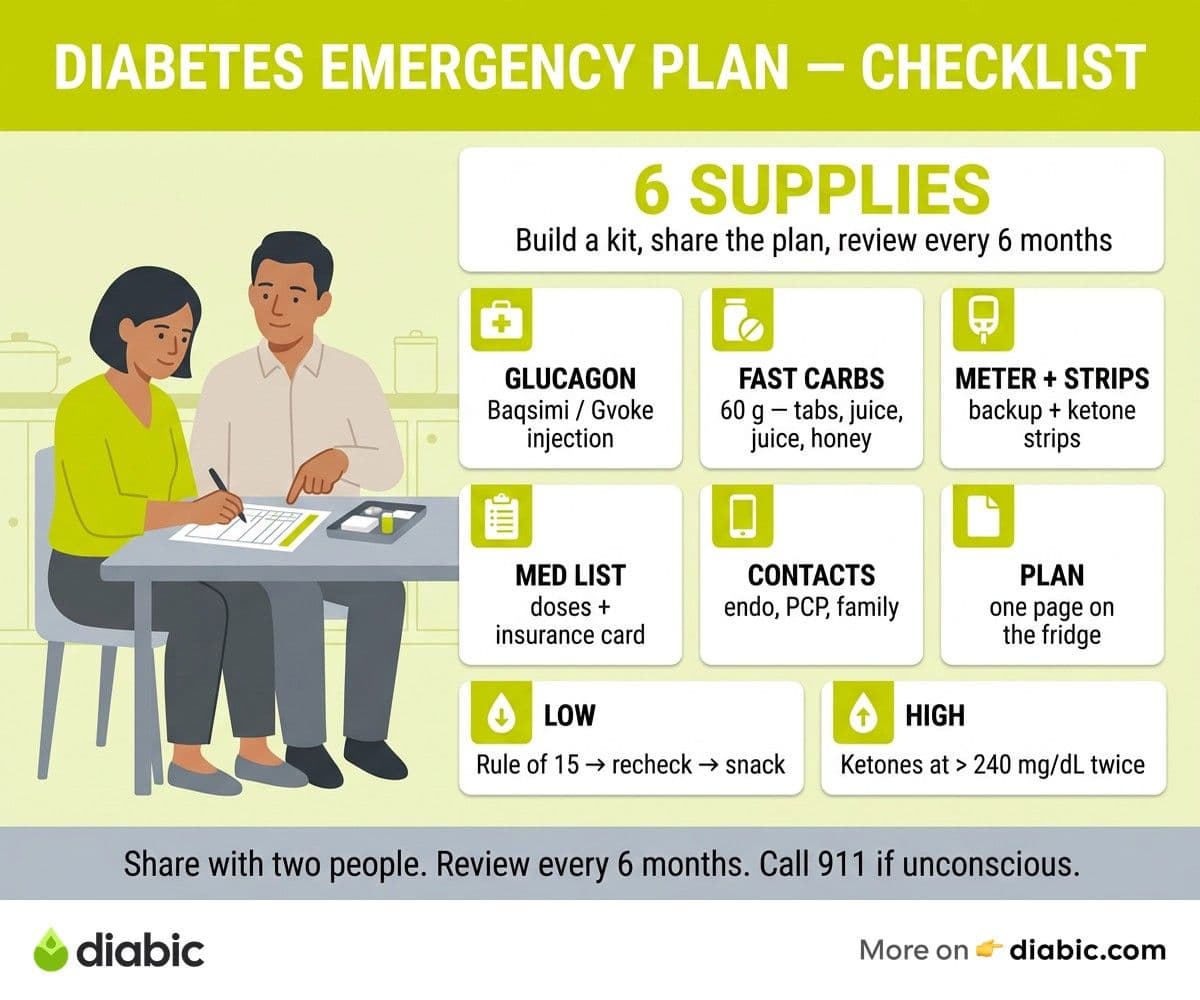
Your home kit should include a current glucagon product, whether that is an injection kit, Baqsimi nasal spray, or Gvoke HypoPen. Pair it with at least 60 grams of fast-acting carbs in non-perishable forms: glucose tablets, glucose gel tubes, juice boxes that travel without refrigeration, and a few packets of honey. Add a backup blood glucose meter with fresh test strips, a separate ketone meter or urine ketone strips, and lancing supplies.
Round out the kit with a current medication list that includes dosages, an insurance card photo, and contact information for your endocrinologist, primary care provider, and one family member. Include a small flashlight, a pair of clean socks, and a printed copy of your emergency plan. Replace expired items every six months on a fixed schedule, like daylight saving weekends, so nothing slips past its date.
Diabetes Management Steps for a Low Blood Sugar Emergency
When you catch a low early, the fix is the ADA Rule of 15: consume 15 grams of fast-acting carbs, wait 15 minutes, and recheck. Glucose tablets are predictable and easy to count, but four ounces of juice, four ounces of regular soda, or a tablespoon of honey work too. Strong diabetes management builds this routine into muscle memory long before any emergency.
Once blood sugar is back above 70 mg/dL, follow with a small snack that includes protein, like cheese and crackers or peanut butter on toast, to keep levels stable. Read our deep dive on hypoglycemia emergency treatment for a more detailed breakdown of the Rule of 15 and the warning signs of hypoglycemia unawareness. Frequent lows below 70 mg/dL are not normal and should prompt a conversation with your provider about adjusting your regimen.
If the person cannot eat or drink because they are unconscious, seizing, or too confused to swallow safely, do not put food or liquid in their mouth. Give glucagon by following the steps in our guide on how to use a glucagon emergency kit, turn them on their side, and call 911. Severe lows always warrant a call, even after recovery, because they often signal that something in the medication or food plan needs review.
High Blood Sugar Emergency Steps
High blood sugar feels less dramatic than a low, which is exactly why it sneaks up on people. The danger is diabetic ketoacidosis, often called DKA, which can develop over hours when the body cannot use glucose and starts breaking down fat for fuel. Ketone strips, either blood or urine, are the only way to know whether a high reading has crossed into DKA territory.
Check ketones any time blood sugar reads over 240 mg/dL twice in a row, when you feel sick with nausea or vomiting, or when illness is brewing. Trace or small ketones with normal hydration usually respond to extra water and a correction dose taken under your provider's sick day rules. Moderate to large ketones with stomach pain, fruity breath, fast breathing, or vomiting are not a home situation. Read our piece on what ketoacidosis feels like and how to treat it so you can spot the pattern before it spirals.
Call your provider when ketones do not clear within a few hours of correction and hydration. Head to the emergency room or call 911 if you cannot keep liquids down, ketones are large, you are short of breath, or you are confused. Our companion guide on when to go to the ER for diabetes lists the exact red flags worth a hospital visit and what to bring with you.
Creating an Emergency Plan for School or Work
Schools and workplaces need a written plan they can follow without you in the room. For kids with type 1 diabetes, the JDRF (now Breakthrough T1D) school resources and a 504 plan or Diabetes Medical Management Plan are the gold standard, and most school districts already have templates. Include current medication doses, insulin-to-carb ratios, glucagon storage location, who can give it, and a school-specific contact tree.
For adults, a workplace plan can be as simple as a one-page document shared with one or two trusted coworkers and your direct manager. Cover where supplies live, what your low and high warning signs look like, what fast-acting glucose to grab if you cannot speak clearly, and the threshold for calling 911. Workplace accommodations under the Americans with Disabilities Act can include break flexibility, snack access at the desk, and a private space for blood glucose checks.
Train at least one coworker, school nurse, or teacher on how to use your specific glucagon product. A trainer device costs nothing from the manufacturer and turns an abstract instruction into muscle memory. Refresh the plan and the training every school year or after any job change, and store a copy of the document somewhere accessible to HR or the school office.
Emergency Planning for Travel and Time Away From Home
Travel multiplies the variables that matter for diabetes, so the FEMA emergency preparedness guidance for chronic conditions is a useful reference for trip planning too. Pack at least double the supplies you expect to need, split between your carry-on and a personal item, and never check insulin or glucagon in the cargo hold where temperatures swing wildly. TSA allows insulin pumps, CGMs, syringes, and glucagon through security with a doctor's note, though the note is rarely required.
Build a one-page summary of your medications, devices, and emergency contacts in English and in the local language for international travel. Save it as a photo on your phone, print a copy for your wallet, and store a copy in your suitcase. A medical ID bracelet or necklace, paired with a digital health card on your phone's lock screen, gives first responders the information they need when you cannot speak. See our companion guide on traveling with diabetes devices for airport security tips.
If you lose supplies abroad, pharmacies in most countries will fill an insulin prescription with a copy of your bottle label or a photo of your prescription. The international SOS network and your travel insurance hotline are worth knowing in advance, especially for trips longer than a week. Build the contact info into your phone before you leave, not after something goes wrong.
Reviewing and Updating Your Diabetes Emergency Plan Checklist
Plans go stale faster than people expect. New medications, a different insulin, a new pump or CGM, a new job, a new baby, a new pet that wakes you at 3 a.m., any of these changes should trigger a plan refresh. At a minimum, review the document every six months on the same daylight saving rhythm you use to replace expired supplies.
Practice the plan with the people in it at least once a year. Walk your spouse through where the glucagon is stored and what each step looks like, even if you covered it before. Run through a sick day scenario with your kids so they know which adult to call. The goal is for the plan to be in muscle memory, not just on paper, because real diabetes management lives in the practice rather than the document.
Update contact information whenever your provider changes, and refresh medication lists after every titration or new prescription. Share the latest version with the people who need it: spouse, parents, employer, school nurse, regular travel companions. A plan that lives only on your phone helps no one if your phone is locked and you cannot unlock it.
Frequently Asked Questions
What should be included in a diabetes emergency plan?
A solid plan covers supply lists, low and high blood sugar response steps, glucagon location and instructions, current medication doses, provider contacts, insurance details, and red flags that warrant a 911 call. Add school or workplace specifics, travel notes, and a recent photo of yourself or your child. Keep it under two pages so anyone can read it under stress.
How to prepare for a diabetes emergency at school or work?
Write a one-page plan, share it with at least two adults, and train them on your specific glucagon product using a free trainer device. Stock supplies in a labeled location accessible to staff, set up legal protections like a 504 plan for school or ADA accommodations at work, and review the plan each school year or after any job change.
How often should a diabetes emergency plan be updated?
Review the plan at least every six months and any time something material changes: new medication, new device, new job, new caregivers, or after any emergency event. Tie reviews to a recurring calendar reminder, like daylight saving weekends, so the rhythm survives busy seasons.
A diabetes emergency plan checklist is most useful when it is short, current, and shared with the right people, so spend an afternoon now rather than rewriting one in a hospital waiting room. Save the supply list above to your phone, schedule a six-month review, and tell at least two people where the printed copy lives. In any severe emergency, call 911 or your provider's emergency line right away.
Shahriar P. Shuvo is the founder of Diabic. He has lived with diabetes for over 14 years, and built Diabic to deliver the practical, evidence-based self-management tools he wished existed when he was first diagnosed. By trade, Shahriar is a senior design and frontend engineer with 6+ years shipping products at Agora, Timescale (now Tiger Data), and ShareTrip. He writes from the intersection of lived diabetes experience and product craft, focused on what works in daily management rather than what sounds good in a textbook.
Medically reviewed by
Dr. Rezwana Parvin Rumpa is an obstetrics and gynaecology specialist with clinical focus on gestational diabetes, PCOS, and fertility. She holds the MRCOG (Final Part) from the Royal College of Obstetricians and Gynaecologists in London, the MRCPI (Final Part) from the Royal College of Physicians of Ireland, and an MBBS from Shaheed Monsur Ali Medical College under Dhaka University. Dr. Rumpa serves as a Senior Medical Officer in the Obs and Gynae department at BRB Hospitals Ltd, where she has spent three years managing prenatal care, emergency obstetric cases, and women's-health surgery. On Diabic, she medically reviews content for women living with diabetes, with particular attention to pregnancy, PCOS, and reproductive-health intersections.
More from Treatment & Medication
View all
Recognizing Diabetic Coma Warning Signs Early
Learn to spot diabetic coma warning signs early. We cover DKA, HHS, and severe hypoglycemia symptoms, plus when to call 911 for immediate help.

Switching to Injectable Diabetes Medication: What to Expect
Switching to injectable diabetes medication can feel daunting. Learn what to expect, how to manage side effects, and why this step is progression, not.

Hyperglycemic Hyperosmolar Syndrome: Warning Signs to Know
Hyperglycemic hyperosmolar syndrome is a serious type 2 diabetes emergency. Learn the warning signs, triggers, and when to call 911 for HHS care.
Clinician-reviewed habits, plain-language guides, and honest answers - the small shifts that make living with diabetes feel lighter, every day.