Hypoglycemia Emergency Treatment: Act Fast to Stay Safe
Hypoglycemia emergency treatment guide: ADA Rule of 15, glucagon steps, severe low signs, and exactly when to call 911 for low blood sugar.

In this article(9)
Hypoglycemia emergency treatment is a skill set every person on insulin and every household around them should rehearse before they ever need it. When blood sugar drops below safe levels, the brain loses its primary fuel within minutes, and the window for a smooth recovery closes quickly. We wrote this guide so you and the people who love you can move from "what do we do" to "do the next thing on the list" when seconds count.
A scary low does not always look like the cartoon version of shaking and sweating. Sometimes it looks like a teenager arguing about putting on socks, an adult who suddenly cannot find a word, or a sleeping partner who feels weirdly clammy. Recognizing the early signals, knowing the ADA Rule of 15, and understanding when to switch from juice to glucagon are the three skills that turn a frightening moment into a manageable one.
From my experience: A 3am low feels different from a 3pm low, and that is something I had to learn the hard way after about 14 years on insulin. Waking up at 73 mg/dL with my Dexcom G7 already alarming, I used to fumble for juice boxes in the dark and overtreat every time. Now I keep four glucose tabs and a small bottle of regular soda right on the nightstand, in the same spot every night, so the muscle memory works even when my brain is barely online.
What Is a Hypoglycemia Emergency
Mild low blood sugar happens often for people on insulin or sulfonylureas, and most of those moments are fixable with a few glucose tablets. A hypoglycemia emergency is different. The ADA Standards of Care 2025 hypoglycemia framework defines clinically significant hypoglycemia as blood sugar below 54 mg/dL, and severe hypoglycemia as any low requiring another person's help to recover, regardless of the exact reading.
Brain cells run almost entirely on glucose, and they cannot store it the way muscles can. When circulating glucose drops too far, those cells stop functioning normally, which is why confusion, slurred speech, and unconsciousness show up so fast. That biology is also why the normal blood sugar levels chart we publish has 70 mg/dL flagged as the action threshold rather than 54, since waiting until 54 leaves no margin to respond before symptoms escalate.
Anyone using insulin is at risk, including people with type 1 diabetes, gestational diabetes treated with insulin, and many people with type 2 on insulin or sulfonylureas. Risk rises during exercise, after alcohol, with skipped meals, after a dose change, and during illness. Reviewing your insulin therapy for type 1 diabetes routine each year with your provider often surfaces the small adjustments that prevent recurrent severe lows.
How to Recognize Severe Low Blood Sugar
Early warning signs include shakiness, sweating, a racing heart, sudden hunger, headache, anxiety, and tingling around the mouth. These are adrenaline-driven symptoms, and they exist precisely so you have a chance to fix the problem before things get serious. Many of these classic diabetes symptoms also overlap with anxiety or low caffeine, which is why a quick blood glucose check should always settle the question rather than guessing.
Progressing signs mean the brain is starting to run low on fuel. Confusion, slurred speech, blurred vision, difficulty walking, and personality changes all show up here. Family members often catch this stage before the person with diabetes does, because the affected person may insist they are fine while clearly not making sense. If you watch someone you love and your gut says something is wrong, treat first and ask questions later.
Severe signs are seizures, loss of consciousness, and inability to swallow safely. At this stage you need to call 911 immediately and prepare to give glucagon. Some people develop hypoglycemia unawareness, where the early warning signs disappear after years of repeated lows or because of certain medications. The American Red Cross diabetic emergency first aid materials are a useful refresher, and a continuous glucose monitor with low alerts is one of the most reliable ways to compensate for unawareness. If your warning signs have faded, talk to your provider about a CGM and reviewing your overnight basal rates.
Step by Step Hypoglycemia Emergency Treatment
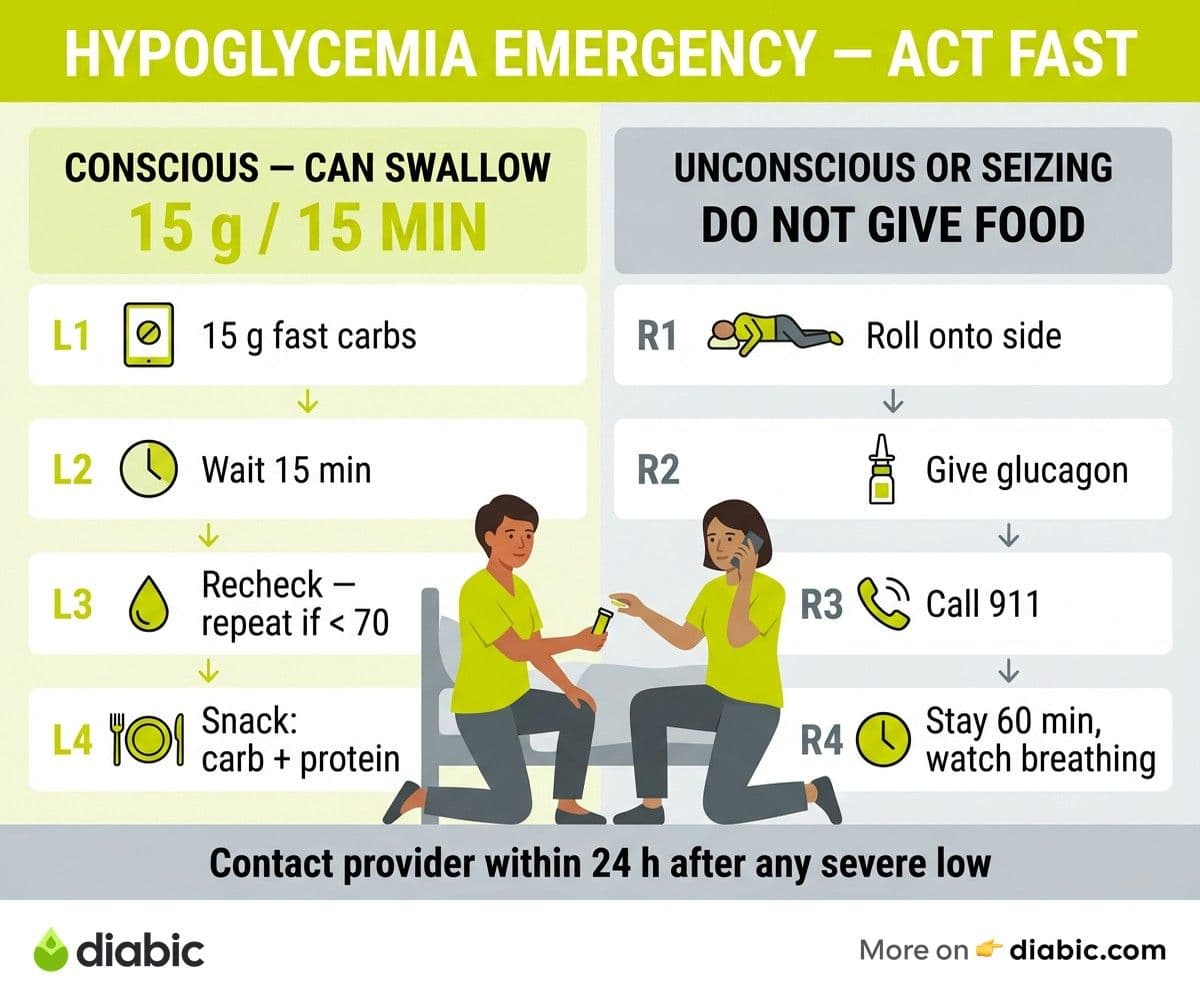
If the person is conscious and can swallow, the ADA Rule of 15 is your script. Give 15 to 20 grams of fast-acting carbohydrate in a form that absorbs quickly: 4 glucose tablets, 4 ounces of juice or regular soda, a tablespoon of honey, or a glucose gel tube. Avoid foods with fat or protein at this stage, since they slow absorption when speed is the priority.
Wait 15 minutes, then recheck blood sugar. If it is still below 70 mg/dL, repeat another 15 grams of fast carbs and wait another 15 minutes. Once blood sugar is back above 70, follow with a small snack that combines protein and a slower carb, like crackers with cheese or peanut butter on toast, to keep levels stable. Skipping the follow-up snack is a common reason lows bounce back within an hour.
If the person is unconscious, seizing, or unable to swallow safely, do not put anything in their mouth. Forcing juice or food into someone who cannot swallow can cause aspiration into the lungs. Turn them onto their side in the recovery position, give glucagon, and call 911. Stay with them, monitor breathing, and be ready to start CPR if it becomes necessary while waiting for paramedics.
Using Glucagon in an Emergency for Better Diabetes Management
Glucagon is the rescue tool when oral treatment is impossible, and proactive diabetes management means having it on hand and knowing how to use it. Three forms are available in the United States: traditional injection kits that require mixing powder with diluent, Baqsimi nasal spray, and prefilled auto-injectors like Gvoke HypoPen and Zegalogue. The FDA prescribing information for glucagon products covers the official labeling for all three categories.
Each product has its own steps, but the principle is the same. Get the dose into the person, turn them on their side because vomiting after glucagon is common, and call 911 even if they wake up looking fine. Our deep dive on how to use a glucagon emergency kit walks through every step for each product type with the level of detail you want to read before an emergency, not during one.
Everyone close to a person with diabetes should know where the glucagon lives, what form it takes, and how to administer it. Manufacturers offer free trainer devices that look identical to the real product, and a fifteen minute practice session once a year is enough to keep the skill fresh. Pair this with a written diabetes emergency plan that you share with family, roommates, and at least one trusted coworker.
What to Do After a Severe Episode
Do not leave the person alone for at least 60 minutes after recovery. Glucagon empties the liver's glucose stores, which means blood sugar can drop again as those stores are depleted. Continue checking glucose every 15 minutes for the first hour, then every 30 minutes for the next two hours, especially overnight when symptoms are easier to miss.
Contact the healthcare provider about the episode within 24 hours, even if the person feels back to normal. Severe hypoglycemia is almost always a signal that something in the management plan needs adjustment, whether that is a basal rate, an insulin-to-carb ratio, a medication interaction, or a missed meal pattern. Document what happened: time, last meal, last insulin dose, the glucose reading at the start of the event, what was given, and how long recovery took. That log is gold for your endocrinologist and saves them from guessing.
The emotional aftermath of a severe low is real and worth naming out loud. Many people develop fear of hypoglycemia after a major event, which can lead to running blood sugar deliberately high to avoid another scare. That trade-off increases long-term complication risk, so working with a diabetes educator or therapist who understands chronic illness is often as important as the medical adjustments. Our piece on when to go to the ER for diabetes covers the medical follow-up side, but the emotional side deserves equal attention.
Preventing Hypoglycemia Emergencies
Prevention is the long game, and it starts with recognizing your personal patterns. Frequent lows around the same time of day usually point to a basal rate that needs adjustment, an insulin-to-carb ratio that is too aggressive, or a routine factor like a daily walk that is not accounted for in your dosing. Tracking lows for two weeks and bringing the data to your next appointment often produces a more useful conversation than a generic check-in.
Keep fast-acting glucose accessible everywhere your day takes you: nightstand, desk drawer, car, bag, gym locker, and bedside table. The Diabetes Care journal research on hypoglycemia prevention consistently shows that easy access to treatment is one of the strongest predictors of catching lows early. A medical ID bracelet or necklace adds a layer of protection if you become unable to communicate.
Continuous glucose monitor alarms are one of the most powerful prevention tools available today. Setting a low alert at 80 or 85 mg/dL gives you a chance to catch a falling trend before it becomes a crisis, and overnight alarms have prevented countless severe events for people who used to wake up dangerously low. Talk to your provider about CGM access if you do not have one yet, and ask about adjusting medications when lows happen more than once or twice a week.
Frequently Asked Questions
What to do when someone has a severe low blood sugar episode?
If they are conscious and can swallow, give 15 to 20 grams of fast-acting carbs, wait 15 minutes, and recheck. If they are unconscious or cannot swallow, do not put anything in their mouth. Turn them on their side, give glucagon by injection, nasal spray, or auto-injector, and call 911. Stay with them until paramedics arrive.
How low does blood sugar have to be to be an emergency?
Blood sugar below 54 mg/dL is classified as clinically significant and demands immediate treatment. Severe hypoglycemia, defined as needing another person's help to recover, is a medical emergency at any reading. Confusion, seizures, or unconsciousness from low blood sugar always warrant a 911 call, regardless of the number on the meter.
In any severe low blood sugar event, call 911 or your provider's emergency line. The point of practicing hypoglycemia emergency treatment ahead of time is so the steps feel automatic when they have to be: recognize the signs, treat with fast carbs or glucagon, get help, and follow up with your care team within 24 hours so the same scare does not happen again.
Shahriar P. Shuvo is the founder of Diabic. He has lived with diabetes for over 14 years, and built Diabic to deliver the practical, evidence-based self-management tools he wished existed when he was first diagnosed. By trade, Shahriar is a senior design and frontend engineer with 6+ years shipping products at Agora, Timescale (now Tiger Data), and ShareTrip. He writes from the intersection of lived diabetes experience and product craft, focused on what works in daily management rather than what sounds good in a textbook.
Medically reviewed by
Dr. Rezwana Parvin Rumpa is an obstetrics and gynaecology specialist with clinical focus on gestational diabetes, PCOS, and fertility. She holds the MRCOG (Final Part) from the Royal College of Obstetricians and Gynaecologists in London, the MRCPI (Final Part) from the Royal College of Physicians of Ireland, and an MBBS from Shaheed Monsur Ali Medical College under Dhaka University. Dr. Rumpa serves as a Senior Medical Officer in the Obs and Gynae department at BRB Hospitals Ltd, where she has spent three years managing prenatal care, emergency obstetric cases, and women's-health surgery. On Diabic, she medically reviews content for women living with diabetes, with particular attention to pregnancy, PCOS, and reproductive-health intersections.
More from Treatment & Medication
View all
Recognizing Diabetic Coma Warning Signs Early
Learn to spot diabetic coma warning signs early. We cover DKA, HHS, and severe hypoglycemia symptoms, plus when to call 911 for immediate help.

Switching to Injectable Diabetes Medication: What to Expect
Switching to injectable diabetes medication can feel daunting. Learn what to expect, how to manage side effects, and why this step is progression, not.

Hyperglycemic Hyperosmolar Syndrome: Warning Signs to Know
Hyperglycemic hyperosmolar syndrome is a serious type 2 diabetes emergency. Learn the warning signs, triggers, and when to call 911 for HHS care.
Clinician-reviewed habits, plain-language guides, and honest answers - the small shifts that make living with diabetes feel lighter, every day.