Glycohemoglobin A1C: Is Your Number Normal?
Wondering what your glycohemoglobin A1C result means? Learn normal A1C ranges, how it converts to blood sugar, and what to do about your number.

In this article(11)
Your glycohemoglobin A1C result just came back, and now you are staring at a number wondering what it means for your health. Maybe it is 5.4%, maybe 6.8%, maybe somewhere in between, and the lab report did not exactly come with a friendly explainer. We get the mix of curiosity and worry that often shows up in that moment.
This single test offers a snapshot of your average blood sugar over the past two to three months, and understanding it can shape how you approach the weeks ahead. The number itself does not prescribe an action, but it does open the right conversation with your healthcare team. We will walk through what the test measures, what the ranges mean, and how to respond if your number is higher than you hoped.
From my experience: After 14 years with type 1, I have learned to read my A1C the same way I read the weather: useful, real, and not the whole picture. The first time my Dexcom data and my A1C did not match, my time in range looked great but the number came back higher than I expected, and my endocrinologist walked me through how nighttime variability was quietly raising the average. The number was not "wrong"; it was telling me something my finger sticks alone could not.
What Is a Glycohemoglobin A1C Test
The A1C test, sometimes called HbA1c or glycated hemoglobin, measures the percentage of hemoglobin in your red blood cells that has glucose attached to it. Hemoglobin is the protein that carries oxygen through your blood, and when sugar circulates in your bloodstream, some of it sticks to those proteins. The higher your average blood sugar over time, the more glucose ends up bonded to hemoglobin, and the higher your A1C reads.
Because red blood cells live for roughly three months before being replaced, the result reflects your blood sugar pattern across that window rather than a single moment. A finger-stick reading or a continuous glucose monitor tells you what is happening right now, while the A1C tells you the bigger story. Both kinds of information matter, and they answer different questions about your health.
This is also why providers rely on the A1C as a primary diabetes test for both diagnosis and ongoing care. The National Institute of Diabetes and Digestive and Kidney Diseases explains that one strength of the test is convenience, since you do not need to fast before the blood draw. If you are still sorting out understanding the differences between type 1 and type 2, pairing that context with your A1C result can make conversations with your doctor more productive.
What Is a Normal A1C Range
The official cutoffs come from the American Diabetes Association and have been used to standardize diagnosis across the United States and much of the world. The ADA Standards of Care define the categories most clinicians lean on during a checkup. These thresholds give you a starting point, though your individual target may sit slightly above or below the strict diagnostic cutoff depending on your age, other conditions, and treatment plan.
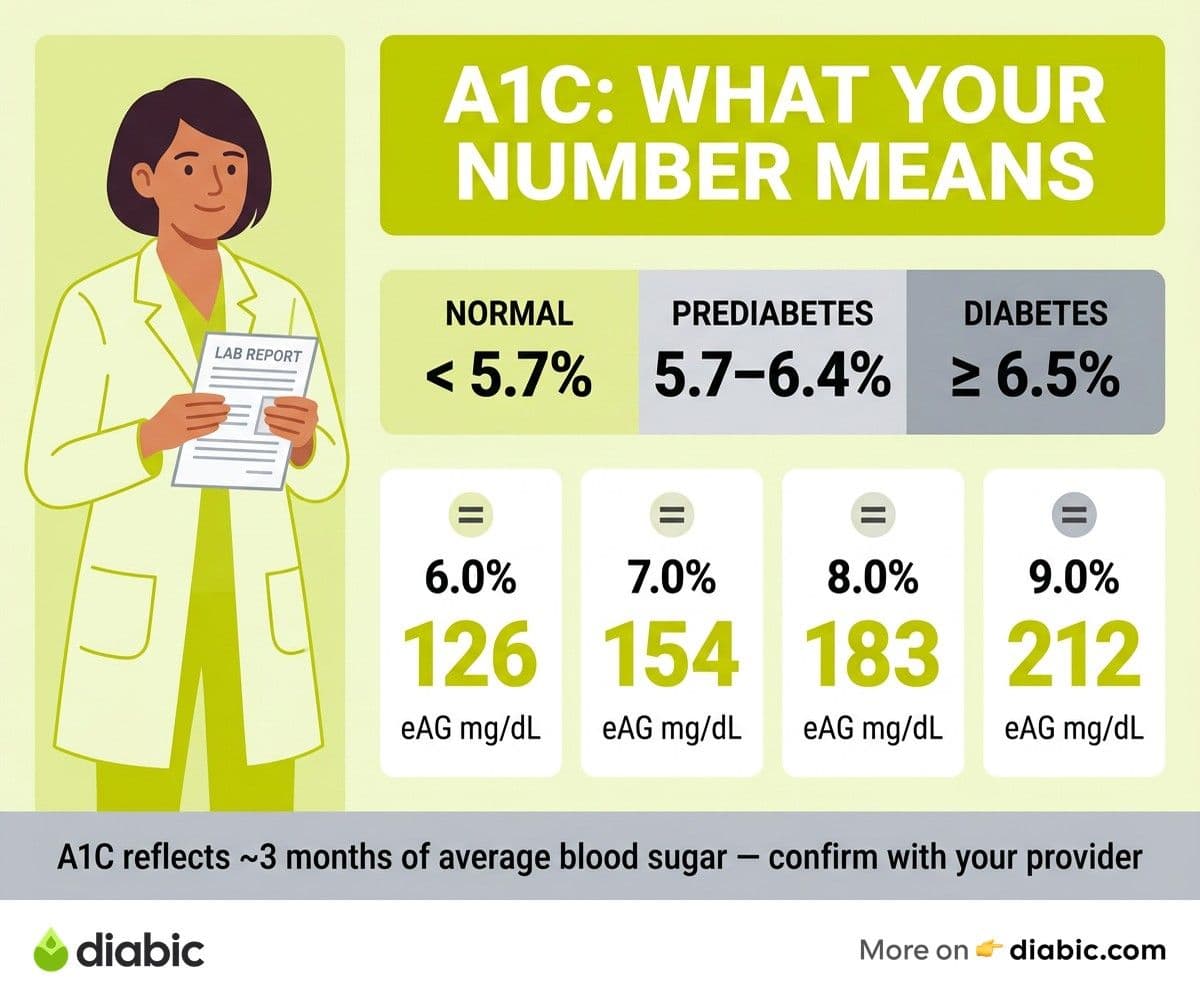
Here is a quick reference for the standard a1c normal range categories along with what each tier typically signals.
If your number lands in the prediabetes zone, you are far from alone, and the news is more workable than it might feel. Reading what prediabetes really means can help you separate the diagnosis from the panic that often comes with it. Many people in this range stay there for years or move back into the normal range with steady changes to food, movement, and sleep.
For people already living with diabetes, the goal is rarely to chase a "perfect" number. Talk to your doctor about the A1C target that fits your situation, since older adults, people with frequent low blood sugar, or those with other health conditions sometimes do better with a slightly higher goal. A target that ignores your real life is one you will struggle to keep, so personalization beats one-size-fits-all every time.
How Your A1C Translates to Average Blood Sugar
A percentage can feel abstract until you connect it to the milligrams per deciliter you see on your meter. The estimated average glucose, or eAG, is the conversion that translates your A1C into the blood sugar units you already recognize. This makes the result less of a black box and more of a working number you can reason about week to week.
The chart below shows the rough conversion most labs use, drawn from research published in Diabetes Care. Keep in mind that two people with the same A1C can have different glucose patterns, so this is a guide rather than a guarantee.
This translation bridges the gap between a quarterly lab visit and the daily readings you collect at home. If your A1C is 7.2% but your meter usually shows numbers around 130, that mismatch is worth bringing up with your provider. Looking at blood sugar levels by age and time alongside your A1C gives you a fuller view of how your body is responding.
The conversion has limits, though. Some people run higher fasting numbers and lower post-meal numbers, while others show the opposite pattern, and the A1C smooths all of that into one average. That is one reason continuous glucose monitors have become popular, since they reveal the variability that a quarterly lab cannot.
Factors That Can Affect Your A1C Results
The A1C is reliable for most people, but it is not foolproof. Anything that changes how long red blood cells live or how hemoglobin behaves can nudge the result in either direction. Knowing this matters because a misleading number could lead to an unnecessary diagnosis or, conversely, missed signs of high blood sugar that deserve attention.
Conditions that may produce falsely high or low readings include iron-deficiency anemia, sickle cell trait or disease, thalassemia, recent blood loss or transfusion, and chronic kidney or liver disease. Pregnancy can also shift the result, which is why providers often turn to other tests during prenatal care. According to the National Glycohemoglobin Standardization Program, certain hemoglobin variants more common in people of African, Mediterranean, and Southeast Asian ancestry can interact with some A1C testing methods.
If you suspect your result does not match your lived experience, your provider can order alternatives like a fructosamine test, a glycated albumin test, or an oral glucose tolerance test. None of this means the A1C is unreliable for most people, only that it should be interpreted alongside the rest of your story. A useful question to ask is whether your hemoglobin or kidney status makes A1C less accurate for you.
Medications and supplements can play a role too. High-dose vitamin C and E, certain HIV treatments, and some chemotherapy drugs have been linked to A1C interference in research. Bring a complete medication list to your appointment so your provider can spot anything worth flagging.
How Often Should You Get an A1C Test
Frequency depends on what is happening with your blood sugar and your treatment plan. The ADA recommends testing at least twice a year for people whose management is stable and meeting their goals. If your treatment has recently changed or your numbers are not where you and your provider want them, every three months is more typical and gives you a clearer view of whether adjustments are working.
There are situations where more frequent testing makes sense. After starting a new medication, adjusting insulin doses, or making significant lifestyle changes, your provider may want to see how those shifts show up over the next quarter. The CDC's guidance on A1C reminds us that the test is most useful when results are reviewed in context, not in isolation.
Less frequent testing has its own logic. If your A1C has held steady for years and your daily readings line up, twice a year is often plenty. The goal is not to collect data for the sake of data but to make sure your plan is still working.
What to Do If Your A1C Is Higher Than Expected
A higher-than-expected A1C is information, not a verdict. One number does not erase the work you have already done, and it does not predict the next three months any more than last quarter's weather predicts tomorrow. Take a breath, then look at the result with curiosity instead of self-criticism, because A1C is designed to move and you have a real runway to influence the next reading.
Start by talking to your doctor about possible reasons for the change. Stress, illness, sleep disruption, new medications, weight changes, and shifts in activity can all move the needle. Sometimes a higher glycohemoglobin a1c result points to a treatment plan that needs an update, and sometimes it reflects a tough season that has already passed. Reviewing type 2 diabetes treatment options before your appointment can help you ask better questions about what might come next.
Small, consistent changes tend to beat dramatic overhauls. Adding a 10-minute walk after dinner, swapping one sweetened drink for water, or building one protein-rich breakfast into your week can each chip away at average glucose. Research on insulin resistance, summarized in our piece on reversing insulin resistance, points to how stacking modest habits compounds over weeks rather than days. We would rather you keep two changes for three months than try seven and quit by week four.
If your A1C has been climbing despite your best efforts, that is a sign to revisit your plan with your healthcare team rather than a sign to push harder alone. Adjusting medication, adding a continuous glucose monitor, or working with a diabetes educator can each change the equation. You are not failing the test. You are gathering information that helps the next round go better.
Frequently Asked Questions
What is a normal A1C level for a non-diabetic?
For someone without diabetes, a normal A1C level is typically below 5.7%. An A1C between 5.7% and 6.4% suggests prediabetes, while 6.5% or higher on two separate tests indicates diabetes. Your healthcare provider can interpret your specific result alongside your symptoms, family history, and other lab work to figure out what makes sense as a next step.
How often should you get an A1C test?
The ADA recommends A1C testing at least twice per year for people whose blood sugar management is stable and meeting target. If your treatment plan recently changed or your A1C is above your goal, every three months is more common. Ask your provider what schedule fits your situation, since the right cadence depends on what is happening with your treatment plan and overall health.
Can a glycohemoglobin A1C result be wrong?
A1C results can be skewed by conditions that affect red blood cells, such as anemia, hemoglobin variants, recent blood loss, kidney disease, or pregnancy. Certain medications and supplements can also influence the reading. If your A1C does not match your home glucose readings, talk to your doctor about alternative tests like fructosamine or glycated albumin.
What is the difference between A1C and fasting blood sugar?
Fasting blood sugar shows your glucose level at one moment after at least eight hours without eating, while A1C reflects your average over the past two to three months. Both can be used to diagnose diabetes, and providers often use them together. They answer different questions, so neither replaces the other in a complete picture of your blood sugar.
Dr. Shanto Arian is an internal medicine physician now specializing in clinical and aesthetic dermatology, with a parallel academic focus on epidemiology and public health. He holds an MBBS, MPH, MSc (UK), MRCP (UK), MRCPI (Ireland), Diploma in Dermatology (UK), and Diploma in Aesthetic Medicine (USA). Dr. Arian trained in internal medicine, including hospital work on hematology cases such as graft-versus-host disease, before moving toward dermatology. Skin is one of the earliest places diabetes shows itself, from acanthosis nigricans and diabetic dermopathy to slow foot wound healing, and that intersection is where his clinical and Diabic-review work meet. On Diabic, Dr. Arian medically reviews content on diabetes diagnosis, complications, dermatologic manifestations, and pharmacotherapy, ensuring every claim aligns with current ADA, NICE, and peer-reviewed literature.
Medically reviewed by
Dr. Rezwana Parvin Rumpa is an obstetrics and gynaecology specialist with clinical focus on gestational diabetes, PCOS, and fertility. She holds the MRCOG (Final Part) from the Royal College of Obstetricians and Gynaecologists in London, the MRCPI (Final Part) from the Royal College of Physicians of Ireland, and an MBBS from Shaheed Monsur Ali Medical College under Dhaka University. Dr. Rumpa serves as a Senior Medical Officer in the Obs and Gynae department at BRB Hospitals Ltd, where she has spent three years managing prenatal care, emergency obstetric cases, and women's-health surgery. On Diabic, she medically reviews content for women living with diabetes, with particular attention to pregnancy, PCOS, and reproductive-health intersections.
More from Treatment & Medication
View all
Recognizing Diabetic Coma Warning Signs Early
Learn to spot diabetic coma warning signs early. We cover DKA, HHS, and severe hypoglycemia symptoms, plus when to call 911 for immediate help.

Switching to Injectable Diabetes Medication: What to Expect
Switching to injectable diabetes medication can feel daunting. Learn what to expect, how to manage side effects, and why this step is progression, not.

Hyperglycemic Hyperosmolar Syndrome: Warning Signs to Know
Hyperglycemic hyperosmolar syndrome is a serious type 2 diabetes emergency. Learn the warning signs, triggers, and when to call 911 for HHS care.
Clinician-reviewed habits, plain-language guides, and honest answers - the small shifts that make living with diabetes feel lighter, every day.