Insulin Resistance Symptoms Most People Overlook
Insulin resistance symptoms hide in plain sight as fatigue, cravings, and stubborn belly fat. Learn the subtle signs to catch before prediabetes sets in.

In this article(8)
Insulin resistance symptoms rarely announce themselves with a dramatic moment. Instead, they build quietly over years, hiding behind weight gain, fatigue, and skin changes that most people never connect to blood sugar. Catching these signs early can put you ahead of a prediabetes or type 2 diabetes diagnosis.
That is the part that frustrates so many people. The symptoms feel like personal failings rather than a metabolic pattern. The afternoon crash, the cravings that will not quit, the belly fat that does not respond to diet changes. None of it feels like a medical condition. It feels like life. And yet the underlying pattern is often the same.
Subtle Insulin Resistance Symptoms to Know
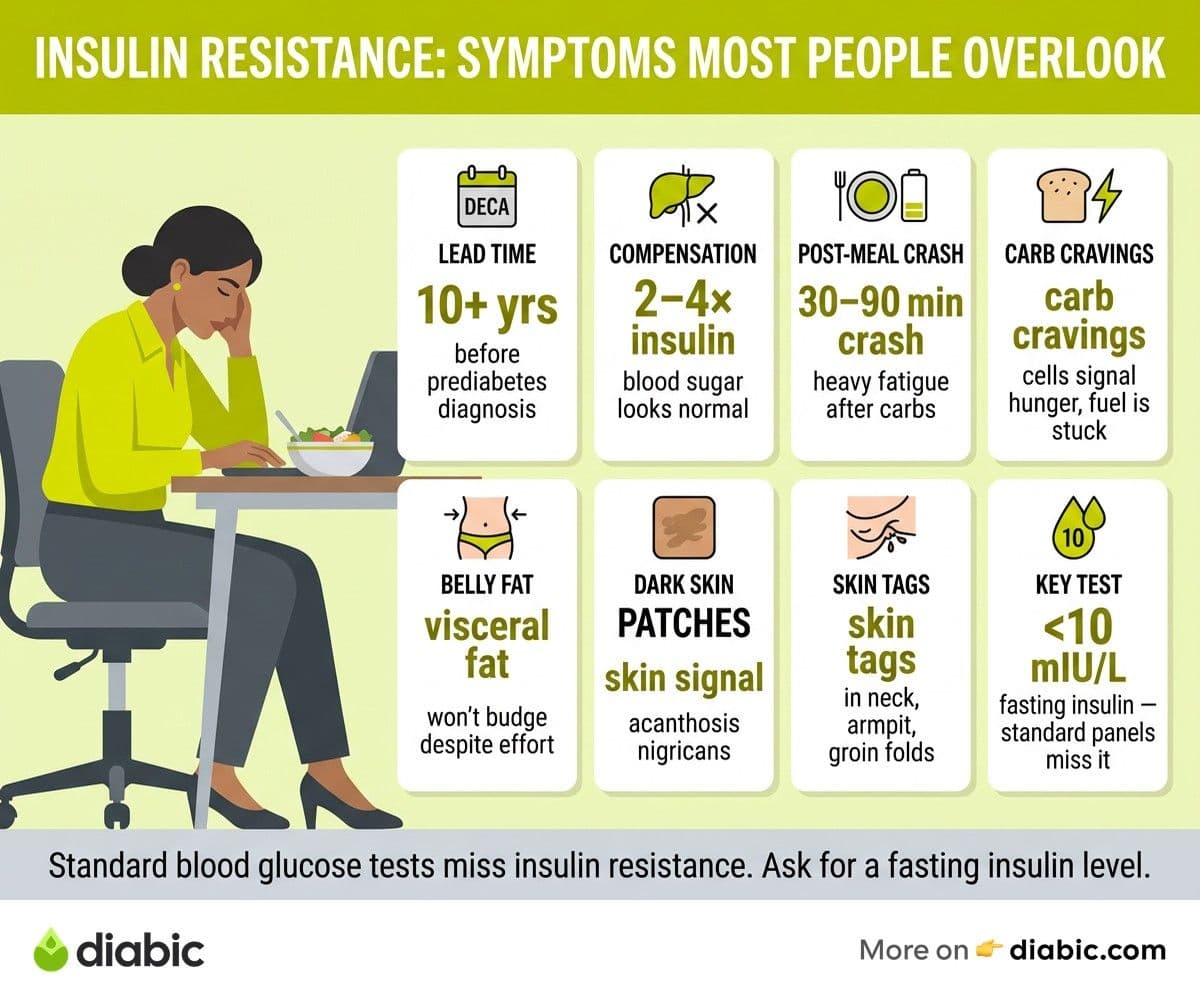
These diabetes symptoms tend to surface long before blood sugar shows up as abnormal on a standard test. According to the American Diabetes Association, insulin resistance can develop years (sometimes a decade or more) before a prediabetes diagnosis.
Persistent fatigue, especially after meals. When cells resist insulin, glucose has a harder time getting in. The result is a heavy, sleepy feeling 30 to 90 minutes after eating, particularly after carb-heavy meals. Many people describe it as needing to lie down after lunch, even when they slept well the night before.
Increased hunger and carbohydrate cravings. Insulin influences appetite hormones. When the system is out of balance, cells signal hunger even when fuel is plentiful. Cravings tend to skew toward fast-acting carbs like bread, pasta, and sweets, which then drive another insulin spike.
Weight gain concentrated around the midsection. Insulin pushes the body to store fat, and visceral fat (the deep belly fat around organs) is especially metabolically active. A waist that has thickened over the past few years while the rest of the body has stayed similar is a classic sign.
Dark, velvety patches of skin (acanthosis nigricans). These darker patches appear most often on the back of the neck, in the armpits, or in groin folds. They are not dirt and do not wash off. They are caused by elevated insulin signaling skin cells to multiply and pigment abnormally.
Difficulty losing weight despite consistent diet and exercise efforts. When insulin runs high all day, it actively blocks fat-burning. People can do everything by the book and still see no movement on the scale. This is one of the most demoralizing signs of insulin resistance, and one of the most common.
Skin tags appearing in folds of the body. Small soft growths on the neck, eyelids, armpits, or under the breasts can be a clue. Like acanthosis nigricans, they are linked to elevated insulin and tend to multiply as resistance worsens.
If three or more of these sound familiar, it is worth a conversation with your doctor. Our piece on early signs of diabetes covers a few related clues that often get missed at routine appointments.
How Insulin Resistance Connects to Signs of Diabetes
The signs of diabetes you read about in most articles (thirst, frequent urination, blurred vision) are downstream symptoms. Insulin resistance is upstream. Understanding the path between them is what makes early detection possible.
Insulin is the hormone that lets glucose move from the bloodstream into cells. When cells stop responding to insulin properly, glucose lingers in the blood. The pancreas notices and releases more insulin to push the glucose through. This works for a while. Sometimes for many years.
According to the NIDDK, this compensation is why blood sugar can stay nearly normal even as insulin levels climb to two, three, or four times what they should be. A standard fasting glucose test will look fine. The problem is invisible without a fasting insulin measurement.
Eventually, the pancreas tires out. Insulin production drops. Blood sugar starts to climb. Fasting glucose creeps into the prediabetes range (100 to 125 mg/dL). A1C edges toward 5.7 percent. At this point, the symptoms start to look more like classic diabetes symptoms that sneak up on you, including thirst, urination, and fatigue.
Some people live with insulin resistance for decades without ever crossing into diabetes. Others move through prediabetes to type 2 within a few years. Genetics, body composition, sleep, stress, and diet all influence which path you walk. The pattern is not destiny, but the early signs are an invitation to act.
Testing for Insulin Resistance
Most standard blood panels do not catch insulin resistance directly. Knowing what to ask for changes that.
Fasting insulin levels. This measures how much insulin your pancreas is producing in the fasted state. A normal fasting insulin is generally below 10 mIU/L, and ideally closer to 5. A reading in the high teens or above suggests the pancreas is working hard to compensate.
HOMA-IR (Homeostatic Model Assessment of Insulin Resistance). This is a calculation that uses fasting insulin and fasting glucose together to estimate how resistant your cells are. Most labs can run it if you ask, or you can plug your numbers into an online calculator. Values above 1.9 typically suggest meaningful insulin resistance.
Fasting glucose and A1C as indirect indicators. These are the standard tests, and they are useful but late. Fasting glucose between 100 and 125 mg/dL is prediabetes. An A1C of 5.7 to 6.4 percent is the same. By the time these numbers shift, insulin resistance has usually been present for a while. Our piece on prediabetes symptoms explains what this stage feels like.
Other useful markers. Fasting triglycerides over 150 mg/dL, low HDL cholesterol, elevated ALT (a liver enzyme tied to fatty liver), and high uric acid can all hint at insulin resistance even when glucose looks fine. If you have a strong family history or several risk factors, ask whether these belong on your next blood panel. According to Mayo Clinic, the earlier the assessment, the more options you have.
Risk Factors That Amplify Insulin Resistance
Several factors raise the likelihood that insulin resistance will develop and progress. Understanding which ones apply to you helps you prioritize where to put your energy.
Genetics and family history play a strong role. If a parent or sibling has type 2 diabetes, your baseline risk is higher. The same is true if your family has a pattern of metabolic syndrome, fatty liver, or PCOS. Our piece on type 2 diabetes causes covers the genetic picture in more depth.
A sedentary lifestyle is one of the strongest modifiable factors. Skeletal muscle is the largest insulin-responsive tissue in the body. The less it is used, the less efficiently it absorbs glucose. The CDC consistently identifies physical inactivity as a top driver of diabetes risk in the United States.
Sleep quality matters more than most people realize. Even a single night of poor sleep can reduce insulin sensitivity the next day. Chronic short sleep (under six hours per night) is associated with substantially higher rates of insulin resistance and type 2 diabetes.
Chronic stress and elevated cortisol push blood sugar up and reduce insulin sensitivity over time. Stress is not just a feeling. It is a hormonal cascade with measurable effects on glucose metabolism.
Polycystic ovary syndrome (PCOS) is closely tied to insulin resistance in women. Up to 70 percent of women with PCOS have some degree of insulin resistance, and addressing it often improves cycle regularity, fertility, and weight management together.
What You Can Do About Insulin Resistance Today
The good news, and it is genuinely good news, is that insulin resistance often responds well to lifestyle changes. The earlier you start, the more reversible it tends to be.
Movement is the fastest lever. Even a 10-minute walk after meals reduces post-meal glucose and improves insulin sensitivity over the following 24 hours. Resistance training a few times per week builds the muscle tissue that absorbs glucose without needing extra insulin. You do not need a gym or a complicated plan. Consistency beats intensity.
Dietary shifts that improve insulin sensitivity. Reducing refined carbohydrates and added sugars, increasing fiber from vegetables and legumes, prioritizing protein at each meal, and eating within an 8 to 12 hour daytime window all help. There is no single correct diet for insulin resistance, and we will not pretend there is. Mediterranean, lower-carb, and plant-forward patterns all show benefit in research. The best one is the one you can sustain.
Sleep, stress, and weight loss work together. Aiming for 7 to 9 hours of sleep, building stress-reduction practices into your week, and losing even 5 to 10 percent of body weight (when applicable) can meaningfully improve insulin sensitivity. None of these are quick fixes. All of them stack.
Talk to your doctor about medication if appropriate. Metformin is the most common first-line option for prediabetes and insulin resistance and has decades of safety data behind it. Other medications may be considered depending on your overall health picture. This is a conversation to have with a provider, not a recommendation we can make. Our piece on prediabetes: why catching it now matters covers what an early intervention plan can look like.
From my experience: I live with type 1 diabetes, not insulin resistance, but I see this pattern constantly in friends and family. A close friend in her late thirties spent five years frustrated by stubborn weight gain and fatigue. Standard bloodwork looked fine every time. A fasting insulin of 22 finally explained it. Six months of walking after meals, prioritizing protein, and getting her sleep back to seven hours took her insulin down to 9. Nothing dramatic. Just a steady stack of small changes that added up.
FAQ
How do you know if you have insulin resistance?
Insulin resistance is most accurately detected through blood tests that measure fasting insulin levels, fasting glucose, and A1C, ideally combined into a HOMA-IR calculation. Physical signs such as dark, velvety skin patches on the neck or armpits, skin tags, stubborn belly fat, and fatigue after eating can all point to insulin resistance. Many people have insulin resistance for years before standard glucose tests catch it, so asking your doctor for a fasting insulin test (especially if you have risk factors) is the most reliable next step.
Can insulin resistance be reversed?
Research suggests that insulin resistance can often be improved or even reversed through lifestyle changes such as regular physical activity, a balanced diet lower in refined carbohydrates, weight management when applicable, better sleep, and stress reduction. In some cases, medications like metformin may help. The earlier you address it, the more reversible it tends to be, which is why catching the symptoms before progression to prediabetes or type 2 diabetes matters so much. Talk to your doctor about which combination of strategies is right for you.
The quiet insulin resistance symptoms covered above are the easiest to ignore and the most useful to act on. Pick the two or three that sound most familiar, bring them up at your next appointment, and ask whether a fasting insulin draw belongs on the same blood panel as your usual labs. Catching insulin resistance symptoms while standard glucose still looks fine is where the real prevention work happens.
Shahriar P. Shuvo is the founder of Diabic. He has lived with diabetes for over 14 years, and built Diabic to deliver the practical, evidence-based self-management tools he wished existed when he was first diagnosed. By trade, Shahriar is a senior design and frontend engineer with 6+ years shipping products at Agora, Timescale (now Tiger Data), and ShareTrip. He writes from the intersection of lived diabetes experience and product craft, focused on what works in daily management rather than what sounds good in a textbook.
Medically reviewed by
Dr. Shanto Arian is an internal medicine physician now specializing in clinical and aesthetic dermatology, with a parallel academic focus on epidemiology and public health. He holds an MBBS, MPH, MSc (UK), MRCP (UK), MRCPI (Ireland), Diploma in Dermatology (UK), and Diploma in Aesthetic Medicine (USA). Dr. Arian trained in internal medicine, including hospital work on hematology cases such as graft-versus-host disease, before moving toward dermatology. Skin is one of the earliest places diabetes shows itself, from acanthosis nigricans and diabetic dermopathy to slow foot wound healing, and that intersection is where his clinical and Diabic-review work meet. On Diabic, Dr. Arian medically reviews content on diabetes diagnosis, complications, dermatologic manifestations, and pharmacotherapy, ensuring every claim aligns with current ADA, NICE, and peer-reviewed literature.
More from Diabetes Knowledge
View all
6 Safe Dessert for Gestational Diabetes Recipes You Can
Six dessert for gestational diabetes recipes that satisfy your sweet tooth without spiking blood sugar, with carb counts and pairing tips you can use.

8 High Fiber Foods That Help with Prediabetes
Add these 8 high fiber foods for prediabetes to slow glucose absorption, support steady blood sugar, and meet the daily fiber target most people miss.

Mediterranean Diet for Prediabetes: A Practical Guide
The mediterranean diet for prediabetes is one of the best-studied eating patterns for prevention. Here is what to eat, what to avoid, and how to start.
Clinician-reviewed habits, plain-language guides, and honest answers - the small shifts that make living with diabetes feel lighter, every day.