Diabetes Test Strips Guide: Types, Costs, Tips 2026
A practical diabetes test strips guide covering how strips work, what they cost, how to store them, and the savings tips most packaging never mentions.

In this article(13)
A diabetes test strips guide is not the most thrilling read on the internet, but understanding how strips work, what they cost, and how to store them properly can save real money and prevent the kind of inaccurate readings that send people in circles. Most strip boxes give you a one-page insert and call it a day. There is much more to it.
This diabetes test strips guide covers the chemistry, the brand differences, the per-strip pricing in 2026, and the storage habits that quietly extend strip life. By the end you should be able to walk into any pharmacy and pick the right strips for your meter, your budget, and your testing routine.
How Diabetes Test Strips Work
Knowing your numbers is part of the basic diabetes ABCs that NIDDK's managing diabetes guide lays out, and the strip is the small piece of hardware that makes that possible at home. Every modern test strip is a tiny biosensor. When a drop of blood touches the sample port, capillary action pulls it across an enzyme layer that reacts with glucose to produce a small electrical current. The meter measures that current and converts it to the milligrams per deciliter you see on the screen.
The enzyme matters. Most strips today use either glucose oxidase (GO) or glucose dehydrogenase (GDH), and the two react slightly differently to interfering substances. GO strips can be affected by high oxygen levels, which is rare in fingertip blood but worth knowing if you are testing in unusual conditions. GDH strips are less sensitive to oxygen but can give falsely high readings in the presence of certain sugars used in some IV fluids and dialysis solutions, per the FDA safety communication on glucose monitoring. For day-to-day fingerstick testing in healthy adults, both types are accurate and FDA-cleared.
The strip itself has three working parts. A sample port pulls the blood in by capillary action, the reagent pad holds the enzyme and chemical reagents, and the electrode carries the resulting electrical signal back to the meter. This is also why strips from one brand do not work in another brand's meter. Each meter is calibrated to a specific strip's electrical signature, and swapping is not a feature, it is a hardware mismatch.
If you have ever wondered why strips are so much more expensive than the meter, this is part of the answer. The chemistry is delicate, the manufacturing tolerances are tight, and the FDA requires lot-by-lot accuracy testing. The price reflects the precision more than the materials.
Types of Diabetes Test Strips
Most people only encounter blood glucose strips, but there are actually a few types worth knowing about, and the differences matter when you are buying.
Brand-specific blood glucose strips
These are the strips designed for a specific glucometer family. OneTouch Verio strips work in OneTouch Verio meters. Contour Next strips work in Contour Next meters. Accu-Chek Guide strips work in the Accu-Chek Guide line. FreeStyle Lite, Precision Xtra, and the rest follow the same logic. Each brand encodes its strips electronically, and the meter rejects mismatches.
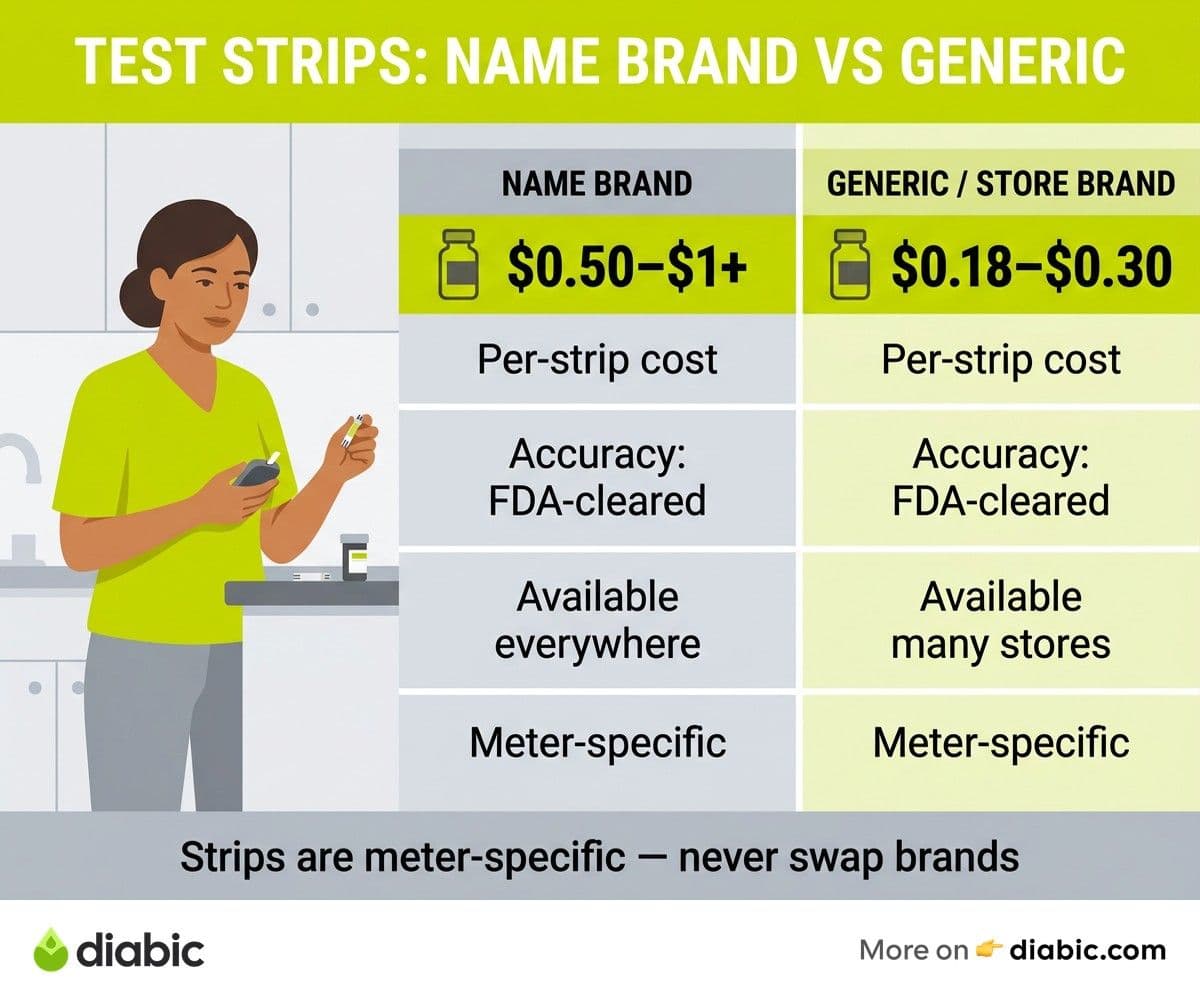
The brand-specific market splits roughly into two tiers. Premium brands (OneTouch, Accu-Chek, FreeStyle, Contour) typically run $0.85 to $1.40 per strip without insurance. Value brands (ReliOn at Walmart, True Metrix at chain pharmacies, Prodigy at independents) run $0.18 to $0.45 per strip. The accuracy difference between tiers is small once you adjust for proper technique. The price difference is not.
Generic and compatible strips
There is no real "compatible" market in diabetes strips the way there is in printer ink. A few off-brand strips have tried to clone OneTouch or Accu-Chek strip electronics, and most have either been pulled by the FDA or have given inconsistent readings. If you find a generic strip claiming to work in a brand-name meter, treat it skeptically and check the FDA 510(k) clearance database before trusting it for dosing decisions.
The closest thing to "generic" is store-brand strips paired with their matching store-brand meters. ReliOn (Walmart), CVS Advanced, Walgreens True Metrix, and Equate are all FDA-cleared in their own meters and cost a fraction of the premium brands. They are not interchangeable with OneTouch or Accu-Chek meters. To compare specific brands and meters head to head, see our best blood glucose meters breakdown.
Ketone strips versus glucose strips
Ketone test strips are not the same as glucose strips, though some meters (Precision Xtra, Nova Max Plus) accept both with separate strip codes. Ketone strips test for beta-hydroxybutyrate in the blood and are useful for spotting diabetic ketoacidosis early, especially in type 1. Urine ketone strips are cheaper but less precise and lag blood ketones by several hours.
If you are picking up ketone strips, double-check the box. The two strip types are usually packaged in similar foil pouches and easy to mix up. For more on related supplies, see our piece on glucose tablets for hypoglycemia, which often live in the same kit.
Urine glucose strips
Urine glucose strips still exist but are largely obsolete for daily diabetes management. They only show glucose that has spilled into the urine after blood sugar has been very high for hours, which makes them nearly useless for in-the-moment decisions. They occasionally show up in pre-diabetes screening or low-resource clinical settings.
A Diabetes Test Strips Guide to 2026 Costs
Test strip pricing in 2026 spans a range that surprises most people seeing it laid out for the first time. The same small piece of plastic and chemistry can cost six times more at one pharmacy than another.
Several factors push pricing up or down within each brand. Pharmacy retail without insurance is almost always the highest price. Online bulk vendors like ADW Diabetes, Amazon, and Total Diabetes Supply are typically 15 to 35 percent cheaper than chain pharmacies. Manufacturer mail-order programs (LifeScan, Roche) sometimes match or beat online pricing. Insurance copays vary from $0 (preferred tier) to your full retail price (non-formulary), which is why checking your plan's preferred brand list before buying a meter saves the most money long term.
The "wrong cheap meter" trap is real. A meter with a $9 sticker and $1.30 strips costs more in three months than a $20 meter with $0.20 strips costs in two years. Always check strip pricing before committing to any meter, especially the bargain models at the front of the store.
From my experience: I have lived with type 1 diabetes for fourteen years, and one habit that quietly cut my supply spending was running a quick strip-cost audit every January. I check my pharmacy receipts, compare with current GoodRx and Amazon pricing, and switch if the gap is more than 30 percent. Most years I save $200 to $500 with twenty minutes of work.
How to Store and Handle Test Strips Correctly
Strip storage is the part of strip ownership most people get wrong, and bad storage is one of the most common reasons readings drift outside the FDA's accuracy standard.
Keep strips in the original sealed container, with the cap closed tight. The vial contains a desiccant that absorbs moisture, and once strips are exposed to humid air, the enzyme starts to degrade. Foil-wrapped single strips do not need a vial, but the foil should be intact until you are ready to test. A torn foil pouch is a strip you should throw out.
Temperature matters more than people assume. Most manufacturers, including Contour Next and OneTouch, list a storage range of 39 to 86 degrees Fahrenheit. A glove box in summer regularly exceeds 120 degrees. A purse left on a hot patio is the same problem. If your strips have been heat-soaked, the cheapest fix is to throw the box out, log the loss, and store the next box at room temperature.
Check the expiration date, and check the date you opened the vial. Most vials have a "use within X months after opening" window printed on the label, often 90 or 180 days. Writing the open-date on the side of the vial in marker is a small habit that prevents confusion later.
Do not transfer strips between containers. Even moving a few strips into a smaller travel vial will expose them to ambient humidity, since the desiccant in the original container is calibrated for the strip count it was packed with. If you need a travel option, use single-foil-wrapped strips or carry the whole vial.
Signs a strip is no longer good include visible discoloration on the reagent pad, a strip that the meter rejects with a code error, and readings that swing wildly when retested with the same blood drop. If two strips from the same vial give very different results, the vial is suspect. For more on what affects accuracy, see our piece on glucometer accuracy.
Saving Money on Diabetes Test Strips
The same strip can cost you very different amounts depending on where you buy it and what you pair it with. Five strategies usually capture most of the available savings.
Use insurance correctly. The Medicare diabetes supplies page explains the Part B allowance for strips, which is generous for insulin users. Private plans almost always have one or two preferred strips on the formulary at low or zero copay. Calling your pharmacy benefits line and asking which strip is tier 1 is the single highest-value phone call you can make.
Stack a coupon. GoodRx, SingleCare, and Cost Plus Drugs offer coupons that can drop a $90 box of OneTouch Verio strips to under $40 at most chains. Show the coupon before your insurance is run and let the pharmacist take the lower price.
Buy 100-count boxes. The per-strip cost in a 100-count box is typically 20 to 30 percent lower than two 50-count boxes. Online vendors like ADW Diabetes and Amazon sell 100-counts at a further discount.
Sign up for manufacturer rebates and subscription programs. LifeScan's OneTouch program, Roche's Accu-Chek customer care, and Ascensia's Contour Next loyalty program all ship free meters and offer mail-order strip pricing below pharmacy rates. Apply through the official manufacturer site, not a third-party reseller.
Switch meters when the math says so. If you are paying more than $0.40 per strip and not on a manufacturer subsidy, a switch to ReliOn or Contour Next will pay for itself in weeks. Our affordable test strips and budget meters post breaks down exact pricing for the value tier.
Frequently Asked Questions
What types of diabetes test strips are there?
The main types are brand-specific blood glucose strips (OneTouch, Contour, Accu-Chek, FreeStyle, ReliOn), store-brand strips that work in matching store meters, ketone strips for detecting diabetic ketoacidosis, and the largely obsolete urine glucose strips. Blood glucose strips are what almost everyone with diabetes uses for daily monitoring. Ketone strips are a separate category and are not interchangeable with glucose strips, even on dual-purpose meters.
How do you save money on diabetes test strips?
Switch to a meter whose strips match your insurance formulary, buy in 100-count boxes, use GoodRx or SingleCare coupons at the pharmacy counter, sign up for manufacturer rebate programs from LifeScan, Roche, or Ascensia, and consider Walmart ReliOn for the lowest cash price in the United States. Stacking these strategies typically cuts the bill by 50 to 80 percent.
Can you use expired test strips?
Expired strips can give inaccurate readings because the enzyme on the reagent pad degrades over time, especially after the vial has been opened. The FDA and every major manufacturer recommend against using strips past the printed expiration date or past the open-date window listed on the vial. If you are stuck without unexpired strips, an expired strip from a sealed vial is more reliable than one from an opened vial that has been around for months. Either way, talk to your doctor before making dosing decisions based on readings from expired strips.
The short version of any diabetes test strips guide is this: pick a meter that matches your insurance formulary, store strips at room temperature in their original vial, and run a quick price audit once a year. That handful of habits is the difference between a $30 monthly supply bill and a $200 one.
Shahriar P. Shuvo is the founder of Diabic. He has lived with diabetes for over 14 years, and built Diabic to deliver the practical, evidence-based self-management tools he wished existed when he was first diagnosed. By trade, Shahriar is a senior design and frontend engineer with 6+ years shipping products at Agora, Timescale (now Tiger Data), and ShareTrip. He writes from the intersection of lived diabetes experience and product craft, focused on what works in daily management rather than what sounds good in a textbook.
Medically reviewed by
Dr. Shanto Arian is an internal medicine physician now specializing in clinical and aesthetic dermatology, with a parallel academic focus on epidemiology and public health. He holds an MBBS, MPH, MSc (UK), MRCP (UK), MRCPI (Ireland), Diploma in Dermatology (UK), and Diploma in Aesthetic Medicine (USA). Dr. Arian trained in internal medicine, including hospital work on hematology cases such as graft-versus-host disease, before moving toward dermatology. Skin is one of the earliest places diabetes shows itself, from acanthosis nigricans and diabetic dermopathy to slow foot wound healing, and that intersection is where his clinical and Diabic-review work meet. On Diabic, Dr. Arian medically reviews content on diabetes diagnosis, complications, dermatologic manifestations, and pharmacotherapy, ensuring every claim aligns with current ADA, NICE, and peer-reviewed literature.
More from Devices & Technology
View all
Fasting vs Postprandial Glucose: What's the Difference
Fasting vs postprandial glucose readings tell different stories about your blood sugar. Learn what each number means and how to act on it.

Best Glucometer for Elderly and Low-Vision Users
Best glucometer for elderly and low-vision users: large displays, audio readouts, no-coding strips, and budget picks that make daily testing easier.

Online Diabetes Coaching: How to Choose a Good One
Online diabetes coaching can fill the gaps between doctor visits. Learn what credentials to check, red flags to avoid, and how to pick a quality program.
Clinician-reviewed habits, plain-language guides, and honest answers - the small shifts that make living with diabetes feel lighter, every day.