CGM vs Glucometer: Which Should You Choose
CGM vs glucometer compared on accuracy, cost, and daily use. A clear framework to choose the right blood sugar monitor for your situation.

In this article(15)
Choosing between a CGM vs glucometer comes down to how much data you actually need, what your diabetes management demands day to day, and what you can sustain financially. Both tools measure blood sugar accurately enough to make decisions on, but the experience of using them is completely different. One gives you a snapshot when you ask for it. The other paints a continuous picture you can scroll through.
The right answer is not the same for everyone. A person with stable type 2 on metformin may get everything they need from a few fingersticks a week, while a person with type 1 or hypoglycemia unawareness may need a sensor that alerts them at 3 a.m. This comparison walks through the differences honestly, including where each device falls short.
CGM vs Glucometer: How They Work Differently
A glucometer measures glucose in a drop of capillary blood from your fingertip. You lance, apply a drop to a strip, wait a few seconds, and read the number. The result is a single point in time, accurate to within roughly 15 percent of a lab value when the device meets FDA accuracy standards. It tells you what your blood sugar is right now and nothing about where it was an hour ago or where it is heading.
A continuous glucose monitor uses a small sensor inserted under the skin, where a thin filament sits in interstitial fluid and reads glucose every one to five minutes. The sensor wears for 7, 10, or 14 days depending on the brand, and it streams data to a phone, receiver, or insulin pump. The reading you see is not your blood. It is the fluid surrounding your cells, which tracks blood sugar with a small lag that we will return to in the accuracy section.
The data difference reshapes daily decisions. With a meter, you have eight to twelve numbers a day at most, and you fly blind between tests. With a CGM, you can see whether your number is climbing fast or falling, which changes how you respond to a borderline reading. Our explainer on what is a CGM and how it works covers the sensor technology in more detail.
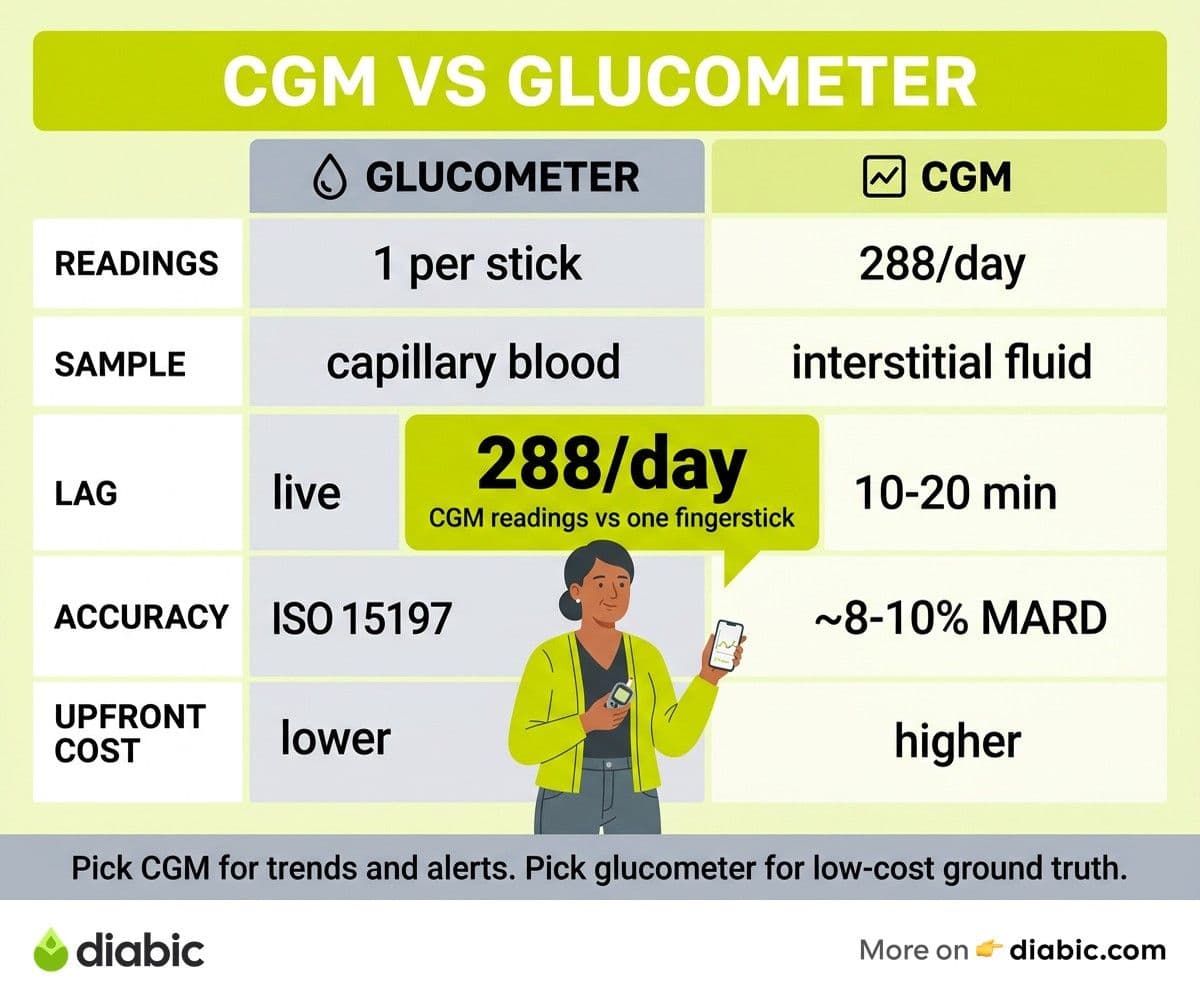
Here is how the two devices stack up across the factors that matter most:
A meter answers "what is my number right now" cheaply and reliably. A CGM answers "what is my number doing" with the data depth that insulin decisions often require.
What this means in real life
A meter answers the question, "What is my blood sugar right now?" A CGM answers, "What is my blood sugar doing?" Both questions matter, but they support different management styles. Someone using meal-time insulin benefits enormously from trend arrows, while someone managing type 2 with diet and one oral medication may not need that level of granularity.
The pattern visibility from a CGM also reveals things meters miss entirely. Overnight lows, post-meal spikes from foods you assumed were safe, and the effect of stress or poor sleep on your numbers all become visible. For some people, that visibility is empowering. For others, it is anxiety-inducing. Knowing yourself matters here.
Accuracy Comparison: CGM vs Glucometer
Glucometer accuracy is governed by the FDA standard mentioned above and the international ISO 15197:2013 benchmark, which requires that 95 percent of readings fall within 15 percent of a lab reference at glucose levels above 75 mg/dL. Most meters from established brands meet or exceed this standard when used correctly. The everyday accuracy of a meter is more about user technique than device limits, as we cover in our piece on glucometer accuracy factors.
CGM accuracy is reported as MARD, which stands for mean absolute relative difference. A MARD of 9 percent means the average sensor reading differs from a paired lab value by 9 percent. The current generation of sensors from Dexcom and Abbott FreeStyle reports MARD figures around 8 to 9 percent, which is comparable to or slightly better than a typical home meter on a strict accuracy scale.
The catch is the interstitial fluid lag. CGM readings reflect glucose in the fluid surrounding your cells, which trails behind blood glucose by roughly 5 to 15 minutes. When your blood sugar is stable, the lag is invisible. When your blood sugar is changing rapidly, after a meal, during exercise, or while treating a low, the CGM number can be several points behind what a fingerstick would show.
When each device is more reliable
A meter is more reliable for confirming a fast-changing reading. If your CGM shows 60 and dropping but you just ate glucose tabs five minutes ago, a fingerstick gives you a faster, more current answer. Most CGM manufacturers tell users to confirm with a fingerstick before treating a low or making a major insulin decision when the trend arrows show rapid change.
A CGM is more reliable for spotting patterns the meter cannot see. Overnight glucose data, the shape of post-meal curves, and the cumulative time spent in target range are all impossible to capture with a few fingersticks per day. The pattern data from a CGM has been shown to support better A1C outcomes in studies cited in the ADA Standards of Care 2026.
Both devices have edge cases. Meters can be thrown off by unwashed hands, expired strips, or extreme temperatures. CGMs can read low for the first 24 hours of a new sensor, can drift toward the end of a wear cycle, and can be affected by certain medications including high-dose vitamin C and acetaminophen on older models. Knowing your device's quirks matters.
CGM and Glucometer Cost Comparison
A glucometer is the cheapest entry point. Most basic meters cost between 10 and 50 dollars, and many manufacturers give them away free with a starter kit of strips. The recurring cost is in the strips, which range from about 20 cents to over a dollar per strip depending on brand, pack size, and whether you have insurance coverage. Lancets are inexpensive, usually a few cents each.
For someone testing four times a day, the annual strip cost ranges from roughly 290 dollars on the budget end to 1,460 dollars at the high end without insurance. Insurance coverage usually brings this number down significantly, though some plans cap monthly strip allowances at 100 to 150 strips. People testing more frequently often pay out of pocket for the overflow.
CGM costs are higher and structured as ongoing subscriptions. A Dexcom G7 sensor (10-day wear) and Libre 3 Plus sensor (15-day wear) each retail at a comparable monthly cash price, ranging from roughly 250 to 500 dollars per month before insurance. Pharmacy benefits and durable medical equipment coverage often reduce this dramatically for people who qualify under their plan, but uninsured cash prices remain a real barrier.
Annual cost estimates
Without insurance, a year of basic glucometer testing at four strips per day might run 400 to 800 dollars including a meter and lancets. The same year with a CGM might cost 3,000 to 6,000 dollars at full retail. With insurance, both numbers can drop substantially, sometimes to under 100 dollars per year for a meter user with a copay-style plan, and to a few hundred dollars per year for a CGM user with strong coverage.
Insurance access has expanded significantly. Medicare now covers CGMs for people with type 1 diabetes, type 2 on insulin, or recurrent severe hypoglycemia. Many private plans follow similar criteria. The difference between paying full price and paying a copay can be the deciding factor, and it is worth a phone call to your insurer before assuming a CGM is out of reach.
Some people use a hybrid approach. A CGM during high-stakes weeks (illness, travel, medication changes) paired with a meter the rest of the time can balance data needs and cost. Others find the predictability of monthly CGM cost easier to budget than variable strip purchases.
Who Should Use a Glucometer
A continuous glucose monitoring system is overkill for many people, and a basic meter is a better fit. People with stable type 2 diabetes managed by metformin or diet alone often have predictable blood sugar patterns that do not require minute-by-minute tracking. A few fingersticks per week to confirm fasting and post-meal patterns may be all they need.
People with prediabetes who want occasional checks fall into a similar category. The goal is awareness and pattern detection, not real-time alerts, and a meter delivers that at low cost. Our roundup of reliable blood glucose meters for home testing walks through specific picks at different price points.
Anyone on a tight budget without strong CGM insurance coverage should consider whether a meter meets their actual decision-making needs. A meter is also a reasonable choice for people who do not want to wear a device on their body or who have skin sensitivities to sensor adhesives. Simplicity is a legitimate preference.
Glucometer-friendly profiles
Type 2 on oral medication only, with stable A1C and no hypoglycemia history, often does well with a meter. The data needs are modest, the management decisions are slower-paced, and the cost difference is meaningful. Many people in this category test fasting once a day and post-meal occasionally to spot food-driven patterns.
Gestational diabetes management often relies on meters as well, especially in the early weeks before any insulin or medication is added. The fingerstick schedule is structured (fasting, post-meal at one or two hours), and the data fits the testing protocol. Some pregnancies later transition to CGM use depending on insurance and provider preference.
People with hypoglycemia unawareness, frequent severe lows, or unpredictable patterns are usually better served by a CGM. A meter alone does not catch the lows that happen between tests, which is the situation where a CGM's continuous data and alerts add the most value.
Who Should Use a CGM
People with type 1 diabetes are the most established CGM population. Insulin-dependent management requires frequent dosing decisions, and trend data plus alerts make those decisions safer and more accurate. Hybrid closed-loop insulin pump systems also rely on CGM data to automate background insulin delivery.
People with type 2 on insulin or sulfonylureas have a meaningful hypoglycemia risk and benefit from continuous monitoring. The 2026 ADA standards explicitly support CGM use in this group, and recent research suggests improved A1C outcomes when CGMs replace fingersticks for insulin-treated type 2 management. Our cluster on the best CGMs for type 2 diabetes covers specific options.
Hypoglycemia unawareness is one of the strongest reasons to use a CGM. People who no longer feel the early warning symptoms of a low rely on alerts to catch numbers before they become dangerous. Overnight alerts, in particular, can be lifesaving. A meter cannot deliver this protection regardless of how often you test.
CGM-friendly profiles
Anyone wanting pattern visibility, not just snapshot data, will get more value from a CGM than from a meter. Seeing how a specific food, exercise session, or stress event shapes your curve over hours is the kind of insight that changes behavior. Meters cannot replicate this.
Active people, athletes, and people who exercise frequently often appreciate the trend data during and after activity. Knowing whether a number is stable, climbing, or falling helps with carb timing and insulin adjustments around workouts in ways fingersticks cannot match.
People who hate fingersticks are sometimes pushed toward CGMs for comfort reasons. The sensor insertion is once every 7 to 15 days depending on the brand, which beats poking your finger eight times a day. Skin sensitivity is the main offset to consider, but most people tolerate the adhesives well.
Can You Use Both a CGM and a Glucometer Together
Yes, and many CGM users keep a meter for confirmation tests. When the trend arrows show rapid change, when a number does not match how you feel, or when you are driving and the reading is borderline, a fingerstick gives you a faster, more current answer than the sensor.
Older CGM models required twice-daily fingerstick calibrations, and that has largely gone away with the current generation. Dexcom G7 and FreeStyle Libre 3 are factory-calibrated and do not need fingersticks for normal operation, though both manufacturers recommend a meter check before treating a low or dosing insulin when the CGM and your symptoms disagree.
Backup matters too. Sensors can fail, fall off, or read inaccurately at the very start or end of a wear cycle. Having a meter and strips on hand prevents a lost day of testing if your CGM goes down. People in remote areas or those who travel internationally often keep a meter as standard backup.
From my experience: I went from a meter-only setup to adding a CGM about eight years into my type 1 management, and the change reshaped how I make decisions. The meter still has a place in my kit, mostly for confirming fast-changing numbers and as backup when a sensor fails. What surprised me was how much the CGM revealed about overnight patterns I had been completely missing. The two devices solve different problems, and after fourteen years of T1D, I would not give up either.
FAQ
Is a CGM better than a glucometer?
Better depends on what you need. A CGM gives more data, trend information, and alerts, which matters most for insulin users, people with hypoglycemia unawareness, and anyone needing pattern visibility. A glucometer is cheaper, simpler, and entirely sufficient for stable type 2 management with no hypoglycemia risk. For most insulin-dependent users, a CGM is the stronger fit. For diet-controlled or single-medication type 2, a meter often does the job.
Should I switch from a glucometer to a CGM?
Talk to your provider about whether your insurance covers a CGM and whether your management would benefit from continuous data. Strong cases for switching include frequent insulin dosing, hypoglycemia unawareness, recurring overnight lows, or wanting pattern visibility for behavior change. If your blood sugars are stable, your A1C is on target, and your meter testing is sustainable, switching is optional rather than urgent.
Can you use a CGM without a prescription?
Some CGMs are now available over the counter in the United States. The Dexcom Stelo and Abbott Lingo are two examples, marketed for adults not on insulin. Prescription CGMs like Dexcom G7 and FreeStyle Libre 3 still require a prescription for insurance coverage and for the higher-accuracy use cases that include insulin dosing. Always confirm device suitability with your care team before starting.
The honest summary on CGM vs glucometer is that neither device is universally better. Match the tool to your management style, your medication picture, and your budget, and revisit the choice when those factors change. If you are unsure where you land, talk to your provider with your last few months of data in hand and let your real numbers guide the decision rather than a marketing page.
Dr. Shanto Arian is an internal medicine physician now specializing in clinical and aesthetic dermatology, with a parallel academic focus on epidemiology and public health. He holds an MBBS, MPH, MSc (UK), MRCP (UK), MRCPI (Ireland), Diploma in Dermatology (UK), and Diploma in Aesthetic Medicine (USA). Dr. Arian trained in internal medicine, including hospital work on hematology cases such as graft-versus-host disease, before moving toward dermatology. Skin is one of the earliest places diabetes shows itself, from acanthosis nigricans and diabetic dermopathy to slow foot wound healing, and that intersection is where his clinical and Diabic-review work meet. On Diabic, Dr. Arian medically reviews content on diabetes diagnosis, complications, dermatologic manifestations, and pharmacotherapy, ensuring every claim aligns with current ADA, NICE, and peer-reviewed literature.
Medically reviewed by
Dr. Rezwana Parvin Rumpa is an obstetrics and gynaecology specialist with clinical focus on gestational diabetes, PCOS, and fertility. She holds the MRCOG (Final Part) from the Royal College of Obstetricians and Gynaecologists in London, the MRCPI (Final Part) from the Royal College of Physicians of Ireland, and an MBBS from Shaheed Monsur Ali Medical College under Dhaka University. Dr. Rumpa serves as a Senior Medical Officer in the Obs and Gynae department at BRB Hospitals Ltd, where she has spent three years managing prenatal care, emergency obstetric cases, and women's-health surgery. On Diabic, she medically reviews content for women living with diabetes, with particular attention to pregnancy, PCOS, and reproductive-health intersections.
More from Devices & Technology
View all
Fasting vs Postprandial Glucose: What's the Difference
Fasting vs postprandial glucose readings tell different stories about your blood sugar. Learn what each number means and how to act on it.

Best Glucometer for Elderly and Low-Vision Users
Best glucometer for elderly and low-vision users: large displays, audio readouts, no-coding strips, and budget picks that make daily testing easier.

Online Diabetes Coaching: How to Choose a Good One
Online diabetes coaching can fill the gaps between doctor visits. Learn what credentials to check, red flags to avoid, and how to pick a quality program.
Clinician-reviewed habits, plain-language guides, and honest answers - the small shifts that make living with diabetes feel lighter, every day.