Affordable Glucose Test Strips and Budget Meters 2026
Find affordable glucose test strips, budget meters, and real prescription savings tips that cut diabetes supply costs without sacrificing accuracy.

In this article(12)
The cost of affordable glucose test strips adds up fast when you test four, six, or eight times a day. If your current strips run more than a dollar each, you are likely spending hundreds more per year than you need to. The good news is the gap between expensive and budget supplies is mostly branding, not accuracy.
This piece walks through the real per-strip prices in 2026, the budget meters that hold up against pricier names, and the prescription tricks that quietly knock 50 to 80 percent off the bill. Numbers shift with promotions, so always confirm at checkout before stocking up.
Why Glucose Test Strip Costs Matter More Than Meter Price
The meter you bring home is almost never the real expense. Most major glucometers sell for $10 to $30, and several brands give them away free with a coupon or sample request. The strips are where the math gets ugly, and that is by design.
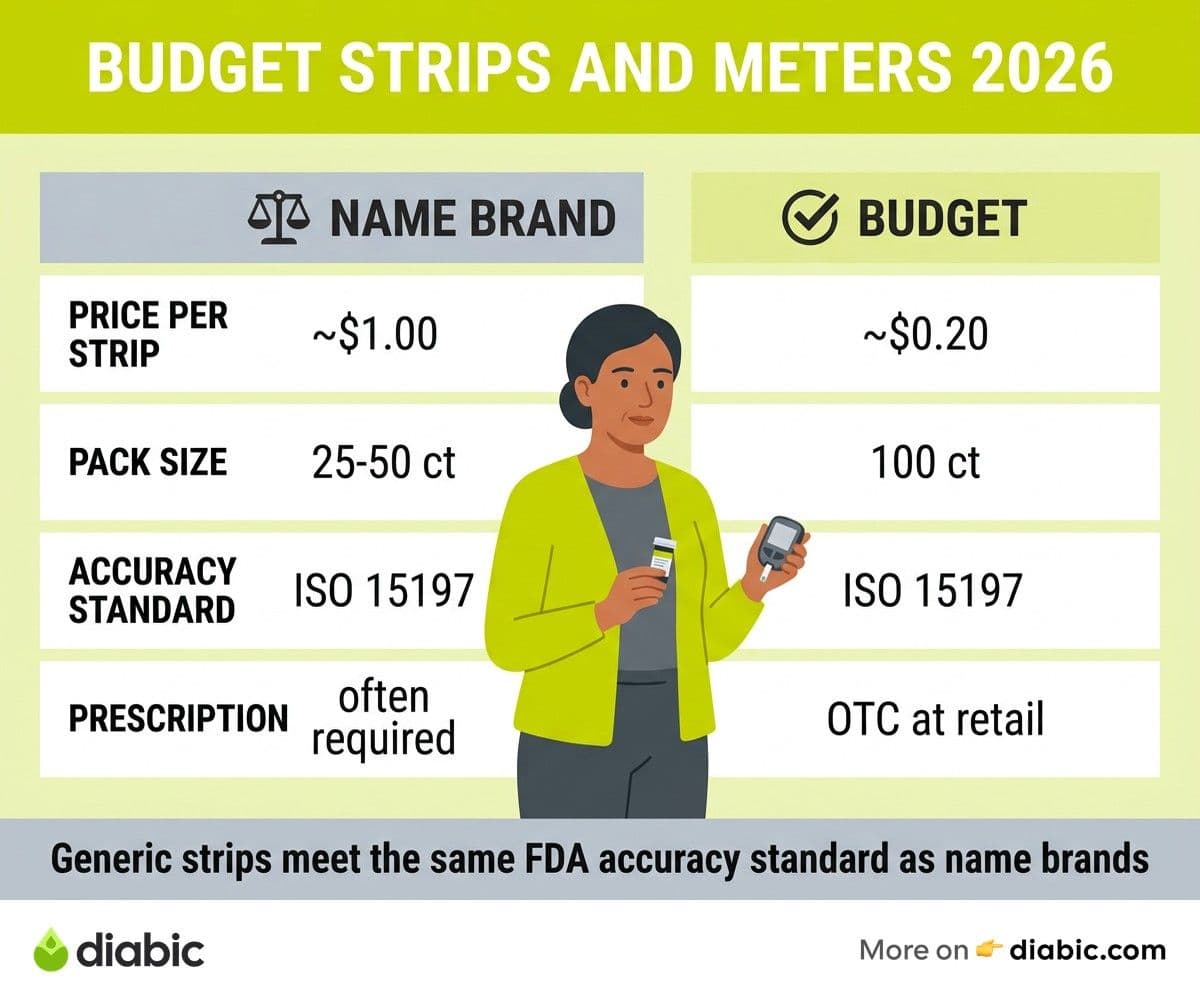
Brand-name strips like OneTouch Verio and Accu-Chek Guide currently run about $0.85 to $1.40 per strip at retail without insurance, according to current GoodRx listings. Test four times a day at $1 a strip and you are looking at roughly $120 a month, or close to $1,460 a year. Bump testing to eight times a day, which is common for people on insulin, and the same strips push past $2,900 annually.
Compare that to ReliOn Premier strips at Walmart, which sit at roughly $0.18 per strip in the 100-count box. The difference between $0.18 and $1.20 per strip across a year of frequent testing is the price of a decent vacation. Manufacturers know this, which is why the meter is the loss leader and the strip catalog is the profit center.
The takeaway is simple. Picking a meter without checking the long-term strip math is the single most expensive mistake people make in diabetes self-care. Our diabetes test strips guide goes deeper into how strip chemistry affects what you actually pay.
Best Budget Blood Glucose Meters in 2026
A good budget blood glucose meter still has to meet the FDA's accuracy standard, which requires that 95 percent of results fall within 15 percent of a lab reference, per FDA guidance for self-monitoring blood glucose meters. Several inexpensive meters hit that bar, and a few exceed it.
ReliOn Premier BLU and ReliOn Prime
The Walmart ReliOn line is the budget benchmark in the United States. The ReliOn Premier BLU meter typically retails around $17, with strips at $0.18 each in the 100-count box. ReliOn Prime sits a step below at about $9 for the meter and $0.20 per strip. Both are made by Arkray and have been used in clinical settings for years.
Pros: lowest sustained per-strip cost, no insurance needed, available in person at any Walmart pharmacy. Cons: the data app is basic, the meter is plastic and feels less premium, and replacement strips are not stocked everywhere outside Walmart.
Contour Next One
The Contour Next One is the value pick for people who want clinical-grade accuracy without paying OneTouch prices. The meter is often free with a manufacturer offer, and strips run roughly $0.45 to $0.85 each depending on where you buy. Contour Next has consistently scored well in independent accuracy studies and connects to a clean smartphone app.
Pros: excellent accuracy, second-chance sampling that lets you add more blood within 60 seconds, smartphone connectivity. Cons: strips cost more than ReliOn, and pharmacy prices vary wildly without insurance.
Prodigy AutoCode
Prodigy AutoCode is the meter most often recommended for older adults or anyone who finds small screens frustrating. The meter is around $20 and strips sit near $0.30 each in bulk online. It has a talking voice feature for low vision, no coding required, and accepts a small 0.6 microliter sample.
Pros: accessible features, low strip cost, widely covered by Medicare. Cons: design is utilitarian, and the connected app trails Contour and OneTouch.
True Metrix
True Metrix from Trividia Health is the pharmacy-shelf option when ReliOn is not nearby. The meter is around $18 and strips average $0.45 each. Many independent and chain pharmacies stock it as a generic alternative.
For more head-to-head detail, see our breakdown of the best blood glucose meters for home testing and how glucometer accuracy varies between budget and premium models.
How to Save Money on Affordable Glucose Test Strips
The cheapest strip in the cabinet is the one you actually buy at the lowest price you can find, and there are five reliable ways to lower that price.
Buy in 100-count boxes instead of 50s. The per-strip cost typically drops 20 to 30 percent at the higher count. Walmart, Amazon, and ADW Diabetes all carry 100-count ReliOn, Contour, and OneTouch boxes, often $15 to $25 cheaper per box than two 50-counts.
Use GoodRx, SingleCare, or Cost Plus Drugs coupons at the pharmacy counter. A single GoodRx coupon can pull a $90 box of OneTouch Verio strips down to under $40 at most chain pharmacies. Show the coupon before the pharmacist runs your card, not after.
Ask your doctor to write a prescription even if your strips are over the counter. A prescription is what unlocks insurance reimbursement, FSA and HSA payments, and pharmacy-tier discounts. The same ReliOn strips that cost $18 at the front of the store can cost less or be fully covered when run through pharmacy insurance with a prescription.
From my experience: I have lived with type 1 diabetes for fourteen years, and the single biggest cost cut I ever made was switching from OneTouch to ReliOn Premier and asking my endocrinologist to write the script. My monthly strip cost dropped from about $140 to $24, and my A1C did not budge. The strips read within a couple of points of my CGM check after check.
Apply for manufacturer rebates and patient assistance. LifeScan (OneTouch), Roche (Accu-Chek), and Ascensia (Contour) all run patient programs that ship free meters and offer mail-order strip subscriptions at lower prices. Many programs do not require proof of low income. Check the manufacturer's official site rather than third-party offers.
Consider whether generic or store-brand strips fit your meter. ReliOn, CVS Advanced, and Walgreens True Metrix strips are not interchangeable with brand meters. They only work in the matching meter. So switching meters is sometimes the move, especially if you are out of warranty on your current device.
Insurance and Assistance Programs
Insurance coverage for test strips varies widely, and assuming you are not eligible without checking is a common, expensive mistake.
Medicare Part B covers blood glucose meters and a set quantity of strips per month for people with diabetes, with the amount depending on whether you take insulin. The Medicare diabetes supplies page lists the current allowance and the suppliers that accept assignment. Going through a participating supplier matters because nonparticipating ones can charge above Medicare's approved amount.
Medicaid covers test strips in every state, though preferred brands and quantities differ by state plan. If your state's preferred strip is not the one your meter uses, your prescriber can usually request a formulary exception, especially if your meter was provided through Medicaid in the first place.
Private insurance plans almost always have a preferred strip on the formulary, and stepping outside that brand can quadruple your copay. Call your plan's pharmacy benefits line and ask which test strips are tier 1 and which meters are eligible. Switching meters to match the formulary is often free since most manufacturers send the meter at no charge.
If you are uninsured or underinsured, the American Diabetes Association financial help page and breakthroughT1D's resource directory list nonprofit programs that ship free supplies. Insulin and pump assistance gets the most attention, but several of these same programs cover meters and strips. For a closer look at how supply costs stack up across diabetes care, see our piece on insulin pump cost with insurance.
Frequently Asked Questions
How do you save money on glucose test strips?
The fastest savings come from switching to a Walmart ReliOn meter and 100-count strip box, which drops per-strip cost to about $0.18. Layer in a GoodRx or SingleCare coupon at the pharmacy, ask your doctor for a prescription so insurance and FSA cover the cost, and request manufacturer rebate programs from LifeScan, Roche, or Ascensia. Combined, these moves usually cut the bill by 60 to 80 percent.
What is the cheapest blood glucose meter and strip combo?
The ReliOn Prime meter at roughly $9 with strips at about $0.20 each is the lowest sustained-cost combo widely available in the United States in 2026. The ReliOn Premier BLU upgrades the meter to a Bluetooth-enabled model for around $17, with strips at $0.18 in the 100-count box. Both are sold only at Walmart and Walmart.com.
Are generic test strips as accurate as brand-name strips?
FDA-cleared generic and store-brand strips, including ReliOn and True Metrix, must meet the same accuracy standard as premium brands, which means 95 percent of results must fall within 15 percent of a lab reference. Independent testing has found that several budget strips are at least as accurate as Accu-Chek and OneTouch in everyday use. Talk to your doctor about your current meter and whether switching makes sense for your routine, especially if you adjust insulin based on readings.
The cheapest way to keep affordable glucose test strips on hand long term is to match your meter to your insurance formulary, buy in 100-count boxes, and stack a manufacturer rebate or pharmacy coupon at checkout. Run the math once and you may not have to think about it again for a year.
Dr. Shanto Arian is an internal medicine physician now specializing in clinical and aesthetic dermatology, with a parallel academic focus on epidemiology and public health. He holds an MBBS, MPH, MSc (UK), MRCP (UK), MRCPI (Ireland), Diploma in Dermatology (UK), and Diploma in Aesthetic Medicine (USA). Dr. Arian trained in internal medicine, including hospital work on hematology cases such as graft-versus-host disease, before moving toward dermatology. Skin is one of the earliest places diabetes shows itself, from acanthosis nigricans and diabetic dermopathy to slow foot wound healing, and that intersection is where his clinical and Diabic-review work meet. On Diabic, Dr. Arian medically reviews content on diabetes diagnosis, complications, dermatologic manifestations, and pharmacotherapy, ensuring every claim aligns with current ADA, NICE, and peer-reviewed literature.
Medically reviewed by
Dr. Rezwana Parvin Rumpa is an obstetrics and gynaecology specialist with clinical focus on gestational diabetes, PCOS, and fertility. She holds the MRCOG (Final Part) from the Royal College of Obstetricians and Gynaecologists in London, the MRCPI (Final Part) from the Royal College of Physicians of Ireland, and an MBBS from Shaheed Monsur Ali Medical College under Dhaka University. Dr. Rumpa serves as a Senior Medical Officer in the Obs and Gynae department at BRB Hospitals Ltd, where she has spent three years managing prenatal care, emergency obstetric cases, and women's-health surgery. On Diabic, she medically reviews content for women living with diabetes, with particular attention to pregnancy, PCOS, and reproductive-health intersections.
More from Devices & Technology
View all
Fasting vs Postprandial Glucose: What's the Difference
Fasting vs postprandial glucose readings tell different stories about your blood sugar. Learn what each number means and how to act on it.

Best Glucometer for Elderly and Low-Vision Users
Best glucometer for elderly and low-vision users: large displays, audio readouts, no-coding strips, and budget picks that make daily testing easier.

Online Diabetes Coaching: How to Choose a Good One
Online diabetes coaching can fill the gaps between doctor visits. Learn what credentials to check, red flags to avoid, and how to pick a quality program.
Clinician-reviewed habits, plain-language guides, and honest answers - the small shifts that make living with diabetes feel lighter, every day.