Traveling With Diabetes Devices: A Practical Guide for 2026
Plan smarter trips with this guide to traveling with diabetes devices, covering TSA rules, time zones, insulin storage, and packing checklists.

In this article(12)
- TSA Rules for Diabetes Wearable Devices: What You Need to Know
- Packing Your Diabetes Devices for Air Travel
- Going Through Airport Security With an Insulin Pump
- Keeping Your Continuous Glucose Monitoring System Connected While Traveling
- Managing Insulin and Supplies Across Time Zones
- International Travel: Country-Specific Tips
- Cruise, Road Trip, and Adventure Travel With Diabetes Tech
- Final Steps Before Traveling With Diabetes Devices
Traveling with diabetes devices does not have to mean anxiety at every airport checkpoint or scrambling for supplies in an unfamiliar city. With the right preparation, your CGM, insulin pump, and other gear can go anywhere you do.
This guide covers TSA rules, packing strategies, time zone insulin adjustments, and the real-world tips that experienced travelers rely on. We pulled the official rules from TSA, ADA, CDC, and device manufacturers, then layered in lessons from years of personal travel with type 1 diabetes.
If you are about to take your first trip since starting on a pump or sensor, this should help you walk to your gate calmly and arrive with everything still working.
TSA Rules for Diabetes Wearable Devices: What You Need to Know
The Transportation Security Administration allows people with diabetes to bring all necessary supplies through security, including insulin, syringes, lancets, glucose tabs, juice boxes, and electronic devices. The current TSA medical conditions guidance lists insulin pumps and continuous glucose monitors specifically and confirms they can stay attached to your body throughout screening.
You are not required to carry a doctor's letter, but having one is helpful, especially for international travel or unfamiliar agents. A simple letter on clinic letterhead listing your diagnosis, your devices, and your supplies covers most situations. The TSA also offers a free notification card you can print and hand to an officer at the checkpoint, which can shorten the conversation.
Body scanners use millimeter-wave technology, and most pump and CGM manufacturers, including Dexcom, Abbott, Medtronic, Tandem, and Insulet, recommend you do not put your device through walk-through metal detectors or full-body scanners. You can ask for a pat-down and visual inspection instead. We will walk through that step by step in a later section.
Packing Your Diabetes Devices for Air Travel
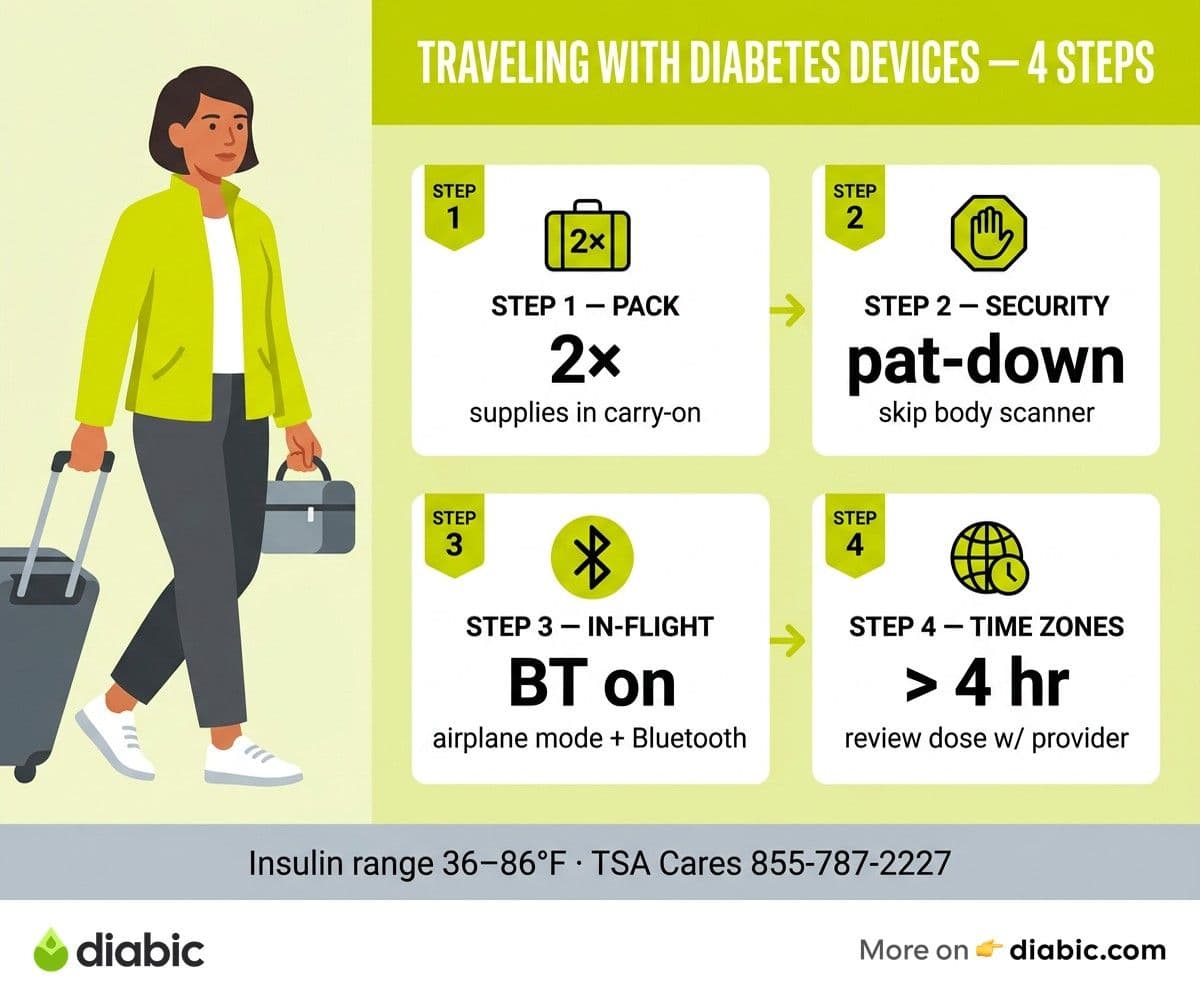
The cardinal rule when traveling with diabetes devices is simple. Your insulin, pump supplies, sensor supplies, and a backup glucose meter all go in your carry-on. Checked luggage gets lost, gets cold in cargo holds, and arrives whenever the airline decides. Insulin frozen at altitude is no longer effective.
For a typical trip, plan to carry roughly twice the supplies you think you will need. If you use 1 sensor every 10 days and your trip is 2 weeks long, pack 4 sensors. Pumps fail. Adhesive falls off in tropical humidity. Backup is not paranoia, it is practical. Our roundup of the best diabetes wearable devices in 2026 covers the supplies and accessories worth bringing along.
Insulin storage matters more than most people realize. The American Diabetes Association recommends keeping insulin between 36 and 46 degrees Fahrenheit until first use, then up to 86 degrees for a few weeks once opened. A small insulated travel case with a Frio cooling pouch or gel pack handles most situations without freezing the vial. Avoid storing insulin in checked baggage, the trunk of a car parked in the sun, or directly on ice.
Bring extras of everything that can fail. That includes:
- Pump infusion sets, reservoirs, and battery or charger
- CGM sensors, transmitters if applicable, and adhesive patches
- A backup blood glucose meter, test strips, and lancets
- Fast-acting glucose (tabs, gels, or juice boxes) within reach during the flight
- A long-acting insulin pen or vial as a backup if you wear a pump
Pack one set of supplies in your personal item under the seat in case your overhead bag gets gate-checked at the last minute.
Going Through Airport Security With an Insulin Pump
The security line is where most first-time travelers feel nervous. The good news is the process is almost always smooth once you know the steps.
When you reach the checkpoint, tell the officer that you have an insulin pump and a continuous glucose monitor before you start the screening. Hand over your TSA notification card or doctor's letter if you have one. Most officers will direct you to a body scanner or, on request, a pat-down lane.
If you wear a pump or CGM, request a pat-down rather than going through the body scanner. Manufacturers including Insulet's Omnipod and Dexcom advise that scanners and X-ray machines may damage the device or cause inaccurate readings, so the safer choice is to bypass the scanner entirely. The pat-down takes a few extra minutes and is conducted in public unless you ask for a private screening room. Our insulin pump guide for type 1 diabetes covers the basics of pump care if you are still learning your device.
If an agent is unfamiliar with your device, stay calm and ask politely for a supervisor. Most TSA Cares supervisors are trained on insulin pumps and CGMs. You can also call TSA Cares at 855-787-2227 up to 72 hours before your flight to arrange assistance, especially helpful if you have multiple connections or a tight schedule.
International airports vary. European airports generally follow similar policies, though specific protocols differ. Some airports in Asia and the Middle East still ask travelers to remove pumps for X-ray screening, which manufacturers do not recommend. Carry your doctor's letter, ideally translated into the local language, and a printed manufacturer travel statement. If you must remove a pump, disconnect it briefly rather than sending it through X-ray attached.
From my experience: I have lived with type 1 diabetes for 14 years and have flown with both Dexcom and Omnipod through dozens of airports across North America, Europe, and Asia. The single best habit I built was speaking up immediately at the front of the line. Officers respond well when you are calm, prepared, and clear about what you have. I have only had one bad experience in all those trips, and it was solved by asking for a supervisor.
Keeping Your Continuous Glucose Monitoring System Connected While Traveling
CGM connectivity is one of the most overlooked travel issues. A sensor that disconnects mid-flight is annoying. A sensor that loses data across a 12-hour time zone shift can throw off your management for days.
Most modern CGMs, including Dexcom G7 and Freestyle Libre 3, pair with your phone over Bluetooth and continue working in airplane mode as long as Bluetooth stays on. iPhones and most Android phones allow Bluetooth in airplane mode through a separate toggle. Check the settings before takeoff so your sensor keeps streaming data to your phone in flight. Understanding how a continuous glucose monitoring system works can help you troubleshoot if connectivity drops.
Dexcom recommends that international travelers using the Dexcom Follow app have remote followers update their region settings, and that travelers crossing many time zones may see data display delays for a short period. Abbott's Libre app also adjusts to phone time settings, though some users prefer to set the phone manually to local time after landing rather than during transit.
Time zone shifts can affect alert thresholds. If you have low alerts at night, those alerts will fire on local phone time after your phone updates. Adjust high and low thresholds before bed on your first night in the new zone if your routine has changed, for example if dinner is later than usual. The general principle is to keep the sensor running and let it adapt, then re-evaluate trends after 24 hours in your new location.
Managing Insulin and Supplies Across Time Zones
Time zone insulin adjustment is one of the genuinely tricky parts of travel for people on insulin. The shorter the trip, the simpler the math. The longer the trip and the bigger the time shift, the more it pays to plan with your endocrinologist before you fly.
For trips of 1 to 3 hours of time difference, most people on multiple daily injections continue their normal long-acting insulin schedule on local time. For shifts of 4 hours or more, especially eastward travel that shortens the day, your provider may suggest splitting a long-acting dose or adjusting timing across 2 days. Pump users have more flexibility because basal rates run continuously regardless of time zone, but you may need to update the pump's clock to local time after landing so meal boluses and reports line up.
The American Diabetes Association publishes traveler resources that suggest carrying a written insulin plan in case you need help abroad. Talk to your doctor 2 to 3 weeks before any trip with a major time zone change so you can practice any new routine before you leave.
Hot climates require their own playbook. Insulin loses effectiveness above 86 degrees Fahrenheit, and pump reservoirs can develop air bubbles in heat. Store insulin in a hotel mini-fridge if available, but check the temperature first because some mini-fridges run cold enough to freeze the vial. Frio pouches activate with cold water and keep insulin cool for 45 hours without refrigeration, making them a useful backup in remote locations.
If you run out of supplies abroad, pharmacies in most developed countries can help. A local doctor can write a prescription, and major insulin brands are sold under different names in different countries. Embassies and the CDC traveler health resources maintain lists of English-speaking medical providers in many destinations.
International Travel: Country-Specific Tips
Carrying insulin across international borders is legal in most countries with proper documentation. Bring your prescription bottle or box with the original pharmacy label, your prescription itself, and your doctor's letter. Some countries, including the United Arab Emirates, Singapore, and Japan, have stricter import rules for controlled substances. Check the embassy website of your destination 4 to 6 weeks before travel.
Electrical adapters matter for pump and CGM charging. Tandem t:slim X2, Omnipod 5 Controller, and most CGM receivers charge over USB, so a multi-port USB-C charger with a regional plug adapter handles most of your needs. Keep a backup charging cable in your carry-on. Battery-powered devices, including Medtronic pumps that use AAA batteries, require fresh batteries available locally if you are gone long enough to drain a set.
Travel insurance is worth investigating. Standard medical travel insurance often excludes pre-existing conditions, but specialty plans for people with diabetes do exist. Read the fine print on coverage for lost devices, replacement supplies, and emergency evacuation. The peace of mind is usually worth the premium for longer trips.
Cruise, Road Trip, and Adventure Travel With Diabetes Tech
Cruise ships have onboard medical centers, but supplies for diabetes are limited and prices are high. Pack everything you need plus a substantial buffer. Saltwater and humidity wear on adhesive, so plan for sensor changes more often than at home and bring sensor overpatches. Most CGMs are water-resistant for swimming, but check your specific device's depth and time limits.
Road trips give you more control over storage and supply spacing, but heat is the main risk. Never leave insulin or sensors in a hot car. A small cooler with a thermometer, refreshed daily, handles most cross-country drives. If you stop for gas in 100-degree heat, take the cooler inside with you.
Adventure travel, including hiking, skiing, and backcountry trips, requires the most planning. Ski resorts can drop electronics into freezing temperatures, which slows pump response and can stop CGM transmitters. Wear devices closer to your body under layers. Backcountry trips far from cell coverage benefit from a written manual diabetes routine in case devices fail. Our diabetes emergency plan checklist walks through what to include.
Backup plans are not optional for remote travel. If your only pump fails on day 4 of a 10-day hiking trip, you need long-acting insulin pens, syringes, and a manual injection schedule you have practiced. Talk to your doctor about a written backup regimen before you leave.
Final Steps Before Traveling With Diabetes Devices
Travel rewards preparation. The traveler who walks to security with supplies organized, a doctor's letter in hand, and a clear plan for time zone changes almost always has a smoother trip than the one figuring it out at the gate. Build a packing checklist you can reuse for every trip, and update it as your devices change.
A few days before your next flight, double-check your sensor expiration dates, refill prescriptions, and confirm pump supplies you have on hand. Save the manufacturer's travel page for your specific pump and CGM as a phone bookmark, since the official guidance is updated periodically and worth re-reading.
If you are still building your travel routine, the related Diabic guides linked throughout this article can help you fine-tune the details. Talk to your doctor about a personal travel plan before any major trip, especially if you are crossing more than 3 time zones.
Frequently Asked Questions
Can you take an insulin pump through airport security?
Yes. The TSA explicitly allows insulin pumps and CGMs through security, attached to your body. Manufacturers recommend asking for a pat-down rather than going through the full-body scanner or X-ray machine, since scanners may damage the device. Tell the officer about your pump before screening begins, and bring a TSA notification card or doctor's letter if you have one.
How to travel with a CGM and insulin pump?
Pack double the supplies you expect to use, keep all insulin and devices in your carry-on, and request a pat-down at security. Keep your phone in airplane mode with Bluetooth on so the CGM keeps streaming. For long flights or multiple time zone changes, talk to your doctor in advance about adjusting basal rates or long-acting insulin timing. Save your device's travel guide on your phone.
Do you need a doctor's note to fly with insulin?
You are not legally required to carry a doctor's note for domestic flights in the United States, but it is strongly recommended. International travel often requires a letter, and some countries ask for one when bringing controlled medications. A simple letter on clinic letterhead with your diagnosis, devices, and supplies covers most situations.
Traveling with diabetes devices is mostly about preparation: a checklist you trust, supplies in your carry-on, and a calm script for the security line. With those pieces in place, your trip stops being a logistics problem and goes back to being a trip.
Shahriar P. Shuvo is the founder of Diabic. He has lived with diabetes for over 14 years, and built Diabic to deliver the practical, evidence-based self-management tools he wished existed when he was first diagnosed. By trade, Shahriar is a senior design and frontend engineer with 6+ years shipping products at Agora, Timescale (now Tiger Data), and ShareTrip. He writes from the intersection of lived diabetes experience and product craft, focused on what works in daily management rather than what sounds good in a textbook.
Medically reviewed by
Dr. Shanto Arian is an internal medicine physician now specializing in clinical and aesthetic dermatology, with a parallel academic focus on epidemiology and public health. He holds an MBBS, MPH, MSc (UK), MRCP (UK), MRCPI (Ireland), Diploma in Dermatology (UK), and Diploma in Aesthetic Medicine (USA). Dr. Arian trained in internal medicine, including hospital work on hematology cases such as graft-versus-host disease, before moving toward dermatology. Skin is one of the earliest places diabetes shows itself, from acanthosis nigricans and diabetic dermopathy to slow foot wound healing, and that intersection is where his clinical and Diabic-review work meet. On Diabic, Dr. Arian medically reviews content on diabetes diagnosis, complications, dermatologic manifestations, and pharmacotherapy, ensuring every claim aligns with current ADA, NICE, and peer-reviewed literature.
More from Devices & Technology
View all
Fasting vs Postprandial Glucose: What's the Difference
Fasting vs postprandial glucose readings tell different stories about your blood sugar. Learn what each number means and how to act on it.

Best Glucometer for Elderly and Low-Vision Users
Best glucometer for elderly and low-vision users: large displays, audio readouts, no-coding strips, and budget picks that make daily testing easier.

Online Diabetes Coaching: How to Choose a Good One
Online diabetes coaching can fill the gaps between doctor visits. Learn what credentials to check, red flags to avoid, and how to pick a quality program.
Clinician-reviewed habits, plain-language guides, and honest answers - the small shifts that make living with diabetes feel lighter, every day.