What Is Insulin? Function and Risks Without It
What is insulin, how does it move glucose into cells, and what happens to the body when it stops working? A clear, science-backed explainer.

In this article(9)
You have probably heard the word a hundred times, in doctor's offices, on prescription labels, in news headlines about drug prices. But if someone asked you to define it in plain language, would you have an answer ready? What is insulin, really, and why does it sit at the center of every conversation about diabetes? Understanding this single hormone explains more about blood sugar, energy, and metabolism than almost anything else in the body.
Insulin is the hormone that lets your cells use the food you eat. Without it, glucose cannot move out of the bloodstream and into the muscles, brain, and organs that need it for fuel. When insulin works well, you barely notice it. When it stops working, or stops being made at all, the consequences show up fast and they touch almost every system in the body. The rest of this guide walks through what insulin does, how the regulation system works, and what happens when that system breaks down.
From my experience: I was diagnosed with type 1 around 14 years ago, and the moment I really understood what insulin does was when I switched from Lantus to Tresiba and watched my fasting numbers stop drifting upward overnight. That hormone is not abstract once you have lived without it. Even now, between MDI and pump days, the smallest gap in basal coverage shows up on my Dexcom within a couple of hours.
What Is Insulin and What Does It Do in Your Body
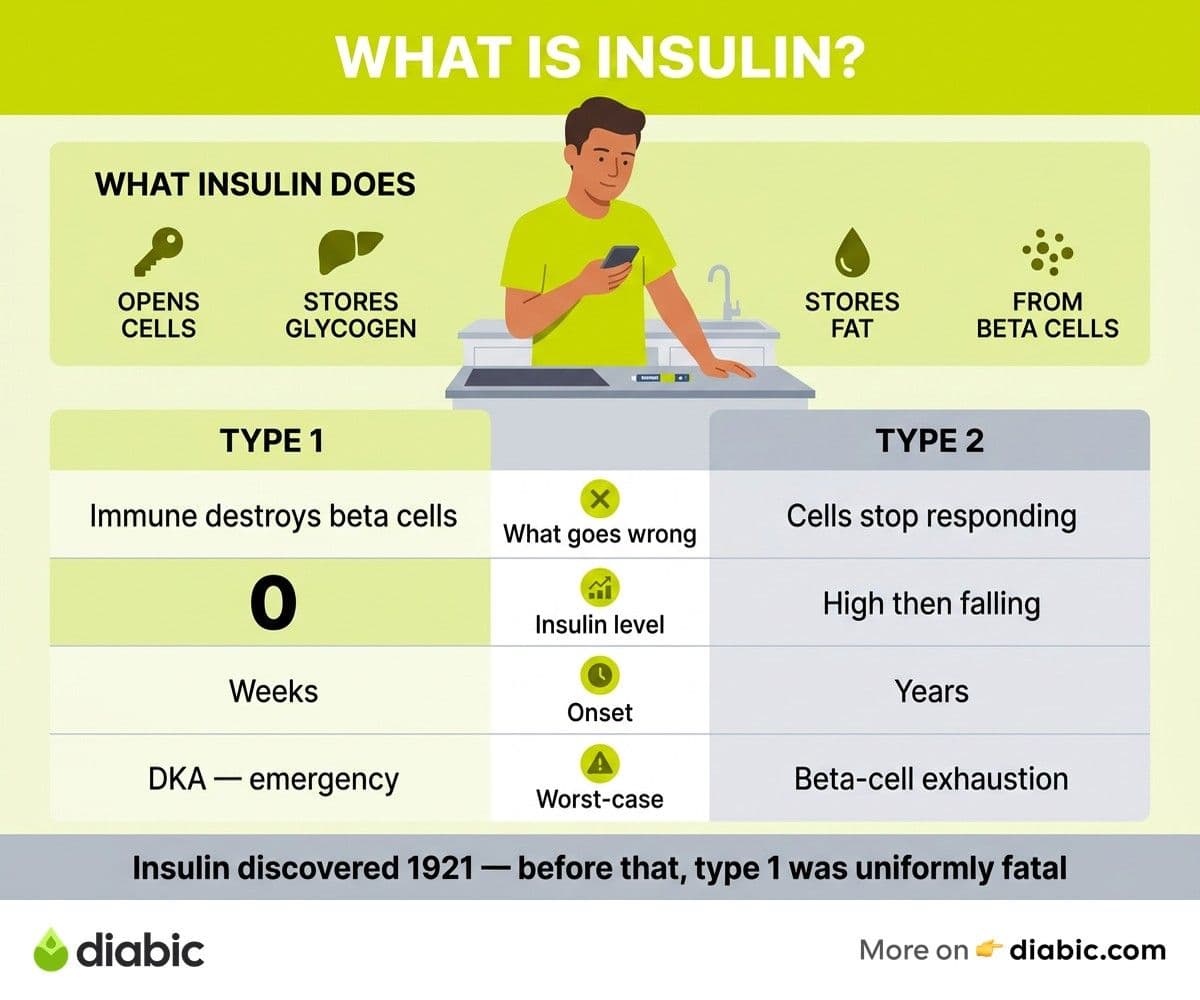
Insulin is a small protein hormone made by the beta cells of the pancreas, a soft organ tucked behind the stomach. The pancreas releases insulin into the bloodstream in response to rising blood sugar, mostly after you eat. Once it is circulating, insulin acts like a key that fits into receptors on the surface of cells, signaling them to open glucose channels and pull sugar in from the blood. The National Institute of Diabetes and Digestive and Kidney Diseases describes this as one of the most fundamental signaling pathways in human metabolism.
That key-and-lock image is useful, but insulin does more than open doors. It also tells the liver when to store extra glucose as glycogen, signals fat cells to take up and store fat after meals, and helps muscle tissue absorb amino acids for protein synthesis. In other words, insulin is not only a blood sugar hormone, it is a master switch for how the body decides between storing energy and burning it. The Joslin Diabetes Center frames insulin as the body's signal that food is available and growth is safe.
When the system is healthy, insulin levels rise and fall in sync with eating. A small baseline amount circulates between meals to keep things steady, and a larger pulse fires off after each meal to handle the incoming glucose. This rhythm is what keeps fasting blood sugar in a narrow band even though you might go many hours without food. Once you understand that pulse, you start to see why insulin shows up in conversations not just about diabetes but also about weight, hunger, and energy.
How Insulin Regulates Blood Sugar
Blood sugar regulation is a feedback loop, and insulin is one half of it. When you eat carbohydrates, they break down into glucose, which enters the bloodstream and raises your blood sugar. The pancreas detects that rise and releases insulin within minutes. Insulin then drives glucose into cells, blood sugar comes back down, and insulin release slows again. The other half of the loop is glucagon, a hormone the pancreas releases when blood sugar runs low, telling the liver to break down stored glycogen and release glucose back into circulation.
The liver plays a quiet but essential role here. After a meal, when insulin is high, the liver soaks up extra glucose and stores it as glycogen for later. Between meals, when insulin levels drop, the liver releases glucose slowly to keep your brain fed through the night. Research summarized in the American Diabetes Association Standards of Care describes this hepatic balancing act as central to fasting glucose stability, and it is one of the first things to drift off in early metabolic disease.
There is also a difference between fasting insulin levels, which sit low and steady, and postprandial (after-meal) insulin release, which spikes and clears within a few hours. Reviews in Nature Reviews Endocrinology describe insulin signaling as one of the most studied pathways in human biology precisely because so many tissues depend on it, and so many diseases trace back to it. When this elegant system works, you feel nothing. When it breaks down in either direction, the consequences are serious and they form the basis of every type of diabetes.
What Happens When Your Body Stops Making Insulin
In type 1 diabetes, the immune system mistakenly attacks and destroys the beta cells in the pancreas, the only cells in the body that make insulin. Over time, the pancreas loses its ability to produce insulin entirely. Without insulin, glucose has no way to leave the bloodstream and enter cells, so blood sugar climbs higher and higher while the cells themselves are effectively starving in the middle of plenty.
The symptoms of this state come on quickly, often over weeks rather than years. People notice extreme thirst because the body is trying to flush excess glucose through the kidneys, frequent urination for the same reason, sudden weight loss as the body burns fat and muscle for fuel, and deep fatigue from cells that cannot access energy. Blurred vision and fruity-smelling breath can show up as the situation worsens. These are not subtle signals, and many people end up in emergency rooms before they get a diagnosis.
The most dangerous outcome of complete insulin loss is diabetic ketoacidosis (DKA). When cells cannot use glucose, the body shifts to burning fat, which produces acidic byproducts called ketones. Ketones build up in the blood and lower its pH, which interferes with everything from heart rhythm to brain function. DKA is a life-threatening medical emergency, and our piece on what ketoacidosis feels like walks through the warning signs in more detail. The treatment is replacement insulin, fluids, and electrolytes, which is why insulin therapy for type 1 is started immediately at diagnosis and continued for life.
What Happens When Your Body Resists Insulin
Type 2 diabetes works differently. Here, the pancreas still makes insulin, often plenty of it, but cells stop responding to its signal effectively. This is called insulin resistance, and it usually develops gradually over years, often without obvious symptoms in the early stages. The pancreas tries to keep up by pumping out more insulin, a state called hyperinsulinemia, and for a while blood sugar can stay in a normal range thanks to that extra effort.
Over time, though, the beta cells get worn down by the constant overproduction. Eventually they cannot keep pace, insulin output starts to fall, and blood sugar begins to rise into the person with diabetes range. Research published in Diabetes Care shows that this slow decline in beta-cell function is one of the defining features of type 2 progression, and it explains why some people who start with diet and exercise alone eventually need oral medication or even insulin themselves. The body is not failing because the person did something wrong, it is failing because a system has been working overtime for years.
This gradual onset is the opposite of type 1, where insulin production collapses fast. The type 1 vs type 2 differences come down to this distinction between supply and signal. In type 1, there is no insulin to be had. In type 2, insulin is present but ignored, until the supply also starts to slip. Both end in elevated blood sugar, but the path there and the early treatment options are different. That is why a question as simple as "what is insulin" leads to two very different stories about what goes wrong.
Why Understanding Insulin Matters for Your Health
You do not need a biology degree to manage diabetes well, but a working mental model of insulin makes almost everything else click into place. Why does a long walk after dinner help with blood sugar? Because exercising muscles can take up glucose with much less insulin than resting ones, an effect documented across decades of metabolic research. Why does stress raise blood sugar even when you have not eaten? Because stress hormones tell the liver to dump glucose, and if your insulin response is impaired, that glucose lingers.
Knowing what insulin does also helps you understand why your treatment plan looks the way it does. If your provider talks about basal insulin, bolus insulin, or specific types of insulin used in treatment, you have a frame for the conversation rather than a list of unfamiliar names. The same goes for medications that improve insulin sensitivity, slow glucose absorption, or boost the pancreas. Each one targets a specific point in the loop you have just walked through.
The conversation about insulin should not start and end with injections, even though that is how most public discussion treats it. Insulin shapes hunger, sleep, energy, and mood. Understanding the hormone gives you a lever for daily decisions, not just clinical ones. Whether you have diabetes, prediabetes, or simply someone in your life who does, knowing what insulin is and what happens without it changes the way you read your own body's signals.
Frequently Asked Questions
What happens when your body stops making insulin?
When the body can no longer produce insulin, as in type 1 diabetes, glucose cannot enter cells for energy and accumulates in the bloodstream. This leads to dangerously high blood sugar, dehydration, and rapid weight loss as the body burns fat for fuel. Without prompt treatment, it can progress to diabetic ketoacidosis (DKA), a life-threatening emergency that requires immediate medical care.
What is the difference between insulin and glucose?
Glucose is a sugar that serves as the body's primary energy source, and it comes from the carbohydrates you eat. Insulin is a hormone made by the pancreas that allows glucose to move from the bloodstream into cells. Without insulin, glucose stays trapped in the blood and cells cannot access the energy they need to function.
Can the body live without insulin at all?
No, the human body cannot survive long-term without insulin. Even people with type 1 diabetes, whose pancreas no longer makes insulin, depend on injected or pumped insulin to live. Before insulin was discovered in 1921, type 1 diabetes was uniformly fatal, usually within months of diagnosis.
The bigger answer to what is insulin is that it is the hormone that lets food become fuel. When you understand its role, the rest of diabetes care, from why a post-dinner walk lowers blood sugar to why stress can push numbers up, fits into a single coherent picture. Talk to your doctor about how your own insulin story is unfolding, and use that conversation to shape the daily choices that move your numbers most.
Shahriar P. Shuvo is the founder of Diabic. He has lived with diabetes for over 14 years, and built Diabic to deliver the practical, evidence-based self-management tools he wished existed when he was first diagnosed. By trade, Shahriar is a senior design and frontend engineer with 6+ years shipping products at Agora, Timescale (now Tiger Data), and ShareTrip. He writes from the intersection of lived diabetes experience and product craft, focused on what works in daily management rather than what sounds good in a textbook.
Medically reviewed by
Dr. Shanto Arian is an internal medicine physician now specializing in clinical and aesthetic dermatology, with a parallel academic focus on epidemiology and public health. He holds an MBBS, MPH, MSc (UK), MRCP (UK), MRCPI (Ireland), Diploma in Dermatology (UK), and Diploma in Aesthetic Medicine (USA). Dr. Arian trained in internal medicine, including hospital work on hematology cases such as graft-versus-host disease, before moving toward dermatology. Skin is one of the earliest places diabetes shows itself, from acanthosis nigricans and diabetic dermopathy to slow foot wound healing, and that intersection is where his clinical and Diabic-review work meet. On Diabic, Dr. Arian medically reviews content on diabetes diagnosis, complications, dermatologic manifestations, and pharmacotherapy, ensuring every claim aligns with current ADA, NICE, and peer-reviewed literature.
More from Treatment & Medication
View all
Recognizing Diabetic Coma Warning Signs Early
Learn to spot diabetic coma warning signs early. We cover DKA, HHS, and severe hypoglycemia symptoms, plus when to call 911 for immediate help.

Switching to Injectable Diabetes Medication: What to Expect
Switching to injectable diabetes medication can feel daunting. Learn what to expect, how to manage side effects, and why this step is progression, not.

Hyperglycemic Hyperosmolar Syndrome: Warning Signs to Know
Hyperglycemic hyperosmolar syndrome is a serious type 2 diabetes emergency. Learn the warning signs, triggers, and when to call 911 for HHS care.
Clinician-reviewed habits, plain-language guides, and honest answers - the small shifts that make living with diabetes feel lighter, every day.