Spotting Diabetes Kidney Problems Symptoms Early
Learn how to recognize diabetes kidney problems symptoms early, what tests to ask for, and the subtle signs that may point to kidney stress.

In this article(9)
Spotting diabetes kidney problems symptoms early is one of the most impactful things you can do for your long-term health. The challenge is that kidney damage from diabetes is often silent in its earliest stages, which means you can feel completely fine while changes are already happening inside the kidneys. Knowing what tests to ask for and what subtle signals to watch for puts you in a much stronger position to act before things progress.
Diabetes is the leading cause of kidney disease in the United States, according to the Centers for Disease Control and Prevention. About one in three adults with diabetes has some level of chronic kidney disease, and many do not know it. That gap between what is happening biologically and what shows up as a noticeable symptom is exactly why early screening matters so much.
The good news is that kidney damage from diabetes is not inevitable. With the right monitoring, lifestyle steps, and conversations with your care team, you can protect your kidney function for many years. This guide walks through what early problems look like, the screening tests that catch them, and the signs that deserve a same-week call to your doctor.
Why Early Detection Changes Everything
Kidney damage tends to follow a slow, predictable arc when it is driven by diabetes. The earliest changes happen at the level of tiny filtering units inside the kidneys, long before you feel anything different. Catching the process at this stage gives you the best chance of slowing or stabilizing it.
Once kidney function drops far enough to cause obvious symptoms, you may already be in stage 3 or beyond. The National Kidney Foundation notes that people who learn about kidney disease early often have better outcomes because they can adjust medications, blood pressure targets, and lifestyle choices while the kidneys still have room to recover. Stage 1 disease responds far better to intervention than stage 3 or 4 does.
The difference is meaningful. Someone diagnosed at stage 1 may keep stable kidney function for decades with consistent care. Someone diagnosed at stage 3 may face a faster path toward dialysis or transplant if the underlying drivers, especially blood sugar and blood pressure, are not addressed. Understanding the CKD stages with diabetes helps you see why those early years are the most valuable window you have.
Screening, not symptoms, is the most reliable way to find early kidney trouble. That is the single most important takeaway here. If you wait for your body to tell you something is wrong, you have already missed the easiest part of the curve to correct.
The Key Tests That Catch Kidney Problems Early
Two simple tests do most of the work in early detection, and both are part of standard diabetes care. Together, they give your doctor a clear picture of how your kidneys are filtering blood and whether protein is leaking into your urine. These are the same tests that frame any conversation about diabetes with kidney disease guide decisions later on.
The first is eGFR, which stands for estimated glomerular filtration rate. It is calculated from a routine blood test that measures creatinine, along with your age and other factors. eGFR estimates how many milliliters of blood your kidneys filter each minute. A number above 90 generally means normal function, while numbers in the 60 to 89 range may indicate early decline if other signs are present. Below 60 for three months or more is the threshold for chronic kidney disease.
The second is UACR, the urine albumin-to-creatinine ratio. This urine test detects albumin, a protein that should not normally pass through healthy kidney filters. Even small amounts of albumin in the urine can be the earliest measurable sign of diabetes-related kidney stress. Research published in Diabetes Care shows that UACR screening picks up changes years before eGFR drops, which is why both tests matter together.
The American Diabetes Association recommends at least an annual UACR and eGFR for adults with type 2 diabetes and for adults with type 1 diabetes who have had the condition for five years or longer. Some people benefit from more frequent testing, especially if previous results were borderline or if blood pressure has been hard to manage.
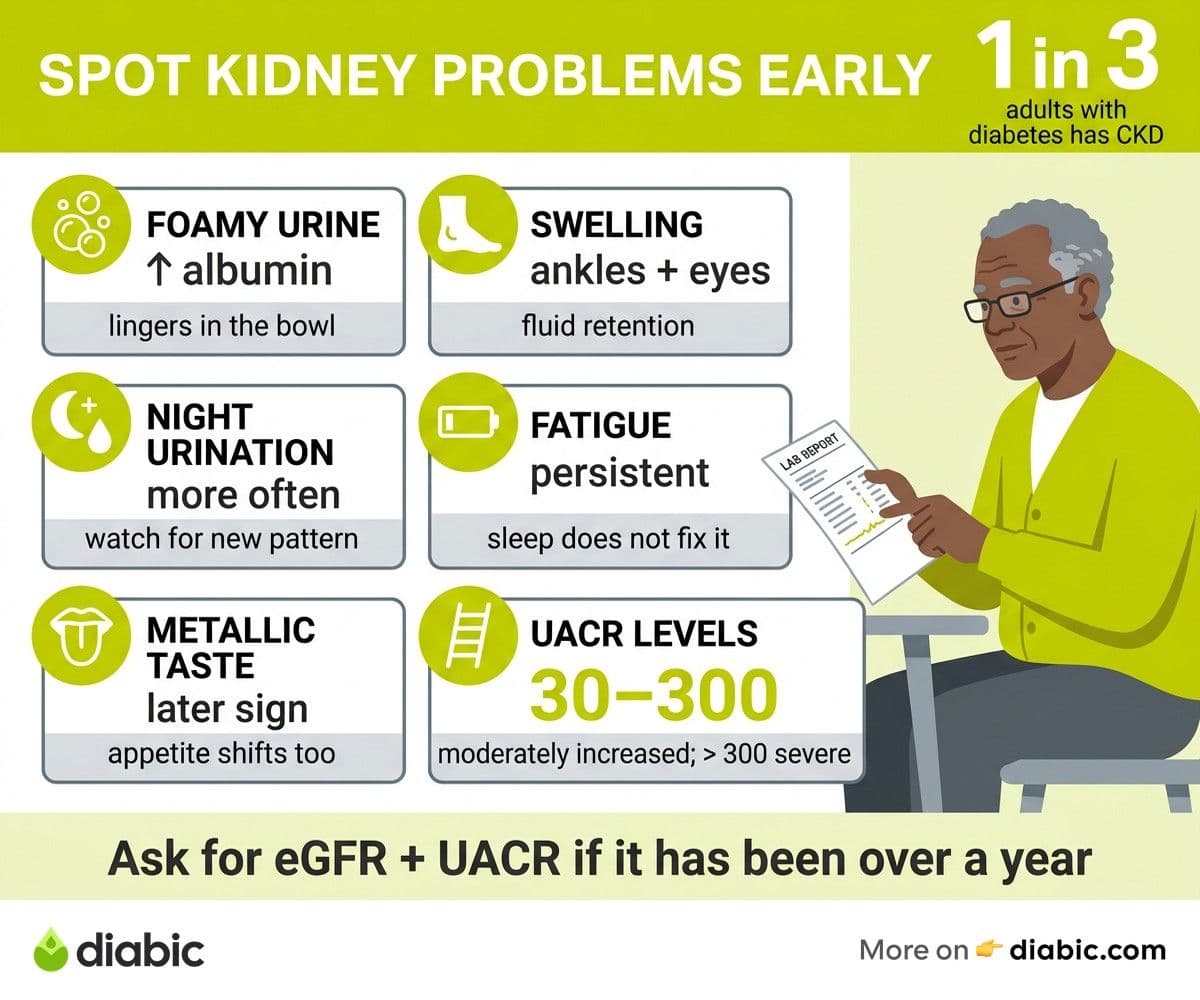
When you get your results, ask for the actual numbers, not just a "normal" or "abnormal" label. A UACR under 30 mg/g is considered normal, 30 to 300 mg/g indicates moderately increased albuminuria, and above 300 mg/g is severely increased. Tracking these numbers across years tells a richer story than any single result.
Subtle Diabetes Kidney Problems Symptoms to Watch For
While screening should be your primary tool, your body sometimes drops quiet hints that something is shifting. None of these signs are specific to kidney disease on their own, but in combination, or alongside diabetes, they deserve attention. The National Institute of Diabetes and Digestive and Kidney Diseases lists several early signals worth watching.
Foamy or bubbly urine that lingers in the toilet bowl can indicate protein leaking into the urine. A few bubbles are normal, but persistent foam that does not dissipate after a few minutes is worth mentioning to your doctor. This is one of the more specific clues that your kidneys may be letting albumin through.
Swelling, also called edema, often shows up first in the ankles, feet, or around the eyes in the morning. When kidneys cannot regulate fluid balance well, that fluid pools where gravity sends it. Shoes feeling tighter or rings that suddenly will not slide off, can both be quiet hints.
More frequent urination, especially at night, sometimes signals kidney stress, though it can also reflect high blood sugar pulling extra water into the urine. If nighttime trips to the bathroom increase without a clear reason, that pattern is worth tracking and sharing.
Persistent fatigue that does not improve with sleep can develop when kidneys struggle to clear waste products or when red blood cell production drops. Many people with early kidney changes describe a heavy, dragged-down feeling that is hard to pin on any one cause.
Changes in appetite or a metallic taste in the mouth sometimes appear as kidney function declines further. These are later signs, but they are worth knowing about so you can connect the dots if they show up alongside other symptoms.
Risk Factors That Increase the Chance of Kidney Problems
Some people are more likely than others to develop kidney complications from diabetes, and knowing where you stand helps you and your doctor decide how aggressively to monitor. Risk is not destiny, but it does shape the screening conversation.
The strongest risk factor is duration of diabetes combined with periods of higher average blood sugar. The longer the kidneys have been exposed to elevated glucose, the more wear shows up on those filtering units. This is part of how diabetes affects the kidney over time, and it is also why steady management matters far more than perfect numbers on any single day.
High blood pressure is the second major driver. Hypertension and diabetes together create more kidney damage than either does alone. The connection between blood pressure and diabetes is direct: every point of pressure above target adds strain to the same vessels glucose is already stressing. The CDC highlights blood pressure as one of the most modifiable risk factors for chronic kidney disease in people with diabetes.
Family history of kidney disease raises baseline risk, even when blood sugar is well managed. If a parent or sibling has had kidney problems, mention that during your visits. Smoking accelerates kidney decline through its effects on blood vessels and inflammation, and quitting at any age may help slow that process.
Certain ethnic backgrounds, including African American, Hispanic, and Native American communities, carry higher rates of diabetes-related kidney disease. The reasons involve a mix of genetic, environmental, and access-to-care factors. If you fall into one of these groups, talking with your doctor about earlier or more frequent screening is reasonable.
From my experience: Living with type 1 diabetes for fourteen years taught me that kidney screening was the easiest part of my annual checkup to skip. It did not feel urgent because I felt fine. The year I finally asked for a UACR alongside my regular labs, the result came back borderline. That single number changed my approach to blood pressure and hydration in ways that years of general advice never had. The test was a few extra minutes. The information shaped the next decade of my care.
What to Do If You Notice Warning Signs
Noticing possible diabetes kidney problems symptoms is not a reason to panic, but it is a reason to act. Most kidney issues identified early can be slowed, and many can be stabilized with the right adjustments. The first step is always a conversation, not a diagnosis.
Schedule a kidney function test with your doctor. Ask specifically for both eGFR and UACR if they have not been done in the past twelve months. If your last test was borderline, a repeat in three months helps your doctor see whether the change is a trend or a one-time blip. Lab results can fluctuate based on hydration, recent exercise, or even certain foods, so one number rarely tells the whole story.
Share what you have noticed in concrete terms. Instead of saying you are tired, describe how your energy compares to six months ago. Instead of saying your urine looks different, mention how often the foam appears and how long it lasts. Specific descriptions help your doctor sort signal from noise.
Try not to spiral while you wait for results. Early detection is the part of this story that has the best outcomes, and most people with early changes have years of stable kidney function ahead of them. Your doctor may suggest tighter blood pressure targets, a closer look at medications such as ACE inhibitors or ARBs, or referrals to a kidney specialist if results warrant it. You can read more about kidney disease treatment options to prepare for those conversations.
If results show meaningful changes, your care plan may shift in several ways. Blood sugar targets might be tightened or, in some cases, loosened to reduce hypoglycemia risk. Medication doses can change as kidney function changes, since some drugs are cleared through the kidneys. Diet adjustments around sodium, protein, and potassium may come up, though they should be guided by your team rather than self-prescribed.
FAQ
What are the early symptoms of diabetes kidney problems?
Early-stage kidney disease often has no symptoms at all, which is why screening matters more than waiting for warning signs. When subtle clues do appear, they include foamy urine, swelling in the ankles or around the eyes, increased nighttime urination, persistent fatigue, and changes in appetite. Any of these in combination with diabetes is worth a conversation with your doctor.
How do you know if diabetes is damaging your kidneys?
The most reliable way to know is through annual eGFR and UACR testing. eGFR estimates how well your kidneys filter blood, while UACR detects protein leaking into your urine. Together they catch changes long before symptoms appear. The American Diabetes Association recommends these tests at least once a year for adults with type 2 diabetes and for adults with type 1 diabetes of five or more years.
How often should people with diabetes get kidney tests?
At minimum, once a year for both eGFR and UACR. People with previously abnormal results, longer duration of diabetes, high blood pressure, or other risk factors may benefit from testing every three to six months. Your doctor can recommend a schedule that matches your risk profile and history.
If you take one thing from this guide, let it be that diabetes kidney problems symptoms are usually quiet until they are not. Annual screening is the most reliable tool you have, and the numbers from those tests are worth tracking year over year. A few minutes once a year can shape decades of kidney health, and that is a trade worth making.
Shahriar P. Shuvo is the founder of Diabic. He has lived with diabetes for over 14 years, and built Diabic to deliver the practical, evidence-based self-management tools he wished existed when he was first diagnosed. By trade, Shahriar is a senior design and frontend engineer with 6+ years shipping products at Agora, Timescale (now Tiger Data), and ShareTrip. He writes from the intersection of lived diabetes experience and product craft, focused on what works in daily management rather than what sounds good in a textbook.
Medically reviewed by
Dr. Shanto Arian is an internal medicine physician now specializing in clinical and aesthetic dermatology, with a parallel academic focus on epidemiology and public health. He holds an MBBS, MPH, MSc (UK), MRCP (UK), MRCPI (Ireland), Diploma in Dermatology (UK), and Diploma in Aesthetic Medicine (USA). Dr. Arian trained in internal medicine, including hospital work on hematology cases such as graft-versus-host disease, before moving toward dermatology. Skin is one of the earliest places diabetes shows itself, from acanthosis nigricans and diabetic dermopathy to slow foot wound healing, and that intersection is where his clinical and Diabic-review work meet. On Diabic, Dr. Arian medically reviews content on diabetes diagnosis, complications, dermatologic manifestations, and pharmacotherapy, ensuring every claim aligns with current ADA, NICE, and peer-reviewed literature.
More from Health & Complications
View all
Diabetes and Dental Implants: What to Know First
Diabetes dental implants guide covering safety, A1C targets, recovery expectations, gum health prep, and what to ask your oral surgeon before surgery.

Burning Mouth Syndrome and Diabetes Explained
Burning mouth syndrome diabetes link explained, including neuropathy, dry mouth, and thrush causes plus treatment options that may bring real relief.

Dental Care for people with diabetes: Tips That Help
Practical dental care diabetics need, with real tips for protecting teeth and gums when diabetes raises your risk for oral health problems.
Clinician-reviewed habits, plain-language guides, and honest answers - the small shifts that make living with diabetes feel lighter, every day.