Duloxetine and Diabetic Neuropathy: How It Helps Nerve Pain
How duloxetine and diabetic neuropathy treatment work together: mechanism, side effects, gabapentin comparison, and questions to ask your doctor.

In this article(16)
If your feet burn at night or your hands buzz with pins and needles, you have probably already heard the names of a few nerve pain medications from your doctor or your pharmacist. One of them is duloxetine, sold under the brand name Cymbalta. Looking at duloxetine and diabetic neuropathy together helps you understand why this medication keeps coming up in treatment conversations.
Duloxetine is one of only a small number of medicines specifically approved by the FDA for the pain that comes with diabetic peripheral neuropathy. It is also widely used for depression and anxiety, which gives it a useful dual role for many people living with diabetes. None of that means it is the right choice for everyone, and the side effect profile is real.
This article walks through how the medication works, what to expect when starting it, the trade-offs against gabapentin and pregabalin, and the kinds of questions worth bringing to your next appointment.
What Is Duloxetine (Cymbalta)?
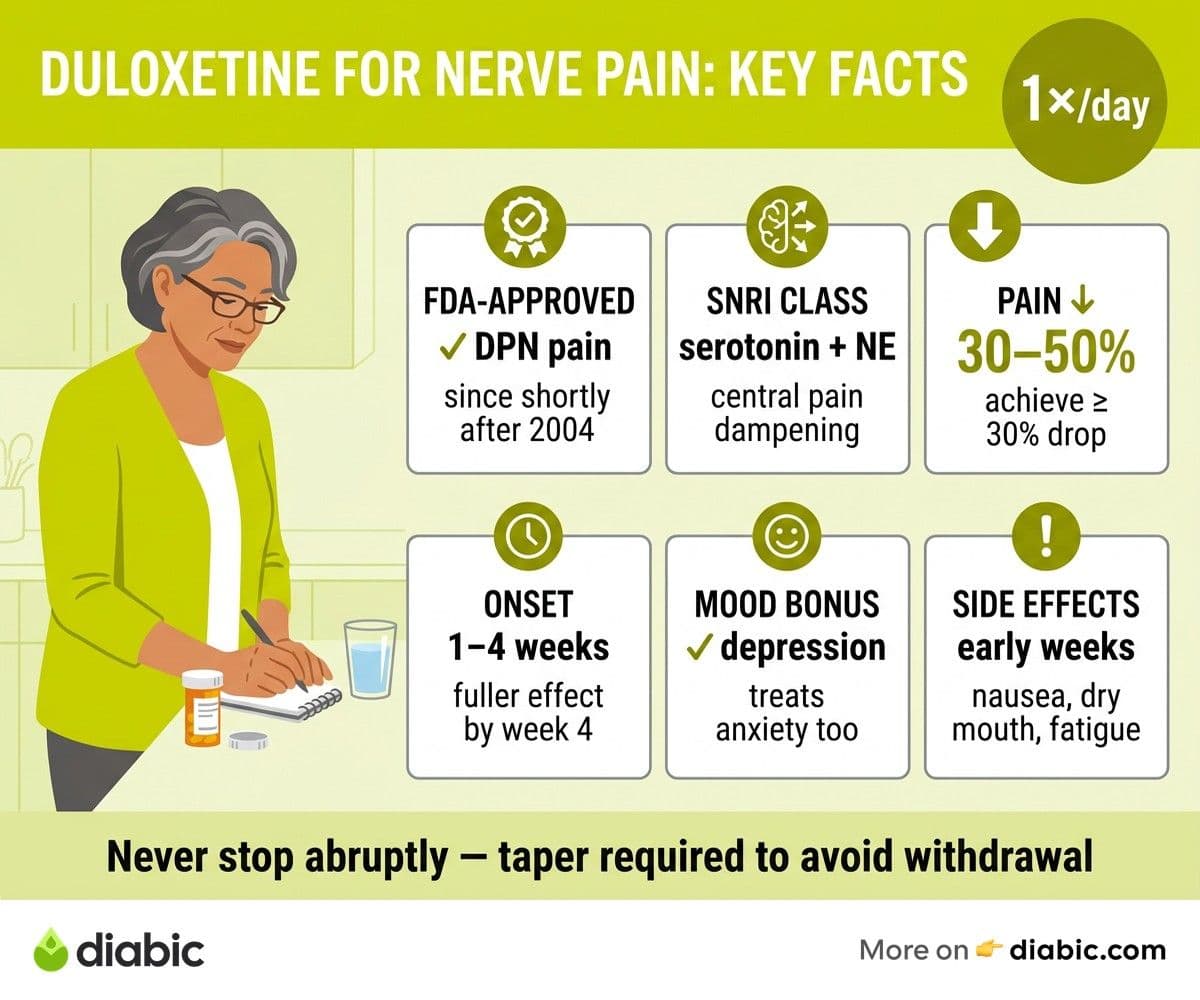
Duloxetine belongs to a class of medications called serotonin-norepinephrine reuptake inhibitors, often shortened to SNRIs. It was first approved by the U.S. Food and Drug Administration in 2004 for major depressive disorder, and it received approval for diabetic peripheral neuropathic pain shortly after. That FDA-approved indication for nerve pain is uncommon, which is part of why duloxetine carries weight in clinical guidelines.
Unlike a traditional pain reliever such as ibuprofen or acetaminophen, duloxetine does not work at the site of an injury. It works in the central nervous system by changing how pain signals are processed in the brain and spinal cord. That distinction matters for nerve pain, which behaves differently from injury or inflammation pain.
The American Diabetes Association lists duloxetine, along with pregabalin and gabapentin, as a recommended first-line medication for painful diabetic peripheral neuropathy in its Standards of Care. For someone weighing options, that recommendation reflects a strong base of evidence rather than promotional pressure. If you are still gathering general background on the condition, our overview of diabetic neuropathy treatment options explains the wider menu of choices alongside duloxetine.
Why duloxetine sits high on the list
A few factors push duloxetine into early consideration for many people with painful nerve symptoms. It is taken once a day rather than multiple times. It does not generally cause weight gain the way some other neuropathy medications can. And for the many people who also live with anxiety or depression alongside their diabetes, treating both at once with one prescription can be a meaningful simplification.
If you are not yet sure your symptoms are nerve damage at all, our guide on recognizing diabetic peripheral neuropathy early walks through common patterns and warning signs that warrant a clinical evaluation.
How Duloxetine Reduces Neuropathy Pain
Nerve pain is not just regular pain turned up louder. Damaged nerves send abnormal signals on their own, and the spinal cord and brain often amplify those signals over time. Standard painkillers struggle with this kind of pain because the problem is not at the skin or the joint, it is in the wiring.
Duloxetine works on two neurotransmitters: serotonin and norepinephrine. Both play roles in the body's natural pain-dampening pathways, especially the descending inhibitory system that travels from the brainstem down the spinal cord. By keeping more of these chemicals available at nerve junctions, duloxetine strengthens the brain's ability to turn down pain signals before they reach conscious awareness.
The NIDDK describes duloxetine as one of the medications used to relieve nerve pain in diabetes, alongside other oral and topical options. Trials published in journals like Diabetes Care have shown that a meaningful share of people taking duloxetine report at least a 30 to 50 percent reduction in pain compared with placebo. Not everyone responds, and the size of the benefit varies, which is why honest expectations matter from day one.
A reasonable goal is improvement, not elimination. Many people report that pain becomes less intrusive, sleep gets better, and daily activities feel more manageable, even if the underlying tingling does not disappear. For people asking whether the underlying nerve damage itself can heal, our piece on whether diabetic neuropathy can be reversed takes that question seriously.
What to Expect When Starting Duloxetine
Most clinicians start duloxetine at a low dose and increase slowly over a few weeks. This stepwise approach helps your body adjust and reduces the chance of unpleasant side effects in the first few days. Your provider will set the schedule that fits your situation, so we will not list specific milligram amounts here. Talk to your doctor about the right starting dose for you.
Pain relief usually takes time. Some people notice improvement in the first week or two, but the fuller effect often shows up after a month at a steady dose. If you stop after only a few days because nothing seems to be happening, you may be giving up before the medicine has had a fair trial.
Stopping duloxetine abruptly can cause withdrawal symptoms, including dizziness, irritability, vivid dreams, and a flu-like feeling. If you and your doctor decide to discontinue it, the dose is typically tapered down rather than stopped cold turkey. Mark this clearly on your mental list of things never to do without a plan.
Tracking whether it is working
Keeping a simple pain diary in the first month or two pays off. Note your average pain on a 0 to 10 scale at the same time each day, alongside your sleep quality and any side effects. Bring that record to your follow-up visit. Numbers help you and your provider make a clear-eyed decision about whether to continue, adjust, or switch.
Common Side Effects and How to Manage Them
Like every medication, duloxetine has a side effect profile worth knowing before you start. Most side effects are most noticeable in the first one to two weeks and ease as your body adjusts.
Nausea is the most common complaint and often improves on its own. Taking the dose with food can help, as can timing it to a part of the day when feeling slightly off is easiest to handle. The Mayo Clinic notes that nausea, dry mouth, drowsiness, fatigue, constipation, and decreased appetite are among the more frequent side effects.
Drowsiness or sleep changes can run in either direction. Some people feel sleepy during the day, others have insomnia. Working with your prescriber on the timing of the dose, morning versus evening, often resolves this. Sexual side effects, including reduced libido and difficulty with orgasm, are possible and are worth raising directly even though many people feel awkward bringing them up.
Less common but more serious effects include liver enzyme changes, increased blood pressure, and rare cases of serotonin syndrome when combined with other serotonergic drugs. Anyone taking other antidepressants, certain pain medications like tramadol, or migraine triptans should make sure their full medication list is clearly known to every prescriber and pharmacist.
From my experience: in 14 years of living with type 1 diabetes I have watched friends in our community try duloxetine with very different results. One described it as the first medication that let her sleep through the night without burning feet waking her up. Another stopped after two weeks because the nausea did not pass. Both responses are normal. Neither tells you what your experience will be.
Duloxetine vs. Gabapentin: How Do They Compare?
Gabapentin and pregabalin are the other commonly used first-line medicines for diabetic nerve pain. They belong to a different class called gabapentinoids and work by quieting overactive nerve signaling in the spinal cord, rather than by adjusting brain neurotransmitters.
Both classes appear in the ADA Standards of Care, and head-to-head studies generally find similar pain relief on average, with notable differences in side effects and individual response. There is no universal winner. There is only the best fit for a specific person.
A few practical differences tend to drive the choice:
- Dosing schedule. Duloxetine is once daily. Gabapentin is usually three times a day. Pregabalin is twice daily. If pill timing is hard for you, that matters.
- Side effect signatures. Duloxetine tends toward nausea, sweating, and possible sexual side effects. Gabapentin tends toward weight gain, swelling in the legs, and drowsiness. Both can cause dizziness.
- Mood and anxiety. Duloxetine treats depression and anxiety as a secondary benefit. Gabapentin does not have that role.
- Cost. Both are available as generics, which keeps prices reasonable for many people. Insurance formularies still vary, so check before you commit.
- Combination therapy. Some people use duloxetine and gabapentin together when single agents are not enough. Research suggests this combination may help certain patients, though it raises the side effect load.
If you want a deeper look at gabapentinoids specifically, our articles on gabapentin for diabetic neuropathy and Lyrica for diabetic peripheral neuropathy pain cover those options in their own right.
Is duloxetine better than gabapentin for neuropathy?
The honest answer is that neither is universally better. Both are FDA-approved for diabetic nerve pain (gabapentin is used off-label for diabetic neuropathy, while pregabalin holds the FDA approval in the gabapentinoid class). Trials show similar average benefit, and the right choice depends on your sleep pattern, mood history, kidney function, body weight goals, and tolerance for specific side effects. This is a real conversation with your provider rather than a one-size-fits-all answer.
Questions to Ask Your Doctor About Duloxetine
Walking into the appointment with a few prepared questions usually leads to a better discussion. The list below is not exhaustive, but it covers the most useful ground for most people.
- Is duloxetine appropriate given my full medical and medication history, including any depression, anxiety, liver issues, or blood pressure concerns?
- How will we know it is working, and at what point will we re-evaluate?
- What is the plan if the first dose increase causes side effects?
- How does duloxetine interact with my current diabetes medications, blood pressure medications, and any over-the-counter products or supplements I take?
- If I miss a dose, what should I do?
- What signs should prompt me to call rather than wait for our next visit?
- Could a topical option, lifestyle adjustment, or different oral medication fit my situation better?
If your nerve pain is also coming with foot numbness, the conversation may overlap with what we cover in our piece on foot care and protection for people with diabetic neuropathy.
Putting Duloxetine and Diabetic Neuropathy Together
Duloxetine is a well-studied option for diabetic peripheral neuropathy pain, with a clear FDA approval, a recognized place in clinical guidelines, and a familiar side effect profile that most clinicians can manage. For people who also live with depression or anxiety, the dual benefit can simplify a complicated medication list.
It is not a cure, and it is not the right fit for every person. Knowing how duloxetine and diabetic neuropathy management connect helps you have a productive conversation with your provider rather than a passive one. Bring your questions, your medication list, and an honest description of your symptoms. The decision belongs to you and your care team together.
If you want to see how this option lines up against the broader picture of diabetic peripheral neuropathy drugs, our community frequently compares experiences with duloxetine, gabapentin, pregabalin, and topical treatments side by side.
FAQ
How does duloxetine help diabetic neuropathy?
Duloxetine raises serotonin and norepinephrine activity in the central nervous system, which strengthens the body's natural pain-dampening pathways. This helps reduce the abnormal pain signals produced by damaged nerves in diabetic peripheral neuropathy.
Is duloxetine better than gabapentin for neuropathy?
Neither is universally better. Both have similar average effectiveness in studies. Duloxetine is once daily and may also help mood, while gabapentin is dosed multiple times per day and may cause more weight gain. The right choice depends on your full health picture and what side effects you can tolerate.
Can duloxetine help with both pain and mood?
Yes. Duloxetine is FDA-approved for major depressive disorder and generalized anxiety disorder in addition to diabetic peripheral neuropathic pain. For people managing both nerve pain and a mood condition, treating both with one medication can be a useful simplification, though it should be decided with your prescriber.
How long does duloxetine take to work for nerve pain?
Some people notice improvement in the first one to two weeks, but the fuller effect typically appears after a month at a steady dose. Stopping early often means stopping before the medication has had a fair trial.
Can I stop duloxetine on my own if I do not like it?
Stopping abruptly can cause withdrawal symptoms like dizziness, irritability, and flu-like sensations. Talk to your doctor before making any change. A gradual taper is the standard approach to discontinuing duloxetine safely.
When you weigh how duloxetine and diabetic neuropathy management fit together, the goal is a clear picture of expected benefit, realistic side effects, and a follow-up plan you both agree on. Bring questions, bring a pain diary, and bring an open mind to the next visit.
Dr. Shanto Arian is an internal medicine physician now specializing in clinical and aesthetic dermatology, with a parallel academic focus on epidemiology and public health. He holds an MBBS, MPH, MSc (UK), MRCP (UK), MRCPI (Ireland), Diploma in Dermatology (UK), and Diploma in Aesthetic Medicine (USA). Dr. Arian trained in internal medicine, including hospital work on hematology cases such as graft-versus-host disease, before moving toward dermatology. Skin is one of the earliest places diabetes shows itself, from acanthosis nigricans and diabetic dermopathy to slow foot wound healing, and that intersection is where his clinical and Diabic-review work meet. On Diabic, Dr. Arian medically reviews content on diabetes diagnosis, complications, dermatologic manifestations, and pharmacotherapy, ensuring every claim aligns with current ADA, NICE, and peer-reviewed literature.
Medically reviewed by
Dr. Rezwana Parvin Rumpa is an obstetrics and gynaecology specialist with clinical focus on gestational diabetes, PCOS, and fertility. She holds the MRCOG (Final Part) from the Royal College of Obstetricians and Gynaecologists in London, the MRCPI (Final Part) from the Royal College of Physicians of Ireland, and an MBBS from Shaheed Monsur Ali Medical College under Dhaka University. Dr. Rumpa serves as a Senior Medical Officer in the Obs and Gynae department at BRB Hospitals Ltd, where she has spent three years managing prenatal care, emergency obstetric cases, and women's-health surgery. On Diabic, she medically reviews content for women living with diabetes, with particular attention to pregnancy, PCOS, and reproductive-health intersections.
More from Health & Complications
View all
Diabetes and Dental Implants: What to Know First
Diabetes dental implants guide covering safety, A1C targets, recovery expectations, gum health prep, and what to ask your oral surgeon before surgery.

Burning Mouth Syndrome and Diabetes Explained
Burning mouth syndrome diabetes link explained, including neuropathy, dry mouth, and thrush causes plus treatment options that may bring real relief.

Dental Care for people with diabetes: Tips That Help
Practical dental care diabetics need, with real tips for protecting teeth and gums when diabetes raises your risk for oral health problems.
Clinician-reviewed habits, plain-language guides, and honest answers - the small shifts that make living with diabetes feel lighter, every day.