Diabetes Mellitus: What Most People Get Wrong
Diabetes mellitus is widely misunderstood. Learn what the term really means, the full classification, and the myths most people still believe.

In this article(10)
Diabetes mellitus is a term you have probably heard but may not fully understand. Misconceptions about what it means, how many types exist, and who gets it are surprisingly common, even among people living with the condition. This guide sets the record straight on what the term actually covers and what most people get wrong.
The confusion is understandable. The term sounds clinical, the types overlap in some symptoms, and decades of casual usage have blurred the lines. Cleaning up the vocabulary helps you make sense of your own diagnosis or someone else's.
What Diabetes Mellitus Actually Means
The word "diabetes" comes from Greek and refers to excessive urination, one of the earliest and most noticeable symptoms. "Mellitus" is Latin for "sweet, like honey," added centuries ago when physicians realized that the urine of affected patients was sweet to the taste. The full name distinguishes it from diabetes insipidus, a separate and far less common condition that affects water balance through the kidneys but does not involve blood sugar.
So when your medical chart uses the full term, it means the metabolic condition that affects glucose. When you or anyone else simply says "diabetes," you almost always mean the same thing.
The condition is not a single disease. It is a group of related metabolic disorders, all sharing one defining feature: chronically elevated blood glucose. Beyond that, the underlying causes, treatments, and long-term courses can be very different. The World Health Organization classifies several distinct types, each with its own diagnostic and management framework.
Understanding the term as a classification rather than a single diagnosis matters because it shapes your treatment. Insulin therapy that is essential for one type may be unnecessary for another. A diet pattern that works for one person might miss the mark for you. The umbrella label tells you the playing field. Your specific type tells you the rules.
The Full Classification
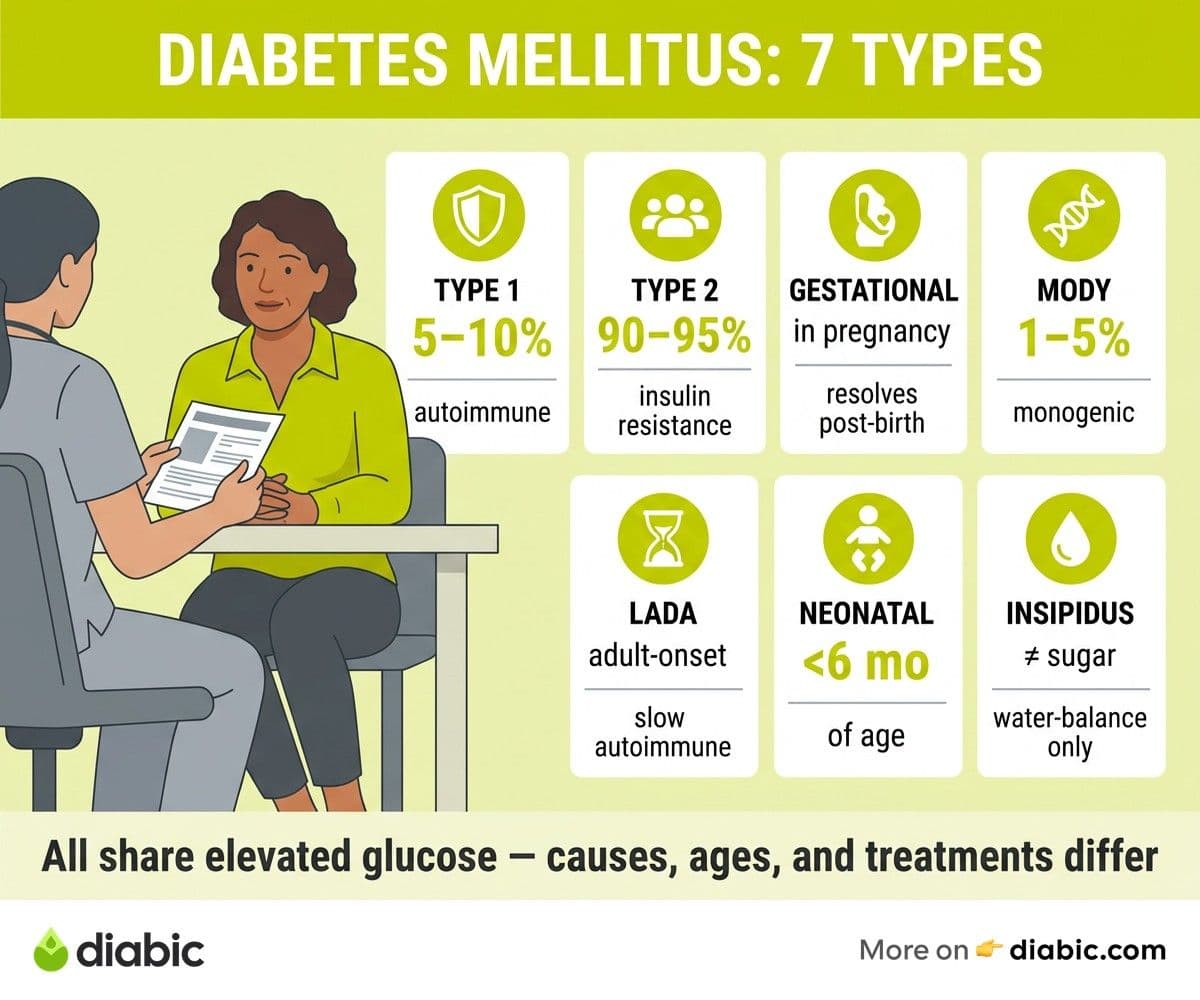
The American Diabetes Association recognizes four main categories of diabetes, plus several less common types that often get overlooked.
Type 1 An autoimmune condition in which the immune system destroys the insulin-producing beta cells of the pancreas. The body produces little or no insulin. If you have type 1, you require insulin therapy for life. Onset is most common in childhood or adolescence but can occur at any age. Type 1 accounts for roughly 5 to 10 percent of cases.
Type 2 The most common form, accounting for 90 to 95 percent of cases. The body becomes resistant to insulin and over time may also produce less of it. Strongly linked to genetics, weight, and lifestyle. Treatment ranges from lifestyle changes alone to oral medications, injectable therapies, and sometimes insulin.
Gestational diabetes (GDM) A form that develops during pregnancy, typically in the second or third trimester. Hormones from the placenta cause insulin resistance, and some women cannot produce enough extra insulin to compensate. GDM usually resolves after birth, but it raises future type 2 diabetes risk for both mother and child.
Other specific types This category includes several less common forms that are often misdiagnosed. LADA (latent autoimmune diabetes in adults) is a slow-onset form of type 1 in adults, often initially mistaken for type 2. MODY (maturity-onset diabetes of the young) is a genetic form caused by single-gene mutations. Neonatal diabetes appears in the first six months of life. Secondary diabetes is caused by another condition (like pancreatitis or Cushing's syndrome) or by medications. Our guide to what is LADA diabetes explores one of the most commonly missed forms.
Prediabetes is also part of this picture, though it is not yet a full diagnosis. Your blood sugar is elevated above normal but below the diagnostic threshold. It is a strong warning sign and a stage where you can often slow or stop progression to type 2. For a fuller foundation, our overview of what is diabetes covers the basics in plain language.
The classification matters for treatment because each type responds to different interventions. Treating type 1 like type 2 (or vice versa) leads to poor outcomes.
Common Misconceptions
Misconceptions about diabetes management drive a lot of unnecessary fear, judgment, and bad advice. Here are four of the most common, with the actual science.
Myth 1: Diabetes mellitus and diabetes are different conditions. They are the same thing. The full medical term is "diabetes mellitus"; "diabetes" is the everyday shorthand. The "mellitus" distinction only matters because it separates the condition from diabetes insipidus, which involves a different organ system entirely.
Myth 2: Only one type of diabetes exists. This belief leads you to assume that all people with diabetes need insulin, all should avoid carbs equally, or all developed the condition through the same path. The reality is at least four major types and several rarer ones, each with distinct biology. Treatment, dietary needs, and risk factors vary significantly by type.
Myth 3: All diabetes is caused by eating too much sugar. Sugar consumption is not the sole cause. Type 1 is autoimmune and not related to diet. Type 2 has a strong genetic component, and while diet and weight matter, many people develop it without high sugar intake. Sugar is one risk factor among many. Our deeper look at does sugar cause diabetes walks through the actual research.
Myth 4: Treatment always requires insulin. Only type 1 always requires insulin. If you have type 2, you may manage your condition with lifestyle changes alone, oral medications, or non-insulin injectables. Insulin becomes necessary only if other treatments stop working. Gestational diabetes is often managed with diet and monitoring; insulin is added only when blood sugar targets cannot be reached otherwise. The piece on what is type 3 diabetes also covers a less familiar discussion about diabetes and brain health.
From my experience: I have lost count of how many times someone has asked if I "got" diabetes by eating too much candy as a kid. After more than a decade of explaining it, the most useful framing has been: think of the condition the way you think of cancer. It is a category, not a single diagnosis. The type matters more than the label.
How It Is Diagnosed
The same blood tests confirm a diagnosis across all main types, though additional tests help identify which type you have. The Mayo Clinic outlines the standard diagnostic workflow.
Hemoglobin A1C: Measures average blood sugar over the past 2-3 months. 6.5 percent or higher (on two separate occasions) confirms diabetes. 5.7-6.4 percent indicates prediabetes.
Fasting plasma glucose: Measured after at least 8 hours without food. 126 mg/dL or higher confirms diabetes. 100-125 mg/dL is prediabetes.
Oral glucose tolerance test (OGTT): Measures blood sugar before and 2 hours after drinking a glucose solution. A 2-hour reading of 200 mg/dL or higher indicates diabetes. Used routinely to screen for gestational diabetes during pregnancy.
Random plasma glucose: A reading of 200 mg/dL or higher, combined with classic symptoms of high blood sugar, can confirm diabetes without fasting.
To distinguish type 1 from type 2 (especially in adults), providers may order autoantibody tests, including GAD, IA-2, and ZnT8. Positive autoantibodies suggest type 1 or LADA. C-peptide testing measures how much insulin the body is still producing. Low C-peptide with positive autoantibodies points strongly to type 1. The NIDDK provides detailed information on the diagnostic process.
Genetic testing is sometimes used when MODY is suspected (early onset, family history of diabetes across multiple generations, atypical clinical picture). Accurate type identification matters because it determines whether someone needs lifelong insulin, can stop diabetes medication after pregnancy, or might respond to a specific drug class.
Living With the Condition: A Unified Approach
Despite the differences across types, the basic management framework is similar. If you have diabetes mellitus, you benefit from monitoring blood sugar, eating in a way that supports steady glucose levels, staying physically active, getting enough sleep, and managing stress.
What differs is the specific protocol. If you have type 1, you use insulin with every meal and adjust doses constantly. If you have type 2, you may take metformin alone, combine multiple medications, use injectables like GLP-1 agonists, or eventually need insulin. With gestational diabetes you track blood sugar closely during pregnancy and usually stop testing after delivery, though you should continue to be screened periodically.
Accurate diagnosis is what makes effective treatment possible. A person with LADA who is misdiagnosed as type 2 may struggle on oral medications alone for years before insulin becomes obvious. Someone with MODY may be put on aggressive type 2 treatments when a milder, type-specific approach would work better. Our deeper comparison of type 1 vs type 2 differences explains why the distinction matters in daily life.
The goal across every type is the same: keep blood sugar in the target range often enough to prevent the complications that come from chronically high glucose. The path to that goal looks different depending on the type, but the destination is shared.
FAQ
What is the difference between diabetes and diabetes mellitus?
There is no practical difference. The full medical term is "diabetes mellitus," and "diabetes" is the everyday shorthand. The "mellitus" part distinguishes it from diabetes insipidus, a rare condition involving the kidneys and water regulation. When people say "diabetes," they almost always mean the same thing.
How many types are there?
The main types are type 1, type 2, gestational, and prediabetes. Beyond these, there are several less common types including LADA, MODY, neonatal diabetes, and secondary diabetes caused by other conditions or medications. Each type has distinct causes and requires different treatment approaches.
Can you have more than one type?
It is rare but possible. Some people have features of both type 1 and type 2 (sometimes called "double diabetes"), particularly if they have type 1 and develop insulin resistance from weight gain over time. The treatment approach blends elements of both.
Is the condition the same in children and adults?
The classification is the same, but the type distribution differs. Type 1 is more common in children, though it can occur at any age. Type 2 was historically rare in children but is increasing alongside rising childhood obesity rates. Diagnosis in younger people often requires antibody testing to distinguish the type accurately.
Diabetes mellitus is one umbrella covering several distinct conditions, all linked by elevated blood sugar but each with its own biology. Knowing your type is the first step to making sense of everything that follows.
Shahriar P. Shuvo is the founder of Diabic. He has lived with diabetes for over 14 years, and built Diabic to deliver the practical, evidence-based self-management tools he wished existed when he was first diagnosed. By trade, Shahriar is a senior design and frontend engineer with 6+ years shipping products at Agora, Timescale (now Tiger Data), and ShareTrip. He writes from the intersection of lived diabetes experience and product craft, focused on what works in daily management rather than what sounds good in a textbook.
Medically reviewed by
Dr. Shanto Arian is an internal medicine physician now specializing in clinical and aesthetic dermatology, with a parallel academic focus on epidemiology and public health. He holds an MBBS, MPH, MSc (UK), MRCP (UK), MRCPI (Ireland), Diploma in Dermatology (UK), and Diploma in Aesthetic Medicine (USA). Dr. Arian trained in internal medicine, including hospital work on hematology cases such as graft-versus-host disease, before moving toward dermatology. Skin is one of the earliest places diabetes shows itself, from acanthosis nigricans and diabetic dermopathy to slow foot wound healing, and that intersection is where his clinical and Diabic-review work meet. On Diabic, Dr. Arian medically reviews content on diabetes diagnosis, complications, dermatologic manifestations, and pharmacotherapy, ensuring every claim aligns with current ADA, NICE, and peer-reviewed literature.
More from Diabetes Knowledge
View all
6 Safe Dessert for Gestational Diabetes Recipes You Can
Six dessert for gestational diabetes recipes that satisfy your sweet tooth without spiking blood sugar, with carb counts and pairing tips you can use.

8 High Fiber Foods That Help with Prediabetes
Add these 8 high fiber foods for prediabetes to slow glucose absorption, support steady blood sugar, and meet the daily fiber target most people miss.

Mediterranean Diet for Prediabetes: A Practical Guide
The mediterranean diet for prediabetes is one of the best-studied eating patterns for prevention. Here is what to eat, what to avoid, and how to start.
Clinician-reviewed habits, plain-language guides, and honest answers - the small shifts that make living with diabetes feel lighter, every day.