Glucose Test During Pregnancy: How It Works
Learn how the glucose test pregnancy screening works, what the numbers mean, and what happens next if your results come back outside the normal range.

In this article(13)
The glucose test pregnancy screening is one of those appointments that generates plenty of anxiety and not nearly enough information. You walk in, drink something sweet, sit in a waiting room for an hour, and then leave with no clear sense of what just happened or what your numbers will mean. If you are dreading the sugary drink or wondering what your provider is actually looking for, you are in good company.
This guide walks through every step of the screening, the difference between the one-step and two-step protocols, and how to read your results. We will also cover what happens if you are diagnosed with gestational diabetes, because a positive screen does not have to feel like a crisis. With clear information and a calm plan, most pregnancies move forward beautifully.
What Is the Pregnancy Glucose Test
The pregnancy glucose test is a screening tool used to check for gestational diabetes, a form of high blood sugar that develops during pregnancy. It is typically done between 24 and 28 weeks of pregnancy, when placental hormones reach the levels that most strongly affect insulin sensitivity. The goal is simple: see how well your body processes a measured dose of sugar at a time when many women's metabolism shifts.
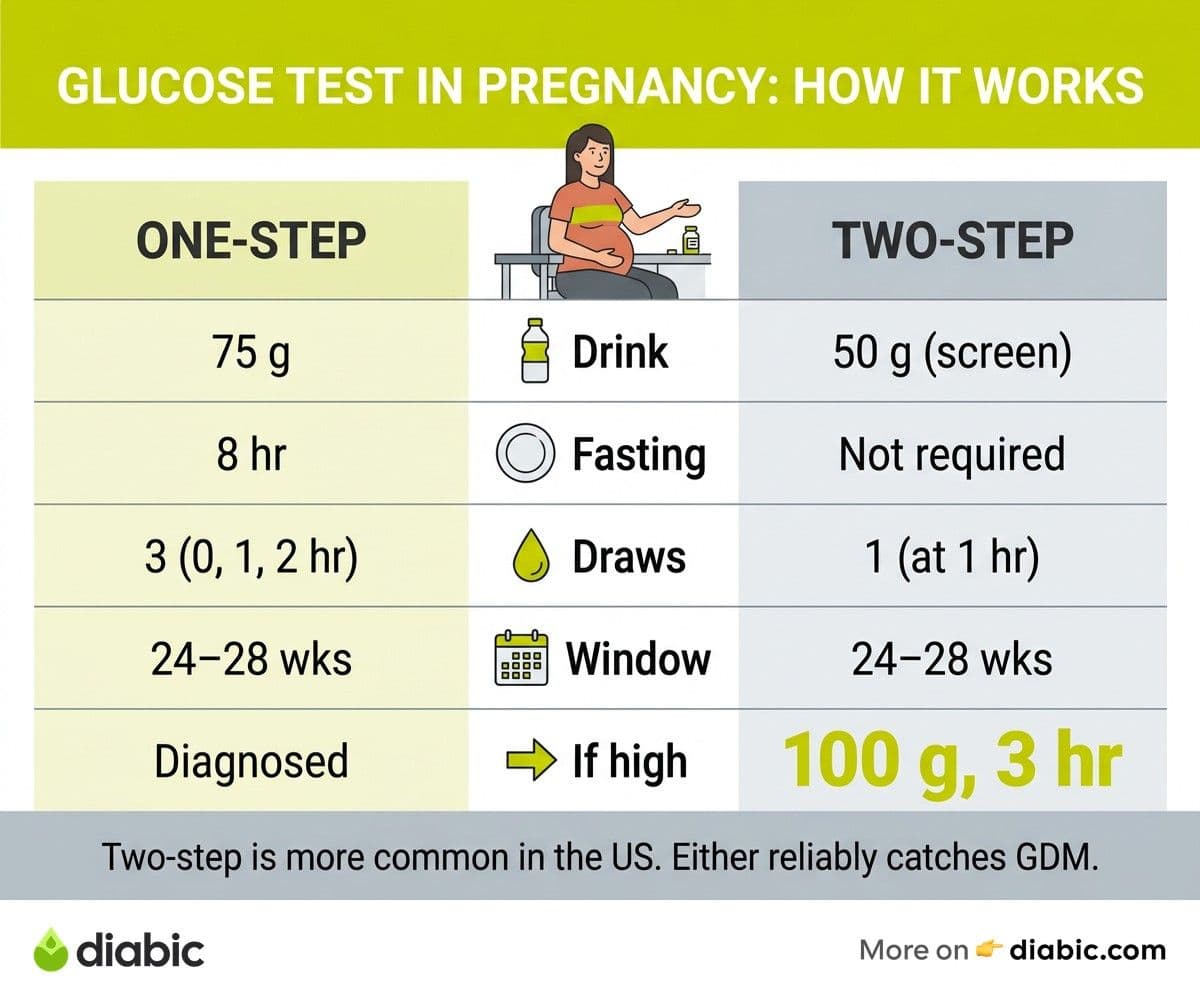
There are two accepted approaches to screening, and the American College of Obstetricians and Gynecologists (ACOG) recognizes both. The one-step method uses a 75g oral glucose tolerance test (OGTT) with a fasting draw and follow-up draws at one and two hours. The two-step method, which is more common in the United States, starts with a 50g screen and only moves to a longer 100g confirmatory test if the screen is elevated.
Your provider will choose the protocol based on your risk factors, your clinic's standard practice, and what your insurance covers. If you have early warning signs, ask about the gestational diabetes symptoms that often go unnoticed during pregnancy. Some women also benefit from preconception planning before they even conceive, especially if they have a family history of diabetes.
How the One-Hour Glucose Screening Works
The one-hour screening, sometimes called the glucose challenge test, is the most common starting point in the United States. You do not need to fast beforehand, which is one of the few diabetic pregnancy tests that lets you eat normally before you arrive. When you check in, your provider hands you a 50g glucose solution, often orange or fruit-punch flavored, and asks you to drink the entire bottle within five minutes.
After you finish the drink, the clock starts. You sit in the waiting area for exactly one hour, during which most clinics ask you not to walk around, eat, or drink anything else. Movement and additional food can change how quickly your body processes the sugar, which would skew the result. At the one-hour mark, a phlebotomist takes a single blood draw to measure your glucose level.
Most providers use a cutoff between 130 and 140 mg/dL, though the Centers for Disease Control and Prevention (CDC) notes that thresholds can vary. A result above your clinic's cutoff does not mean you have gestational diabetes. It simply means you move on to the longer three-hour test for confirmation. Roughly one in four women who screen positive on the one-hour go on to have a normal three-hour result.
What to Expect on the Day of the Test
Plan to be at the clinic for at least 75 to 90 minutes, including check-in, the drink, and the blood draw. Wear short sleeves or a layer that pushes up easily for the venipuncture. The drink itself is sugary and syrupy, and many women report it tastes a bit like flat soda left in the sun. If you can chill it briefly before drinking, the cold helps with the texture.
Bring a book, a charged phone, or work you can do quietly while you wait. Some clinics have you stay in the lab area, while others let you sit in the main waiting room. Avoid intense activity, but a calm walk to the bathroom is usually fine. If you start feeling lightheaded, nauseated, or shaky, tell the staff, because these can be normal reactions to a concentrated sugar load on an empty-ish stomach.
The Three-Hour Glucose Tolerance Test
If your one-hour screening comes back elevated, your provider will schedule a three-hour glucose tolerance test, also called the 100g OGTT. This is the test that actually diagnoses gestational diabetes, and the protocol is more involved. You fast overnight for 8 to 12 hours, drink only water, and arrive at the lab first thing in the morning.
The lab draws a fasting blood sample first, then gives you a 100g glucose drink, which is twice the dose of the one-hour screening. After you finish drinking, the lab draws blood again at one hour, two hours, and three hours. You stay in or near the lab the whole time, since the blood draws have to be timed precisely.
According to American Diabetes Association (ADA) diagnostic criteria, the standard cutoffs for the three-hour test are: fasting below 95 mg/dL, one hour below 180 mg/dL, two hours below 155 mg/dL, and three hours below 140 mg/dL. A diagnosis of gestational diabetes requires two or more values at or above these thresholds. If only one value is elevated, you do not meet the formal diagnostic criteria, though some providers will still recommend monitoring.
Tips for Surviving the Three-Hour Test
The three-hour test is genuinely uncomfortable, and pretending otherwise does not help anyone. Fasting while pregnant is hard, and adding four blood draws plus a heavy sugar load can leave you feeling drained. Schedule the test for a day when you have nothing else planned, and arrange a ride home if possible.
Bring snacks for after the final draw, because your blood sugar may dip once the test ends. A protein-and-carb combo, like a peanut butter sandwich or cheese and crackers, helps stabilize you for the drive home. Stay hydrated with water during the test itself, since dehydration can make you feel worse without changing your results.
Understanding Your Glucose Test Pregnancy Results
Reading glucose test results during pregnancy is not always straightforward, and the numbers benefit from context. A single elevated value on the three-hour test does not equal gestational diabetes under standard ADA criteria, but it is a signal worth discussing with your provider. Some clinics treat one elevated value as borderline and recommend dietary adjustments and home monitoring without a formal diagnosis.
The National Institute of Diabetes and Digestive and Kidney Diseases (NIDDK) explains that the OGTT measures how efficiently your body clears glucose from the bloodstream over time. Higher numbers across multiple draws suggest your insulin response is not keeping pace with the sugar load, which is the hallmark of gestational diabetes. If you want a deeper sense of how fasting numbers fit into the bigger picture, our guide to fasting blood sugar explained walks through what those values look like outside of pregnancy.
A1C testing is generally not used to diagnose gestational diabetes because pregnancy itself can lower A1C by changing red blood cell turnover. However, an A1C drawn early in pregnancy can flag pre-existing diabetes that may have gone undiagnosed before conception. If your provider runs an early A1C and the result is 6.5% or higher, that suggests type 2 diabetes rather than gestational diabetes, and care plans differ.
From my experience: I have lived with type 1 diabetes for 14 years, and even though my situation is different from gestational diabetes, I know how charged a single blood test result can feel. When my wife went through her glucose screening, what helped most was reminding ourselves that the numbers are information, not a verdict on her pregnancy. Ask your provider to walk you through your specific values, and write them down so you can refer back without relying on memory.
What Happens If You Are Diagnosed
A gestational diabetes diagnosis is not the end of a healthy pregnancy. It is the beginning of a more attentive one. Most women who are diagnosed manage their blood sugar through dietary changes alone, without ever needing insulin or oral medication. Your provider will likely refer you to a registered dietitian or certified diabetes care and education specialist (CDCES) for tailored meal planning.
You will start checking blood sugar at home, usually four times a day: fasting in the morning and one or two hours after each meal. The targets for pregnancy are tighter than for non-pregnant adults, often fasting below 95 mg/dL and one-hour postmeal below 140 mg/dL. Your provider will give you specific numbers based on your situation. Our gestational diabetes diet guide walks through the food strategies that tend to keep postmeal numbers in range.
If diet and movement alone cannot meet your targets, your provider may recommend insulin or, in some cases, oral medication. This is not a failure on your part. It simply means your placenta is producing more insulin-blocking hormones than your pancreas can offset. After delivery, blood sugar usually returns to normal within a few days, though follow-up testing at 6 to 12 weeks postpartum is important to confirm.
After Pregnancy: What to Watch For
Women who have had gestational diabetes carry a higher lifetime risk of developing type 2 diabetes, with research suggesting up to half will develop it within 10 years if they do not take preventive steps. The good news is that the same lifestyle habits that managed your gestational diabetes, balanced meals, regular movement, and adequate sleep, also reduce your long-term risk dramatically.
Your provider will recommend an A1C or fasting glucose test at six to twelve weeks postpartum, and then every one to three years afterward. Breastfeeding has been associated with lower postpartum diabetes risk in some research. If you are planning future pregnancies, talk to your doctor about preconception screening so any glucose changes are caught early.
FAQ
What happens during a glucose test in pregnancy?
You drink a measured dose of glucose solution, then have your blood drawn at specific time intervals to see how your body processes the sugar. The one-hour screening is shorter and does not require fasting, while the three-hour confirmatory test involves fasting overnight and four total blood draws. The whole process is monitored in or near a lab so timing stays precise.
How do I read glucose test results during pregnancy?
Each blood draw has a target threshold set by your provider, typically based on ADA or ACOG criteria. On the three-hour test, two or more elevated values usually meet the diagnostic criteria for gestational diabetes. A single elevated value is sometimes treated as borderline and may warrant home monitoring without a formal diagnosis. Always ask your provider to explain your specific numbers.
Can I eat before the one-hour glucose screening?
Yes, the one-hour screening does not require fasting. You can eat normally beforehand, though many providers suggest avoiding large amounts of sugar or simple carbs in the hour or two right before the test. The three-hour confirmatory test is different and does require an overnight fast.
What if I throw up the glucose drink?
If you vomit within the first 30 minutes after drinking the solution, the test usually has to be rescheduled because not enough sugar was absorbed. If you bring up small amounts later in the test, tell the lab staff so they can note it on your chart. Some clinics offer an alternative, such as a jelly bean test or a food-based challenge, for women who cannot tolerate the syrupy drink.
If you are still mapping out the broader prenatal landscape, our piece on early gestational diabetes symptoms is a useful companion read. The more you understand about how the glucose test pregnancy screening works and what your numbers actually mean, the easier it is to advocate for the testing and follow-up care you deserve.
Dr. Rezwana Parvin Rumpa is an obstetrics and gynaecology specialist with clinical focus on gestational diabetes, PCOS, and fertility. She holds the MRCOG (Final Part) from the Royal College of Obstetricians and Gynaecologists in London, the MRCPI (Final Part) from the Royal College of Physicians of Ireland, and an MBBS from Shaheed Monsur Ali Medical College under Dhaka University. Dr. Rumpa serves as a Senior Medical Officer in the Obs and Gynae department at BRB Hospitals Ltd, where she has spent three years managing prenatal care, emergency obstetric cases, and women's-health surgery. On Diabic, she medically reviews content for women living with diabetes, with particular attention to pregnancy, PCOS, and reproductive-health intersections.
Medically reviewed by
Dr. Shanto Arian is an internal medicine physician now specializing in clinical and aesthetic dermatology, with a parallel academic focus on epidemiology and public health. He holds an MBBS, MPH, MSc (UK), MRCP (UK), MRCPI (Ireland), Diploma in Dermatology (UK), and Diploma in Aesthetic Medicine (USA). Dr. Arian trained in internal medicine, including hospital work on hematology cases such as graft-versus-host disease, before moving toward dermatology. Skin is one of the earliest places diabetes shows itself, from acanthosis nigricans and diabetic dermopathy to slow foot wound healing, and that intersection is where his clinical and Diabic-review work meet. On Diabic, Dr. Arian medically reviews content on diabetes diagnosis, complications, dermatologic manifestations, and pharmacotherapy, ensuring every claim aligns with current ADA, NICE, and peer-reviewed literature.
More from Living with Diabetes
View all
A Gentle Chair Yoga Routine for people with diabetes
A gentle chair yoga for people with diabetes routine with safe poses, modifications for neuropathy, retinopathy, and joint pain, plus tips for older.

Shift Work and Diabetes: Managing Irregular Hours
Shift work and diabetes is a tough combination. Learn how to manage meals, sleep, medication, and blood sugar when your hours rotate or flip overnight.

Dating with Diabetes: When to Tell a New Partner
Dating with diabetes brings unique disclosure questions. Here is when to tell a new partner, what to say, and how to handle the conversation with.
Clinician-reviewed habits, plain-language guides, and honest answers - the small shifts that make living with diabetes feel lighter, every day.