Tattoos and Diabetes: Safety Tips to Know First
Tattoos and diabetes can mix safely with the right prep. Learn how to manage healing, infection risk, placement, and aftercare before your appointment.

In this article(9)
Getting tattoos when you have diabetes is absolutely possible, but it does require some extra planning. The key concerns, slower healing and higher infection risk, are manageable with the right precautions. Here are the safety tips you need before booking your appointment.
The conversation around tattoos and diabetes used to be much more cautious than it is today. Modern hygiene standards in licensed studios have changed the landscape, and most people with well-managed blood sugar can get tattoos without serious problems. The catch is that "well-managed" really matters here, and so does picking the right artist, the right body location, and a thoughtful aftercare routine.
This guide pulls together what the medical research says, what reputable studios recommend, and the small details that often get missed.
Tattoos and Diabetes: Can You Get One Safely?
Yes. People with diabetes get tattoos every day without issues, and most of those experiences go smoothly because of basic preparation. The American Diabetes Association acknowledges that tattoos are not off limits, while emphasizing that blood sugar stability and skin health both matter for healing.
What changes with diabetes is the margin for error. A tattoo creates thousands of tiny puncture wounds, and the body's ability to heal those wounds depends on circulation, immune function, and skin integrity. All three can be affected by elevated blood sugar over time. That is why most providers recommend checking in with your healthcare team before booking an appointment, especially if you have related skin complications of diabetes or recent infections.
A short pre-tattoo checklist worth running through:
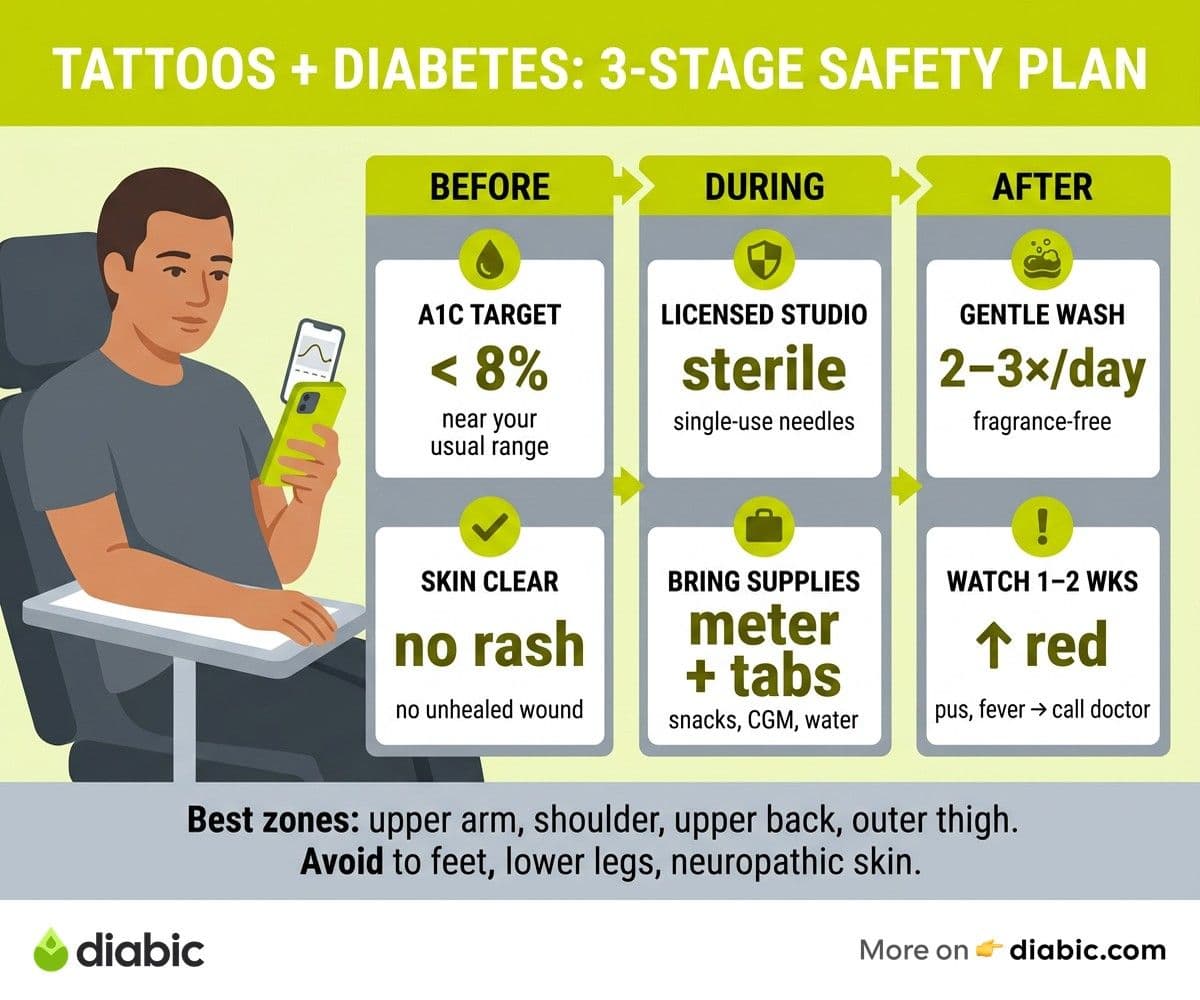
- A1C in your usual range or close to your target, ideally under 8 percent
- No active skin infections, rashes, or unhealed wounds anywhere on your body
- Your endocrinologist or primary care provider knows your plan
- Any blood thinners or immunosuppressants discussed with your prescriber
Bringing snacks, glucose tabs, and your meter or CGM to the appointment is also smart. A long session can drop blood sugar in some people, particularly when adrenaline wears off.
Why Healing Takes Longer with Diabetes
Wound healing involves a coordinated sequence of inflammation, new blood vessel growth, and tissue repair. Each step depends on circulation and immune cell function. Persistently high blood sugar slows several of these steps at once, which is why the NIDDK explains that diabetes is associated with delayed wound healing.
A few specific mechanisms are at work. White blood cells move more slowly and fight bacteria less effectively when blood sugar runs high. Tiny capillaries are damaged by years of glucose exposure, reducing the supply of oxygen and nutrients to the skin. Peer-reviewed studies in Diabetes Care have documented these effects in wounds of all kinds, including surgical incisions, ulcers, and traumatic injuries.
Neuropathy is another factor that often gets overlooked. If a particular area has reduced sensation, you may not notice early warning signs of irritation, infection, or excessive scabbing. That is part of why placement choices matter, which we will get to shortly. For more on supporting recovery, our guide on diabetic wound healing at home covers the essentials that apply to tattoo aftercare too.
The good news is that steady blood sugar in the weeks before and after a tattoo significantly improves healing outcomes. You do not need perfection. You need consistency.
Infection Risks and How to Minimize Them
People with diabetes are more susceptible to bacterial and fungal skin infections, and a fresh tattoo is essentially an open wound for the first one to two weeks. The combination is manageable, but it is the part of the process that deserves the most attention.
Start with the studio itself. The CDC tattoo safety guidance and the Mayo Clinic both emphasize that infection risk drops sharply when basic hygiene standards are met. Look for these signals in person:
- A current state or local license posted visibly
- Single-use, sterile needles opened in front of you
- Disposable barriers on equipment and surfaces
- Gloves changed between steps and after any contact with non-sterile surfaces
- Clear written aftercare instructions handed to you before you leave
Tell your artist about your diabetes ahead of time. A good artist will not be alarmed, and the heads-up lets them adjust pacing, offer breaks, and choose appropriate colors and depths. It also opens a conversation about aftercare, which often differs slightly from the studio's default protocol.
Aftercare matters as much as studio hygiene. Wash the area gently with fragrance-free soap and lukewarm water two to three times a day. Apply only the ointment your artist recommends, in a thin layer. Keep the tattoo loosely covered as instructed in the first 24 to 48 hours, then let it breathe. For more on preventing skin issues in general, see our diabetes skin infection prevention guide.
Watch for signs of infection in the first two weeks:
- Spreading redness that goes beyond the tattoo edges
- Warmth, swelling, or skin that feels hot to the touch
- Pus, yellow discharge, or foul smell
- Fever, chills, or feeling generally unwell
- Pain that increases rather than decreases after day three
Any of these signs means a same-day call to your healthcare provider, not next week.
Where on the Body to Consider (and Where to Avoid)
Body location matters more for people with diabetes than for most other clients. The reason is circulation. Areas farther from the heart, particularly the lower legs, ankles, and feet, have reduced blood flow even in healthy adults. With diabetes, that reduction is often more pronounced.
Areas to be cautious about or avoid:
- Feet, ankles, and lower legs, where circulation is lowest and healing is slowest
- Hands, especially fingers, for the same reason
- Areas with diagnosed neuropathy where sensation is reduced
- Skin with existing complications like dermopathy, ulcers, or recent injuries
The lower leg concern overlaps with diabetic foot care. The risks that make foot ulcers serious also make foot tattoos riskier than average. If you cannot reliably feel a hot stove on a body part, that part is probably not the best place for a tattoo.
Better options usually include:
- Upper arms and shoulders
- Upper back and chest
- Outer thigh and hip
- Forearm, with caution if you have hand or wrist neuropathy
Knowing where neuropathy starts is part of this decision. Our guide on recognizing diabetic peripheral neuropathy walks through the early signs, which are useful to compare against your own experience before booking.
From my experience: I have a forearm piece I am proud of and an ankle tattoo I regret, mostly because the ankle piece took nearly twice as long to heal and required two touch-ups. After 14 years with type 1 diabetes, I have learned that placement is not just about visibility or pain tolerance. The body parts where I have full circulation and full sensation healed in two weeks. The lower extremity took six. If I were starting over, I would stick to upper-body placements until I had a much better picture of my circulation and nerve health.
Before, During, and After Your Tattoo Session
Preparing for a tattoo with diabetes is mostly about managing your blood sugar like you would for any moderately stressful event. Aim for stable readings the day of, eat a real meal one to two hours beforehand, and bring snacks plus a fast-acting glucose source.
During the session, keep communication open with your artist. Ask for a break every 60 to 90 minutes, even if you feel fine. Check your blood sugar or glance at your CGM during those breaks. Stress and adrenaline can mask early symptoms of a low, so do not rely on how you feel alone.
Aftercare follows a fairly predictable timeline:
- Days 1 to 3: oozing and redness are normal, gently clean two to three times a day
- Days 4 to 7: itching often peaks, do not scratch, pat to soothe
- Days 8 to 14: scabbing flakes off naturally, do not pick at it
- Weeks 3 to 4: deeper layers continue to heal, color settles
- Weeks 6 to 8: full healing for most people, longer with diabetes
If healing seems slower than this timeline, that does not necessarily mean something is wrong. Diabetes-related healing can run a week or two longer than average. What you are watching for is worsening over time rather than steady improvement, or any of the infection signs listed earlier.
Touch-ups are common with any tattoo and slightly more so with diabetes, since healing variability can affect ink retention. Most reputable studios include one free touch-up within a few months. Schedule it once the tattoo is fully healed, not before.
FAQ
Is it safe to get a tattoo with diabetes?
Yes, for most people with well-managed blood sugar and no active skin issues. The main risks, slower healing and higher infection susceptibility, are real but manageable with proper preparation, a reputable studio, and careful aftercare. A pre-tattoo conversation with your healthcare provider is a useful starting point, especially if your A1C has been outside your target recently.
What precautions should people with diabetes take before getting a tattoo?
Aim for stable blood sugar in the weeks leading up to the appointment, ideally with an A1C close to your usual target. Make sure no skin infections or unhealed wounds are present. Choose a licensed studio with strict hygiene practices, tell your artist about your diabetes, and bring snacks, glucose, and your meter or CGM to the session.
Where is the safest place to get a tattoo with diabetes?
Areas with strong circulation and full sensation tend to heal best. Upper arms, shoulders, upper back, chest, and outer thighs are commonly considered safer choices. Feet, ankles, lower legs, and hands tend to heal more slowly because of reduced circulation, and any area with diagnosed neuropathy is generally best avoided.
The honest summary on tattoos and diabetes is that the combination is workable when blood sugar is steady, the studio is reputable, and placement respects your circulation. Loop your endocrinology team into the timing, give yourself extra healing margin, and treat aftercare with the same care you would give any open wound, because that is exactly what a fresh tattoo is.
Shahriar P. Shuvo is the founder of Diabic. He has lived with diabetes for over 14 years, and built Diabic to deliver the practical, evidence-based self-management tools he wished existed when he was first diagnosed. By trade, Shahriar is a senior design and frontend engineer with 6+ years shipping products at Agora, Timescale (now Tiger Data), and ShareTrip. He writes from the intersection of lived diabetes experience and product craft, focused on what works in daily management rather than what sounds good in a textbook.
Medically reviewed by
Dr. Shanto Arian is an internal medicine physician now specializing in clinical and aesthetic dermatology, with a parallel academic focus on epidemiology and public health. He holds an MBBS, MPH, MSc (UK), MRCP (UK), MRCPI (Ireland), Diploma in Dermatology (UK), and Diploma in Aesthetic Medicine (USA). Dr. Arian trained in internal medicine, including hospital work on hematology cases such as graft-versus-host disease, before moving toward dermatology. Skin is one of the earliest places diabetes shows itself, from acanthosis nigricans and diabetic dermopathy to slow foot wound healing, and that intersection is where his clinical and Diabic-review work meet. On Diabic, Dr. Arian medically reviews content on diabetes diagnosis, complications, dermatologic manifestations, and pharmacotherapy, ensuring every claim aligns with current ADA, NICE, and peer-reviewed literature.
More from Health & Complications
View all
Diabetes and Dental Implants: What to Know First
Diabetes dental implants guide covering safety, A1C targets, recovery expectations, gum health prep, and what to ask your oral surgeon before surgery.

Burning Mouth Syndrome and Diabetes Explained
Burning mouth syndrome diabetes link explained, including neuropathy, dry mouth, and thrush causes plus treatment options that may bring real relief.

Dental Care for people with diabetes: Tips That Help
Practical dental care diabetics need, with real tips for protecting teeth and gums when diabetes raises your risk for oral health problems.
Clinician-reviewed habits, plain-language guides, and honest answers - the small shifts that make living with diabetes feel lighter, every day.