Diabetes and Gum Disease: Causes and Prevention
Diabetes gum disease runs both ways. Learn why diabetes raises the risk, how gum infection affects blood sugar, and prevention steps that may help.

In this article(11)
If your dentist has ever told you that your gums look inflamed, the next sentence often surprises people: blood sugar may be playing a role. Diabetes gum disease is a two-way street, where high glucose makes gum infections more likely and gum infections can push glucose higher. Understanding the link gives you a real edge in protecting both your mouth and your overall health.
The relationship is well established in research and recognized by both diabetes and dental organizations. The good news is that prevention is mostly about doing the basics consistently, paired with steady blood sugar care. Small daily habits add up to a noticeable difference over a year or two.
Why Does Diabetes Increase the Risk of Gum Disease?
Diabetes raises gum disease risk through several overlapping pathways. The American Diabetes Association oral health resources explain that high blood sugar affects the immune response, slows healing, and changes the environment inside the mouth in ways that favor harmful bacteria.
Your immune system is your first defense against the bacteria that cause gum disease. When blood sugar runs high over time, immune cells respond more slowly and less effectively. White blood cells that would normally clear infection get sluggish, and small inflammations have a chance to escalate into bigger problems.
High blood sugar also feeds the bacteria. Glucose levels in saliva tend to mirror blood glucose levels, and that extra sugar provides food for the bacteria living in plaque. Bacteria multiply faster, plaque hardens into tartar, and the gums respond with inflammation. Reduced blood flow to the gums, common in poorly managed diabetes, makes healing harder once damage starts.
The cycle becomes self-reinforcing. Inflammation from diabetes gum disease releases inflammatory signals into the bloodstream, which can worsen insulin resistance and push blood sugar higher. Higher blood sugar then feeds more bacterial growth and more inflammation. Breaking the cycle at any point helps. Related oral effects like dry mouth and diabetes often show up alongside gum changes and respond to similar habits.
How Gum Disease Affects Diabetes
Gum disease and diabetes are connected in both directions. Periodontal infection is more than a local mouth problem; it produces a low-grade systemic inflammation that affects how your body responds to insulin. Research published in the Journal of Periodontology and other peer-reviewed outlets has documented measurable A1C improvements after periodontal treatment in people with diabetes.
The bidirectional relationship works like this: gum infection raises inflammation, inflammation worsens insulin resistance, insulin resistance pushes blood sugar higher, and high blood sugar makes gum infection harder to control. Treating the gum infection can reduce inflammation, which may help blood sugar respond better to insulin.
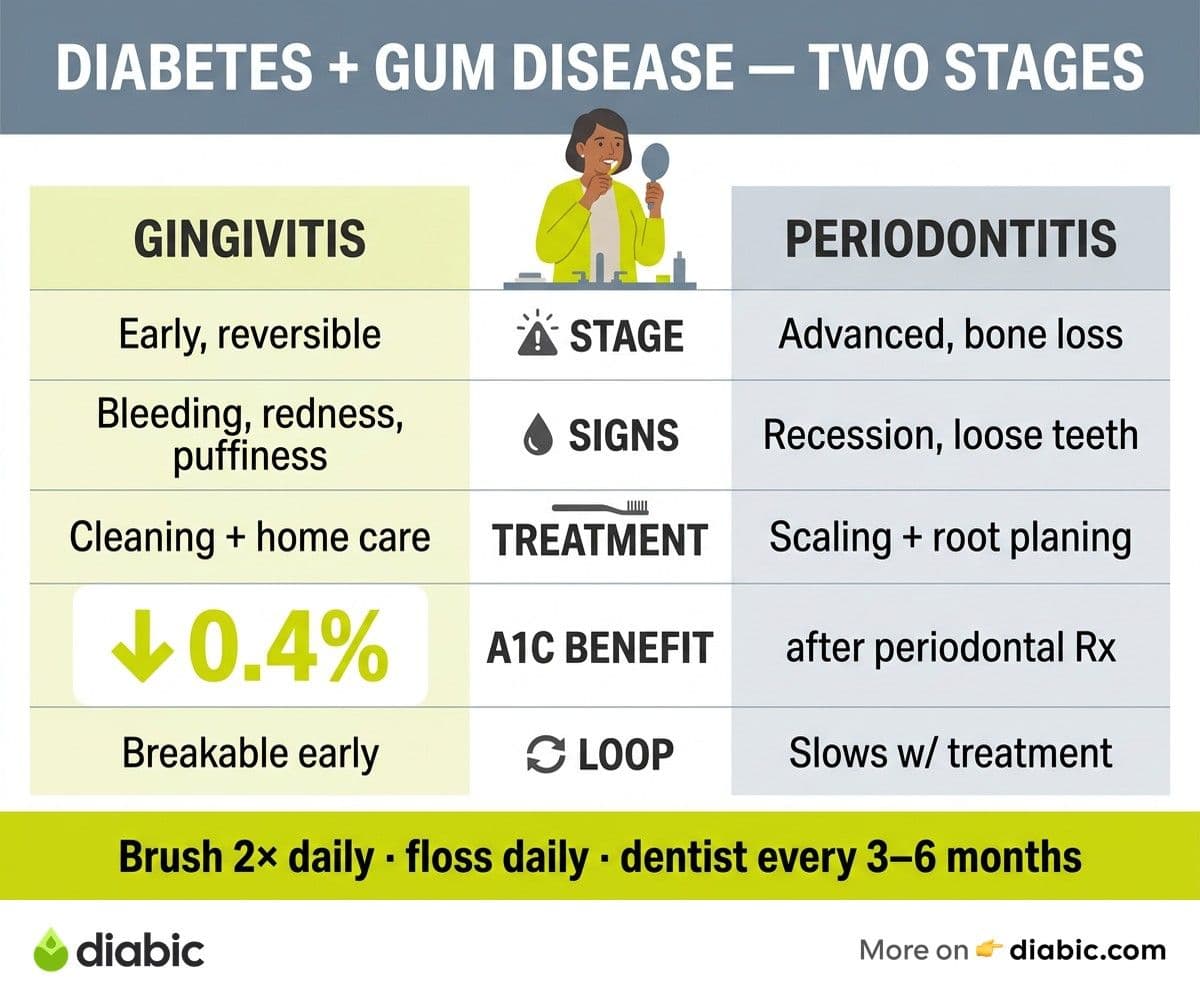
A 2018 systematic review in the journal noted that nonsurgical periodontal treatment was associated with an average A1C reduction of about 0.4 percent in people with type 2 diabetes. That is a meaningful change for many people, comparable to what some medications produce. For more on related oral effects, our guide to the diabetes and tooth decay connection explains how the same blood sugar dynamics affect cavities too.
Stages of Gum Disease to Recognize
Periodontal disease diabetes screening tends to start at the dentist's office, but knowing the stages helps you spot changes between visits. The earlier you catch it, the easier it is to reverse.
Gingivitis is the early, reversible stage. Gums look red or puffy, may bleed when you brush or floss, and sometimes feel tender. Bad breath that does not go away can be a sign too. At this stage, the bone supporting your teeth has not been affected, and good home care plus a professional cleaning often clears it within a few weeks.
Periodontitis is the more advanced stage. The infection moves below the gumline, the gums pull away from the teeth, and the bone that holds the teeth in place starts to erode. Signs include receding gums, loose teeth, persistent bad breath, pus around the gums, and changes in how your teeth fit together when you bite. The CDC oral health data shows that periodontitis affects nearly half of adults over 30, with people who have diabetes facing higher prevalence.
Warning signs to bring to your dentist include any bleeding that lasts longer than a week or two, gum tenderness, visible gum recession, loose teeth, or persistent bad breath. Catching periodontitis early changes outcomes meaningfully. Late-stage cases sometimes require surgery, while earlier cases respond to nonsurgical care.
How to Prevent Diabetes Gum Disease at Home
Prevention rests on two pillars that reinforce each other: oral hygiene and blood sugar management. Doing both consistently is more powerful than doing either one perfectly.
Daily oral hygiene basics:
- Brush twice daily for two minutes with fluoride toothpaste
- Floss every day, ideally before bed, to disrupt plaque between teeth
- Use an antimicrobial mouth rinse if your dentist recommends it
- Replace your toothbrush every three to four months, or sooner if bristles fray
- Clean your tongue gently with a brush or scraper
Blood sugar management is the other half. Aim for the A1C and time-in-range goals you set with your provider. Steady glucose levels reduce the bacterial fuel and inflammatory drivers behind gum disease. Even small improvements may help.
Regular dental visits catch problems early. Most people with diabetes benefit from cleanings every six months, while those with active gum issues may need quarterly visits. Tell your dentist about your diabetes diagnosis, your medications, and your most recent A1C. Our guide on how often people with diabetes should visit the dentist walks through the timing and what to expect.
Quitting smoking deserves its own line. Smoking is a major independent risk factor for gum disease, and smokers with diabetes face significantly higher rates of severe periodontitis. Stopping smoking reduces inflammation in gum tissue and improves the response to dental treatment.
Dental Care Basics for Gum Protection
The right tools and technique matter more than the brand on the package. The American Dental Association recommends a soft-bristled toothbrush, a fluoride toothpaste, and floss or another interdental cleaner used daily. Electric toothbrushes can be helpful for people with limited dexterity or those who tend to brush too hard.
Brushing technique:
- Hold the brush at a 45-degree angle to the gumline
- Use short, gentle strokes, not aggressive scrubbing
- Cover the outer, inner, and chewing surfaces of every tooth
- Brush gently along the gumline, where plaque collects
- Spend about 30 seconds in each quadrant for a full two minutes
Flossing matters because brushing alone misses about 35 percent of tooth surfaces. Slide the floss gently between teeth, curve it around each tooth in a C shape, and move it up and down along the side of the tooth and just below the gumline. Water flossers are a reasonable alternative for people who struggle with traditional floss, though they do not replace it for everyone.
Specialized products such as antimicrobial rinses, prescription-strength toothpastes, and interdental brushes can be useful adjuncts when your dentist recommends them. They are not magic, but they help when used as part of a consistent routine. Our [dental care tips for people with diabetes](/dental-and-oral-health/dental-care-for-people with diabetes-tips-that-help) guide goes deeper into product choices.
From my experience: After fourteen years with type 1 diabetes, my dentist showed me that I was missing the same back molar on the lower right almost every night. We added a small interdental brush at bedtime, and at the next cleaning my hygienist noted clear improvement. The detail mattered more than the effort.
Treatment Options for Gum Disease with Diabetes
If gum disease has set in, treatment is usually effective when caught early. The first line is professional cleaning called scaling and root planing. The dentist or hygienist removes plaque and tartar from above and below the gumline, then smooths the tooth roots so the gums can reattach.
Antibiotic therapy may be added when infection is significant. This can include oral antibiotics, antimicrobial mouth rinses, or antibiotic gels placed directly into gum pockets. Talk to your doctor about how antibiotics may interact with your diabetes medications and what to watch for.
Surgical options come into play for advanced periodontitis. Procedures such as flap surgery or bone and tissue grafts may help restore support around teeth that have lost significant bone. Recovery can be slower in people with diabetes, and your dental and diabetes teams ideally coordinate care to set you up for the best healing.
Coordinating dental and diabetes care produces better results than treating each in isolation. Share your A1C with your dentist, share your dental status with your diabetes team, and ask each provider what the other should know. People who develop oral thrush alongside diabetes often see similar improvements when both conditions are addressed together. Research suggests that integrated care leads to better outcomes for both gum health and blood sugar trends in diabetes gum disease.
FAQ
Why does diabetes increase the risk of gum disease?
Diabetes impairs the immune response, reduces blood flow to the gums, and raises glucose levels in saliva, which feeds harmful bacteria. High blood sugar also slows healing, so small gum problems escalate more easily. The combination raises the risk of both gingivitis and the more serious periodontitis.
How to prevent gum disease when you have diabetes?
Brush twice daily with fluoride toothpaste, floss every day, use an antimicrobial rinse if recommended, manage blood sugar steadily, visit your dentist every six months, and avoid smoking. These habits work together, and consistency matters more than perfection.
Can treating gum disease lower A1C?
Research suggests that nonsurgical periodontal treatment may lower A1C by an average of about 0.4 percent in people with type 2 diabetes. The effect is meaningful for many people. Talk to your doctor and dentist about how to coordinate care if you are managing both conditions.
Are dental visits safe with diabetes?
Yes. Most routine dental care is safe and recommended for people with diabetes. Tell your dentist about your medications and your recent A1C, and try to schedule appointments at times when your blood sugar is usually stable. Bring a snack and glucose tabs in case of low blood sugar.
Diabetes gum disease prevention does not require a dramatic overhaul. It rewards small, steady habits, regular dental visits, and steady blood sugar work. Pick the one habit you have been meaning to add, talk to your doctor or dentist about your next step, and let the basics do their quiet work over time.
Shahriar P. Shuvo is the founder of Diabic. He has lived with diabetes for over 14 years, and built Diabic to deliver the practical, evidence-based self-management tools he wished existed when he was first diagnosed. By trade, Shahriar is a senior design and frontend engineer with 6+ years shipping products at Agora, Timescale (now Tiger Data), and ShareTrip. He writes from the intersection of lived diabetes experience and product craft, focused on what works in daily management rather than what sounds good in a textbook.
Medically reviewed by
Dr. Shanto Arian is an internal medicine physician now specializing in clinical and aesthetic dermatology, with a parallel academic focus on epidemiology and public health. He holds an MBBS, MPH, MSc (UK), MRCP (UK), MRCPI (Ireland), Diploma in Dermatology (UK), and Diploma in Aesthetic Medicine (USA). Dr. Arian trained in internal medicine, including hospital work on hematology cases such as graft-versus-host disease, before moving toward dermatology. Skin is one of the earliest places diabetes shows itself, from acanthosis nigricans and diabetic dermopathy to slow foot wound healing, and that intersection is where his clinical and Diabic-review work meet. On Diabic, Dr. Arian medically reviews content on diabetes diagnosis, complications, dermatologic manifestations, and pharmacotherapy, ensuring every claim aligns with current ADA, NICE, and peer-reviewed literature.
More from Health & Complications
View all
Diabetes and Dental Implants: What to Know First
Diabetes dental implants guide covering safety, A1C targets, recovery expectations, gum health prep, and what to ask your oral surgeon before surgery.

Burning Mouth Syndrome and Diabetes Explained
Burning mouth syndrome diabetes link explained, including neuropathy, dry mouth, and thrush causes plus treatment options that may bring real relief.

Dental Care for people with diabetes: Tips That Help
Practical dental care diabetics need, with real tips for protecting teeth and gums when diabetes raises your risk for oral health problems.
Clinician-reviewed habits, plain-language guides, and honest answers - the small shifts that make living with diabetes feel lighter, every day.