Diabetic Dental Checkup Frequency: How Often to Go
Diabetic dental checkup frequency matters more than most people realize. Learn how often to visit, what to expect, and how to protect your oral health.

In this article(28)
Knowing the right diabetic dental checkup frequency can help you stay ahead of oral health problems before they start. People with diabetes face a higher risk of gum disease, tooth decay, and infections, which makes regular dental visits more important than the standard once-a-year reminder card. The schedule that works for your neighbor may not be the one that works for you.
Most adults are told to see the dentist twice a year, but that advice was built around the average mouth, not yours. When blood sugar runs high, the bacteria in your mouth get more fuel, healing slows down, and small problems turn into big ones faster. The right plan respects that biology rather than ignoring it.
This guide walks through how often you should book visits, what to expect at each appointment, and how to spot trouble between cleanings. The goal is not perfection. The goal is staying ahead of the problems that diabetes makes more likely.
How Often Should people with diabetes Visit the Dentist
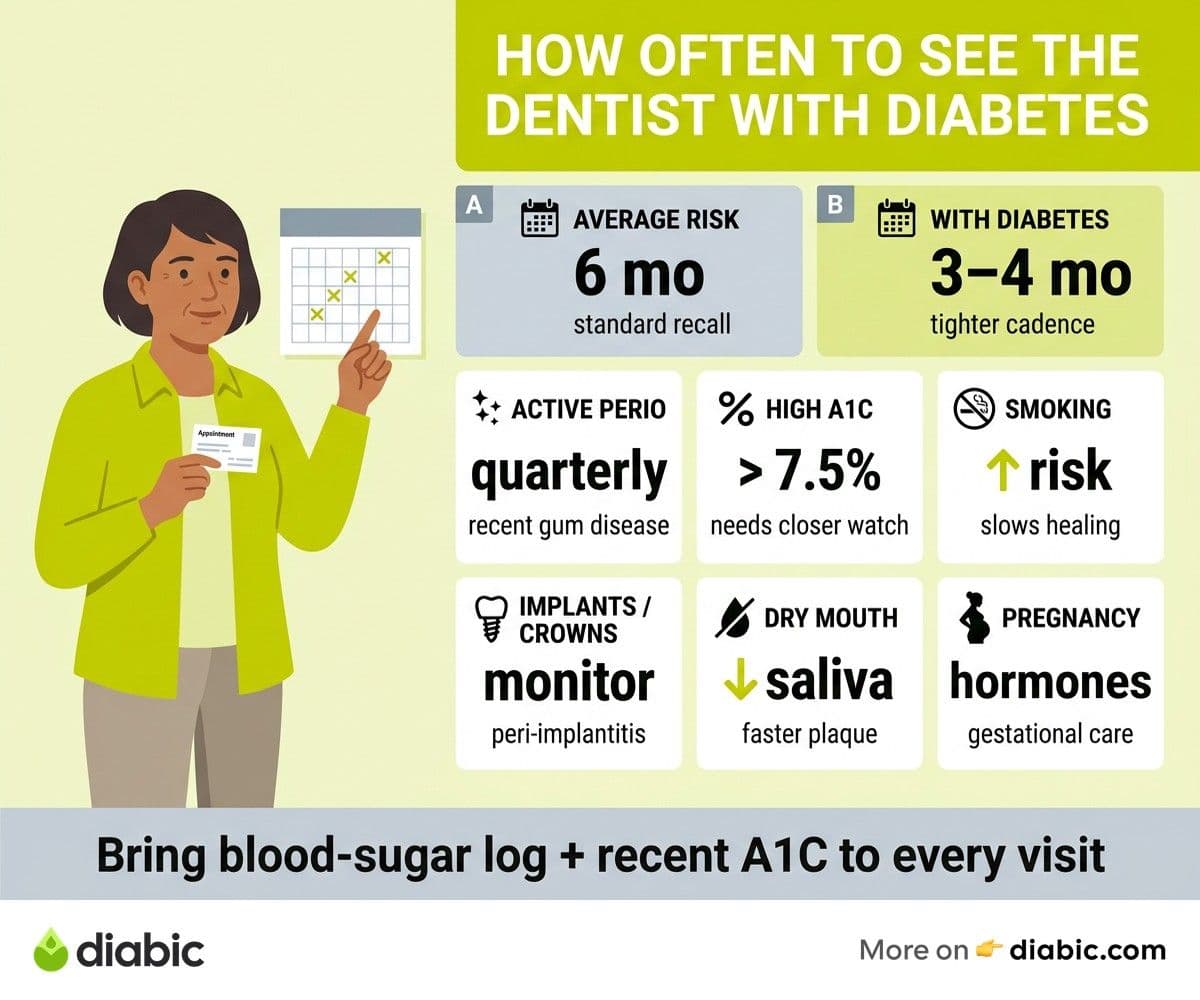
For most people with diabetes, dental cleanings every three to six months are a smarter target than the standard twice-a-year visit. The American Dental Association notes that diabetes is a recognized risk factor for periodontal disease, and people with elevated blood sugar tend to develop gum problems earlier and more aggressively. A shorter interval gives your dentist a chance to catch inflammation before it does lasting damage.
The American Diabetes Association recommends that people with diabetes share their A1C and current management plan with their dental team. That information helps your dentist decide whether you can stretch to six months or whether quarterly visits make more sense. The same recommendation aligns with the diabetes eye exam schedule most providers follow, where risk drives frequency rather than calendar habit.
Why every six months may not be enough
Six months is a long time for plaque to harden into tartar and for early gum inflammation to progress to bone loss. If your A1C is above target or you have already had bleeding gums, the every-six-months plan often misses the window for easy treatment. By the time you arrive, what could have been a deep cleaning has become a more invasive procedure.
People who run higher blood sugars also produce less saliva, which is the mouth's natural rinse cycle. Less saliva means more cavities, more bad breath, and more bacterial growth between visits. Booking a cleaning every three to four months interrupts that cycle before it builds momentum.
Factors that determine your schedule
Several things move you toward more frequent visits. Recent gum disease, an A1C above 8 percent, smoking, dry mouth, and a history of cavities all push the timeline closer to every three months. So does pregnancy with gestational diabetes, where hormonal changes raise gum sensitivity even further.
On the other hand, people with stable blood sugar, healthy gums, and a strong home-care routine can often hold to six-month intervals safely. Ask your dentist for a specific recommendation based on your last exam rather than guessing. The plan should be written down so both of you remember it.
Do people with diabetes Need More Frequent Dental Checkups
For many people the answer is yes, and the reason is biology rather than overcaution. High blood glucose feeds the bacteria responsible for plaque, while diabetes also slows the immune response that normally keeps those bacteria in check. The result is faster progression from healthy gums to gingivitis to periodontitis if visits are spaced too far apart, a connection NIDDK details in its overview of diabetes and gum disease.
A study published in the Journal of Clinical Periodontology found that patients with diabetes who received professional cleanings every three months showed less gum pocket depth and better attachment levels than those on a standard six-month plan. The closer visits also produced small but measurable improvements in A1C, suggesting the inflammation reduction had whole-body benefits.
Risk factors that call for quarterly visits
If you are managing diabetes alongside any of these conditions, ask your dentist about a quarterly schedule:
- Active or recently treated gum disease
- A1C consistently above 7.5 to 8 percent
- Smoking or recent smoking history
- Dental implants or crowns that need close monitoring
- Dry mouth from medications or autoimmune conditions
- Pregnancy with diabetes of any type
Quarterly does not mean four full exams. Many practices alternate between a thorough exam-and-cleaning visit and a shorter maintenance cleaning. The pattern keeps your costs reasonable while still catching problems early.
What the research shows on outcomes
Research on dental visit frequency in people with diabetes consistently points the same direction. Closer monitoring catches inflammation when it is reversible, reduces tooth loss over a decade, and may help with blood sugar stability. None of this means the dentist alone will manage your diabetes. It means the mouth is part of the picture and worth the extra hour every few months.
From my experience: After 14 years with type 1 diabetes, I learned the hard way that gums tell the truth before A1C does. A few weeks of stress and high readings showed up in my mouth before they showed up on a lab report, and a quarterly hygienist appointment caught it early. Now I treat dental visits the same way I treat my endocrinologist visits, on a schedule, not when something hurts.
What Happens During a Dental Checkup for people with diabetes
A person with diabetes dental checkup frequency conversation only matters if the visits themselves are thorough. The good news is that most modern practices already adjust their protocol when they know a patient has diabetes. You should still come prepared so nothing gets skipped.
The visit usually starts with a health update, where the team asks about your current medications, recent A1C, and any changes since the last visit. Share your numbers honestly. The dentist is not grading you, they are calibrating risk.
Oral exam for signs of trouble
The exam looks for early gingivitis, deeper periodontitis, soft-tissue infections, and any cavities forming on tooth surfaces. The dentist also checks the inside of your cheeks, the floor of your mouth, and your tongue for thrush, ulcers, and dry-tissue patches. People with diabetes are more prone to fungal overgrowth, so this part of the exam matters as much as the cavity check.
X-rays are usually taken once a year, sometimes more often if there is a known problem area. They show bone loss that you and the dentist cannot see with the naked eye, which is the most reliable early sign of advancing gum disease.
Professional cleaning and plaque removal
The hygienist removes the hardened tartar that home brushing cannot reach. For people with diabetes, this step is doing more than cosmetic work. It is removing the bacterial reservoir that drives chronic inflammation and pushes A1C upward.
If you have pockets deeper than four millimeters, the cleaning may extend below the gumline. This is sometimes called scaling and root planing, and it may be split across two visits. Local anesthetic is common, and most people tolerate it well.
Screening for diabetes-related conditions
Beyond the standard cleaning, your dental team should screen for oral thrush (the white patches that signal yeast overgrowth), dry mouth severity, and the burning-mouth sensation some people describe when blood sugar runs high. Each of these has specific home-care steps that work better than generic advice.
Bring your blood sugar log to the appointment, especially if you are due for an extraction or any procedure that involves bleeding. Your dentist may want to coordinate timing with your meal and medication schedule.
Diabetic Dental Checkup Frequency and Gum Disease Detection
Gum disease and diabetes feed each other in both directions. High blood sugar makes gum infections more likely, and active gum infections make blood sugar harder to manage. Breaking the loop early is much easier than breaking it late, which is the whole case for frequent checkups.
The earliest stage, gingivitis, is reversible with a professional cleaning and better home care. Once it progresses to periodontitis, the gum has pulled away from the tooth and bone has started to dissolve. That damage does not come back on its own. For more on the biology behind this, see our piece on diabetes and gum disease.
How regular visits detect gingivitis early
A trained hygienist measures pocket depth around every tooth at each visit. Pockets of one to three millimeters are healthy. Four millimeters and up signal trouble, and tracking the trend across visits is what separates a stable mouth from one that is sliding. You will not feel the change at four millimeters, which is exactly why the exam is the only way to catch it.
Bleeding on probing is the other early signal. Healthy gums do not bleed when gently checked, and bleeding gums in someone with diabetes deserve attention even if there is no pain. A short course of more frequent cleanings often resolves the inflammation entirely.
The cost and pain savings of early intervention
Treating gingivitis is a cleaning and some better flossing technique. Treating advanced periodontitis can involve gum surgery, bone grafting, or extractions and implants. The price difference is often a factor of ten, and the recovery is far harder.
People who come in every three to four months rarely face the expensive end of that spectrum. The math favors prevention so heavily that most dental insurance plans now cover additional cleanings specifically for patients with diabetes. Ask your insurer if you are not sure.
Why professional cleaning reaches what home care cannot
Even excellent home brushing and flossing leave roughly 30 percent of plaque untouched, mostly along the gumline and between back teeth. That residual plaque hardens into tartar within two to three days. Once it is tartar, no toothbrush will move it.
The hygienist's instruments and ultrasonic scaler remove tartar without damaging enamel. Skipping cleanings is the dental version of skipping insulin, the disease keeps doing its work whether you are paying attention or not.
Dental Care Between Appointments
Frequent visits work best when paired with consistent home care. The goal is to arrive at each cleaning with as little new damage as possible, so the hygienist is maintaining rather than rescuing.
Brush twice daily with a soft-bristled brush, floss once, and add a fluoride rinse if you are prone to cavities. An electric brush helps people with arthritis or unsteady hands cover the surfaces a manual brush misses. None of these add more than five minutes to your day.
For a deeper walk-through of daily routines, our guide on dental care tips for people with diabetes covers technique, product picks, and the small habit shifts that matter most. If a sticky mouth is part of your daily picture, our breakdown of dry mouth and diabetes home remedies pairs naturally with the schedule we describe here.
Daily habits that reduce emergency visits
A few habits carry most of the weight. Brushing after a high-carb meal removes the sugar bacteria love before it sticks. Drinking water through the day rinses the mouth and helps with the dry-mouth issue many people with diabetes face.
Flossing is the single most underrated habit in diabetes oral health. The hygienist can tell within seconds whether you flossed in the past week, and the gum-pocket numbers reflect it. If string floss is hard, a water flosser does the same work with less hassle.
Signs to see the dentist before your next visit
Some symptoms should not wait. Call your dentist if you notice any of the following:
- Bleeding gums that last more than a week
- A persistent bad taste or breath odor
- Loose teeth or shifting bite
- White patches that do not wipe off
- Sharp pain when chewing or with hot and cold foods
- A swollen face, jaw, or neck
A swollen face with diabetes is an urgent visit, not a next-week visit. Infections spread faster when blood sugar is high, and dental infections can move into the bloodstream.
How home care complements professional checkups
Home care and professional cleanings are not interchangeable. Brushing keeps daily plaque under control. Cleanings remove what brushing cannot. Together they keep the mouth healthy. Skip either one and the system fails.
Think of the cleaning as a reset and the daily routine as the maintenance between resets. Neither alone is enough.
Protecting Against Tooth Decay Between Visits
Diabetes tooth decay is partly a sugar-bacteria story and partly a saliva story. Less saliva means less natural protection, more acid sitting on enamel, and more cavities forming in places that used to be safe. The fix is not just brushing harder. It is rebuilding the conditions that protect teeth in the first place.
A balanced eating pattern is the first line of defense. The same approach that supports stable blood sugar also reduces the constant acid bath enamel takes through the day.
Fluoride use at home
A fluoride toothpaste twice a day is the baseline. People at higher decay risk benefit from a prescription-strength fluoride paste at night, which the dentist can prescribe based on your last few exams. A fluoride mouth rinse adds another layer for people with dry mouth.
Avoid rinsing with water immediately after brushing. The thin layer of fluoride that stays on the teeth is what does most of the protective work. Spit, do not rinse, is the standard advice from most hygienists.
Diet choices that protect enamel
Acidic drinks, including sparkling water flavored with citrus, soften enamel temporarily. Brushing right after acid exposure can scrape that softened layer off. Wait 30 minutes, or rinse with plain water first, then brush.
Sticky carbohydrates, including dried fruit and sugar-free gummies that contain sugar alcohols, cling to teeth longer than chocolate or fresh fruit. Choosing crunchy or wet snacks over sticky ones is one of the simplest decay-prevention swaps.
Managing dry mouth between visits
Dry mouth is one of the most common diabetes oral symptoms and one of the most overlooked. Sip water through the day rather than gulping it all at once. Sugar-free gum with xylitol stimulates saliva and has its own anti-cavity effect.
A bedside humidifier helps people who wake up with a sticky mouth. So does avoiding alcohol-based mouthwashes, which can dry the tissue further. If dry mouth is severe, your dentist or doctor can recommend a saliva substitute or prescription rinse.
Putting It All Together
A practical diabetic dental checkup frequency for most people lands somewhere between every three and every six months, decided with your dentist based on your gum health, blood sugar trend, and history. The visit is doing more than polishing teeth. It is monitoring an organ that responds quickly to the same forces that drive diabetes.
Pair the cleanings with daily brushing and flossing, fluoride, dry-mouth management, and a willingness to call early when something feels off. Most diabetes-related dental problems are reversible if caught at the gingivitis stage and expensive once they are not. The schedule is the cheapest part of the prevention.
Talk to your doctor and dentist about your specific risk picture, and write the next appointment on the calendar before you leave the office. The right diabetic dental checkup frequency is the one you actually keep, and the habit of booking forward is the habit that holds your mouth, and your A1C, in a steadier place over the years.
FAQ
How often should people with diabetes visit the dentist?
Most dental professionals recommend that people with diabetes visit every three to six months rather than the standard once or twice a year. Your specific schedule depends on your gum health, blood sugar management, and oral health history. A dentist who knows your A1C trend can recommend the right interval for you.
Do people with diabetes need more frequent dental checkups?
Often, yes. People with diabetes have higher rates of gum disease, tooth decay, and oral infections, and the conditions tend to progress faster than they do for people without diabetes. More frequent checkups allow for earlier detection and lower-cost treatment.
What happens if I skip a dental checkup with diabetes?
Plaque hardens into tartar within days, and gum inflammation that was reversible can become permanent within months. Skipping a single visit is rarely a disaster, but skipping a year often shows up as bone loss on the next set of X-rays. Catching up sooner is always cheaper than catching up later.
Should I share my A1C with my dentist?
Yes. Your A1C tells the dentist how aggressively to plan cleanings, whether to coordinate with your endocrinologist, and how cautious to be with procedures. Sharing it also helps the team set the right diabetic dental checkup frequency for your situation and recognize patterns, like recurring thrush or dry mouth, that connect back to blood sugar.
Shahriar P. Shuvo is the founder of Diabic. He has lived with diabetes for over 14 years, and built Diabic to deliver the practical, evidence-based self-management tools he wished existed when he was first diagnosed. By trade, Shahriar is a senior design and frontend engineer with 6+ years shipping products at Agora, Timescale (now Tiger Data), and ShareTrip. He writes from the intersection of lived diabetes experience and product craft, focused on what works in daily management rather than what sounds good in a textbook.
Medically reviewed by
Dr. Rezwana Parvin Rumpa is an obstetrics and gynaecology specialist with clinical focus on gestational diabetes, PCOS, and fertility. She holds the MRCOG (Final Part) from the Royal College of Obstetricians and Gynaecologists in London, the MRCPI (Final Part) from the Royal College of Physicians of Ireland, and an MBBS from Shaheed Monsur Ali Medical College under Dhaka University. Dr. Rumpa serves as a Senior Medical Officer in the Obs and Gynae department at BRB Hospitals Ltd, where she has spent three years managing prenatal care, emergency obstetric cases, and women's-health surgery. On Diabic, she medically reviews content for women living with diabetes, with particular attention to pregnancy, PCOS, and reproductive-health intersections.
More from Health & Complications
View all
Diabetes and Dental Implants: What to Know First
Diabetes dental implants guide covering safety, A1C targets, recovery expectations, gum health prep, and what to ask your oral surgeon before surgery.

Burning Mouth Syndrome and Diabetes Explained
Burning mouth syndrome diabetes link explained, including neuropathy, dry mouth, and thrush causes plus treatment options that may bring real relief.

Dental Care for people with diabetes: Tips That Help
Practical dental care diabetics need, with real tips for protecting teeth and gums when diabetes raises your risk for oral health problems.
Clinician-reviewed habits, plain-language guides, and honest answers - the small shifts that make living with diabetes feel lighter, every day.