Wine and Diabetes: How It Affects Blood Sugar
Wine and diabetes explained: how dry vs sweet wines move blood sugar, delayed hypo risk, ADA limits, and how to drink wine safely with diabetes.

In this article(10)
A glass of wine at dinner is one of the most common questions we get from readers managing diabetes, and the honest answer is that wine and diabetes interact in ways that are more interesting than scary, as long as you know what to watch for. The variety in the bottle matters. The size of the pour matters. Whether you are taking insulin or a sulfonylurea matters more than either of those. And what you eat alongside the wine can be the difference between a smooth evening and a 2 a.m. low.
This is not a piece about whether you should drink. That is a personal decision shaped by your health, your medications, your relationship with alcohol, and your provider's input. What we can do is walk through the actual physiology, the carb counts you would not find on most labels, and the practical monitoring habits that make wine more predictable when you choose to pour a glass.
From my experience: Living with type 1 for 14 years, the wine lesson that actually stuck came from my Dexcom around 3 a.m. one night. Two glasses of a dry red with dinner had looked perfectly flat at bedtime, and then the alarm pulled me out of sleep at 62 mg/dL. Ever since, when I drink wine with dinner I keep a small slow-carb snack on the nightstand and double-check my basal coverage. The bottle was not the problem; my liver politely sitting on its glucose stores for hours was.
How Wine and Diabetes Interact in the Body
Wine does two different things to blood sugar at the same time, which is why the response can feel confusing. The carbohydrates in wine, mostly residual sugar left over after fermentation, can nudge blood sugar up. Meanwhile the ethanol itself temporarily blocks your liver from releasing glucose, which can drag blood sugar down hours after the last sip. The net effect depends on the carb content, the amount you drink, your medications, and what you ate.
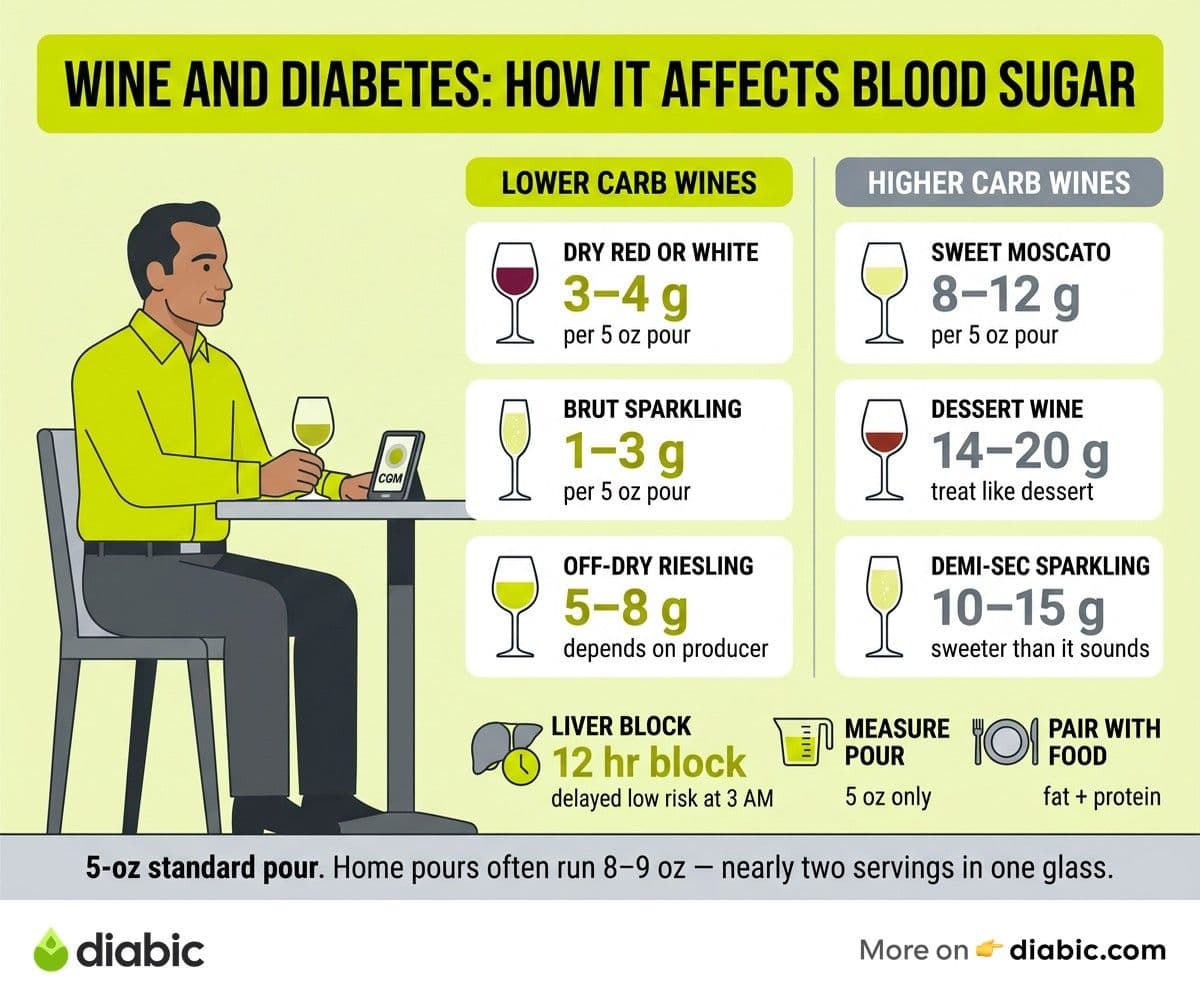
The carb content varies more than most people realize. A 5-ounce pour of dry red or dry white wine usually contains 3 to 4 grams of carbohydrate. A semi-sweet Riesling can land around 5 to 8 grams. A late-harvest dessert wine or a port can easily clear 14 to 20 grams in the same pour. The USDA FoodData Central database is one of the few public sources that tracks these differences in detail, since wine bottles in the United States rarely show nutrition labels.
The delayed hypoglycemia piece is what catches people off guard. The American Diabetes Association notes that alcohol can suppress hepatic glucose production for up to 12 hours after the last drink, which is why a low can show up at 3 a.m. after wine with dinner. People taking insulin or sulfonylureas are at the highest risk because those medications cannot ease off when blood sugar starts falling. Metformin alone does not cause lows, but it does not protect you from this either when wine is in the mix.
Polyphenols and resveratrol get a lot of attention in headlines, mostly attached to red wine. The research is genuinely interesting and genuinely modest. A few small trials suggest mild improvements in HDL cholesterol or fasting glucose with moderate red wine, but the effects are small enough that no major medical body recommends starting to drink for the polyphenols. If you already enjoy a glass and tolerate it well, the compounds are a bonus, not a strategy.
Choosing Wine When You Live With Diabetes
If your goal is keeping post-pour blood sugar predictable, dry wines are the easiest place to start. Cabernet Sauvignon, Pinot Noir, Merlot, Syrah, and most Bordeaux-style reds finish fermentation with very little residual sugar, often under 2 grams per 5-ounce serving. On the white side, Sauvignon Blanc, Pinot Grigio, unoaked Chardonnay, and most dry rosés land in similar territory.
Sparkling wines deserve a closer look at the label, because the dryness scale runs from extra brut and brut nature on the very dry end through brut, extra dry, dry, and demi-sec. Confusingly, "extra dry" champagne is sweeter than "brut." For diabetes purposes, brut nature, extra brut, or brut are the safer bets, with carbs typically in the 1 to 4 gram range per serving. A demi-sec or doux can climb past 10 grams.
Wines worth treating like dessert rather than dinner include Sauternes, ice wine, late-harvest Riesling, ruby and tawny ports, sherry on the sweeter end, Madeira, and Moscato d'Asti. None of these are off-limits, but they belong in the same mental category as a slice of cake. If you want one, dose for it the way you would dose for dessert, and pair it with protein or fat to slow absorption.
For readers exploring low-carb alcoholic drink options for diabetes more broadly, dry wine generally compares favorably to most cocktails and beers on the carb axis, though hard liquor with zero-carb mixers comes in lowest. The tradeoff is that liquor concentrates ethanol per ounce, which raises the delayed-low risk if you do not pace yourself carefully.
Carb Counts and Serving Sizes That Actually Work
The pour is where most people get tripped up. A standard wine serving in nutrition data is 5 ounces, which looks surprisingly small in a modern wine glass. A generous home pour is often closer to 8 or 9 ounces, meaning you may be drinking nearly two servings while counting it as one. If you are tracking carbs or planning around medications, measure your pour with a kitchen scale or a marked glass for a week to recalibrate.
Rough carb estimates for a 5-ounce pour, drawn from USDA data and producer disclosures:
- Dry red (Cabernet, Pinot Noir, Merlot, Syrah): 3 to 4 grams
- Dry white (Sauvignon Blanc, Pinot Grigio, dry Chardonnay): 3 to 4 grams
- Brut champagne or sparkling wine: 1 to 3 grams
- Off-dry Riesling or Gewurztraminer: 5 to 8 grams
- Sweet Moscato or demi-sec sparkling: 8 to 12 grams
- Late-harvest dessert wine or port: 14 to 20 grams
A growing category of "low-sugar" or "keto-friendly" wine brands markets aggressively to people watching carbs. Many of these products are simply dry wines, which would already be low in residual sugar, sold at a premium with marketing copy. A few are genuinely fermented to near-zero residual sugar through extended fermentation. Reading the technical sheet on the producer's website tells you more than the label, and a regular dry wine from a reputable winery often delivers the same numbers for less money.
If a wine has no nutrition information available, a reasonable working assumption for unfamiliar dry table wines is 4 grams of carb per 5 ounces. For unfamiliar sweet or fortified wines, assume 12 grams or more until you can verify. Then check your CGM or glucose meter and let the data refine your estimate over time.
Wine, Medications, and the ADA Pattern
The American Diabetes Association's nutrition therapy guidelines frame moderate alcohol intake as up to one drink per day for women and up to two drinks per day for men, with one drink defined as 5 ounces of wine, 12 ounces of beer, or 1.5 ounces of distilled spirits. Those numbers are not goals to hit. They are upper limits that apply to people who already drink and who do not have other reasons to abstain.
Medication interactions matter more than the abstract limit. Insulin and sulfonylureas, the latter including glipizide, glyburide, and glimepiride, both lower blood sugar actively, and combining them with wine raises hypoglycemia risk substantially. The National Institute on Alcohol Abuse and Alcoholism has detailed guidance for clinicians on these interactions, and it is worth a look if you take either class.
Metformin is generally safer with wine in moderate amounts, though heavy drinking raises the rare risk of lactic acidosis. GLP-1 medications can amplify alcohol's nausea and slowed-stomach-emptying effects, so people on semaglutide or tirzepatide often find that a single glass hits harder than it used to. SGLT-2 inhibitors carry their own caution because alcohol can increase the risk of euglycemic diabetic ketoacidosis. None of these are reasons to swear off wine. They are reasons to talk through specifics with your prescriber.
A few non-negotiable safety rules apply across medications:
- Never drink wine on an empty stomach if you take any glucose-lowering medication
- Eat a meal or substantial snack with carbs and protein alongside or before the wine
- Carry a fast-acting glucose source and tell at least one person you are with that you have diabetes
- Avoid drinking alone if you are still learning your personal pattern with wine
For a deeper look at the broader picture, our guide to alcohol and diabetes walks through beer, spirits, and cocktail-specific guidance. People with type 2 specifically may also want to read about alcohol risks specific to type 2 diabetes, since the cardiovascular and liver-health considerations are distinct.
Red Wine, Resveratrol, and the Honest Evidence
The "red wine is good for you" headline has roots in real research, but the picture is more cautious than the marketing. The CASCADE trial published in the Annals of Internal Medicine followed 224 adults with type 2 diabetes over two years comparing red wine, white wine, and water with dinner. The red wine group showed modest improvements in HDL cholesterol and some lipid markers, with no meaningful change in glycemic outcomes. Both wine groups were drinking 5 ounces with the evening meal, not freely throughout the day.
A few things stand out from CASCADE and similar studies. The benefits required moderate, food-paired consumption, not free-flowing drinking. The effect sizes were small, useful for someone who already drinks but not large enough to outweigh other risks. The participants were Mediterranean-diet adherent at baseline, which is itself a strong cardiovascular intervention. Generalizing the findings to a person who does not eat that way is a stretch.
The American Heart Association is explicit on this point: it does not recommend that anyone start drinking alcohol to improve cardiovascular health. The AHA position acknowledges the observational data linking moderate intake to lower cardiovascular events but stops short of endorsing wine as a heart strategy. Resveratrol supplements similarly underperform expectations in clinical trials, where high-dose pills have not consistently delivered the benefits associated with moderate red wine in cohort studies.
The reasonable takeaway is that if you enjoy red wine and tolerate it, moderate consumption with meals is unlikely to harm cardiometabolic markers and may help slightly. If you do not currently drink, the evidence does not support starting. And if you find that wine consistently disrupts your sleep, mood, or blood sugar, that signal is more important than any population-level study.
Monitoring Wine's Effect on Your Blood Sugar
The fastest way to learn your personal pattern is to test deliberately. A continuous glucose monitor makes this easier, but a meter works too. Check before you drink, an hour after, before bed, and once overnight if you can manage it. Pay particular attention to the 4 to 8 hour window after your last sip, since that is when alcohol-driven lows tend to appear.
Look for a few specific patterns in your CGM data. A small bump 30 to 60 minutes in suggests carb content is doing something, more typical with off-dry or sweet wines. A flat-line followed by a slow drift down 3 to 6 hours later is the classic alcohol signature, more common with dry wines. A sharp spike followed by a sharp drop usually points to a sweet wine on top of a high-carb meal.
A simple log helps more than memory does. Write down the wine variety, the size of the pour, what you ate alongside, your starting blood sugar, and any notable readings over the next 12 hours. After three or four sessions, your own pattern usually becomes legible, and you can adjust food, dose, or timing accordingly.
For evening wine, bedtime checks deserve special attention. Many endocrinologists suggest a small bedtime snack with slow carbs, around 15 grams, when wine has been part of dinner and you take basal insulin. This is exactly the kind of detail to work out with your care team, because the right snack and the right reduction in any insulin dose depend on your specific regimen.
Frequently Asked Questions
Is red wine good for people with diabetes?
The evidence is modest. Studies like the CASCADE trial show small improvements in HDL cholesterol and lipid markers when moderate red wine is consumed with meals, but no major medical organization recommends starting to drink for these benefits. If you already enjoy red wine in moderation, the polyphenols are a reasonable bonus. If you do not drink, the data does not support starting for cardiovascular reasons.
How does wine affect blood sugar levels?
Dry wines typically have a small initial effect because their carb content is low, around 3 to 4 grams per 5-ounce pour. Sweet and dessert wines can spike blood sugar significantly, sometimes 14 to 20 grams of carb per pour. Across all wine types, ethanol can suppress liver glucose release for several hours, which leads to delayed lows that may show up overnight. People taking insulin or sulfonylureas need to watch this delayed effect particularly closely.
What is the safest wine to drink with diabetes?
Dry red and dry white wines are generally the lowest-carb options, alongside brut or extra brut sparkling wines. Cabernet Sauvignon, Pinot Noir, Merlot, Sauvignon Blanc, Pinot Grigio, and unoaked Chardonnay are reliable picks. Pair the wine with food, keep the pour to 5 ounces, and check blood sugar before and several hours after drinking. Talk to your provider if you take insulin or a sulfonylurea, since those medications change the safety calculus.
The honest summary on wine and diabetes is that a glass with dinner can fit into a steady management plan when you respect the carb math, the medication interactions, and the delayed-low window. Pick dry varieties, measure your pour, eat real food alongside, and check your numbers across the next twelve hours until you know your own pattern. Bring the data to your provider so any insulin or sulfonylurea adjustments come from your real readings rather than guesswork.
Shahriar P. Shuvo is the founder of Diabic. He has lived with diabetes for over 14 years, and built Diabic to deliver the practical, evidence-based self-management tools he wished existed when he was first diagnosed. By trade, Shahriar is a senior design and frontend engineer with 6+ years shipping products at Agora, Timescale (now Tiger Data), and ShareTrip. He writes from the intersection of lived diabetes experience and product craft, focused on what works in daily management rather than what sounds good in a textbook.
Medically reviewed by
Dr. Rezwana Parvin Rumpa is an obstetrics and gynaecology specialist with clinical focus on gestational diabetes, PCOS, and fertility. She holds the MRCOG (Final Part) from the Royal College of Obstetricians and Gynaecologists in London, the MRCPI (Final Part) from the Royal College of Physicians of Ireland, and an MBBS from Shaheed Monsur Ali Medical College under Dhaka University. Dr. Rumpa serves as a Senior Medical Officer in the Obs and Gynae department at BRB Hospitals Ltd, where she has spent three years managing prenatal care, emergency obstetric cases, and women's-health surgery. On Diabic, she medically reviews content for women living with diabetes, with particular attention to pregnancy, PCOS, and reproductive-health intersections.
More from Living with Diabetes
View all
A Gentle Chair Yoga Routine for people with diabetes
A gentle chair yoga for people with diabetes routine with safe poses, modifications for neuropathy, retinopathy, and joint pain, plus tips for older.

Shift Work and Diabetes: Managing Irregular Hours
Shift work and diabetes is a tough combination. Learn how to manage meals, sleep, medication, and blood sugar when your hours rotate or flip overnight.

Dating with Diabetes: When to Tell a New Partner
Dating with diabetes brings unique disclosure questions. Here is when to tell a new partner, what to say, and how to handle the conversation with.
Clinician-reviewed habits, plain-language guides, and honest answers - the small shifts that make living with diabetes feel lighter, every day.