Iron Supplements and Diabetes: What to Know
Iron supplements and diabetes have a tricky relationship. Learn how iron status affects insulin resistance, A1C accuracy, and supplement safety.

In this article(12)
Most supplement conversations are simple, take it if you are low, skip it if you are not. Iron is different. The relationship between iron supplements and diabetes is one of the few areas in nutrition where both deficiency and excess can hurt you, and where the same lab test, your A1C, can be thrown off by your iron status. That makes a routine iron pill less routine than it looks.
If you are managing diabetes and wondering whether to take iron, this is the kind of decision that genuinely needs a blood test and a conversation with your provider before a trip to the supplement aisle. Below, we will walk through what the research shows, what to ask your doctor, and how iron interacts with the other minerals you may already be taking.
The Connection Between Iron Supplements and Diabetes
People with diabetes are more prone to iron deficiency than the general population, but the picture is uneven. Premenopausal women, vegetarians, vegans, people on long-term metformin, and anyone with chronic kidney disease are most at risk. Studies in the American Journal of Clinical Nutrition have shown that iron status is meaningfully different across these subgroups, which is why a single recommendation does not fit everyone.
Metformin deserves a specific note. Long-term metformin use is associated with reduced absorption of vitamin B12 and, in some studies, lower iron stores too. The American Diabetes Association recommends periodic B12 monitoring for people on metformin for several years, and many endocrinologists extend that to a periodic ferritin and iron panel for the same reason.
The paradox is what makes iron tricky in diabetes. Too little iron causes fatigue, breathlessness, and impaired glucose handling because hemoglobin and oxygen delivery are compromised. Too much iron, on the other hand, accumulates in tissues like the liver and pancreas and is associated with worse insulin resistance and a higher risk of type 2 diabetes. Healthy iron status sits in a middle band, and supplementing without testing can push you in the wrong direction. If you are early in your supplement decisions, our broader piece on vitamin D supplements for diabetes covers the same testing-first principle that applies here.
Can Iron Supplements Affect Blood Sugar?
The short answer, iron itself does not raise blood sugar in the moment, but iron status influences your blood sugar story in two important ways.
The first is insulin resistance. Research published in Diabetes Care and similar peer-reviewed journals has shown that elevated ferritin, the storage form of iron, is consistently linked with increased insulin resistance and a higher risk of developing type 2 diabetes. Mechanistically, excess iron generates oxidative stress in pancreatic beta cells and liver tissue, which impairs how those tissues respond to insulin. This is one reason hereditary hemochromatosis, a genetic iron-overload condition, is associated with secondary diabetes when untreated.
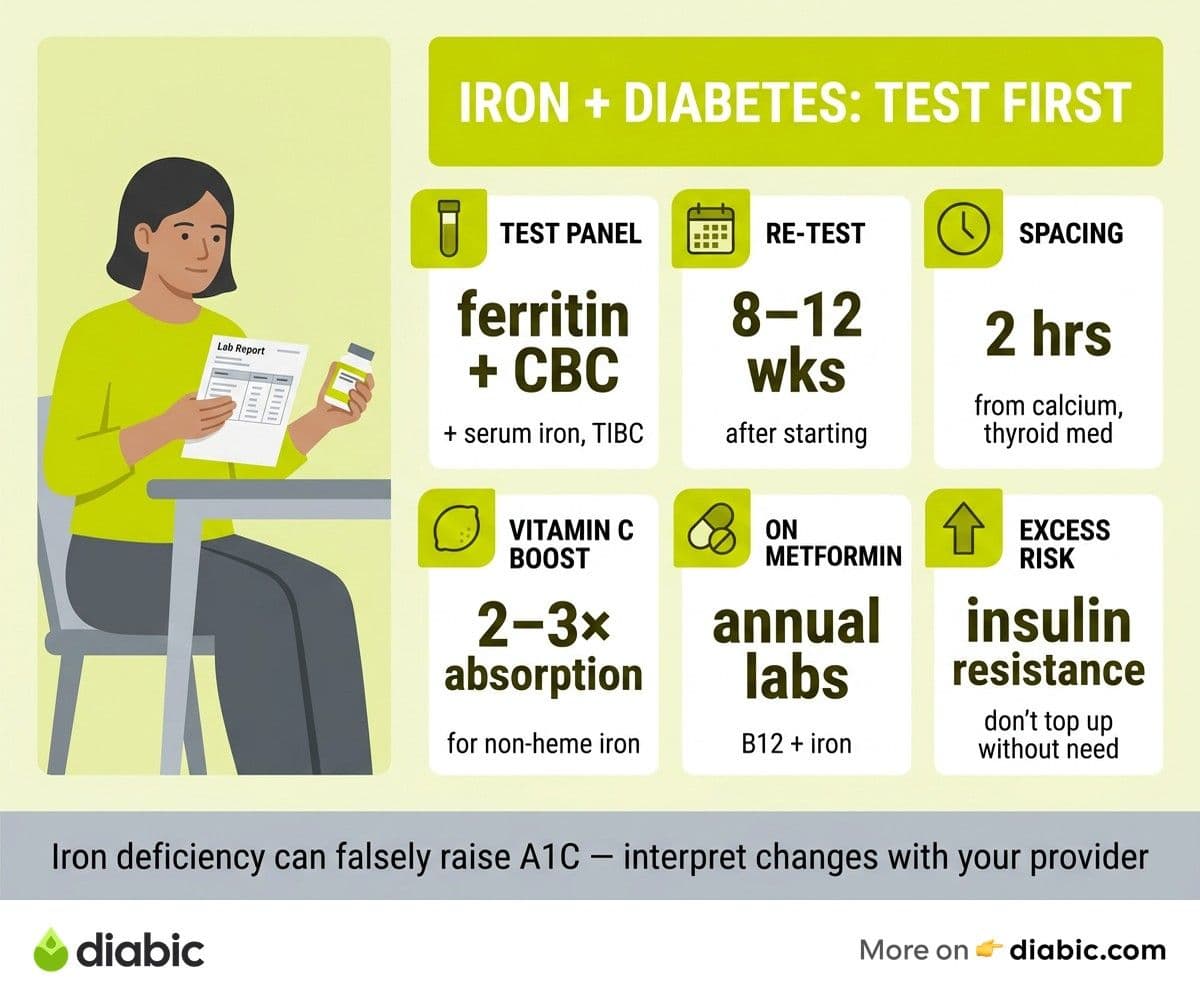
The second is A1C test accuracy. Your A1C reflects how much glucose has attached to hemoglobin over the past 2 to 3 months, and it depends on a relatively normal red blood cell turnover rate. Iron deficiency anemia can falsely raise A1C results because older, more glucose-laden red blood cells stick around longer. After iron supplementation kicks in and red cell turnover normalizes, A1C may temporarily fall in a way that does not actually reflect a change in your blood sugar.
What that means in practice, if you start an iron supplement and your A1C looks meaningfully different at your next visit, that change might be partly mechanical rather than a real shift in glucose control. Your provider can interpret it alongside fasting glucose, time-in-range from a CGM if you have one, and a fructosamine test if needed.
Calcium Supplements and Diabetes: A Related Consideration
Calcium supplements for diabetes come up in the iron conversation because the two minerals compete for absorption in the gut. Taking calcium and iron at the same time can reduce iron uptake by 50 percent or more, which is a problem if you are supplementing to correct a deficiency.
Calcium has its own role in diabetes management. It is involved in insulin secretion from pancreatic beta cells and in muscle contraction, including the heart muscle. Most people get enough calcium from food, but postmenopausal women, people who avoid dairy, and those on long-term steroids may benefit from supplementation under medical guidance.
If you take both, the standard advice is to separate them by at least 2 hours. A common pattern, iron with breakfast and calcium with dinner, or vice versa. Some people pair calcium with their evening meal because it can support sleep through its effects on melatonin pathways.
When calcium supplementation makes sense for someone with diabetes generally lines up with the same criteria as the rest of the population, low intake from food, documented bone density concerns, or a provider's specific recommendation. The diabetes context mostly matters for the timing, not the decision itself.
Are Iron Supplements Safe for People with Diabetes?
Iron supplements are safe for people with diabetes when they correct a documented deficiency under medical supervision. They are not safe as a daily multivitamin top-off if your levels are already in range, because the body has no efficient way to excrete excess iron, and stores accumulate over years.
The National Institutes of Health Office of Dietary Supplements provides reference ranges and supplementation guidance, but the right dose for you depends on how low your levels are, why they are low, and what other medications you take. We are not going to list specific dosages here, that is genuinely a conversation for your doctor.
Side effects are common with iron supplements and worth knowing about going in. Constipation, nausea, dark stools, and stomach upset affect a meaningful share of people who take ferrous sulfate, the most common form. Switching to ferrous bisglycinate or taking the supplement every other day instead of daily can reduce side effects without compromising absorption, based on more recent research from groups studying alternate-day dosing protocols.
Drug interactions matter for diabetes medications. Iron can reduce the absorption of levothyroxine if you take thyroid medication, which a meaningful share of people with type 1 diabetes do. It can also interact with antibiotics in the tetracycline and quinolone families. Spacing iron at least 2 hours from these medications usually prevents the issue.
The non-negotiable step is testing first. Ask for a ferritin level alongside a CBC and a serum iron panel before starting iron, and re-test after 8 to 12 weeks of supplementation to confirm the strategy is working. Without those data points, you are guessing.
Nutrition and Diabetes: Getting Iron from Food First
When the goal is good nutrition and diabetes management, food is almost always the safer starting point for iron. The body absorbs iron from food more selectively than from supplements, which lowers the overload risk.
Iron in food comes in two forms. Heme iron, found in red meat, poultry, and fish, is absorbed at 15 to 35 percent. Non-heme iron, found in beans, lentils, tofu, spinach, fortified cereals, and pumpkin seeds, is absorbed at a more variable 2 to 20 percent depending on what you eat with it. Both forms are useful, and a diabetes-friendly diet can include plenty of either.
Vitamin C dramatically boosts non-heme iron absorption. Pairing lentils with bell peppers, spinach with strawberries, or fortified cereal with citrus can multiply your absorption two to three times over. This is one of the easiest meal-planning tricks for vegetarians and vegans managing diabetes.
A few things inhibit iron absorption and matter for timing. Coffee and tea contain tannins that block non-heme iron, so an iron-rich meal followed by coffee absorbs less iron than the same meal with water. Calcium, as covered above, competes with iron. Whole grains contain phytates that bind iron, though soaking, sprouting, and fermenting reduces this effect. None of this means avoiding coffee or whole grains, it just means spacing them when you are working to rebuild iron stores.
If you are mostly plant-based, the practical approach is to combine non-heme iron sources with vitamin C at meals and save coffee or tea for between meals. Most people get enough iron from a varied diet without supplements, even with diabetes.
Working with Your Doctor on Iron and Diabetes
Iron is one of the supplements where ordering the right tests is more useful than reading another article. The standard panel includes ferritin, serum iron, total iron-binding capacity (TIBC), transferrin saturation, and a CBC. Each one tells a different piece of the story, and your provider needs the whole picture to make a recommendation.
Interpreting iron labs in the context of diabetes adds a wrinkle. Ferritin is also an inflammation marker, so if you have elevated inflammation from poorly managed diabetes, infections, or autoimmune conditions, ferritin can look artificially high. A CRP test alongside ferritin helps your provider sort out whether high ferritin reflects iron stores or inflammation.
The Endocrine Society has guidance on micronutrient testing in people with metabolic conditions, and most endocrinologists will run iron labs as part of an annual workup if you are on metformin or have other risk factors. If iron supplementation is started, a follow-up panel at 8 to 12 weeks tells you whether the dose is working, and a longer-term re-test at 6 months helps you decide when to stop.
Other minerals come up in this conversation too. Zinc supplements for diabetes and magnesium supplements and diabetes both have their own diabetes-specific considerations, and zinc in particular can compete with iron for absorption if both are taken at the same time. Your provider can help you build a supplement schedule that does not have minerals canceling each other out.
From my experience: In 14 years of living with diabetes, I have had my iron tested every year as part of a standard panel, and the levels have moved meaningfully in both directions over time. The takeaway, my own data has been more useful than any general recommendation. If you are not getting iron tested at least annually, especially on metformin, that is the first thing worth fixing before you decide whether to supplement.
FAQ
Are iron supplements safe for people with diabetes?
Iron supplements are safe when used to correct a documented deficiency under medical supervision. Supplementing without a confirmed need can push iron stores higher than is healthy, and research has linked elevated ferritin with worsened insulin resistance and higher type 2 diabetes risk. Test first, supplement second, and re-test to confirm the strategy is working.
Can iron supplements affect blood sugar levels?
Iron does not directly raise blood sugar after a dose, but iron status affects insulin resistance and the accuracy of A1C tests. Excess iron stores are associated with higher insulin resistance over time, and iron deficiency anemia can artificially raise A1C readings while supplementation can artificially lower them. Your provider should interpret A1C changes alongside other glucose markers if you are on iron.
Should I take iron with my diabetes medication?
Many diabetes medications are fine to take alongside iron, but a few interactions matter. Iron can reduce the absorption of levothyroxine if you also take thyroid medication, and it can interact with certain antibiotics. Spacing iron at least 2 hours away from these medications and from calcium supplements is the standard approach. Your pharmacist can flag any specific concerns for your medication list.
What is the best form of iron for someone with diabetes?
The form that works best is the one your body tolerates and absorbs. Ferrous sulfate is the most studied and least expensive but causes more GI side effects in some people. Ferrous bisglycinate is gentler on the stomach and well-absorbed. Heme iron polypeptide is another option for sensitive stomachs. The dose, schedule, and form should be set by your provider based on your labs.
Can metformin cause iron deficiency?
Long-term metformin use is associated with lower iron stores in some people, alongside the better-known effect on B12 absorption. The mechanism is not fully understood, but the practical implication is straightforward, if you have been on metformin for several years, your annual labs should include ferritin and a B12 level. Catching low iron early lets you address it through diet or supplementation before it becomes anemia.
The honest answer about iron supplements and diabetes is that there is no universal recommendation, and that is fine. The recommendation is to know your numbers, work with someone who can interpret them in your specific context, and treat any supplement decision as a data-informed one rather than a hunch. Get the test, then get the answer.
Shahriar P. Shuvo is the founder of Diabic. He has lived with diabetes for over 14 years, and built Diabic to deliver the practical, evidence-based self-management tools he wished existed when he was first diagnosed. By trade, Shahriar is a senior design and frontend engineer with 6+ years shipping products at Agora, Timescale (now Tiger Data), and ShareTrip. He writes from the intersection of lived diabetes experience and product craft, focused on what works in daily management rather than what sounds good in a textbook.
Medically reviewed by
Dr. Shanto Arian is an internal medicine physician now specializing in clinical and aesthetic dermatology, with a parallel academic focus on epidemiology and public health. He holds an MBBS, MPH, MSc (UK), MRCP (UK), MRCPI (Ireland), Diploma in Dermatology (UK), and Diploma in Aesthetic Medicine (USA). Dr. Arian trained in internal medicine, including hospital work on hematology cases such as graft-versus-host disease, before moving toward dermatology. Skin is one of the earliest places diabetes shows itself, from acanthosis nigricans and diabetic dermopathy to slow foot wound healing, and that intersection is where his clinical and Diabic-review work meet. On Diabic, Dr. Arian medically reviews content on diabetes diagnosis, complications, dermatologic manifestations, and pharmacotherapy, ensuring every claim aligns with current ADA, NICE, and peer-reviewed literature.
More from Diet & Fitness
View all
Simple Diabetes Exercise Routine for Beginners
A simple diabetes exercise routine for beginners with a 7-day plan, strength basics, and safety tips to help you move more without feeling overwhelmed.

Diabetes Friendly Smoothie Recipes: 5 No-Spike Picks
Five diabetes friendly smoothie recipes that balance protein, fat, and fiber to keep blood sugar steady. Includes a simple framework for building your own.

Can Exercise Prevent Diabetes? Research Says Yes
Can exercise prevent diabetes? Landmark studies show a 58% lower risk with regular activity. Here's how much you need and which workouts help most.
Clinician-reviewed habits, plain-language guides, and honest answers - the small shifts that make living with diabetes feel lighter, every day.