Living With Type 1 Diabetes: A Daily Guide
Living with type 1 diabetes day to day takes real planning. Get the routines, tools, and mindset shifts that make management feel doable, not overwhelming.

In this article(18)
Living with type 1 diabetes means managing a condition that never takes a day off. Every meal, every workout, every stressful meeting can shift your blood sugar in ways that are hard to predict. This daily guide covers the routines, tools, and mindset shifts that make type 1 diabetes manageable rather than constantly overwhelming.
We are not promising perfect numbers. We are sharing the rhythms that help most people with type 1 build a life that feels stable, even when blood sugar refuses to cooperate. The goal is not to think about diabetes less. The goal is to think about it more efficiently, so it takes up less mental space over time.
Most people newly living with type 1 diabetes worry about the workload first and the long term second. Both concerns deserve real answers. The sections below walk through how a typical day looks, how to use your numbers without obsessing over them, and how to keep the emotional side from quietly wearing you down.
What Living with Type 1 Diabetes Looks Like Day to Day
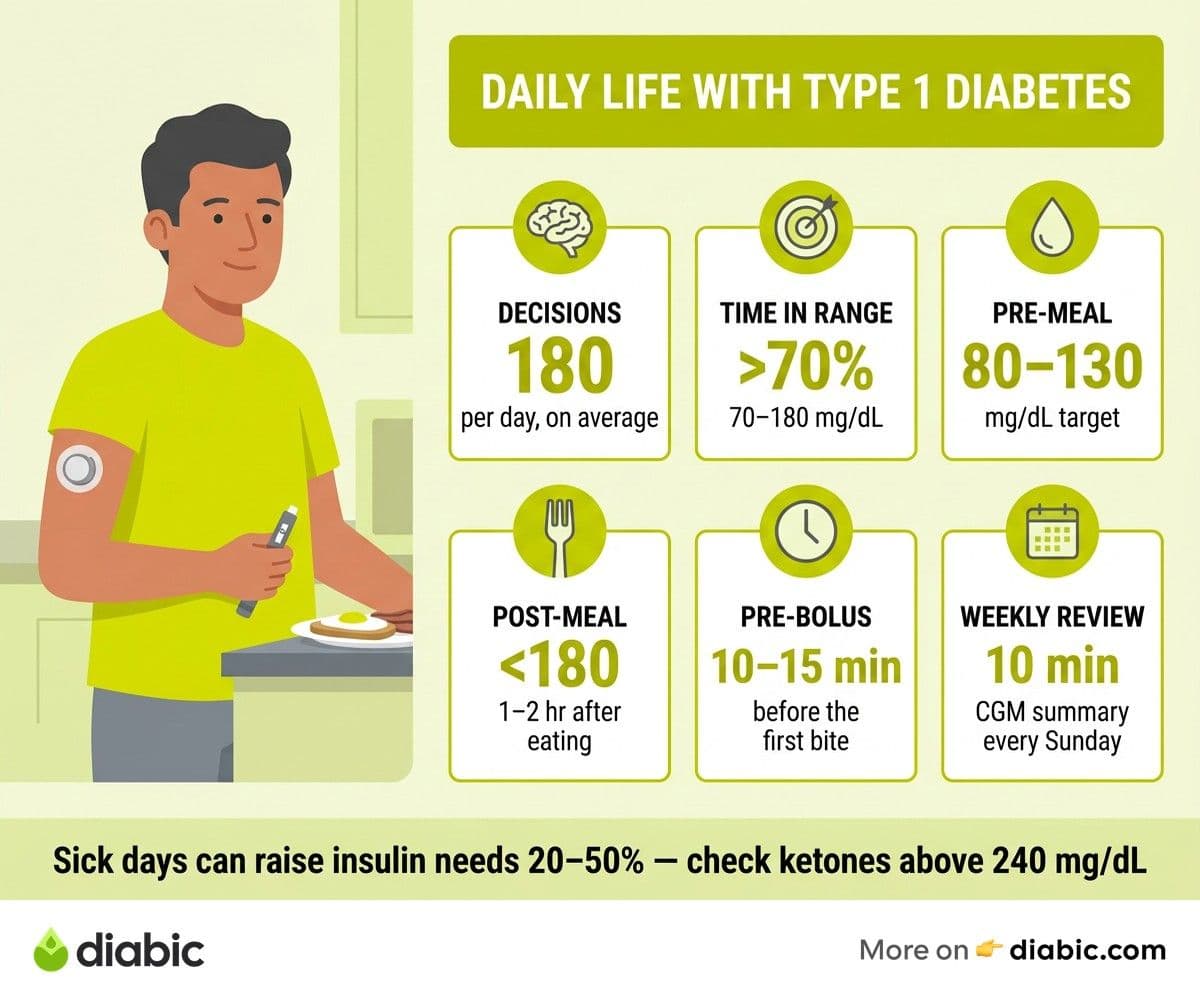
Daily life with type 1 diabetes runs on a quiet loop of small decisions. Check, dose, eat, move, recheck. None of these steps are dramatic on their own, but they add up to roughly 180 extra choices a day that someone without diabetes does not have to make. According to the American Diabetes Association, this constant decision load is one of the main reasons routines matter so much.
A solid morning routine usually starts with a blood sugar check, either through a finger prick or a quick glance at a continuous glucose monitor. Many people then take a basal dose of long-acting insulin or trust their pump to deliver it automatically. Breakfast comes with a carb count and a bolus dose, ideally given 10 to 15 minutes before the first bite. That pre-bolus window can be the difference between a smooth morning and a 250 mg/dL spike at 10 a.m.
By midday, real life starts to interfere with the plan. A walking meeting drops your numbers. A stressful presentation pushes them up. A surprise birthday cake at lunch needs a correction dose and maybe a temporary basal change. This is where understanding insulin therapy for type 1 pays off, because you stop reacting to numbers and start anticipating them. If a reader is still working out the basics of what is type 1 diabetes, starting with that foundation makes the daily routine much easier to follow.
Evenings carry their own challenges. Dinners are often larger, fattier, and later than other meals, which can cause delayed glucose rises hours after eating. Many people with type 1 also fight the dawn phenomenon overnight, where hormones push blood sugar up before sunrise. A consistent bedtime check, a snack policy that matches your insulin sensitivity, and an alarm threshold on your CGM can keep nighttime lows and highs from running your sleep.
Blood Sugar Monitoring as a Daily Habit
Monitoring is the foundation that everything else rests on. Without numbers, dosing turns into guessing. With numbers, you can spot patterns and adjust. The CDC's guidance on managing blood sugar recommends regular checks before meals, before bed, and any time you feel off, with more frequent checks during illness, exercise, or medication changes.
Finger-prick testing versus CGM
Finger-prick meters are still accurate, affordable, and useful as a backup, but most people with type 1 in the United States now use a continuous glucose monitor as their primary tool. A CGM checks your interstitial glucose every one to five minutes and shows trend arrows that tell you which direction your number is heading. That direction often matters more than the single value itself.
A reading of 110 with a double-down arrow is heading for a low and needs action right now. A reading of 110 flat is calm and means you can keep doing whatever you were doing. Finger sticks cannot show trends. Most users keep a meter on hand to confirm CGM readings during suspected lows, after sensor changes, or when something feels wrong.
How often to check and what numbers mean
A typical day with a CGM means glancing at the screen 8 to 12 times. A typical day on finger sticks means 6 to 10 manual checks. The NIDDK guide on managing diabetes lays out target ranges in plain terms: most adults aim for 80 to 130 mg/dL before meals and below 180 mg/dL one to two hours after eating. Your endocrinologist may set wider or tighter targets depending on your age, hypoglycemia history, and pregnancy status.
Time in range, not just A1C, has become a key metric. Spending more than 70 percent of your time between 70 and 180 mg/dL is the modern goal for most adults. Lower percentages are not failures. They are useful information that points toward a routine that needs an adjustment.
Recognizing patterns over days and weeks
Single readings tell you what is happening right now. Patterns tell you what to change. A high every Monday at 3 p.m. might mean your work schedule keeps you sitting longer than the rest of the week. Repeated lows on Wednesday nights might point to your weekly basketball game and a basal rate that needs trimming.
Most CGM apps generate weekly summaries. Reviewing them every Sunday for ten minutes is one of the highest-uses diabetes habits we know of. Bring the summaries to every endocrinology appointment so your care team is reading data, not memory.
Insulin Management in Everyday Situations
Dosing in a textbook is straightforward. Dosing in real life is messier. Restaurants serve unpredictable carb amounts. Travel changes your meal timing and stress levels. Exercise can drop your blood sugar fast or push it up if it is intense enough. Each scenario benefits from a small, repeatable strategy.
Eating out without spiraling
Restaurant meals tend to be high in fat, salt, and hidden carbs. Fat slows digestion, which can delay a glucose rise by two to four hours, long after a normal pre-meal bolus has peaked. Many people with type 1 use a split bolus for restaurant meals, giving part of the dose up front and part 30 to 60 minutes later when the glucose actually starts climbing.
Carb estimation gets easier with practice. Apps like Carb Manager, Calorie King, and the chain restaurant menus on the Breakthrough T1D resource hub can ground your guesses in real numbers. When in doubt, dose conservatively and correct later. A high you can fix is safer than a low at a restaurant.
Traveling with type 1
Travel days break every pattern at once. New time zones shift basal timing. Airport security sometimes flags pumps and CGMs. Hot cars degrade insulin in hours. The basics that make travel easier include packing twice the supplies you think you will need, carrying a doctor's letter, and storing insulin in a temperature-controlled case like Frio.
Sleeping in a different bed changes your blood sugar even without time zone shifts. Many people run a slightly higher temporary basal during travel days because stress and inactivity on planes nudge numbers upward. Test more often when you arrive somewhere new, especially in the first 24 hours.
Exercise and movement
Exercise is one of the most rewarding and frustrating parts of living with type 1. Aerobic activity like running and cycling tends to lower blood sugar quickly. Anaerobic work like sprints and heavy lifting can spike it. Mixed activities like soccer and tennis can do both in the same hour.
A pre-exercise check, a snack if you are below 120 mg/dL, and a temporary basal reduction 60 to 90 minutes before steady cardio is a common starting point. For deeper guidance, our piece on type one diabetes exercise tips walks through specific protocols for different activity types. Caffeine matters too, since it can blunt hypoglycemia awareness during workouts. Our breakdown of caffeine and type 1 diabetes covers how to time it.
Sick days
Illness pushes blood sugar up almost across the board. The body releases stress hormones that work against insulin. Even a head cold can require 20 to 50 percent more insulin for a few days. The American Diabetes Association recommends checking ketones whenever blood sugar stays above 240 mg/dL for more than two readings, especially during illness, because diabetic ketoacidosis can develop fast in type 1.
Sick day rules every household should know include keeping fast-acting carbs nearby, having a glucagon kit that everyone knows how to use, and calling your endocrinologist sooner rather than later if numbers are not responding. Dehydration and high blood sugar feed each other. Sip fluids steadily, even when you do not feel like eating.
The Emotional Side of Type 1
The emotional weight of type 1 is real, and it deserves the same attention as any blood sugar number. Diabetes burnout is a recognized clinical pattern where the daily decisions, alarms, and worries become too much. People stop checking, skip doses, and avoid appointments. The ADA mental health resources describe burnout as common, treatable, and not a sign of weakness.
From my experience, after 14 years with diabetes, the burnout chapters were the hardest, not the diagnosis itself. There was a stretch around year seven when I stopped looking at my CGM for two weeks and ate dinner without bolusing because I was tired of thinking. The way out was not willpower. It was telling my endocrinologist what was happening and dropping my A1C target temporarily so I could rebuild trust with my own routines.
The mental load is also worth naming. Estimates from researchers at the T1D Exchange put diabetes-related decisions at around 180 per day, on top of every other adult responsibility. Building a support system, whether that is a partner who learns to spot lows, an online community like r/diabetes_t1, or a therapist who works with chronic illness, lightens that load. Professional mental health support is appropriate any time diabetes feels heavier than usual for more than two or three weeks.
Tools and Technology That Help
Diabetes tech has shifted what daily life can look like. The current landscape includes three main CGM systems in the United States: Dexcom G7, FreeStyle Libre 3, and Medtronic Guardian 4. Each has different sensor wear times, accuracy profiles, and integrations with insulin pumps. Insurance coverage drives many decisions, but trying samples through your endocrinologist can help you find a system you actually want to wear.
Automated insulin delivery, sometimes called hybrid closed-loop or AID, is the biggest practical change of the last decade. Systems like Tandem Control-IQ, Omnipod 5, and Medtronic 780G adjust basal insulin every five minutes based on CGM data. They do not replace carb counting or boluses, but they smooth out overnight numbers and reduce the amount of manual correction required. AID is not a cure, and the Breakthrough T1D daily management resources are clear about that, but most users report better sleep and fewer extreme highs.
Useful apps round out the toolkit. Carb counting apps, food databases, and pattern trackers like Sugarmate or Tidepool give you views your pump and CGM apps do not. Medical ID accessories matter too. A bracelet, a phone lock screen note, and an emergency contact your friends know about can save your life if you have a severe low away from home.
Long-Term Health and Prevention
The long arc of type 1 management is about reducing the risk of complications without sacrificing your present-day quality of life. A1C is the standard average measure, and most adults with type 1 aim for below 7 percent, though individual targets vary. Time in range above 70 percent correlates with similar long-term outcomes and is more actionable on a daily basis.
Annual screenings keep small problems from becoming big ones. The standard schedule includes a dilated eye exam each year, a urine albumin test for kidney health, a foot exam, and a lipid panel. Cardiovascular risk in type 1 is real, especially after 20 years of duration, so blood pressure and cholesterol checks belong on the list. None of this needs to be done in panic. It needs to be done on a calendar.
Staying motivated for the long haul is its own skill. The honest truth is that type 1 cannot be cured today, only managed, and our deeper look at whether diabetes can be cured or only managed covers what the research actually shows. Living well with that reality starts with a routine that respects how much energy diabetes takes and leaves room for the rest of your life.
FAQ
What is daily life like with type 1 diabetes?
Daily life with type 1 diabetes revolves around checking blood sugar regularly, counting carbohydrates, and dosing insulin for meals and corrections. It also means planning ahead for exercise, travel, and illness, and paying attention to how stress, sleep, and hormones shift your numbers. While it requires constant attention, many people build effective routines that allow them to live full, active lives.
How to manage type 1 diabetes every day?
Daily management involves consistent blood sugar monitoring through a finger-prick meter or CGM, taking basal and bolus insulin as prescribed, eating balanced meals with carb awareness, staying physically active, and keeping emergency supplies on hand. Reviewing weekly patterns, sharing data with your care team, and protecting your sleep and mental health all contribute. Regular check-ins with your endocrinologist help refine your approach over time.
How many times a day should I check my blood sugar with type 1?
Most adults with type 1 check their blood sugar 6 to 10 times a day with a finger-prick meter, or glance at a CGM more frequently. Common checkpoints include before meals, before bed, before driving, before exercise, and any time you feel symptoms of a high or a low. Your care team will set personalized targets based on your goals, hypoglycemia awareness, and lifestyle.
Can people with type 1 diabetes live a normal life?
Yes. With consistent management, current insulin therapies, and tools like CGMs and automated insulin delivery systems, people living with type 1 diabetes work full careers, raise families, run marathons, and travel widely. The condition adds extra planning to many activities, but it does not put them off limits. Building a strong care team and a support network makes a meaningful difference.
Shahriar P. Shuvo is the founder of Diabic. He has lived with diabetes for over 14 years, and built Diabic to deliver the practical, evidence-based self-management tools he wished existed when he was first diagnosed. By trade, Shahriar is a senior design and frontend engineer with 6+ years shipping products at Agora, Timescale (now Tiger Data), and ShareTrip. He writes from the intersection of lived diabetes experience and product craft, focused on what works in daily management rather than what sounds good in a textbook.
Medically reviewed by
Dr. Shanto Arian is an internal medicine physician now specializing in clinical and aesthetic dermatology, with a parallel academic focus on epidemiology and public health. He holds an MBBS, MPH, MSc (UK), MRCP (UK), MRCPI (Ireland), Diploma in Dermatology (UK), and Diploma in Aesthetic Medicine (USA). Dr. Arian trained in internal medicine, including hospital work on hematology cases such as graft-versus-host disease, before moving toward dermatology. Skin is one of the earliest places diabetes shows itself, from acanthosis nigricans and diabetic dermopathy to slow foot wound healing, and that intersection is where his clinical and Diabic-review work meet. On Diabic, Dr. Arian medically reviews content on diabetes diagnosis, complications, dermatologic manifestations, and pharmacotherapy, ensuring every claim aligns with current ADA, NICE, and peer-reviewed literature.
More from Diabetes Knowledge
View all
6 Safe Dessert for Gestational Diabetes Recipes You Can
Six dessert for gestational diabetes recipes that satisfy your sweet tooth without spiking blood sugar, with carb counts and pairing tips you can use.

8 High Fiber Foods That Help with Prediabetes
Add these 8 high fiber foods for prediabetes to slow glucose absorption, support steady blood sugar, and meet the daily fiber target most people miss.

Mediterranean Diet for Prediabetes: A Practical Guide
The mediterranean diet for prediabetes is one of the best-studied eating patterns for prevention. Here is what to eat, what to avoid, and how to start.
Clinician-reviewed habits, plain-language guides, and honest answers - the small shifts that make living with diabetes feel lighter, every day.