What Is LADA Diabetes? A Type Often Misdiagnosed
What is LADA diabetes? Learn how this slow-onset autoimmune type differs from type 1 and type 2, and why so many adults get the wrong diagnosis first.

In this article(19)
If you are an adult who was recently diagnosed with type 2 diabetes but something feels off, you are not alone. A surprising number of people in that exact situation have a different condition entirely. So what is LADA diabetes, and why does it slip past so many initial workups?
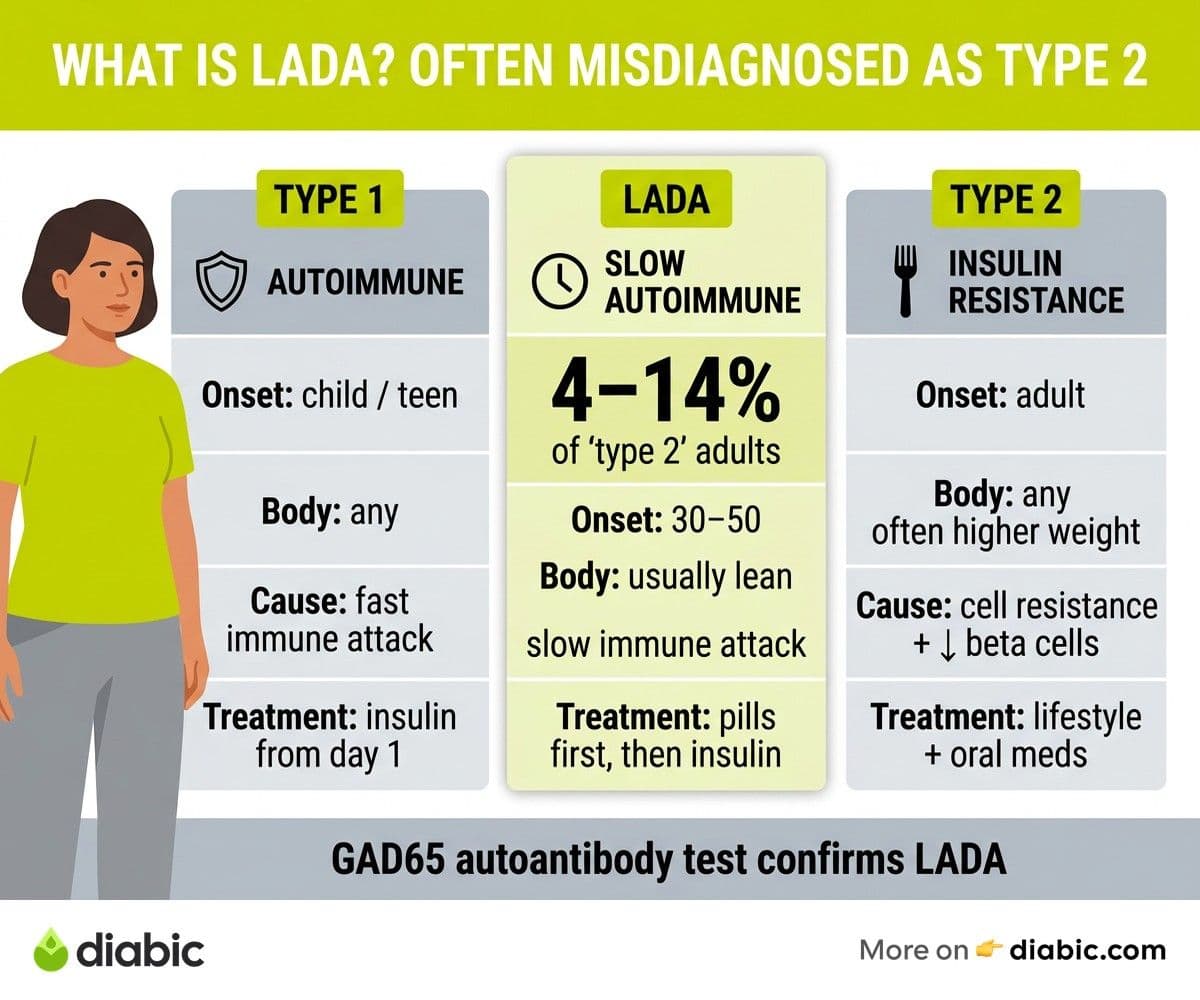
LADA stands for Latent Autoimmune Diabetes in Adults. It is sometimes called type 1.5 because it sits between type 1 and type 2, sharing pieces of each. Estimates suggest that anywhere from 4 to 14 percent of adults diagnosed with type 2 diabetes actually have LADA, which makes it one of the most commonly misdiagnosed forms of diabetes mellitus. The right diagnosis changes the treatment plan in important ways, so it is worth understanding.
What Is LADA Diabetes
LADA is an autoimmune form of diabetes that develops in adulthood, typically after age 30. As the American Diabetes Association explains in its overview of diabetes types, the immune system mistakenly attacks the insulin-producing beta cells in the pancreas, just as it does in classic type 1. The difference is the pace.
In LADA, the autoimmune destruction unfolds gradually, often over several years. People with LADA may produce enough insulin in the first months or even years that oral medications appear to work. Eventually, however, beta-cell function declines to the point where insulin therapy becomes necessary. This slow trajectory is the defining feature.
Because LADA looks like type 2 at first glance and behaves like type 1 over time, it occupies an awkward middle space in clinical practice. Some experts argue it should be considered a slow-onset variant of type 1 rather than its own category, while others treat it as a distinct entity. What matters for you is that the underlying biology is autoimmune, and treatment that ignores that fact tends to lose effectiveness over time. The same autoimmune mechanism is detailed in our piece on type 1 diabetes causes and risk factors.
Who Tends to Develop LADA
LADA most often appears in adults between 30 and 50, though it can show up later. People with LADA tend to be at a normal weight or only modestly overweight, in contrast to the typical type 2 profile. A personal or family history of autoimmune conditions, including thyroid disease, celiac, or rheumatoid arthritis, raises the suspicion further.
Symptoms can be subtle. Mild fatigue, increased thirst, and gradual weight loss often build over months rather than appearing dramatically. This slow burn is part of why LADA is missed: it does not announce itself the way classic type 1 diabetes symptoms often do.
How LADA Differs From Type 1 and Type 2
LADA shares the autoimmune cause of type 1 and the adult onset of type 2, which is why it sits in the middle. Understanding the differences shapes everything from diagnosis to long-term care.
LADA vs. Type 1
Both LADA and type 1 are autoimmune. Both involve the destruction of beta cells. Both eventually require insulin. The contrast is the speed and the age of onset. Classic type 1 most often appears in children and teens, with rapid beta-cell loss that produces dramatic symptoms over weeks. LADA appears in adults, with beta-cell loss measured in years.
People with type 1 typically need insulin from day one. People with LADA may go months or years before insulin becomes essential, which is partly why the diagnosis gets confused. The autoantibody profile is similar (especially GAD65, which is the most common autoantibody in LADA), and the NIDDK's diabetes classification overview groups both under autoimmune diabetes.
LADA vs. Type 2
This is where the misdiagnosis usually happens. Type 2 diabetes is driven by insulin resistance and a relative deficiency of insulin, not by autoimmune beta-cell destruction. Type 2 is closely linked to weight, sedentary lifestyle, and metabolic factors, although genetics plays a role too. LADA has none of those drivers at its core.
Treatment also diverges over time. Type 2 responds well, often for years, to oral medications such as metformin, GLP-1 agonists, and SGLT2 inhibitors. LADA may respond at first, but the underlying autoimmune process keeps eroding beta-cell function, and oral medications gradually lose effectiveness. Insulin therapy becomes the right tool, the same way it is for type 1.
If you want a side-by-side breakdown of the two more familiar types, our piece on type 1 vs. type 2 diabetes key differences is a good companion read. LADA is essentially a third category that shares features with both.
Why LADA Gets Misdiagnosed
The default assumption when an adult develops diabetes is type 2. That assumption makes statistical sense, since roughly 90 percent of adult-onset diabetes is type 2, but it leaves LADA in the blind spot. As the Mayo Clinic notes in its discussion of autoimmune diabetes, age alone is not a reliable signal, and routine workups rarely include the autoantibody tests that would catch LADA.
A few factors keep the misdiagnosis pattern going:
- Most primary care diabetes workups do not include autoantibody panels, so the clue gets missed at the start.
- Initial response to oral medications looks like proof of type 2, even though that response is temporary in LADA.
- Patients are not always asked about family history of autoimmune disease, which is a meaningful red flag.
- Some clinicians are unfamiliar with LADA as a distinct category and may not consider it on the differential.
The consequences of a delayed diagnosis are real. Beta-cell function continues to decline while treatment is chasing the wrong target. The opportunity to start insulin earlier, which research suggests may help preserve remaining beta-cell function, is lost. Blood sugar control gets harder over time as the medications stop working, often confusing both patient and provider.
Red Flags Worth Asking About
If you were diagnosed with type 2 and any of the following apply, it is reasonable to ask your doctor about LADA testing. You are at a normal weight or were when diagnosed. Your A1C is creeping up despite consistent treatment and good adherence. Oral medications worked at first but seem to be losing effectiveness within a year or two. You have a personal or family history of autoimmune disease.
You are not second-guessing your doctor by asking. You are gathering information that helps everyone get to the right plan.
Diagnosing LADA Correctly
The two tests that matter most are the autoantibody panel and the C-peptide test. Together they distinguish autoimmune diabetes (LADA or type 1) from non-autoimmune diabetes (type 2).
The autoantibody panel checks for markers that indicate the immune system is attacking the pancreas. The most useful is GAD65, since it is positive in roughly 80 percent of LADA cases. Other autoantibodies tested include IA-2, ZnT8, and ICA. Even one positive antibody, in the right clinical context, supports an autoimmune diagnosis.
The C-peptide test measures how much insulin your pancreas is still producing. C-peptide is released alongside insulin in equal amounts, so it is a clean marker of native insulin output. In LADA, C-peptide tends to be low-normal at diagnosis and decline over time. In type 2, C-peptide is usually normal or even elevated due to insulin resistance.
Peer-reviewed work indexed in PubMed on LADA diagnosis and management supports using both tests together rather than relying on either alone. If you ask about testing, ask for both.
When to Push for Testing
If your clinical picture does not fit neatly into the type 2 box, ask. Specifically, ask whether a GAD65 antibody test and a C-peptide test would be appropriate. Most insurance plans cover them when there is a clinical reason. Bring your concerns in writing if it helps.
LADA is not the only adult-onset type that gets missed. We cover another commonly overlooked category in our explainer on MODY diabetes, the type most people have not heard of, which is genetic rather than autoimmune.
Treatment Approaches for LADA
The treatment plan for LADA shifts as the underlying biology shifts. Early on, when there is still meaningful beta-cell function, the goal is to support what remains. As beta-cell function declines, the plan moves toward full insulin replacement.
The Case for Early Insulin
A growing body of research suggests that introducing insulin early in LADA may help preserve beta-cell function longer than relying on oral medications alone. The reasoning is that giving the pancreas a rest reduces metabolic stress on the remaining beta cells. While the evidence is not definitive, many endocrinologists now lean toward earlier insulin in suspected LADA, even when blood sugar appears manageable on oral therapy.
This is a different mindset from the typical type 2 progression, where insulin is often the last resort. In LADA, insulin is more like the right tool from the beginning. Our guide to insulin therapy for type 1 covers the basics that translate directly to LADA management.
Medications That May Not Work Long-Term
Sulfonylureas (such as glipizide and glyburide) push the pancreas to produce more insulin. In LADA, that pressure on already-stressed beta cells may accelerate their decline. Many endocrinologists avoid sulfonylureas in confirmed LADA for this reason.
Metformin can be used in LADA, particularly in people who also have insulin resistance, but it is not addressing the core autoimmune problem. GLP-1 agonists and SGLT2 inhibitors are sometimes used as adjuncts, though their role in LADA is still being studied. The point is that medications designed for type 2 are not built for an autoimmune process, and a treatment plan should reflect that.
From my experience: I have lived with type 1 for 14 years, and I have met many people in our community who spent two, three, even five years on type 2 medications before someone ordered the right test. The story is almost always the same: oral meds worked at first, then started slipping, then their doctor finally tested antibodies. The relief of having an explanation, mixed with frustration about the lost time, is something I hear over and over. If your gut says something does not fit, trust it enough to ask.
Lifestyle Habits Still Matter
Even though LADA is autoimmune and not lifestyle-driven, the daily habits that help anyone with diabetes still apply. Consistent meals, sleep, exercise, and stress management all affect insulin sensitivity and quality of life. These do not slow the autoimmune process, but they make day-to-day numbers more predictable.
Working with an endocrinologist (not just a primary care provider) is especially valuable for LADA because the treatment plan needs to evolve as your insulin production changes. Annual antibody and C-peptide testing can help track that progression.
FAQ
How is LADA diabetes different from type 1?
LADA shares the same autoimmune cause as type 1 (the immune system attacks beta cells), but the destruction is slower and the diagnosis happens in adulthood. People with type 1 usually need insulin immediately, while people with LADA may not need insulin for months or years after diagnosis. Over time, most people with LADA do become insulin-dependent as beta-cell function declines.
Can LADA diabetes be misdiagnosed as type 2?
Yes, and it frequently is. Because LADA appears in adults and blood sugar may respond to oral medications at first, it is often labeled as type 2. The key difference is the underlying autoimmune mechanism, which only autoantibody testing (especially GAD65) and C-peptide testing can confirm. If you were diagnosed with type 2 but are at a normal weight, have a family history of autoimmune disease, or are losing effectiveness of oral medications, it is worth asking your doctor about LADA testing.
Is LADA diabetes hereditary?
LADA has a genetic component similar to type 1 diabetes. Family history of type 1, LADA, or other autoimmune conditions raises your risk modestly, but most people with LADA do not have a close relative with it. Environmental factors likely also play a role, though research on the exact triggers is ongoing.
Will I always need insulin if I have LADA?
Most people with LADA eventually require insulin therapy, since the autoimmune process gradually destroys beta-cell function. The timing varies, with some people needing insulin within months of diagnosis and others maintaining beta-cell function for several years. Many endocrinologists now recommend starting insulin earlier rather than later, which research suggests may help preserve remaining beta cells.
What tests should I ask for if I suspect LADA?
Ask your provider about a GAD65 autoantibody test and a C-peptide test. The GAD65 antibody is the most useful single marker for LADA, and the C-peptide test shows how much insulin your pancreas is still producing. Together, these two tests answer the question of whether your diabetes is autoimmune or not, which is the deciding factor in distinguishing LADA from classic type 2 diabetes.
If you are still circling the question of what is LADA diabetes and where you fit on the type 1 to type 2 spectrum, the most useful next step is a focused conversation with your provider about antibody and C-peptide testing. Getting the right label early changes which medications are worth trying, when insulin enters the plan, and how your beta-cell function holds up over time.
Shahriar P. Shuvo is the founder of Diabic. He has lived with diabetes for over 14 years, and built Diabic to deliver the practical, evidence-based self-management tools he wished existed when he was first diagnosed. By trade, Shahriar is a senior design and frontend engineer with 6+ years shipping products at Agora, Timescale (now Tiger Data), and ShareTrip. He writes from the intersection of lived diabetes experience and product craft, focused on what works in daily management rather than what sounds good in a textbook.
Medically reviewed by
Dr. Shanto Arian is an internal medicine physician now specializing in clinical and aesthetic dermatology, with a parallel academic focus on epidemiology and public health. He holds an MBBS, MPH, MSc (UK), MRCP (UK), MRCPI (Ireland), Diploma in Dermatology (UK), and Diploma in Aesthetic Medicine (USA). Dr. Arian trained in internal medicine, including hospital work on hematology cases such as graft-versus-host disease, before moving toward dermatology. Skin is one of the earliest places diabetes shows itself, from acanthosis nigricans and diabetic dermopathy to slow foot wound healing, and that intersection is where his clinical and Diabic-review work meet. On Diabic, Dr. Arian medically reviews content on diabetes diagnosis, complications, dermatologic manifestations, and pharmacotherapy, ensuring every claim aligns with current ADA, NICE, and peer-reviewed literature.
More from Diabetes Knowledge
View all
6 Safe Dessert for Gestational Diabetes Recipes You Can
Six dessert for gestational diabetes recipes that satisfy your sweet tooth without spiking blood sugar, with carb counts and pairing tips you can use.

8 High Fiber Foods That Help with Prediabetes
Add these 8 high fiber foods for prediabetes to slow glucose absorption, support steady blood sugar, and meet the daily fiber target most people miss.

Mediterranean Diet for Prediabetes: A Practical Guide
The mediterranean diet for prediabetes is one of the best-studied eating patterns for prevention. Here is what to eat, what to avoid, and how to start.
Clinician-reviewed habits, plain-language guides, and honest answers - the small shifts that make living with diabetes feel lighter, every day.