Type 1 Diabetes Diagnosis: Tests and Next Steps
A type 1 diabetes diagnosis can feel overwhelming. Learn the tests that confirm T1D, what happens after, and how to build a sustainable first-week routine.

In this article(29)
A type 1 diabetes diagnosis can feel like the ground shifting beneath your feet. The waiting-room minutes between hearing "your blood sugar is very high" and understanding what comes next are some of the longest of anyone's life. If you are in that moment, or you are processing a recent diagnosis for yourself or a child, you are not behind. You are exactly where everyone starts.
This guide walks through how the diagnostic process actually works, what tests confirm the diagnosis (and why each one matters), what to expect in the first few days, and how to build a survivable routine for week one. We will keep the language plain and the focus on what is actionable.
How Type 1 Diabetes Diagnosis Works
Most type 1 diagnoses start with classic symptoms that prompt a blood test. Intense thirst, frequent urination, unexplained weight loss, fatigue, and fruity-smelling breath are the symptoms most likely to send someone (or a parent) to the doctor. As the NIDDK's overview of diabetes testing explains, the first blood glucose result usually points clearly to diabetes; the harder question is what type.
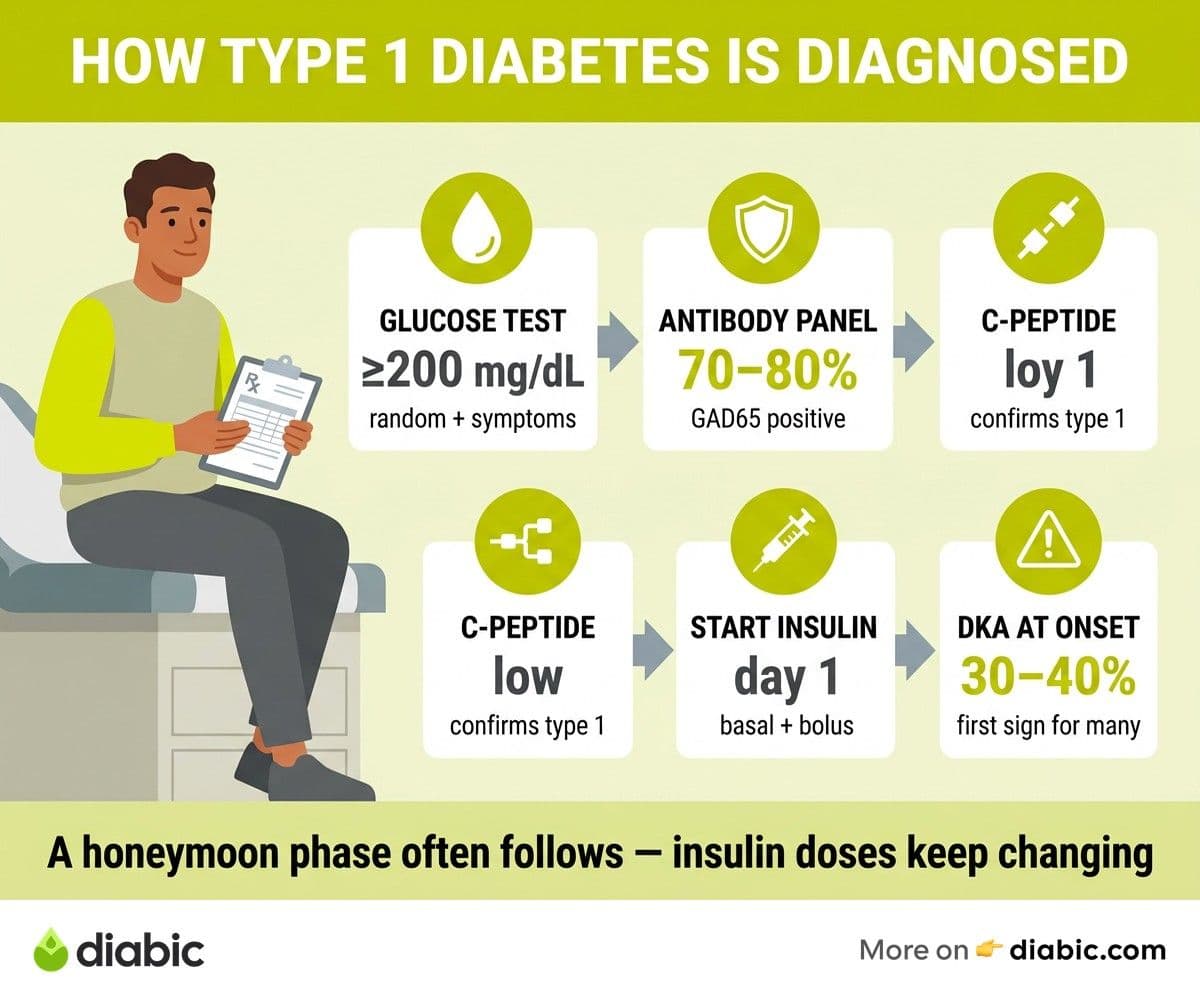
A random blood glucose of 200 mg/dL (11.1 mmol/L) or higher, paired with classic symptoms, is enough for a clinical diagnosis of diabetes. A fasting blood glucose of 126 mg/dL (7.0 mmol/L) or higher on two separate occasions also meets the criteria. Some providers will also run an A1C, which reflects average glucose over the previous 2 to 3 months, with 6.5 percent or higher meeting diagnostic thresholds.
Emergency Diagnosis: When DKA Comes First
For roughly 30 to 40 percent of new T1D cases, the first sign is diabetic ketoacidosis (DKA), a medical emergency in which severe insulin deficiency leads to dangerous acid buildup in the blood. DKA symptoms include vomiting, abdominal pain, rapid breathing, fruity breath, and confusion. People with DKA usually arrive in the emergency department, where insulin is started immediately while the diabetes type is sorted out in parallel.
If DKA was your starting point, the experience can feel especially traumatic. Please give yourself time to process it. Many people in our community describe the first weeks after a DKA diagnosis as a kind of shock that takes longer to fade than the medical recovery itself.
Why Symptoms Alone Are Not Enough
Symptoms can resemble many other conditions, and the Mayo Clinic's diagnosis and treatment overview emphasizes the importance of confirming with blood tests. A high blood glucose result combined with classic symptoms confirms diabetes, but distinguishing type 1 from type 2 and other forms requires additional testing. That distinction shapes everything that follows.
For a deeper look at the underlying biology, our piece on what is type 1 diabetes, a clear explanation covers the autoimmune mechanism that the diagnostic tests are designed to identify.
Tests That Confirm a Type 1 Diabetes Diagnosis
Once diabetes is established, a few additional tests confirm the type. These tests are how providers separate type 1 from type 2 and from related conditions like LADA. The right diagnosis matters because the treatment plan is different.
Autoantibody Panel
Autoantibodies are markers of the autoimmune process that drives type 1 diabetes. According to the American Diabetes Association's diagnosis and testing resources, the standard panel checks for four primary autoantibodies:
- GAD65 (glutamic acid decarboxylase) is the most common positive marker, present in roughly 70 to 80 percent of new T1D cases
- IA-2 (insulinoma-associated antigen 2) is positive in 50 to 70 percent of cases
- ZnT8 (zinc transporter 8) is more recently identified and adds diagnostic sensitivity, particularly in children
- ICA (islet cell antibodies) is the original autoantibody marker, still used in some panels
A positive result on any of these strongly supports a type 1 diagnosis. The more autoantibodies that are positive, the higher the diagnostic confidence. Autoantibody testing also helps identify LADA, a slower autoimmune form often misdiagnosed as type 2 in adults.
C-Peptide Test
C-peptide is a small molecule released alongside insulin in equal amounts whenever the pancreas produces insulin. Measuring C-peptide is the cleanest way to estimate how much insulin your body is still making. In type 1, C-peptide is typically low or undetectable. In type 2, it is normal or elevated due to insulin resistance.
The C-peptide test is especially useful when the autoantibody picture is mixed or when an adult-onset case could be type 1, type 2, or LADA. The combination of positive autoantibodies plus low C-peptide is essentially the gold-standard fingerprint for type 1.
A1C Test
The A1C test measures the percentage of hemoglobin in your blood that has glucose attached, reflecting average glucose levels over the past 2 to 3 months. An A1C of 6.5 percent or higher meets diagnostic criteria for diabetes. After diagnosis, A1C becomes a key long-term tracking tool, with most providers targeting individualized ranges, often 6.5 to 7.5 percent for adults with T1D.
A1C does not, by itself, distinguish type 1 from type 2. It tells you that diabetes is present and gives a sense of how long blood sugar has been elevated. The autoantibody and C-peptide tests do the differentiation.
Why Distinguishing Type 1 From Type 2 and LADA Matters
Misdiagnosis can mean wrong treatment for months or years. Type 2 medications such as metformin, sulfonylureas, and SGLT2 inhibitors are not designed for the autoimmune process driving T1D. People with type 1 who are mistakenly placed on type 2 oral medications can lose precious time and even develop DKA.
Conversely, an adult who actually has type 2 might get pushed onto insulin sooner than necessary if T1D is assumed. Getting the type right means getting on the right plan from day one. Our explanation of type 1 diabetes causes and risk factors goes deeper into the biology behind the diagnostic differences.
What to Expect After Your Diagnosis
The hours and days right after diagnosis are intense. The medical pieces and the emotional pieces both matter, and they often happen in parallel.
Starting Insulin Therapy
Insulin therapy usually starts the same day as a type 1 diagnosis, sometimes within hours. There is no standard "wait and see" period for confirmed T1D, because the body is no longer producing enough insulin to function safely. Initial insulin regimens typically combine a long-acting basal insulin (such as glargine or degludec) with a rapid-acting insulin (such as lispro, aspart, or glulisine) at meals.
Doses are calculated based on weight, current blood sugar, and clinical context. Expect frequent adjustments in the first weeks as your team figures out what your body needs. Some people experience a "honeymoon phase" in the first months after diagnosis, during which the remaining beta cells produce some insulin and total daily insulin needs are temporarily lower. This phase is real, often lasts weeks to months, and eventually ends.
Meeting Your Diabetes Care Team
A new T1D diagnosis usually means meeting a team:
- Endocrinologist or pediatric endocrinologist (the lead diabetes specialist)
- Certified Diabetes Care and Education Specialist (CDCES, formerly CDE)
- Registered Dietitian (RD), often diabetes-specialized
- Nurse educator
- Possibly a mental health professional, social worker, or pump trainer
The first appointments cover insulin administration, blood sugar checking, hypoglycemia recognition, sick-day rules, and basic carb counting. It is a flood. Take notes, ask for written materials, and do not be embarrassed to ask the same question more than once. Everyone does.
Learning to Check Blood Sugar and Count Carbs
Blood sugar checks are the foundation of management. Whether you are using fingersticks or a continuous glucose monitor (CGM), the goal is to develop a feel for how food, insulin, exercise, stress, and sleep move your numbers. CGMs are now standard for most people with T1D and are usually started within the first weeks after diagnosis.
Carb counting is the skill of estimating carbohydrate content in meals so you can dose insulin appropriately. It feels mechanical at first; over time, most people develop solid intuition for familiar foods and only need to count carefully for new things. Apps, food labels, and a kitchen scale during the early weeks all help.
The Emotional Side
Shock, grief, anxiety, anger, numbness. All normal. A diagnosis of a lifelong condition is a real loss, and giving yourself room to grieve is not weakness. Many newly diagnosed people, and many parents of newly diagnosed children, describe the first weeks as a kind of fog.
If feelings of depression, hopelessness, or panic are interfering with daily function, please reach out to a mental health professional. Diabetes-specialized therapists exist and can be hugely helpful. Online communities and in-person peer groups are also part of how people get through the first months.
From my experience: I was 17 when I was diagnosed and spent four days in the hospital on an insulin drip. The clinical part felt clear. The emotional part hit me about a week after I got home, when I sat down to eat lunch and realized this was now every meal, forever. That moment broke me a little. What helped most over the next year was meeting other people with T1D who were further along, who could say with their lives that this is doable. If you are newly diagnosed, please find your people early. The information matters, but the connection matters more than anyone tells you.
First-Week Survival Guide for New Diagnoses
The first week is about survival, not optimization. The goal is to keep blood sugar in a roughly safe range, prevent emergencies, and learn the basics. Perfection is not on the menu, and your numbers will be all over the place. That is normal.
Essential Supplies to Have on Hand
Your care team will give you a starter kit, but here is what should be available at home from day one:
- Insulin (basal and rapid-acting), with backups
- Insulin pens or syringes (whatever your team prescribed)
- Blood glucose meter, test strips, and lancets, even if you are also using a CGM
- Glucose tablets, juice boxes, or another fast-acting sugar source (multiple locations: bedside, car, bag, kitchen)
- Glucagon emergency kit (Gvoke, Baqsimi, or Zegalogue)
- Ketone strips (urine or blood, depending on what your team recommends)
- A simple notebook or app for tracking blood sugar, insulin doses, and meals
The redundancy matters. Glucose tablets should be in every room you spend time in, plus your bag and your car. Hypoglycemia can hit fast, and the moment of needing sugar is not the moment to be hunting for it.
Building a Simple Routine
Try to keep the first week's routine as predictable as possible. Eat similar meals at similar times. Check blood sugar at consistent intervals (before meals, before bed, and at any unusual symptoms). Sleep as much as you can. Track everything, even imperfectly, because the patterns help your team adjust your insulin doses.
Insulin dosing in the first week will involve a lot of phone calls and emails with your care team. Lean into that contact. They want to hear from you. Adjustments are normal, expected, and how dose calibration works.
Foods That Are Easy to Manage Early On
Newly diagnosed is not the time to overhaul your diet. Focus on familiar, reasonably balanced meals where you can estimate carbs without too much guesswork. Some helpful early-week patterns:
- Plate-method meals (a quarter starchy carb, a quarter protein, half non-starchy vegetables)
- Pre-packaged foods with clear nutrition labels
- Simple breakfast options (eggs and toast, plain yogurt with measurable fruit)
- Avoiding high-fat or high-protein meals as your only data source, since those slow carb absorption and complicate insulin timing
You will eat across the full range over time. Right now, the goal is meals that produce predictable patterns so your team can calibrate insulin.
Who to Call When Something Feels Wrong
Your care team should give you specific contact instructions for the first weeks, often including a 24-hour nurse line or on-call endocrinologist. Use it. Specifically, call if:
- Blood sugar stays above 250 mg/dL despite correction insulin
- Ketones are present in urine or blood, especially with high blood sugar
- You cannot keep food or fluids down
- Hypoglycemia is severe, recurrent, or accompanied by confusion
- Anything feels seriously wrong and you are not sure
Glucose patterns will smooth out in the coming weeks as your dosing gets dialed in. Our piece on insulin therapy for type 1 walks through the longer-term picture once survival mode eases.
Building Your Long-Term Care Plan
After the first month or two, the focus shifts from survival to sustainability. Long-term T1D care has a regular rhythm.
Frequency of A1C and Provider Visits
Most adults with T1D see their endocrinologist every 3 to 4 months. A1C is checked at each visit. Children with T1D often have similar or slightly more frequent visits. Visits include reviewing blood sugar data, adjusting insulin doses, checking for complications, and addressing whatever is on your mind.
If you are not seeing an endocrinologist, please ask for a referral. Type 1 management is specialized enough that endocrinology care produces meaningfully better outcomes than primary-care-only management. Many areas have telehealth endocrinology options if local access is limited.
Screening Schedule for Complications
Annual screenings reduce the risk of long-term complications. The standard schedule includes:
- Dilated eye exam every year (or as your eye doctor recommends)
- Urine albumin/creatinine ratio annually for kidney health
- Foot exam at every endocrinology visit, plus an annual comprehensive foot check
- Lipid panel annually, more often if abnormal
- Blood pressure at every visit
- Thyroid function test annually, since autoimmune thyroid disease is more common in T1D
These screenings sound like a lot. In practice, most are bundled into routine visits and feel very manageable.
Technology Options
Continuous glucose monitors (CGMs) are now the standard of care for most people with T1D. Insulin pumps are an option, with hybrid closed-loop (also called automated insulin delivery, AID) systems that pair CGMs with pumps and adjust insulin in real time. Both pumps and multiple daily injections can produce excellent outcomes. The right tool depends on your lifestyle, preferences, and what your insurance covers.
Talking with your care team and connecting with other people with T1D about their tech setups is the best way to figure out what fits. There is no single right answer.
Support Resources
Long-term success with T1D is partly clinical and partly community. Online communities, local meetups, T1D camps for kids, and licensed mental health support are all part of a sustainable plan. Burnout is real, and connection is one of the best protections against it. We cover broader self-management strategies in our pillar piece on what is diabetes, the only guide you need and in our practical living with type 1 diabetes daily guide.
Breakthrough T1D's basics hub is also a useful starting point for newly diagnosed families looking for vetted resources.
FAQ
How is type 1 diabetes diagnosed?
Type 1 diabetes is diagnosed through a combination of blood glucose tests, A1C, autoantibody testing, and C-peptide measurement. Elevated blood glucose plus classic symptoms establishes diabetes; positive autoantibodies (especially GAD65, IA-2, ZnT8, or ICA) plus low C-peptide confirms type 1 specifically and distinguishes it from type 2 and LADA.
What tests confirm type 1 diabetes?
The key tests are autoantibody panels (GAD65, IA-2, ZnT8, ICA), a C-peptide test to measure remaining insulin production, fasting blood glucose, and A1C. Positive autoantibodies plus low C-peptide strongly confirms type 1. Some clinicians also use additional markers like fasting insulin and post-meal glucose to round out the picture.
How long does it take to diagnose type 1 diabetes?
Initial diagnosis of diabetes can happen the same day as a blood test, especially when symptoms are obvious and glucose is dramatically elevated. Confirming the type takes longer because autoantibody and C-peptide results may take days to a week. In many cases, insulin therapy is started immediately based on clinical suspicion while confirmation tests are pending.
Can type 1 diabetes be diagnosed in adults?
Yes. While type 1 most often appears in children and young adults, it can be diagnosed at any age. Adult-onset type 1 is sometimes confused with type 2 because of the patient's age, and the slower-progressing autoimmune form called LADA is frequently misdiagnosed as type 2. Autoantibody testing is the key to a correct adult diagnosis.
What should I do right after a type 1 diagnosis?
Start insulin as prescribed, attend your first care-team appointments, gather essential supplies (glucose tablets, glucagon, meter, ketone strips), and lean on your team for early dose adjustments. Give yourself room to process the emotional weight of a chronic diagnosis, and consider connecting with other people who have lived with type 1 longer. The first few weeks feel overwhelming, and that is expected. It does get more manageable.
A type 1 diabetes diagnosis is the start of a long relationship with insulin, technology, and a care team that gets to know you well over time. The first weeks are about stabilizing numbers and stabilizing yourself. Lean on your endocrinologist or pediatric team, ask the questions that feel basic, and write down the answers because the early appointments blur. Bring a partner or parent into the room when you can, and remember that the steepest learning curve is the first one.
Shahriar P. Shuvo is the founder of Diabic. He has lived with diabetes for over 14 years, and built Diabic to deliver the practical, evidence-based self-management tools he wished existed when he was first diagnosed. By trade, Shahriar is a senior design and frontend engineer with 6+ years shipping products at Agora, Timescale (now Tiger Data), and ShareTrip. He writes from the intersection of lived diabetes experience and product craft, focused on what works in daily management rather than what sounds good in a textbook.
Medically reviewed by
Dr. Shanto Arian is an internal medicine physician now specializing in clinical and aesthetic dermatology, with a parallel academic focus on epidemiology and public health. He holds an MBBS, MPH, MSc (UK), MRCP (UK), MRCPI (Ireland), Diploma in Dermatology (UK), and Diploma in Aesthetic Medicine (USA). Dr. Arian trained in internal medicine, including hospital work on hematology cases such as graft-versus-host disease, before moving toward dermatology. Skin is one of the earliest places diabetes shows itself, from acanthosis nigricans and diabetic dermopathy to slow foot wound healing, and that intersection is where his clinical and Diabic-review work meet. On Diabic, Dr. Arian medically reviews content on diabetes diagnosis, complications, dermatologic manifestations, and pharmacotherapy, ensuring every claim aligns with current ADA, NICE, and peer-reviewed literature.
More from Diabetes Knowledge
View all
6 Safe Dessert for Gestational Diabetes Recipes You Can
Six dessert for gestational diabetes recipes that satisfy your sweet tooth without spiking blood sugar, with carb counts and pairing tips you can use.

8 High Fiber Foods That Help with Prediabetes
Add these 8 high fiber foods for prediabetes to slow glucose absorption, support steady blood sugar, and meet the daily fiber target most people miss.

Mediterranean Diet for Prediabetes: A Practical Guide
The mediterranean diet for prediabetes is one of the best-studied eating patterns for prevention. Here is what to eat, what to avoid, and how to start.
Clinician-reviewed habits, plain-language guides, and honest answers - the small shifts that make living with diabetes feel lighter, every day.