The Best Yoga Routine for Type 2 Diabetes Beginners
A 25-minute best yoga routine for type 2 diabetes beginners with modifications, breathwork, and blood sugar tips you can practice at home today.

In this article(8)
Starting yoga can feel intimidating when you have type 2 diabetes, especially if you have not exercised in a while or your flexibility is not what it used to be. Maybe you have watched a few videos online and felt your knees ache just looking at the poses. The best yoga routine for type 2 diabetes beginners is the one that meets your body where it is today, not the one that asks you to fold like a 22-year-old gymnast. We built the routine below for real bodies that are just getting started, with modifications for every pose and a steady focus on what actually moves blood sugar in a helpful direction.
You do not need a fancy studio, expensive leggings, or a fitness background to begin. You need a flat surface, about 25 minutes, and a willingness to listen to what your body is telling you. We will walk through why this style of movement matters for blood sugar, a complete beginner sequence, modifications if your knees or back complain, and how often to practice for results.
From my experience: I picked up a short evening yoga habit a couple of years ago, mostly for the back stiffness from desk work. The blood sugar effect surprised me. My Dexcom showed a slow, steady drift downward during the held poses, especially Warrior I and Bridge, that did not look like a treadmill drop. It felt more like the way insulin works when it finally lands, and now I keep glucose tablets within arm's reach of my mat the same way I keep them by the bed.
Why Yoga Works Well for Type 2 Diabetes
Yoga sits in a sweet spot that few other movement practices can match. It is low impact, which means less stress on knees, ankles, and hips that may already be carrying extra wear. The American Diabetes Association recommends a mix of aerobic activity and resistance training each week, and a thoughtful yoga practice contributes to both (ADA physical activity standards). Holding poses recruits muscle in a sustained way that improves how your cells respond to insulin over time.
The stress angle is just as important as the muscular one. When cortisol stays elevated from chronic stress, your liver releases more glucose into the bloodstream, which is why morning numbers can creep up even when you have not eaten. A regular practice activates the parasympathetic nervous system, the branch that signals rest and digestion. Research has linked yoga interventions with modest but real reductions in fasting blood sugar and A1C when practice is consistent over 8 to 12 weeks (NCCIH on yoga research).
Yoga also pulls double duty for the tiredness that often shadows life with diabetes. Gentle movement and breathwork lift the heavy fog that comes from blood sugar swings or from carrying the mental load of a chronic condition. If energy crashes are familiar, our notes on diabetes fatigue management pair well with what we cover here. Add in better sleep, which most consistent practitioners report within a few weeks, and the downstream effects on insulin sensitivity compound. Yoga is also forgiving, which is what makes a habit stick when life gets noisy.
The Best Yoga Routine for Type 2 Diabetes Beginners: A 25-Minute Sequence
This sequence is built to warm up the spine, gently engage large muscle groups, and end with a calming nervous system reset. You will need a non-slip mat or a flat carpet, a folded blanket or towel, and ideally two blocks or sturdy books for support. Check your blood sugar before you begin if you are not yet sure how movement affects your numbers, and keep a glucose source nearby in case of a low.
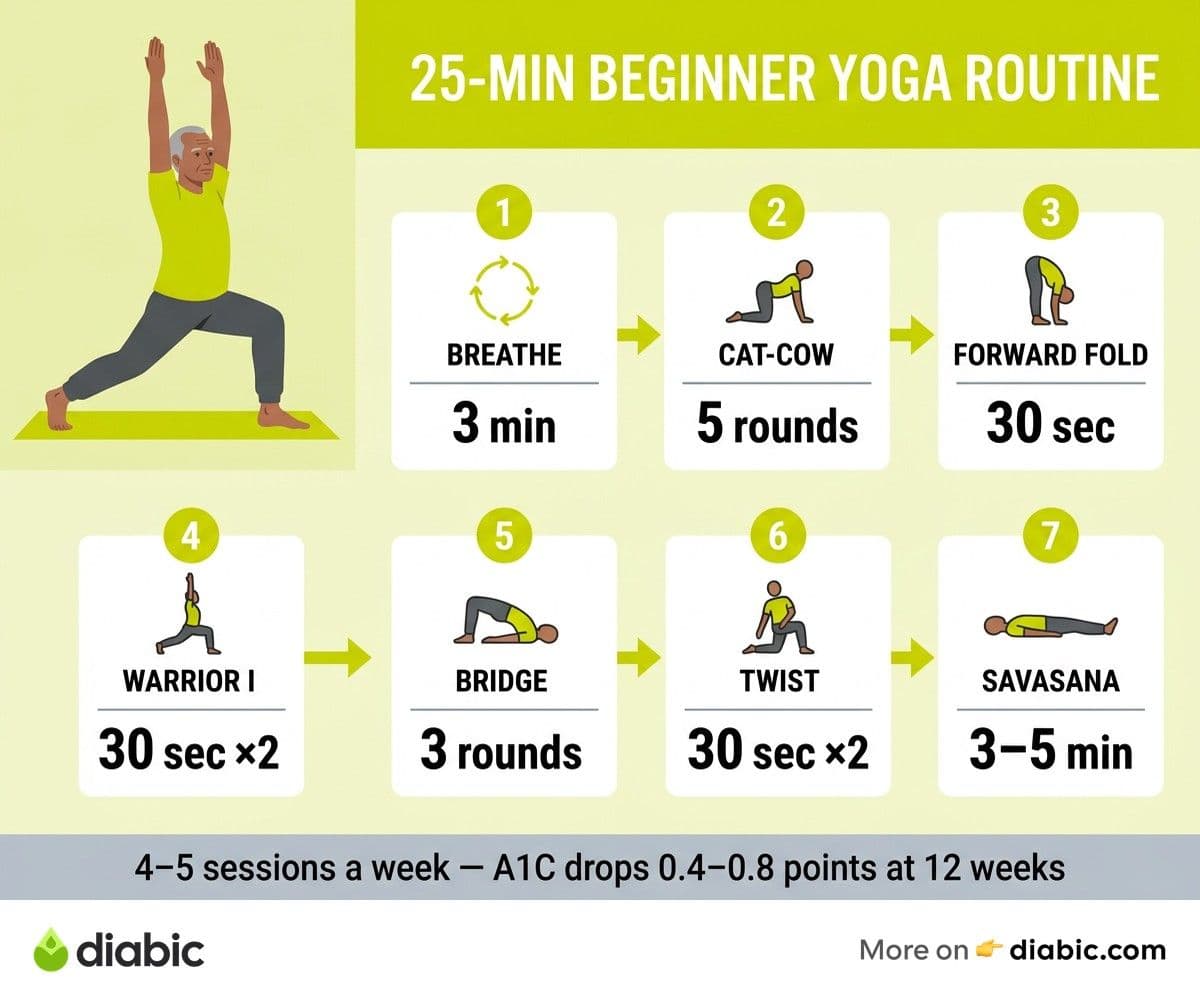
Here is how the poses in the routine stack up at a glance:
Together the sequence balances active muscle work with calming poses, which is the combination that tends to move both blood sugar and stress in a helpful direction.
Warm-up: seated breathing and gentle neck rolls (3 minutes). Sit cross-legged on your blanket, hips slightly higher than your knees. Inhale through your nose for four, exhale for six, and repeat for two minutes. Then roll your neck slowly, three small circles per side.
Cat-Cow (Marjaryasana-Bitilakasana): 5 rounds. Come to your hands and knees, wrists under shoulders and knees under hips. As you inhale, drop your belly and lift your gaze for cow. As you exhale, round your spine toward the ceiling and tuck your chin for cat. Move with your breath, not faster than it.
Standing Forward Fold with bent knees (Uttanasana): hold 30 seconds. From standing, hinge at your hips and let your upper body drape forward. Bend your knees generously so your belly rests against your thighs. Let your head feel heavy, and hold a light grip on opposite elbows if that feels good.
Warrior I (Virabhadrasana I): 30 seconds each side. Step your right foot back about three feet, turning the toes out slightly. Bend your front knee toward 90 degrees and reach your arms overhead. Drop your shoulders away from your ears, breathe steadily, then switch sides. This is one of the most effective yoga poses for diabetes because it asks your large leg muscles to hold steady, which pulls glucose from your bloodstream.
Bridge Pose (Setu Bandhasana): hold 30 seconds, repeat 3 times. Lie on your back with knees bent and feet flat, hip-width apart. Press into your feet to lift your hips toward the ceiling, keeping your shoulders grounded. Lower slowly between rounds, and rest one breath cycle in between.
Supine Twist: 30 seconds each side. Still on your back, hug your right knee to your chest, then guide it across your body to the left. Extend your right arm out and turn your gaze right if your neck allows. Switch sides slowly, breathing into tightness rather than forcing the stretch. Finish with Savasana for 3 to 5 minutes: lie flat, arms at your sides with palms up, eyes closed, and let your breath return to its natural rhythm. This is where your nervous system absorbs the work you just did.
Modifications for Limited Mobility
Yoga is endlessly adaptable, and the routine above bends to your body rather than the other way around. If kneeling on the floor hurts your knees, double up your blanket under them in cat-cow, or skip the floor work and do the sequence standing or seated. Pain is information, not a badge to push through. If a pose hurts in a sharp or pinching way, back off; if it simply feels unfamiliar or warm, that is usually fine.
For standing poses, place a chair or wall within arm's reach for balance. In Warrior I, you can shorten your stance and keep your hands on your hips instead of overhead if shoulder mobility is limited. In forward folds, a generous bend in the knees protects the lower back and hamstrings, especially first thing in the morning when tissues are stiffer. Blocks or thick books under your hands turn floor poses into something your body can actually reach without strain.
If getting down to and up from the floor is the real obstacle, [chair yoga for people with diabetes](/yoga-and-meditation/gentle-chair-yoga-routine-for-people with diabetes) is a complete practice on its own. You can do seated cat-cow, seated twists, seated forward folds, and even Warrior poses with a hand resting on the seatback for support. The goal is to move large muscles regularly, breathe slowly, and reduce stress, all of which work just as well from a sturdy chair as from a mat. The most important modification is the one nobody mentions: skip a pose entirely when your body says no, because saying no today is what lets you show up tomorrow.
How Often to Practice for Blood Sugar Benefits
Consistency outperforms intensity every time. Start with two or three sessions per week for the first two weeks, focusing on remembering the sequence and noticing how your body feels before, during, and after. Build to four or five sessions per week over the following month, and aim for daily practice (even shortened versions) by week six if your schedule allows. A 10-minute session beats a skipped 45-minute session in every measurable way.
Most people see meaningful changes in fasting and post-meal numbers between weeks four and eight of consistent practice. Studies in the Journal of Diabetes Research have shown A1C reductions of around 0.4 to 0.8 percentage points after 12 weeks of structured yoga, comparable to the lower end of some oral medications (study summary via NIH). Your numbers may move faster or slower, and that is normal.
A simple way to see what is working is to test your blood sugar before practice and again 30 to 60 minutes after. Write the numbers down for two weeks alongside the time of day and what you ate beforehand. Patterns will emerge that no generic article can predict for you, like how a morning session steadies fasting numbers or how an evening flow takes the edge off post-dinner spikes.
A common question is whether yoga can replace walking. The honest answer is that they do different things and work best together, which we cover in our breakdown of yoga vs walking. Walking moves blood sugar quickly during and after the activity. Yoga builds the slower improvements in insulin sensitivity, sleep, and stress that change your baseline. Most weeks, a mix of both works better than either alone.
Building a Daily Breathing Practice
Breathwork (sometimes called pranayama) gives you the most return for the smallest time investment. You do not need a mat, a class, or privacy. Five minutes of slow, steady breathing can lower the cortisol that has been quietly pushing your blood sugar up all afternoon, and two techniques are friendly entry points for beginners.
The first is the 4-6 breath we used in the warm-up. Inhale through the nose for a count of four, exhale for a count of six, and repeat for two to five minutes. The longer exhale signals your nervous system to settle. The second is alternate-nostril breathing (Nadi Shodhana), a slightly more involved technique many people find calming before sleep.
Pair breathing with something you already do reliably. Right after brushing your teeth, before your first meal, or while your kettle heats up are all good anchors. Habits stick when they ride on existing ones, not when they live as a new appointment on your calendar. Five minutes daily beats 30 minutes once a week. If you are working on stress more broadly, our piece on diabetes and stress connects cortisol to the daily numbers on your meter.
FAQ
How do I start yoga with type 2 diabetes?
Begin with two or three short sessions per week using a gentle beginner sequence like the one above, and check your blood sugar before and after for the first couple of weeks so you can learn your body's response. Keep fast-acting glucose nearby in case of a low, especially if you take insulin or sulfonylureas. Talk to your doctor before starting if you have diabetic retinopathy, uncontrolled blood pressure, or recent surgery, since some poses may need to be avoided or modified.
What is the best beginner yoga for blood sugar control?
The best yoga routine for type 2 diabetes beginners combines gentle weight-bearing poses (like Warrior I and Bridge), breathwork, and a final relaxation. Weight-bearing poses recruit large muscles to pull glucose from the bloodstream, while breathwork and relaxation reduce cortisol-driven sugar spikes. Practice consistently for at least four to eight weeks before judging whether it is helping, and always pair it with the eating, sleep, and medication plan your healthcare team has put together with you.
Shahriar P. Shuvo is the founder of Diabic. He has lived with diabetes for over 14 years, and built Diabic to deliver the practical, evidence-based self-management tools he wished existed when he was first diagnosed. By trade, Shahriar is a senior design and frontend engineer with 6+ years shipping products at Agora, Timescale (now Tiger Data), and ShareTrip. He writes from the intersection of lived diabetes experience and product craft, focused on what works in daily management rather than what sounds good in a textbook.
Medically reviewed by
Dr. Shanto Arian is an internal medicine physician now specializing in clinical and aesthetic dermatology, with a parallel academic focus on epidemiology and public health. He holds an MBBS, MPH, MSc (UK), MRCP (UK), MRCPI (Ireland), Diploma in Dermatology (UK), and Diploma in Aesthetic Medicine (USA). Dr. Arian trained in internal medicine, including hospital work on hematology cases such as graft-versus-host disease, before moving toward dermatology. Skin is one of the earliest places diabetes shows itself, from acanthosis nigricans and diabetic dermopathy to slow foot wound healing, and that intersection is where his clinical and Diabic-review work meet. On Diabic, Dr. Arian medically reviews content on diabetes diagnosis, complications, dermatologic manifestations, and pharmacotherapy, ensuring every claim aligns with current ADA, NICE, and peer-reviewed literature.
More from Living with Diabetes
View all
A Gentle Chair Yoga Routine for people with diabetes
A gentle chair yoga for people with diabetes routine with safe poses, modifications for neuropathy, retinopathy, and joint pain, plus tips for older.

Shift Work and Diabetes: Managing Irregular Hours
Shift work and diabetes is a tough combination. Learn how to manage meals, sleep, medication, and blood sugar when your hours rotate or flip overnight.

Dating with Diabetes: When to Tell a New Partner
Dating with diabetes brings unique disclosure questions. Here is when to tell a new partner, what to say, and how to handle the conversation with.
Clinician-reviewed habits, plain-language guides, and honest answers - the small shifts that make living with diabetes feel lighter, every day.