Diabetes on a Budget: Affordable Meal Planning That Works
Diabetes on a budget meal planning made practical. Real grocery strategies, budget recipes, and blood sugar friendly foods that cost less than you think.

In this article(11)
Diabetes on a budget meal planning sounds like a contradiction the first time you encounter it. Every glossy nutrition guide seems to feature wild salmon, organic berries, and grass-fed everything, and the running total in your head climbs with each ingredient. We hear from readers who have skipped meals, dropped vegetables from their carts, or given up on planning entirely because they assumed eating well with diabetes had to be expensive.
It does not. Some of the most blood-sugar-friendly foods on the planet are also the cheapest ones in the store, and a few weekly habits can cut a grocery bill by 30 to 40 percent without losing nutritional value. We will walk through how meal planning saves money, which low-cost foods do the most for blood sugar stability, and what a real week of budget-friendly meals can look like.
From my experience: Around 2019, after a stretch where my CGM sensors and Tresiba copays jumped at once, I rebuilt my grocery list from scratch around dried lentils, eggs, frozen broccoli, and store brand Greek yogurt. My weekly bill dropped by close to 40 dollars and my Dexcom graphs got noticeably flatter, mostly because I was eating the same handful of meals on repeat instead of guessing at restaurant carbs.
Diabetes on a Budget: Why Meal Planning Is Your Best Tool
Meal planning works because it removes two of the biggest sources of grocery overspending. The first is impulse buying, which adds up faster than most of us notice. The second is food waste, and U.S. households throw away about 30 percent of the food they purchase, according to USDA estimates. When you walk into the store with a list tied to specific meals, both numbers drop fast, and the savings tend to fund themselves week over week.
Meal planning also helps blood sugar in ways unrelated to cost. Eating similar meals on a regular schedule gives your body predictable inputs, which makes glucose patterns easier to read and adjust, a point the NIDDK reinforces in its overview of diet, eating, and physical activity for diabetes. The ADA Diabetes Food Hub offers free recipes and weekly planning tools that work for any budget, and it is one of the few resources we recommend without reservation. You do not need an app to start, though. A notebook, a phone note, or a printed weekly grid all work just as well.
A practical first week looks like this. Pick three to four breakfast options you can rotate, two lunch templates that travel well, and three to four dinner recipes that scale up for leftovers. Build your shopping list from those choices, then add staples and produce. For more on building structure into the rest of your routine, see our guide on how to build a daily self-care routine for diabetes.
The Real Cost of Eating with Diabetes
People with diabetes spend more on food on average, but most of that gap is avoidable. Studies in the Journal of the Academy of Nutrition and Dietetics have found that the higher costs are usually tied to specialty products marketed as "diabetic," prepared meals, and convenience snacks rather than to staple ingredients. Plain whole foods almost always cost less per gram of protein and fiber than anything labeled diabetic-friendly on the package.
We talk more about this pattern in our piece on the real cost of managing diabetes, but the short version is worth repeating. The biggest unnecessary expenses tend to hide in three places. Branded "low carb" packaged snacks, organic produce when conventional would work fine, and prepared protein products like rotisserie cuts and pre-marinated meats. Cutting these alone can free up 20 to 40 dollars a week for most households.
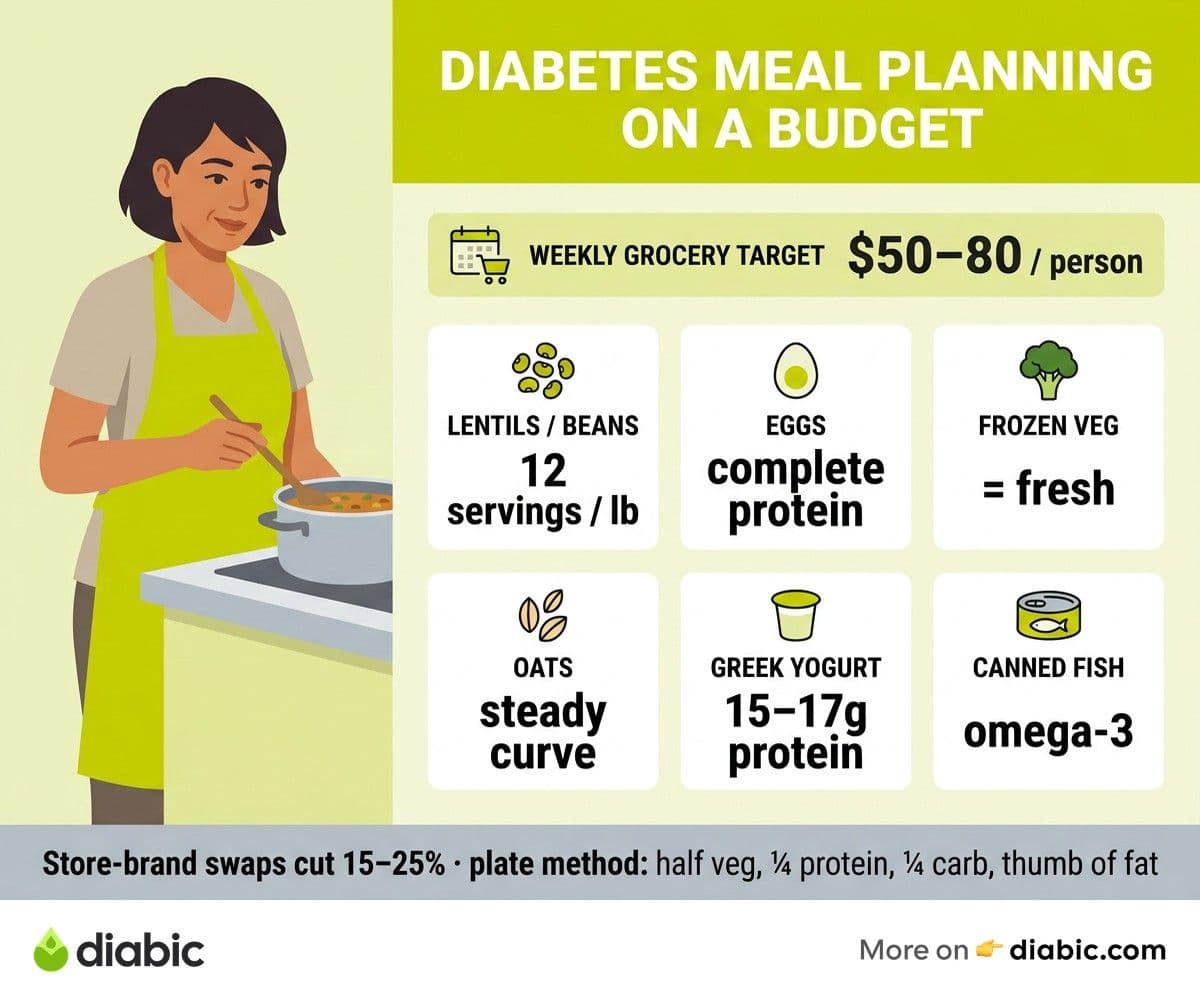
A reasonable budget benchmark for a blood-sugar-friendly grocery list lands between 50 and 80 dollars per person per week, depending on your region and how much you cook from scratch. That assumes mostly whole foods, modest meat portions, and a generous mix of beans, frozen vegetables, and pantry staples.
Budget-Friendly Foods That Support Blood Sugar
Beans and lentils are the workhorses of affordable blood-sugar-friendly eating, and the CDC's diabetes meal planning guidance lists beans, peas, and lentils among the staple choices for a balanced plate. A pound of dried black beans costs roughly the same as a single fast food meal and yields about 12 servings of high-fiber, plant-based protein. Lentils cook in 20 minutes without soaking, which makes them friendlier than dried beans for weeknights. Canned versions cost more but still come in well under most other protein sources per serving. Both deliver slow-digesting carbohydrates and steady glucose responses in most people.
Frozen vegetables are nutritionally equivalent to fresh in nearly every category that matters. They are picked at peak ripeness, flash frozen, and often retain more vitamin C than fresh produce that has traveled for days. The price difference can be substantial, especially out of season, and there is zero waste because you only thaw what you need. Stock frozen broccoli, spinach, mixed peppers, green beans, and cauliflower as your default vegetable layer in any meal. Our list of foods that will not spike your blood sugar goes deeper on which vegetables earn their place in a diabetes-aware kitchen.
A few more affordable staples deserve a regular spot on your list:
- Eggs, which deliver complete protein at a low cost per gram and pair with nearly anything
- Old-fashioned oats, which cost less per serving than cold cereal and produce a steadier glucose curve
- Canned salmon, sardines, and tuna, which provide omega-3 fats at a fraction of fresh fish prices
- Plain Greek yogurt, especially store brand, which is a high-protein breakfast or snack base
- Brown rice and barley, which keep for months and feed many meals from one batch
The Academy of Nutrition and Dietetics guidance on budget-friendly eating reinforces a similar list, with the added note that seasonal produce almost always beats out-of-season organic at the till. Buy berries in summer, root vegetables in winter, and citrus in late winter when prices drop.
Diabetes on a Budget Meal Planning: A Week in Practice
A workable seven-day plan for one person can land under 50 dollars in most U.S. regions. Breakfasts rotate between overnight oats with peanut butter and banana, a two-egg scramble with frozen peppers and a slice of whole grain toast, and plain Greek yogurt with oats and a sprinkle of nuts. Each lands well under a dollar per serving when you buy ingredients in normal grocery quantities.
Lunches lean on batch cooking. A pot of lentil soup made on Sunday yields five to six lunches with whole grain bread or brown rice on the side. Bean and rice bowls topped with frozen corn, salsa, and a wedge of avocado work for another rotation. Egg salad on whole grain bread or a tuna salad with celery and Greek yogurt as the binder rounds out the week and uses pantry staples you already have.
Dinners benefit most from the cook-once-eat-twice rule. A sheet pan of chicken thighs (the cheapest cut by a wide margin) with frozen vegetables feeds two nights. A pot of chili with ground turkey, beans, and tomatoes feeds three. A simple stir-fry built on frozen vegetable mixes, brown rice, and whatever protein is on sale fills a fourth. Plan one "use it up" night midweek to clear leftovers before they turn, which keeps waste at near zero. Feeding America runs food assistance programs that can supplement these plans if your budget is tight in any given week, and many partner pantries now stock fresh produce and lean protein.
Smart Grocery Shopping Strategies
Store brand products are the single biggest lever in any budget shop. Most major chains source their store brand staples from the same manufacturers that produce the name brand version, with formulations that are nutritionally identical or close to it. Canned beans, frozen vegetables, oats, dairy, and eggs all behave the same in your pantry whether they carry a familiar logo or not. Switching to store brand on staples alone usually shaves 15 to 25 percent off a weekly bill.
The perimeter-of-the-store rule still works on a budget, with one adjustment. The frozen aisle deserves a regular stop, even though it sits in the middle of the store. Frozen produce, frozen seafood, and bagged frozen brown rice all earn their place in a blood-sugar-friendly cart. Grocery store apps and digital coupons stack on top of these savings, especially for staples you buy weekly anyway. The USDA MyPlate on a Budget guide walks through similar strategies in more detail, with sample shopping lists at different price points.
Bulk buying works for some items and not others. Dried beans, brown rice, oats, frozen vegetables, eggs in larger packs, and shelf-stable canned goods all reward bulk purchases. Fresh produce, fresh meat, and bread usually do not, because spoilage erases the savings. Dollar stores can help on non-perishable basics, though some lower-cost canned goods carry higher sodium loads, so it is worth reading labels.
Saving on Diabetes Supplies to Free Up Food Budget
The cost of diabetes does not stop at the grocery store, and the math gets easier when you treat your supply costs and food budget as one combined number. Cutting 20 dollars a month off testing strips, lancets, or continuous glucose monitor sensors goes straight into the food column, and the strategies are usually independent. Switching to a less expensive store brand glucose meter, asking about manufacturer rebates on CGM sensors, and using mail-order pharmacy for 90-day supplies are common quick wins.
Patient assistance programs cover supplies as well as medications in many cases. Manufacturers like Abbott and Dexcom run their own copay support programs, and most pharmacies will run a price comparison if you ask. We have a full breakdown in our guide on tips for saving on diabetes supplies. Small monthly reductions compound across a year, and the freed budget tends to land on better quality protein and produce.
Community resources can carry both sides of the budget at once. Federally qualified health centers often have on-site nutritionists, supply assistance programs, and partnerships with local food pantries, and they are usually the highest-uses first call you can make in a tight month.
Frequently Asked Questions
How can you eat healthy with diabetes on a budget?
Focus on affordable whole foods that do the most for blood sugar per dollar spent, beans, lentils, eggs, frozen vegetables, oats, brown rice, and canned fish. Plan meals weekly, cook in batches, and use store brands on staples where the nutrition is identical. Specialty diabetic-labeled products and organic everything are not required for a blood-sugar-friendly plan, and skipping them is one of the fastest ways to lower your weekly bill.
What are cheap meal ideas for people with diabetes?
Lentil soup with whole grain bread, bean and rice bowls topped with salsa and avocado, egg scrambles with frozen peppers and whole grain toast, oatmeal with peanut butter and berries, sheet pan chicken thighs with frozen vegetables, and tuna salad on whole grain bread are all affordable and blood-sugar-friendly. Most come in under two dollars per serving and scale up easily for batch cooking, which is where the real budget savings show up.
Are frozen vegetables as good as fresh for blood sugar?
Yes. Frozen vegetables are picked at peak ripeness and flash frozen, which preserves most nutrients and produces the same blood sugar response as fresh equivalents. They typically cost less, last longer, and reduce waste because you thaw only what you need. The main thing to watch for is added sauces or seasoning packets, which can sneak in sodium and sugar. Plain frozen vegetables are the budget winner.
How much should a person with diabetes spend on food per week?
A reasonable benchmark for a blood-sugar-friendly grocery list lands between 50 and 80 dollars per person per week in most U.S. regions, assuming you cook most meals from scratch. Households that rely on prepared foods or specialty diabetic-labeled products often spend more, which is why diabetes on a budget meal planning leans on staples like beans, eggs, oats, and frozen produce. Build the habit, track it for a month, and the savings tend to surprise you.
Shahriar P. Shuvo is the founder of Diabic. He has lived with diabetes for over 14 years, and built Diabic to deliver the practical, evidence-based self-management tools he wished existed when he was first diagnosed. By trade, Shahriar is a senior design and frontend engineer with 6+ years shipping products at Agora, Timescale (now Tiger Data), and ShareTrip. He writes from the intersection of lived diabetes experience and product craft, focused on what works in daily management rather than what sounds good in a textbook.
Medically reviewed by
Dr. Rezwana Parvin Rumpa is an obstetrics and gynaecology specialist with clinical focus on gestational diabetes, PCOS, and fertility. She holds the MRCOG (Final Part) from the Royal College of Obstetricians and Gynaecologists in London, the MRCPI (Final Part) from the Royal College of Physicians of Ireland, and an MBBS from Shaheed Monsur Ali Medical College under Dhaka University. Dr. Rumpa serves as a Senior Medical Officer in the Obs and Gynae department at BRB Hospitals Ltd, where she has spent three years managing prenatal care, emergency obstetric cases, and women's-health surgery. On Diabic, she medically reviews content for women living with diabetes, with particular attention to pregnancy, PCOS, and reproductive-health intersections.
More from Living with Diabetes
View all
A Gentle Chair Yoga Routine for people with diabetes
A gentle chair yoga for people with diabetes routine with safe poses, modifications for neuropathy, retinopathy, and joint pain, plus tips for older.

Shift Work and Diabetes: Managing Irregular Hours
Shift work and diabetes is a tough combination. Learn how to manage meals, sleep, medication, and blood sugar when your hours rotate or flip overnight.

Dating with Diabetes: When to Tell a New Partner
Dating with diabetes brings unique disclosure questions. Here is when to tell a new partner, what to say, and how to handle the conversation with.
Clinician-reviewed habits, plain-language guides, and honest answers - the small shifts that make living with diabetes feel lighter, every day.