Dry Mouth and Diabetes: Causes and Home Remedies
Dry mouth diabetes is more than uncomfortable. Learn the causes, oral health risks, and home remedies that bring real relief day to day.

In this article(12)
You wake up at 3 a.m. with your tongue glued to the roof of your mouth and reach for the water glass you now keep on the nightstand. By the time the alarm goes off, you have refilled it twice. If that scene feels familiar, you are dealing with one of the most common, and most under-discussed, side effects of living with high blood sugar.
Dry mouth diabetes is the term clinicians use for that constant parched feeling, and the connection between the two conditions is well documented. The American Diabetes Association lists dry mouth among the routine oral complications people with diabetes face, alongside gum disease and slow healing. Understanding why it happens is the first step to making it stop running your day.
This guide walks through the causes, the oral health risks, and the practical home remedies that actually work. We will also cover the over-the-counter products worth trying and the dental care adjustments that protect your teeth when saliva production drops.
Why Does Diabetes Cause Dry Mouth
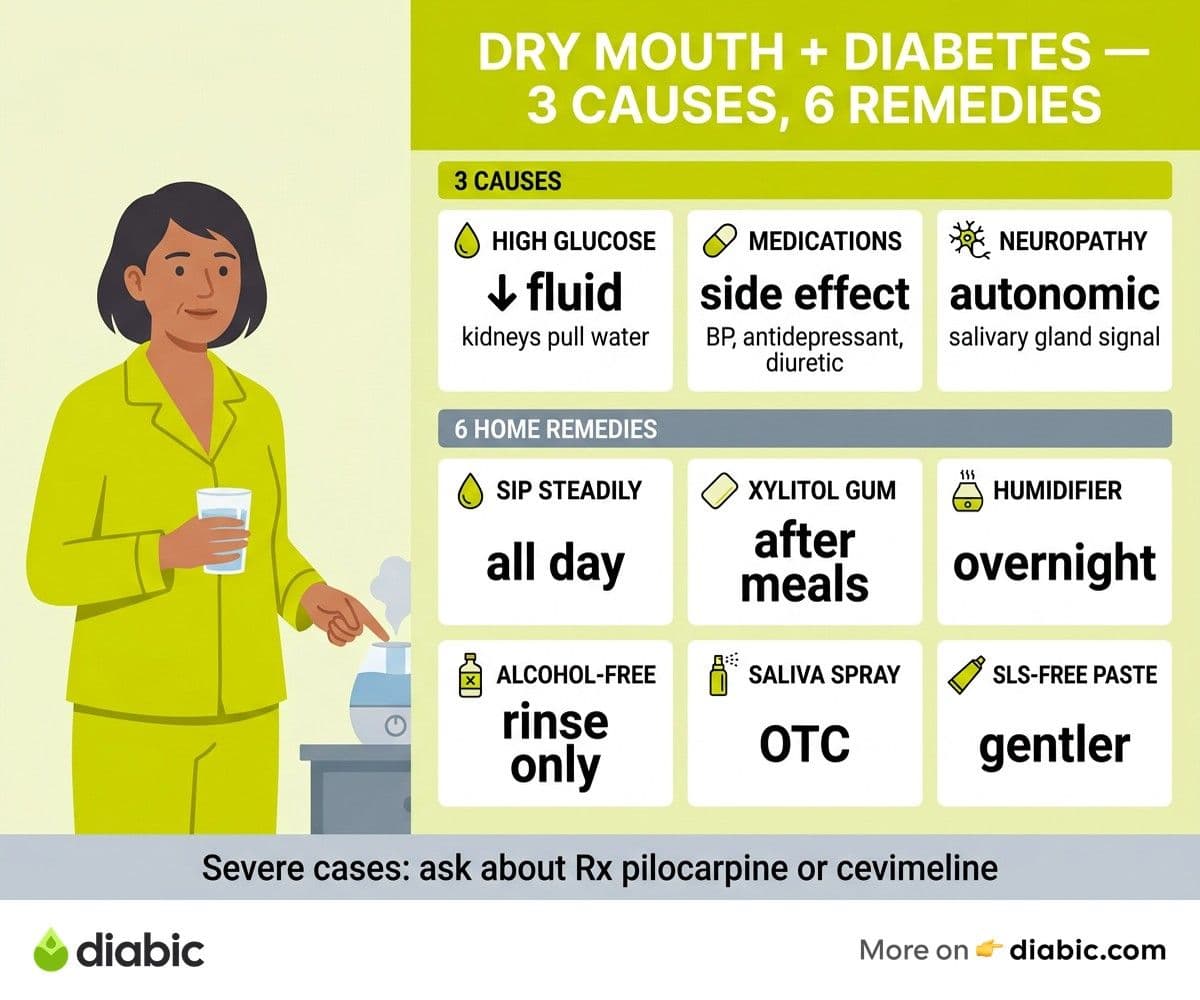
Saliva is mostly water, which means anything that pulls water out of your body affects how much you produce. When blood glucose runs high, your kidneys work harder to filter out the excess sugar, and that process takes fluid with it. The result is the classic frequent urination and thirst cycle that often signals high blood sugar in the first place.
That whole-body dehydration shows up in your mouth almost immediately. The National Institute of Dental and Craniofacial Research explains that reduced fluid availability lowers saliva flow, leaving your mouth feeling sticky, dry, or rough. The higher your average glucose, the more pronounced the effect tends to be.
Medications add another layer. Many drugs commonly used in diabetes management list dry mouth as a side effect, including some blood pressure medications, antidepressants, and diuretics that people with diabetes often take alongside their glucose medications. The Mayo Clinic keeps an extensive list of culprit medications worth reviewing with your pharmacist.
There is also a nerve-related cause that gets less attention. Long-standing high blood sugar can damage the autonomic nerves that signal your salivary glands to produce saliva, a condition called autonomic neuropathy. When those signals weaken, the glands underperform even when you are fully hydrated. This is why some people find drinking more water helps a little but does not solve the problem.
What Are the Best Home Remedies for Dry Mouth With Diabetes
The most reliable home remedy is also the simplest: sip water steadily across the day rather than drinking large amounts at meals. Small, frequent sips keep oral tissues moist and help your salivary glands stay active. Keeping a refillable bottle within arm's reach all day removes the friction of remembering.
Sugar-free gum and lozenges can stimulate saliva on demand. Look for products sweetened with xylitol, which research suggests may also reduce cavity-causing bacteria. Chewing gum after meals does double duty by both prompting saliva flow and helping clear food debris between brushings.
A bedroom humidifier changes the equation overnight, which is when many people notice dry mouth at its worst. Dry indoor air pulls moisture from the tissues lining your mouth and throat while you sleep with your mouth slightly open. Running a cool-mist humidifier through the night can be the difference between waking up parched and waking up comfortable.
A few habits make dry mouth measurably worse and are worth pulling back on:
- Caffeine, which acts as a mild diuretic and reduces saliva
- Alcohol, including the alcohol in many standard mouth rinses
- Tobacco, which damages salivary glands and irritates oral tissues
- Salty or spicy foods late in the evening, which intensify the dry feeling
Switch to alcohol-free mouth rinses formulated for dry mouth. Standard mouthwashes with high alcohol content can leave your mouth drier than before you rinsed.
From my experience: Living with type 1 for fourteen years, I learned the hard way that dry mouth is not just an annoyance. The summer my A1C drifted higher, my mouth felt cottony every morning and I started getting cavities for the first time in years. Adding a humidifier, cutting evening coffee, and getting my numbers back in range fixed it within a few weeks. The mouth was the warning light.
Understanding Xerostomia and Diabetes
Xerostomia is the medical term for the sensation of dry mouth, and it is not always tied to actual reduced saliva flow. Some people produce normal amounts of saliva but still feel dry, while others have measurably reduced flow without the sensation. With diabetes, both versions are common, which is part of why the condition can be tricky to assess.
A dentist or doctor can diagnose xerostomia through a combination of patient history, oral exam, and sometimes a sialometry test that measures saliva flow over a set time. They will also look for the downstream signs: cracked lips, a fissured tongue, redness inside the cheeks, and unusual cavity patterns. If you are experiencing burning sensations alongside dryness, that may point to burning mouth syndrome with diabetes, which sometimes overlaps.
The severity spectrum matters. Mild xerostomia may respond well to home remedies alone, while moderate to severe cases often need prescription saliva stimulants like pilocarpine or cevimeline. If you are sipping water through every meal, struggling to speak for long periods, or seeing rapid cavity formation, the dryness has crossed into territory that benefits from professional help.
How Dry Mouth Diabetes Affects Oral Health
Saliva is not just lubrication. It buffers acid produced by oral bacteria, washes away food particles, and delivers calcium and phosphate to tooth enamel. When flow drops, every one of those protective functions weakens at once.
Cavity risk climbs sharply. Without enough saliva to neutralize acid and rinse away sugar, bacteria spend more time on tooth surfaces producing the acids that dissolve enamel. People with diabetes-related dry mouth often see decay on surfaces that were stable for decades, especially along the gumline and between teeth.
Gum disease accelerates too. The same protective rinse that washes bacteria off teeth also keeps them from settling into the gum sulcus. With reduced saliva, bacterial colonies build faster, plaque hardens into tartar sooner, and gingivitis can progress to periodontitis more quickly. Our guide on diabetes and gum disease prevention covers the warning signs in detail.
Oral infections become more common as well. Fungal overgrowth like oral thrush and diabetes tends to flourish in dry, sugar-rich mouths, which is exactly the environment uncontrolled blood sugar plus dry mouth creates. Bad breath also worsens because the bacteria producing volatile sulfur compounds thrive without saliva to disrupt them.
Over-the-Counter Products That Help
The dry mouth aisle has expanded significantly in the past decade, and the right products can make daily life dramatically more comfortable. Saliva substitutes, often sold as sprays, gels, or lozenges, coat oral tissues with a moisturizing layer that lasts a few hours. Brands like Biotene, ACT Dry Mouth, and Oasis are widely available and designed specifically for xerostomia.
Oral moisturizing gels work especially well overnight. Applied to the gums and tongue before bed, they form a longer-lasting film that bridges the hours when saliva flow naturally slows. People who wake up with their tongue stuck to their palate often see the biggest improvement here.
Toothpaste choice matters more than most people think. Look for fluoride toothpastes formulated for dry mouth, which use gentler foaming agents and skip the sodium lauryl sulfate that can irritate dry tissues. Some prescription options offer 5,000 ppm fluoride for people at high cavity risk, well above the 1,000 to 1,500 ppm in standard pastes.
A few things to avoid in any oral care product:
- Alcohol, which dries tissues further
- Strong mints or whitening agents, which often irritate dry tissues
- Sodium lauryl sulfate (SLS), the foaming agent that worsens dryness
Read labels carefully. "Whitening" and "extra fresh" formulations are usually wrong choices for dry mouth, even when the brand is one you trust for other purposes.
Dental Care Adjustments for Dry Mouth
When saliva drops, your dentist becomes a more active partner. Most clinicians will move people with dry mouth diabetes from the standard six-month recall to a three- or four-month schedule, and our breakdown of how often people with diabetes should visit the dentist explains why that frequency makes a measurable difference.
In-office fluoride treatments give your enamel a protective boost between visits. A high-concentration fluoride varnish or gel applied every three to four months can offset much of the cavity risk that comes with reduced saliva. Some dentists also recommend custom fluoride trays you wear at home for a few minutes daily, which deliver a higher dose than toothpaste alone.
Your brushing and flossing routine may need small adjustments. Soft-bristled brushes are gentler on tissues that already feel raw. Brushing right before bed becomes especially important because the mouth is most vulnerable during low-saliva sleep hours. Flossing once a day, ideally at night, removes the plaque that builds up faster without saliva to help.
Talk to your dentist about prescription options if home remedies and OTC products are not enough. Cholinergic medications like pilocarpine and cevimeline can stimulate the salivary glands directly and may help when nerve damage or medication side effects are the main driver. They are not for everyone, so your full medication list and medical history matter.
Frequently Asked Questions
Why does diabetes cause dry mouth?
High blood sugar pulls water out of your body through increased urination, leaving less fluid available for saliva production. Some diabetes medications also list dry mouth as a side effect, and long-standing high glucose can damage the autonomic nerves that control your salivary glands.
What are the best home remedies for dry mouth with diabetes?
Sip water steadily through the day, chew sugar-free gum or suck on xylitol lozenges, run a cool-mist humidifier overnight, and switch to alcohol-free mouth rinses. Cutting back on caffeine, alcohol, and tobacco usually brings noticeable improvement within a couple of weeks.
Can dry mouth with diabetes go away on its own?
Sometimes. If the main cause is high blood sugar or dehydration, getting glucose back in range and rehydrating often resolves the dryness. When medication side effects or nerve damage are involved, the dryness tends to be more persistent and benefits from ongoing management.
Is mouthwash safe to use if I have dry mouth and diabetes?
Yes, but choose alcohol-free formulas designed for dry mouth. Standard mouthwashes with alcohol can leave the mouth drier than before, which defeats the purpose. Look for rinses labeled for xerostomia or those containing xylitol.
When should I see a doctor about dry mouth?
If home remedies and OTC products are not enough, you are getting frequent cavities, your mouth burns or feels sore, or the dryness is interfering with eating, sleeping, or speaking, talk to your doctor or dentist. Prescription saliva stimulants and other medical options may help.
Dry mouth diabetes is not just background noise; it shapes everything from sleep quality to cavity risk to how comfortable you feel speaking and eating. The good news is that small, consistent changes such as steady hydration, smarter product choices, and a closer relationship with your dental team usually move the needle within weeks. Pair that with steady blood sugar management and you give your mouth the best chance to stay comfortable and healthy for the long haul.
Shahriar P. Shuvo is the founder of Diabic. He has lived with diabetes for over 14 years, and built Diabic to deliver the practical, evidence-based self-management tools he wished existed when he was first diagnosed. By trade, Shahriar is a senior design and frontend engineer with 6+ years shipping products at Agora, Timescale (now Tiger Data), and ShareTrip. He writes from the intersection of lived diabetes experience and product craft, focused on what works in daily management rather than what sounds good in a textbook.
Medically reviewed by
Dr. Rezwana Parvin Rumpa is an obstetrics and gynaecology specialist with clinical focus on gestational diabetes, PCOS, and fertility. She holds the MRCOG (Final Part) from the Royal College of Obstetricians and Gynaecologists in London, the MRCPI (Final Part) from the Royal College of Physicians of Ireland, and an MBBS from Shaheed Monsur Ali Medical College under Dhaka University. Dr. Rumpa serves as a Senior Medical Officer in the Obs and Gynae department at BRB Hospitals Ltd, where she has spent three years managing prenatal care, emergency obstetric cases, and women's-health surgery. On Diabic, she medically reviews content for women living with diabetes, with particular attention to pregnancy, PCOS, and reproductive-health intersections.
More from Health & Complications
View all
Diabetes and Dental Implants: What to Know First
Diabetes dental implants guide covering safety, A1C targets, recovery expectations, gum health prep, and what to ask your oral surgeon before surgery.

Burning Mouth Syndrome and Diabetes Explained
Burning mouth syndrome diabetes link explained, including neuropathy, dry mouth, and thrush causes plus treatment options that may bring real relief.

Dental Care for people with diabetes: Tips That Help
Practical dental care diabetics need, with real tips for protecting teeth and gums when diabetes raises your risk for oral health problems.
Clinician-reviewed habits, plain-language guides, and honest answers - the small shifts that make living with diabetes feel lighter, every day.