Best Office Snacks for people with diabetes
The best office snacks for people with diabetes combine protein, fiber, and shelf stability. See what to keep in your desk drawer to keep blood sugar.

In this article(16)
The best office snacks for people with diabetes strike a balance between convenience, portability, and blood sugar stability, and the usual office vending machine is rarely going to help. With a little planning, you can keep a desk drawer stocked with options that taste good and keep your numbers steady through long meetings, late afternoons, and the occasional pizza-Friday surprise. Most of the work happens once on a Sunday afternoon, then quietly pays off every workday after.
This guide is written for people with diabetes who spend their workdays at a desk, in shared offices, or in meeting rooms where the snack table is rarely on your side. We will cover what to look for, what to buy, and how to time the snacking so it supports your numbers rather than fighting them. If you also work shifts or irregular hours, our companion piece on practical strategies for managing diabetes at work covers the broader workplace picture.
Why Office Snacks for People With Diabetes Need Special Consideration
Office snacks for people with diabetes get a different stress test than snacks at home. The gap between meals at work stretches longer than planned because meetings run over, deadlines compress lunch, and a quick errand turns into an hour. The American Diabetes Association nutrition guidance emphasizes pairing carbs with protein and fiber to slow glucose absorption, and a desk-side snack is where that pairing earns its keep.
The vending machine is the everyday villain. Most options are cheap, shelf-stable refined carbs with added sugar and very little protein or fiber. A bag of pretzels and a soda can push glucose well above 200 mg/dL within an hour, and the crash that often follows pulls you toward another snack 90 minutes later. That cycle is easier to break by removing the option entirely than by trying to resist it daily.
"Healthy" office snacks are sometimes traps too. Granola bars often pack 25 to 30 grams of carbs with little protein, dried fruit concentrates natural sugars into small portions that hit fast, and smoothies from the lobby cafe regularly contain more sugar than soda. Reading the actual label, not the front-of-package marketing, is the most useful skill for picking workplace snacks.
How Strategic Snacking Fits Workplace Diabetes Management
Strategic snacking is not about eating more. It is about placing food where your day already has gaps that affect your glucose. If you eat lunch at noon and dinner at seven, a small protein-anchored snack around 3 or 4 p.m. usually beats arriving at dinner ravenous and overshooting your portion. Research in Diabetes Spectrum suggests that what you eat matters more than how often, but consistent timing helps people predict their numbers more easily.
Managing Diabetes at Work Through Smart Snacking
Managing diabetes at work is partly a logistics problem. Snacks need to travel from the grocery store to your desk in a way that survives traffic, forgotten lunch bags, and the unreliable office fridge. The snacks that get eaten are the ones within arm's reach when hunger hits, which is why a small drawer kit beats a perfect plan that lives at home.
Timing snacks around meetings is the most overlooked piece. A 90-minute meeting at 3 p.m. often becomes the worst part of the day for blood sugar because lunch was three hours ago and dinner is three hours away. Eating a small protein-and-fiber snack 20 minutes before the meeting smooths that window, and a handful of almonds with a hard-boiled egg or a cheese stick with a small piece of fruit fits the slot well.
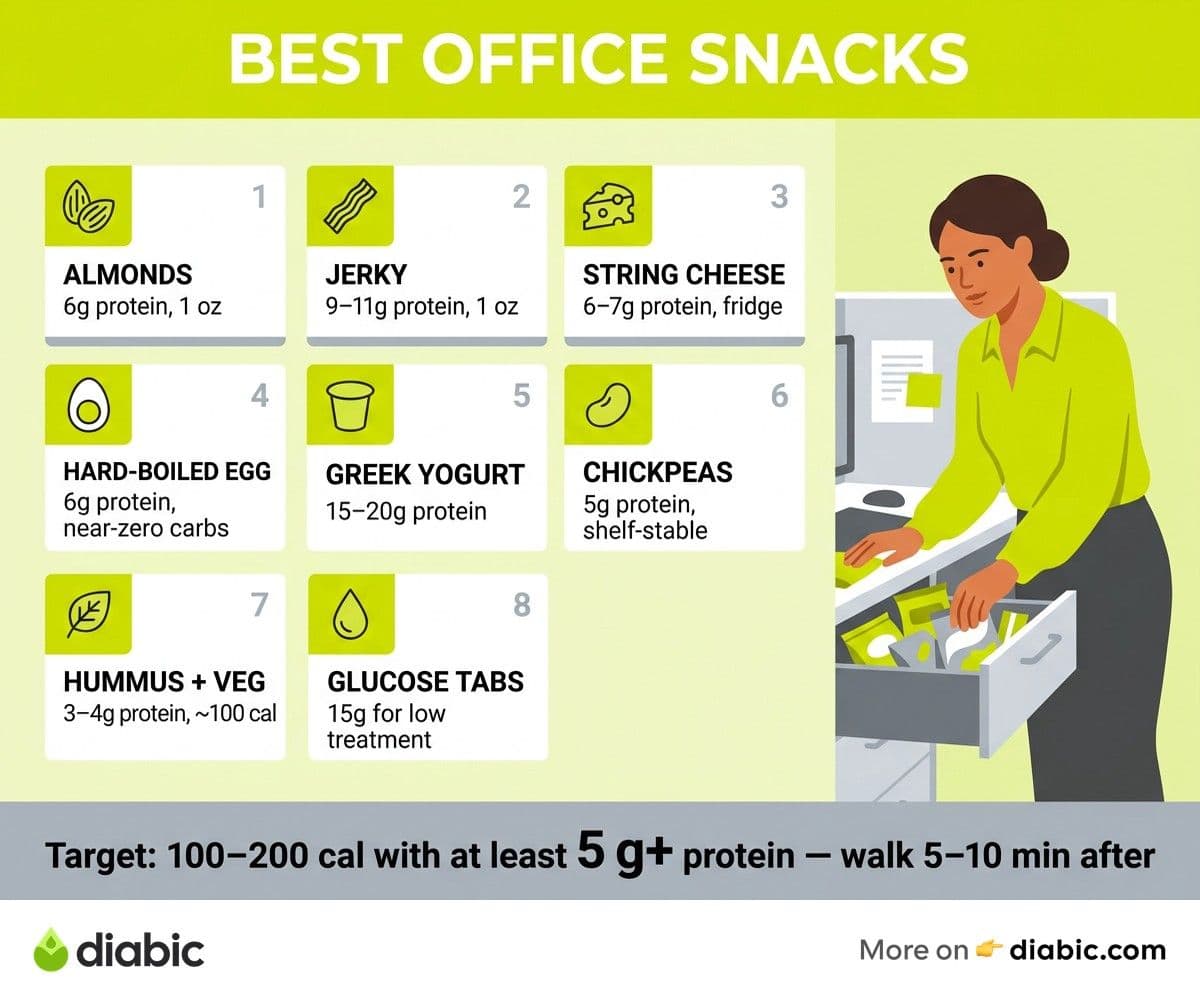
Portion sizes deserve more thought than they get. A "snack" that weighs in at 300 calories starts behaving like a small meal, which can crowd your appetite at dinner and complicate medication timing. We recommend snacks at work in the 100 to 200 calorie range with at least 5 grams of protein and some fiber, which bridges a long afternoon without becoming a substitute meal.
Pre-Packing Versus Buying on the Go
Pre-packing wins on cost, consistency, and glucose impact. The mix that works is a base of pre-packed staples in the desk drawer, supplemented occasionally by a planned grab from a nearby cafe with options you already know fit your numbers. Spend ten minutes on a Sunday assembling zip-top bags of nuts in 1 ounce portions, and you have removed the most common reason snacks go off the rails.
Foods That Keep Blood Sugar Steady at Your Desk
The category that earns the most desk space is nuts and seeds. Almonds, walnuts, pistachios, and pumpkin seeds combine protein, healthy fats, and fiber in a portable, shelf-stable package. Research from the Harvard T.H. Chan School of Public Health consistently links nut consumption to better glycemic control. Watch portions and pre-portion into 1 ounce servings rather than eating from a large bag.
Cheese-based snacks are a workhorse for desk drawers with access to a fridge. String cheese, cheddar squares, or babybel rounds offer 6 to 7 grams of protein with minimal carbs and survive a day or two unrefrigerated in a pinch. Cheese crisps, the baked-cheese kind in small bags, are a shelf-stable cousin with a satisfying crunch. Hard-boiled eggs are nearly perfect too, with six grams of protein and almost zero carbs, and many stores now sell pre-peeled eggs in two-packs.
Vegetables with hummus, guacamole, or nut butter cover the fiber and crunch a desk drawer often lacks. Pre-cut carrots, celery, cucumber slices, or bell pepper strips with a 2-tablespoon hummus cup land around 100 calories with 3 to 4 grams of protein. Apple slices with a single-serve almond or peanut butter packet do something similar and hold up well when refrigeration is not an option.
Yogurt, Jerky, and Other Protein Options
Greek yogurt is one of the strongest snacks in the lineup if your office has a fridge. Plain or low-sugar varieties pack 15 to 20 grams of protein per cup, and you can add a handful of berries or nuts for fiber. Read labels carefully, because flavored yogurts often hide 20 grams or more of added sugar per serving.
Beef, turkey, or salmon jerky has earned its desk-drawer reputation. A single ounce typically delivers 9 to 11 grams of protein with very little carbohydrate, and good-quality jerky lives for months unrefrigerated. Look for varieties with under 5 grams of added sugar per serving. For more low-spike options, our piece on foods that will not spike your blood sugar covers the broader landscape.
Here is how the most common desk-drawer options stack up:
The shelf-stable picks anchor the drawer, and the fridge picks earn their place when refrigeration is available. Mixing both gives you something workable on every kind of office day.
Roasted chickpeas, edamame pods, and seed-based crackers round out the category. Each delivers fiber and protein in shelf-stable form and survives a desk drawer for weeks. Pair seed crackers with cheese or hummus for a more complete snack, because the crackers alone behave more like crisps than a true protein-anchored option.
Desk Exercises That Complement Your Snacking Strategy
Movement after eating is one of the simplest tools for smoothing post-snack glucose, and it does not require a gym or a change of clothes. Studies in Diabetes Care have shown that breaking up sitting with short walks improves post-meal glucose responses in people with type 2 diabetes. A 5 to 10 minute walk after a snack measurably blunts the glucose rise that follows.
If a walk is not possible, a few simple movements at your desk help more than nothing. Calf raises while standing, seated leg extensions, and chair-supported squats each engage large muscles and pull a bit of glucose out of the bloodstream. Aim for two to three minutes of movement after a snack rather than one big effort, and the cumulative effect across a workday is meaningful. We cover more options in our guide to desk exercises for better blood sugar if you want to layer movement on top of your snacking plan.
Building Micro-Movement Habits
The phrase "exercise snack" describes short bursts of movement spread through the day. A two minute stair climb between meetings, a lap of the office floor when refilling water, or a set of bodyweight squats after a snack each count. These micro-movements are easier to sustain than a heroic post-work workout, and they land closer in time to when you ate, which is when they help glucose most. Pairing movement with a specific cue is what makes it stick, so tying a 90 second walk to "after I eat my afternoon snack" turns a vague intention into a habit.
Snacks to Keep in Your Desk Drawer
A well-stocked desk drawer answers the question, "What can I eat right now without leaving my chair?" The shelf-stable layer is the foundation. Single-serve nut packets, jerky sticks, roasted chickpeas, seed crackers, nut butter packets, cheese crisps, and a couple of low-sugar protein bars cover most afternoon hunger spikes without requiring a fridge. Rotate stock weekly so nothing goes stale, because an unappetizing snack is one you will skip in favor of something worse.
Emergency low blood sugar treatment options belong in this kit too. Glucose tabs are the gold standard because they are dose-precise, fast-acting, and shelf-stable for years. Keep at least one tube in your desk drawer, one in your bag, and one in your car. The ADA recommends 15 grams of fast-acting carbohydrate to treat a low, then a recheck 15 minutes later, which is what one tube of standard glucose tabs delivers.
Building a Diabetes Desk Kit
A "diabetes desk kit" extends beyond food. We recommend a small zippered pouch with glucose tabs, your meter and extra strips, lancets, a spare CGM sensor or pump infusion set if you wear one, and one shelf-stable snack reserved for emergencies. The kit lives in the same drawer as your daily snacks but does not get raided for normal hunger, and that separation is what makes it reliable.
Co-workers who know about your diabetes can be part of the kit too. Letting one or two trusted colleagues know where your low-treatment lives, and what to do if you go quiet during a meeting, costs nothing and adds real safety. You do not need to disclose to the whole office, but a single reliable backup is worth the brief conversation.
Keeping Blood Sugar Steady All Day
A simple snacking schedule for an 8-hour workday looks something like this. Breakfast or coffee with a small protein around your start time, lunch in the middle, a planned snack in the mid-afternoon if dinner is more than four hours away, and water throughout. The exact times matter less than the consistency from day to day, because predictable inputs produce predictable outputs on the meter.
Pairing carbs with protein and fat is the rule that earns the most mileage. A piece of fruit alone often spikes glucose, while the same fruit with a tablespoon of nut butter or a slice of cheese behaves very differently because the protein and fat slow gastric emptying. The Academy of Nutrition and Dietetics recommends this pairing approach for steady glucose, and most people with diabetes find their numbers respond within a few days of applying it consistently.
Hydration is so often overlooked. Mild dehydration concentrates blood glucose and can nudge readings upward without you having eaten anything. A water bottle on your desk, refilled at least twice during the workday, is one of the cheapest and most effective interventions available, and unsweetened tea, sparkling water, and black coffee all count.
When the Office Orders Pizza or Brings In Donuts
Pizza Fridays, birthday cakes, donuts in the break room, and catered lunches with limited options all happen. Pretending they do not is not a strategy, and the realistic plan is to know your options in advance. If pizza is happening, eating one slice with a side salad and a tall glass of water lands very differently than eating three slices with soda.
A small portion of a celebratory food, eaten alongside protein and fiber, fits into a diabetes-aware day far more often than people expect. Skipping the donut is fine, and eating half a donut with a hard-boiled egg from your drawer is also fine. The goal is a plan you can sustain, not a perfect record.
From my experience: 14 years with type 1 has convinced me that the desk drawer is one of the most useful tools in workplace diabetes management. Mine has the same five things every week, almonds, beef jerky, peanut butter cups, glucose tabs, and an emergency protein bar. I know what each one does to my numbers within 15 minutes, which means I can make snack decisions in seconds rather than agonizing over a vending machine label when I am already running low.
FAQ
What are the best office snacks for people with diabetes?
The best office snacks for people with diabetes combine protein, healthy fat, and fiber in shelf-stable, portion-controlled packages. Almonds and other nuts, beef or turkey jerky, hard-boiled eggs, individually wrapped cheese, vegetables with hummus, Greek yogurt with berries, and seed-based crackers with nut butter are all strong choices. Look for snacks with under 15 grams of carbs per serving and at least 5 grams of protein, and pre-portion them into single servings.
What healthy desk snacks keep blood sugar steady?
Shelf-stable options like raw or roasted nuts, peanut and almond butter packets, cheese crisps, low-sugar protein bars, jerky, and roasted chickpeas keep blood sugar steady without requiring a refrigerator. If your office has a fridge, hummus with vegetables, plain Greek yogurt, hard-boiled eggs, and string cheese all work well. The pattern that matters most is pairing some carbohydrate with protein and fat, which slows glucose absorption.
How often should someone with diabetes snack at work?
Most people with diabetes do well with one or two planned snacks during an 8-hour workday, typically between meals where the gap stretches longer than four hours. The exact frequency depends on your medication regimen, meal timing, and individual glucose patterns, so talk to your doctor or diabetes educator about what fits your plan. The goal is to bridge long gaps with steady, protein-anchored snacks rather than constant grazing.
Stocking your desk drawer with the right office snacks for people with diabetes is one of the easiest workplace habits to build, and the payoff shows up on your meter and your CGM. Pick three or four staples on your next grocery trip, portion them into single servings on Sunday, and notice how your afternoon numbers respond over the next two weeks. Talk to your doctor about whether your current snack timing fits your medication schedule, because office snacks for people with diabetes work best when they are part of a plan rather than a guess.
Shahriar P. Shuvo is the founder of Diabic. He has lived with diabetes for over 14 years, and built Diabic to deliver the practical, evidence-based self-management tools he wished existed when he was first diagnosed. By trade, Shahriar is a senior design and frontend engineer with 6+ years shipping products at Agora, Timescale (now Tiger Data), and ShareTrip. He writes from the intersection of lived diabetes experience and product craft, focused on what works in daily management rather than what sounds good in a textbook.
Medically reviewed by
Dr. Rezwana Parvin Rumpa is an obstetrics and gynaecology specialist with clinical focus on gestational diabetes, PCOS, and fertility. She holds the MRCOG (Final Part) from the Royal College of Obstetricians and Gynaecologists in London, the MRCPI (Final Part) from the Royal College of Physicians of Ireland, and an MBBS from Shaheed Monsur Ali Medical College under Dhaka University. Dr. Rumpa serves as a Senior Medical Officer in the Obs and Gynae department at BRB Hospitals Ltd, where she has spent three years managing prenatal care, emergency obstetric cases, and women's-health surgery. On Diabic, she medically reviews content for women living with diabetes, with particular attention to pregnancy, PCOS, and reproductive-health intersections.
More from Living with Diabetes
View all
A Gentle Chair Yoga Routine for people with diabetes
A gentle chair yoga for people with diabetes routine with safe poses, modifications for neuropathy, retinopathy, and joint pain, plus tips for older.

Shift Work and Diabetes: Managing Irregular Hours
Shift work and diabetes is a tough combination. Learn how to manage meals, sleep, medication, and blood sugar when your hours rotate or flip overnight.

Dating with Diabetes: When to Tell a New Partner
Dating with diabetes brings unique disclosure questions. Here is when to tell a new partner, what to say, and how to handle the conversation with.
Clinician-reviewed habits, plain-language guides, and honest answers - the small shifts that make living with diabetes feel lighter, every day.