Desk Exercises for Better Blood Sugar at Work
Simple desk exercises for blood sugar that fit into your workday. Learn micro-movements, calf raises, and standing breaks that help glucose.

In this article(9)
You finish a quick lunch at your desk, open the next email, and three hours later realize you have not stood up once. If that scene feels familiar, your blood sugar is probably feeling it too. The good news is that desk exercises for blood sugar are not about turning your cubicle into a gym, they are about small movements that interrupt prolonged sitting and help your body process glucose.
We have watched five-minute changes show up on continuous glucose monitor graphs as smaller post-lunch peaks. You do not need a standing desk or a gym membership to start, just a chair and a timer. This guide covers the science, the moves, and a sample 3-minute routine you can run between meetings today.
From my experience: I started watching this play out on my Dexcom G6 a few years before the G7 came along, and the pattern was hard to argue with. A 1pm sandwich followed by three hours of straight email work would push me past 200 mg/dL almost every time. The same lunch followed by a 10-minute walk around the block kept me under 160. Nothing about the food changed; only what my legs were doing for the next 15 minutes.
Why Desk Exercises for Blood Sugar Actually Work
Sitting for long stretches does something quiet and frustrating to your metabolism. When your large leg and glute muscles stay still, they stop pulling glucose out of your bloodstream as efficiently, and insulin has to work harder to do the same job. Researchers call this acute insulin resistance, and it can show up after just one to four hours of uninterrupted sitting.
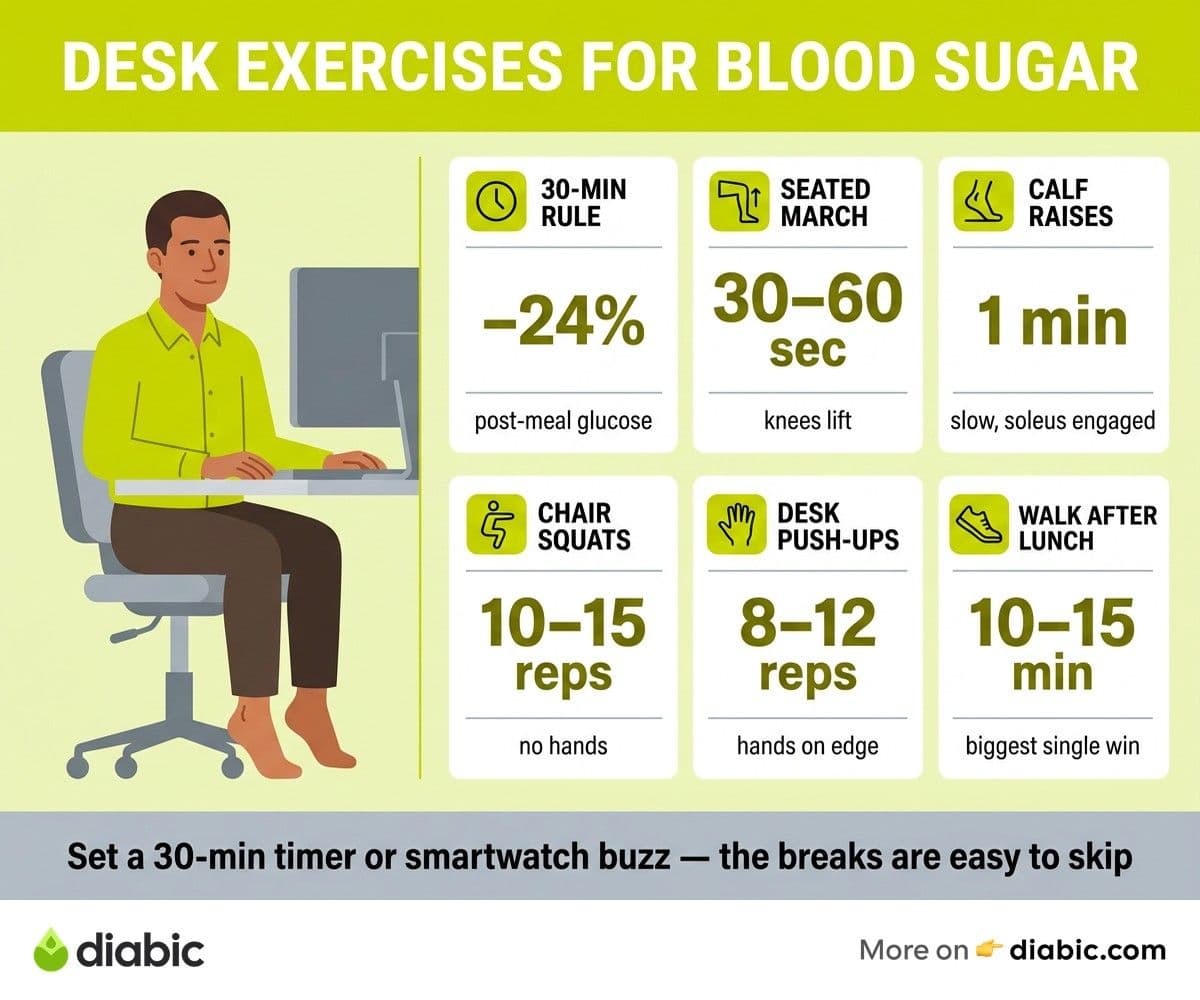
The mechanism behind why this works is encouraging. When you contract your muscles, even with light activity like walking or calf raises, those fibers can absorb glucose through a pathway that does not need much insulin. A landmark study from researcher David Dunstan published in Diabetes Care found that interrupting sitting every 20 minutes with two minutes of light walking reduced post-meal glucose by roughly 24 percent compared to uninterrupted sitting.
Other work from the same group, including studies in the British Journal of Sports Medicine, shows that breaking up sitting time matters independently of how much you exercise overall. You can finish a 30-minute morning workout and still see better numbers if you also break up your afternoon sitting. Intensity is not the secret here, frequency is.
Managing Diabetes at Work Through Movement
Fitting movement into a desk-bound schedule sounds harder than it is, mostly because the obstacles are mental. The blocker is rarely time, it is forgetting, feeling self-conscious, or believing the next email cannot wait. We find the most reliable approach is to attach movement to cues you already respond to, like finishing a meeting or hearing your calendar ping.
Movement breaks work best as part of a broader workplace plan. They pair naturally with our other practical strategies for managing diabetes at work, which cover meal timing, glucose monitoring at the office, and meetings that run long. When you stack a few small habits, the effect on your daily numbers compounds.
Setting reminders is the difference between intention and action. A recurring 30-minute timer on your phone, smartwatch buzz, or browser extension works well. Some people prefer pairing reminders with their water bottle, since refilling it triggers both a stand-up and a walk to the kitchen. The American Diabetes Association recommends discussing any new exercise plan with your healthcare team, especially if you take insulin or other glucose-lowering medications.
Seated Exercises You Can Do at Your Desk
You can get meaningful movement without ever leaving your chair, which matters on days when your calendar is back-to-back. Seated marching is the simplest place to start, lift one knee at a time toward your chest in a deliberate rhythm for 30 to 60 seconds. Add seated leg raises by extending one leg straight out, holding for two seconds, and switching, working both quadriceps without taking your eyes off your screen.
Desk push-ups and chair squats add a strength element that engages bigger muscle groups. For desk push-ups, place your hands shoulder-width apart on the edge of a sturdy desk, step your feet back, and lower your chest toward the desk for 8 to 12 reps. Chair squats are even easier, stand up from your chair without using your hands and sit back down with control, repeating 10 to 15 times.
Ankle circles and calf raises under the desk are our favorite stealth movement, because nobody sees your feet on a video call. A 2022 study from researchers at the University of Houston found that the soleus muscle, the deep calf muscle activated by raising your heels, can sustain elevated glucose uptake for hours when used in a slow, repeated push-up motion. Aim for a minute of slow heel raises a few times a day.
Upper body care matters too, even if shoulder shrugs do not move your blood sugar much. They keep you comfortable enough to stay consistent with the lower-body work. For a 3-minute seated routine, do 30 seconds of seated marching, 10 chair squats, 20 slow calf raises, 10 desk push-ups, and finish with shoulder rolls and a neck stretch. Repeat the circuit two or three times across a workday.
Standing and Walking Breaks
The 30-minute rule is the simplest research-backed framework for office movement. Stand up every 30 minutes for at least two to three minutes of light activity, whether walking to the printer, refilling water, or pacing while you read on your phone. The American College of Sports Medicine has flagged sedentary behavior as a distinct health risk, separate from total exercise, which is why these short interruptions matter even for people hitting their weekly activity goals.
Standing desks can help, but they are not a fix on their own. Standing still for hours has ergonomic costs and does not produce the muscle contractions that move glucose. If you have one, alternate sitting and standing every 30 to 60 minutes, and use standing time to shift your weight, do calf raises, or step away briefly. The benefit comes from variety and small added movements, not from standing still all day.
Walking meetings are one of the easiest workplace upgrades for your glucose, especially for one-on-one calls that do not need screen sharing. A 15-minute walking call after lunch can flatten what would have been a meaningful post-meal spike, and our notes on blood sugar management during long meetings cover how to plan around the calls you cannot walk through. Stair climbing is another high-yield option, two flights three times a day adds up fast. The CDC physical activity guidelines recommend at least 150 minutes of moderate activity per week, and these workplace habits can cover a real chunk of that.
The post-lunch walk deserves its own mention because the data on it is so consistent. Even 10 to 15 minutes of easy walking within 30 minutes of finishing a meal can reduce your glucose peak. Researcher James Levine, who pioneered work on non-exercise activity thermogenesis, has argued that small, frequent movement is metabolically more important than occasional intense workouts.
Smart Snacking to Complement Your Exercise
Pairing a short walk with your snack routine is one of the highest-return moves in this playbook. Many people find a 10-minute post-snack walk turns what would be a noticeable spike into a gentle ripple on their glucose tracker. We cover specific options in our guide to the [best office snacks for people with diabetes](/diabetes-at-work/best-office-snacks-for-people with diabetes), but the rule holds, protein-and-fiber snacks pair best with light movement afterward.
Pre-exercise snacks matter too, especially if you take insulin or sulfonylureas. Going from a desk into a brisk 20-minute walk on an empty stomach can drop your numbers further than expected, and a small snack with 15 to 20 grams of carbohydrate before walking can prevent a low. Our roundup of best office snacks for diabetes is a useful starting list. Talk to your doctor about whether you need to adjust medication timing or add a snack before workplace movement, since the right approach depends on your medication and insulin sensitivity.
Hydration is the easy one to miss, because thirst can mimic hunger and fatigue. Mild dehydration can nudge blood sugar slightly higher and make exercise feel harder than it should. Keep a water bottle within reach and drink steadily, especially if your office is dry. A side benefit of frequent water breaks is the built-in walk to the bathroom, which is movement disguised as biology.
Comparing Desk Exercise to Other Activity
Desk movement is not a replacement for longer workouts, it earns its keep differently. A 45-minute strength session or steady cardio still delivers cardiovascular and muscle-building benefits that micro-movements cannot match. Desk exercise excels at breaking up the sedentary hours between real workouts, smoothing the daily glucose curve that big workouts alone cannot fix.
Yoga-inspired desk stretches add a stress-management layer pure movement breaks miss. Chronic workplace stress raises cortisol, which can push glucose higher independently of food, and slow breathing with stretching helps calm that response. We compare the two approaches in our yoga vs walking for diabetes comparison, but the short version is that both have a role and the best choice depends on your body and schedule that day.
Walking and seated exercises serve different purposes during the workday. Walking is your top choice when you have 10 minutes and can step away, especially after meals. Seated exercises are your fallback when you cannot leave your desk, and calf raises in particular keep working for you during back-to-back meetings. Aim for one walk in the morning, a 10 to 15 minute walk after lunch, and short breaks every half hour in between. Add one or two rounds of the 3-minute seated routine when afternoon energy dips, and you have covered most of what desk exercises for blood sugar can offer.
Frequently Asked Questions
What desk exercises help lower blood sugar?
Seated marching, leg raises, chair squats, desk push-ups, and slow calf raises all engage large muscle groups that help absorb glucose without much insulin. Even standing up from your chair and sitting back down repeatedly for two to three minutes has been shown in research to improve post-meal blood sugar. The trick is doing them often rather than doing them perfectly.
How often should you take movement breaks for blood sugar?
Research from Dunstan and colleagues suggests breaking up sitting every 20 to 30 minutes with two to three minutes of light activity. A 10 to 15 minute walk after meals has the largest effect on post-meal glucose for most people. Setting a recurring timer or smartwatch reminder is the most reliable way to build the habit, because the breaks are easy to skip when you are deep in work.
Talk to your doctor about starting any new exercise program, especially if you take insulin, sulfonylureas, or other medications that can cause low blood sugar. Your healthcare team can help you adjust timing, dosing, and snack strategies so that desk exercises for blood sugar support your numbers rather than complicate them.
Shahriar P. Shuvo is the founder of Diabic. He has lived with diabetes for over 14 years, and built Diabic to deliver the practical, evidence-based self-management tools he wished existed when he was first diagnosed. By trade, Shahriar is a senior design and frontend engineer with 6+ years shipping products at Agora, Timescale (now Tiger Data), and ShareTrip. He writes from the intersection of lived diabetes experience and product craft, focused on what works in daily management rather than what sounds good in a textbook.
Medically reviewed by
Dr. Shanto Arian is an internal medicine physician now specializing in clinical and aesthetic dermatology, with a parallel academic focus on epidemiology and public health. He holds an MBBS, MPH, MSc (UK), MRCP (UK), MRCPI (Ireland), Diploma in Dermatology (UK), and Diploma in Aesthetic Medicine (USA). Dr. Arian trained in internal medicine, including hospital work on hematology cases such as graft-versus-host disease, before moving toward dermatology. Skin is one of the earliest places diabetes shows itself, from acanthosis nigricans and diabetic dermopathy to slow foot wound healing, and that intersection is where his clinical and Diabic-review work meet. On Diabic, Dr. Arian medically reviews content on diabetes diagnosis, complications, dermatologic manifestations, and pharmacotherapy, ensuring every claim aligns with current ADA, NICE, and peer-reviewed literature.
More from Living with Diabetes
View all
A Gentle Chair Yoga Routine for people with diabetes
A gentle chair yoga for people with diabetes routine with safe poses, modifications for neuropathy, retinopathy, and joint pain, plus tips for older.

Shift Work and Diabetes: Managing Irregular Hours
Shift work and diabetes is a tough combination. Learn how to manage meals, sleep, medication, and blood sugar when your hours rotate or flip overnight.

Dating with Diabetes: When to Tell a New Partner
Dating with diabetes brings unique disclosure questions. Here is when to tell a new partner, what to say, and how to handle the conversation with.
Clinician-reviewed habits, plain-language guides, and honest answers - the small shifts that make living with diabetes feel lighter, every day.