Ketoacidosis: Symptoms, Treatment, and Warning Signs
Ketoacidosis can escalate in hours. Learn what DKA feels like, when to call 911, hospital treatment, and how to prevent the next episode.

In this article(10)
If you are reading this because something feels wrong right now, please act first. Ketoacidosis is a true medical emergency that can move from uncomfortable to dangerous within hours, and the safest response is to call 911 or your provider's emergency line immediately. We wrote this so you and the people who love you can recognize the signs early, understand what hospital teams will do, and make another episode less likely.
DKA does not always announce itself loudly at the start. You might think you have the flu, food poisoning, or a tough sugar swing. By the time the breathing changes and confusion settles in, hours have passed. The good news is that the early signs are knowable, and the earlier you respond, the better the outcome tends to be.
What Is Diabetic Ketoacidosis (DKA)
DKA happens when your body cannot get glucose into your cells because there is not enough insulin available. Without insulin, your cells burn fat for fuel, and that process produces acidic byproducts called ketones. When ketones build up faster than your kidneys can clear them, your blood becomes dangerously acidic, your electrolytes shift, and your organs struggle. Blood sugar is usually above 250 mg/dL during DKA and often climbs higher, although a less common form called euglycemic DKA can occur with near-normal numbers.
DKA is most often associated with type 1 diabetes, but people with type 2 can develop it too, especially during serious illness, after surgery, or while taking certain medications. The National Institute of Diabetes and Digestive and Kidney Diseases describes DKA as one of the most serious short-term complications of diabetes, and the American Diabetes Association treats it as a hospital-level emergency. This is not something to manage at home with extra water and a wait-and-see attitude.
If you suspect DKA, call 911 or your provider's emergency line right away. You do not need to be certain. A trip that turns out to be a false alarm is far better than a delay that becomes an ICU stay.
What Ketoacidosis Feels Like
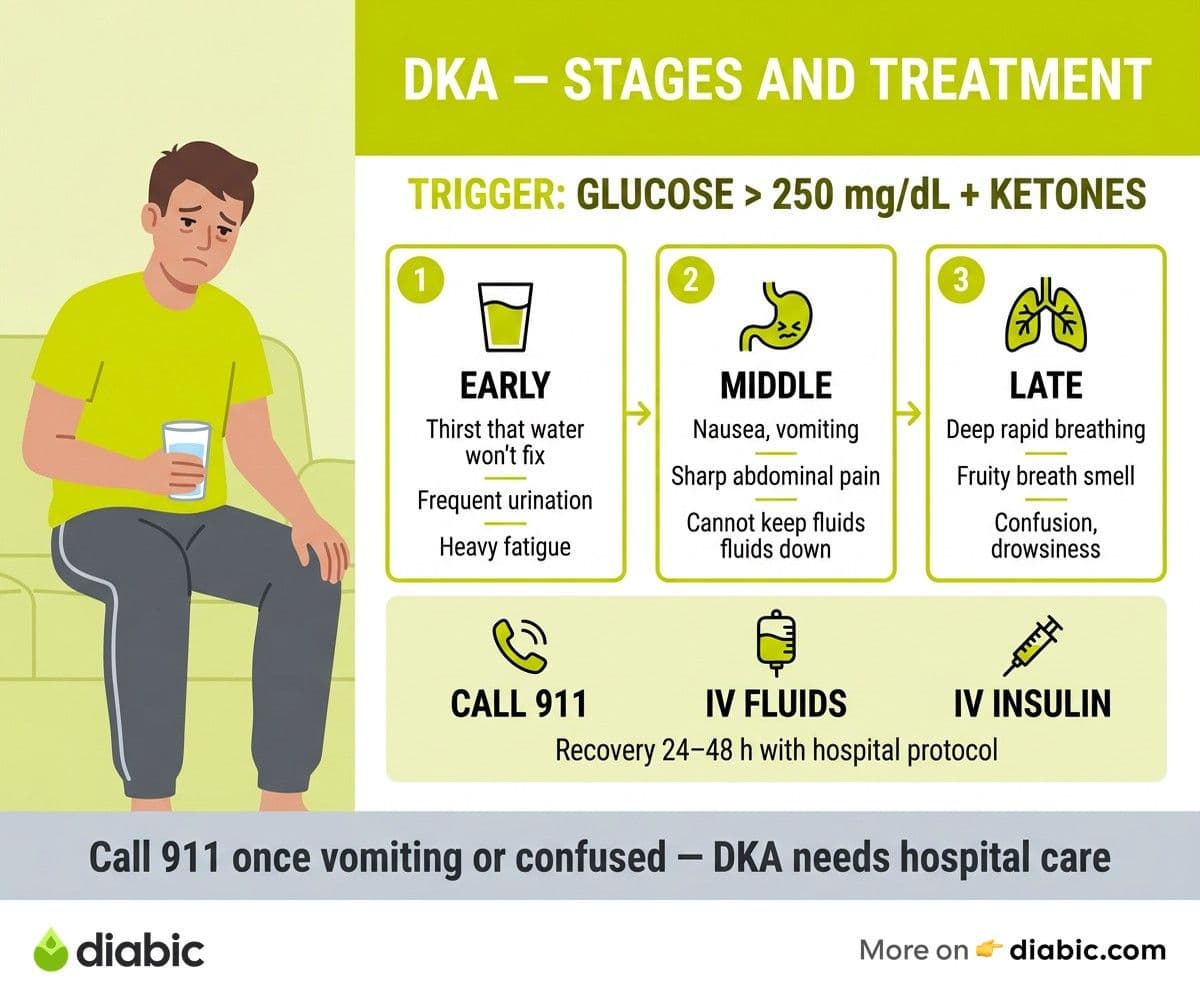
Early DKA often feels like a relentless version of high blood sugar. You may feel a thirst that water does not touch, even after several large glasses, and you might find yourself urinating every thirty to sixty minutes. Your mouth feels dry, your lips crack, and a heaviness settles in your legs that makes simple tasks tiring. These first hours are when intervention works best, and they are also the easiest hours to talk yourself out of taking seriously.
As ketones rise, the picture shifts toward your stomach. Nausea creeps in, vomiting often follows, and many people describe a sharp abdominal pain that can mimic appendicitis or a stomach bug. Once vomiting starts, dehydration accelerates, blood sugar can climb faster, and you lose your ability to keep fluids down. This is the inflection point where calling for help should not be delayed any further.
Later DKA produces signs easier to spot from outside than from inside. Breathing becomes deep, fast, and labored as your lungs try to blow off acid, a pattern doctors call Kussmaul breathing. Your breath may carry a sweet, fruity, or nail-polish-remover smell from acetone. Confusion, drowsiness, slurred speech, and difficulty staying awake can follow, and in severe cases people slip into unconsciousness. If you notice any of these signs, do not drive. Call 911.
From my experience: After 14 years with type 1, I have learned that my earliest DKA warning is not the number on my meter. It is a specific kind of thirst that water will not solve, paired with a flat, exhausted feeling. When those two show up together, I check ketones and call my care team before things get worse. Your early signs may be different, and getting to know yours is one of the most useful pieces of self-knowledge you can build.
When to Call 911 for Ketoacidosis
There is a tendency to bargain with these symptoms, especially if you have ridden out high blood sugars before. We want to make the threshold simple. Call 911 or go to the ER immediately if your blood sugar is above 300 mg/dL and you are vomiting, confused, struggling to breathe, or unable to keep fluids down. Call 911 if a person with diabetes is unresponsive or difficult to wake, or if moderate to large ketones show up on a test and symptoms are getting worse.
The Centers for Disease Control and Prevention and emergency medicine experts agree that DKA is treated in a hospital, not at home, because it requires IV fluids, IV insulin, and continuous lab monitoring that cannot be replicated in a kitchen. Trying to bolus your way out of DKA without medical supervision can cause dangerous potassium shifts. If you are unsure how severe things are, read our piece on when to go to the ER for diabetes, then make the call.
When you reach the dispatcher, say clearly that you have diabetes, that you suspect DKA, and that you are vomiting, confused, or short of breath if any of those apply. Share your most recent blood sugar and ketone result if you have one. Mention any medical ID so first responders can find your information quickly.
What Causes DKA
The most common trigger for DKA is missed or insufficient insulin, whether from a forgotten dose, a problem with a pen or vial, or running out of supplies. Insulin pumps deserve special mention, because a kinked cannula, failed infusion site, or unnoticed occlusion can stop insulin delivery for hours while you have no idea. If you use a pump and see unexplained highs, treating with an injection and checking the site is often the safest first move while you contact your team.
Illness and infection are the second major driver. When your body fights a virus, bacterial infection, or bad food poisoning, stress hormones rise and your insulin needs go up, sometimes dramatically. People newly diagnosed with type 1 diabetes often present in DKA because the symptoms of the disease and the emergency arrive together. If you are unsure whether what you are feeling could be new-onset diabetes, our guide on recognizing the early signs of diabetes walks through what to look for.
A few other triggers deserve attention. SGLT2 inhibitors, used for type 2 diabetes and for heart and kidney protection, can rarely cause euglycemic DKA where blood sugar stays near normal but ketones climb anyway. Major surgery, pancreatitis, heart attack, heavy alcohol use, certain steroid medications, and significant emotional stress can also push the body toward this kind of metabolic crisis. Knowing your A1C trend and lab history gives your care team useful context when something acute happens.
How DKA Is Treated in the Hospital
Hospital treatment for DKA follows a well-established protocol that the American Diabetes Association updates in its consensus statements. The first priority is IV fluids, usually starting with normal saline, to replace the water loss that comes with sustained high blood sugar and vomiting. Rehydration alone often begins to bring glucose down and improves how you feel within the first hour or two.
The second pillar is IV insulin, given as a continuous infusion at a controlled rate so blood sugar drops gradually rather than crashing. Your team is not trying to normalize your number quickly. They are shutting off ketone production while protecting your brain and electrolytes from sudden shifts. Potassium replacement often runs alongside the insulin drip, because insulin pushes potassium back into cells and levels can fall dangerously without supplementation.
Expect frequent blood draws, usually every one to two hours at first, to track glucose, electrolytes, kidney function, and acid levels. Most adults with uncomplicated DKA recover within 24 to 48 hours and transition from IV insulin back to their usual subcutaneous regimen before discharge. Severe cases involving altered mental status or significant electrolyte disturbances may require an ICU or step-down unit. Do not attempt to manage any of this at home with extra injections and Gatorade.
Preventing DKA
Prevention starts with a written sick-day plan that you and your care team build together before you need it. A solid plan covers when to test ketones, how to adjust insulin during illness, what fluids to sip, when to call your provider, and when to head straight to the ER. If you do not have one, ask your endocrinologist or diabetes educator, and read our walkthrough of your diabetes emergency plan checklist to see what a complete plan looks like.
Day-to-day, the strongest protection is consistent insulin delivery and reliable supplies. That means never skipping basal insulin even when you are not eating, keeping backup pens or vials on hand, rotating pump sites on schedule, and replacing infusion sets at the first sign of unexplained highs. If you live with type 1, our overview of insulin therapy for type 1 covers basal and bolus dosing in plain language. Keep ketone strips at home and use them anytime you feel sick or run high for several hours.
A few small habits also pay off. Wear a medical ID so first responders know you have diabetes if you cannot speak for yourself. Tell a roommate, partner, or coworker what an early DKA episode looks like in you and what to do. Save your provider's after-hours line in your phone, and build a relationship with your care team so a quick sick-day message feels normal. None of this is about being a perfect patient. It is about giving yourself a softer landing on the days when diabetes is harder than usual.
Frequently Asked Questions
What does DKA feel like?
DKA usually starts with extreme thirst that water will not relieve, frequent urination, dry mouth, and a heavy, exhausted feeling. As it progresses you may experience nausea, vomiting, sharp abdominal pain, rapid deep breathing, a fruity or acetone smell on your breath, confusion, and difficulty staying awake. These symptoms can worsen rapidly over a matter of hours. If you are experiencing this combination, do not wait it out. Call 911 or your provider's emergency line right away.
How is DKA treated in the hospital?
Hospital treatment for DKA centers on IV fluids to correct dehydration, a continuous IV insulin infusion to gradually lower blood sugar and stop ketone production, and careful electrolyte replacement, especially potassium. Lab values are checked every one to two hours at first, and care often happens in an ICU or step-down unit until acid levels and glucose are stable. Most adults recover within 24 to 48 hours with proper treatment and transition back to their usual insulin regimen before going home.
Can you have DKA with normal blood sugar?
Yes, although it is uncommon. A condition called euglycemic DKA can occur when blood sugar stays near normal but ketones still climb to dangerous levels. It is most often linked to SGLT2 inhibitor medications, prolonged fasting, pregnancy, or heavy alcohol use in people with diabetes. If you feel DKA symptoms but your meter looks fine, check ketones and call your care team anyway.
If you suspect ketoacidosis, call 911 or your provider's emergency line immediately.
Shahriar P. Shuvo is the founder of Diabic. He has lived with diabetes for over 14 years, and built Diabic to deliver the practical, evidence-based self-management tools he wished existed when he was first diagnosed. By trade, Shahriar is a senior design and frontend engineer with 6+ years shipping products at Agora, Timescale (now Tiger Data), and ShareTrip. He writes from the intersection of lived diabetes experience and product craft, focused on what works in daily management rather than what sounds good in a textbook.
Medically reviewed by
Dr. Shanto Arian is an internal medicine physician now specializing in clinical and aesthetic dermatology, with a parallel academic focus on epidemiology and public health. He holds an MBBS, MPH, MSc (UK), MRCP (UK), MRCPI (Ireland), Diploma in Dermatology (UK), and Diploma in Aesthetic Medicine (USA). Dr. Arian trained in internal medicine, including hospital work on hematology cases such as graft-versus-host disease, before moving toward dermatology. Skin is one of the earliest places diabetes shows itself, from acanthosis nigricans and diabetic dermopathy to slow foot wound healing, and that intersection is where his clinical and Diabic-review work meet. On Diabic, Dr. Arian medically reviews content on diabetes diagnosis, complications, dermatologic manifestations, and pharmacotherapy, ensuring every claim aligns with current ADA, NICE, and peer-reviewed literature.
More from Treatment & Medication
View all
Recognizing Diabetic Coma Warning Signs Early
Learn to spot diabetic coma warning signs early. We cover DKA, HHS, and severe hypoglycemia symptoms, plus when to call 911 for immediate help.

Switching to Injectable Diabetes Medication: What to Expect
Switching to injectable diabetes medication can feel daunting. Learn what to expect, how to manage side effects, and why this step is progression, not.

Hyperglycemic Hyperosmolar Syndrome: Warning Signs to Know
Hyperglycemic hyperosmolar syndrome is a serious type 2 diabetes emergency. Learn the warning signs, triggers, and when to call 911 for HHS care.
Clinician-reviewed habits, plain-language guides, and honest answers - the small shifts that make living with diabetes feel lighter, every day.