Lost Motivation for Diabetes Management? Rebuild It
Finding motivation for diabetes management gets harder over time. Here are practical, behavior-based strategies to refill your tank without the guilt.

In this article(12)
You opened the meter case this morning, looked at it for a few seconds, and put it back without testing. Maybe last week you skipped a logging session or pushed your endocrinology appointment to next month. If any of that sounds familiar, you are not lazy or broken, and you are not alone. Lost motivation for diabetes management is one of the most common quiet struggles people face after the first year, and the energy for daily check-ins starts to feel like one heavy bundle.
It has very little to do with willpower. Diabetes asks for steady attention every single day, often without giving you a clear scoreboard in return. We wrote this piece to help you rebuild that energy in a way that respects how human motivation actually works, rather than asking you to white-knuckle your way through another month.
From my experience: Around year eight of T1D, I hit a stretch where I muted my Dexcom alarms for weeks and only changed my pump site when it actually started to hurt. I was not in denial about diabetes, I was just exhausted by it. What pulled me back was not a new app or a stricter goal, it was lowering the bar to one thing, putting my CGM receiver on the kitchen counter where I would see it with my morning coffee, and letting that single cue do the heavy lifting until the rest came back.
Why Motivation Fades Over Time
Motivation is not a character trait that some people are born with and others are not. It is a finite resource that depletes through use, much like physical stamina, and chronic conditions are uniquely good at draining it. Research published in the journal Diabetes Care on sustained self-management behavior shows that adherence to diabetes routines tends to decline over time, even among people who started with strong intentions and good education.
Part of the problem is that diabetes never ends. Most goals in life come with a finish line, but managing blood sugar is a forever task with no graduation ceremony. The urgency you felt right after diagnosis fades as the condition becomes routine, and the brain stops treating it as an emergency that deserves top-shelf attention.
There is also the visibility problem. You can do everything right, eat carefully, walk after dinner, take medication on time, and still see a glucose number that makes no sense. When good behavior does not consistently produce good results, the brain learns that effort is not predictive of outcome, which is one of the fastest ways to kill motivation. If this stage hit you hard right at the start, our piece on coping with a diabetes diagnosis in the first 90 days walks through the emotional terrain in detail.
Life also keeps happening. A new job, a sick parent, a move across town, or a rough mental health stretch will push diabetes down your priority list, and that is not a moral failing. Sometimes what you are experiencing is not just lost motivation but full-on diabetes burnout, which is a recognized state of emotional exhaustion that needs more than a pep talk to address.
The Difference Between Motivation and Discipline
One of the most freeing things you can learn about behavior change is that motivation and discipline are not the same thing. Motivation is the feeling of wanting to do something, while discipline is doing the thing whether or not you feel like it. People who manage chronic conditions well over decades have not figured out how to feel motivated every day, they have figured out how to act without needing to feel motivated first.
This matters because feelings are unreliable narrators. Your motivation will be high on Sunday afternoon when you meal prep and low on Tuesday night when you are tired and the kids need help with homework. Building your management plan around peak motivation is a bit like building a house on a tide line.
The behavioral science alternative is to lean on systems and habits, which is the foundation of work like the Tiny Habits methodology developed at the Stanford Behavior Design Lab. Habits are decisions you have already made, so they require almost no daily motivation to execute. A 2019 review in the Journal of Behavioral Medicine on habit formation in chronic disease management found that automated routines were significantly more durable than willpower-driven plans across multi-year follow-ups.
The practical takeaway is that small, automatic routines free up the mental energy you need for the harder decisions. If checking your blood sugar is a habit, you do not have to negotiate with yourself about it every morning, and that saved energy can go toward the things that genuinely require thought, like adjusting for a stressful week or troubleshooting a stubborn pattern.
Practical Strategies When You Have Lost Motivation for Diabetes Management
When motivation has been gone for a while, the temptation is to swing for the fences with a complete management overhaul. We would gently suggest the opposite. The strategies below are deliberately small, because small things actually get done.
Start with one thing
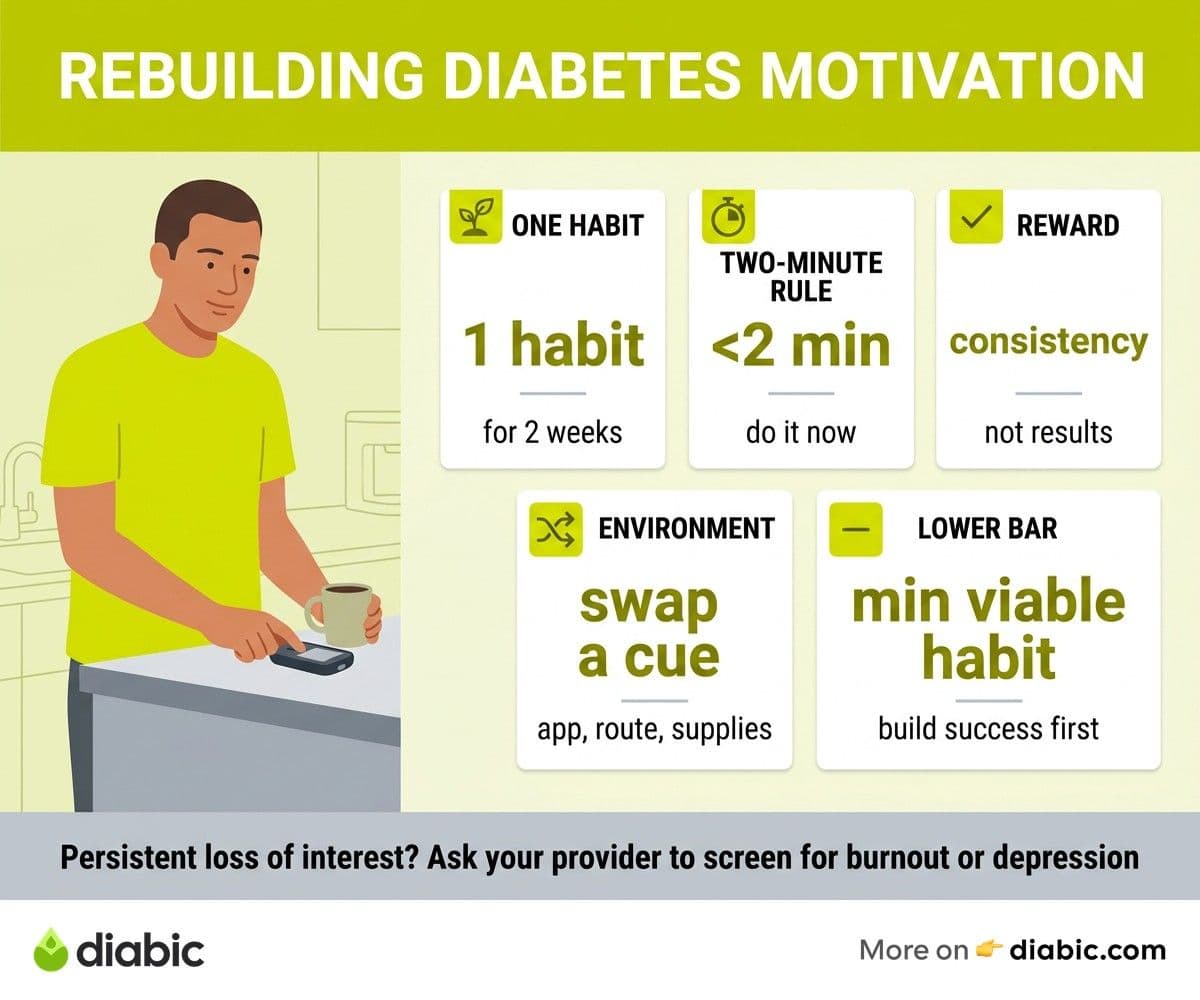
Pick the single habit that would have the biggest impact on how you feel and how your numbers look, and focus only on that for two weeks. Maybe it is checking your blood sugar before breakfast, or taking a ten-minute walk after dinner, or logging what you eat at lunch. Adding one habit at a time has a much higher success rate than trying to relaunch everything at once, which is part of why the American Diabetes Association emphasizes individualized goal-setting in its self-management education and support framework.
Use the two-minute rule
If a diabetes-related task takes two minutes or less, do it the moment you think of it. Refill your test strips, charge your meter, write down a number, send your provider a quick message about a refill. Friction is the silent killer of motivation, and these tiny tasks pile up into something that feels impossible to face. Knocking them out in real time keeps the load light.
Reward consistency, not results
Numbers fluctuate for reasons that have nothing to do with your effort. If you tie rewards to outcomes, you will sometimes punish yourself for doing everything right and got bad luck anyway. Instead, reward the behavior. Five days of pre-meal checks earns a small treat you actually enjoy, regardless of what the readings showed. This is one of the core ideas inside a sustainable daily self-care diabetes routine, and it works because it teaches your brain that effort itself is worth something.
Change your environment
Sometimes the issue is not you, it is your setup. A meter you dislike, a logging app you find annoying, a snack drawer that does not match your goals, or a schedule with no room for movement will all chip away at motivation. Try a fresh app, a different lancing device, a new place to keep your supplies, or a walking route that makes you want to go outside. Small environmental shifts can do more than another pep talk ever will.
Lower the bar before you raise it
Most motivation losses come from goals that quietly became too big to face. If you used to log every meal and now you log nothing, the answer is probably not "log everything again starting tomorrow." The answer is to log one meal a day for a week, and let success build on itself. Behavior scientists call this scaling down to the minimum viable habit, and it is one of the most reliable ways to restart a stalled routine without triggering the shame spiral that usually follows another failed restart.
Finding Your Why Again
Practical strategies will get you moving, but they tend to stall without a deeper reason underneath them. The strongest motivators are not abstract like "be healthier" or "get my A1C down," they are specific, vivid, and personal. Your health is not the goal. Your health is what enables the goal.
Try this exercise. Write down three concrete things you want your future to include that require your body to cooperate. Maybe it is hiking with your kids next summer, dancing at a wedding, finishing a degree, traveling somewhere specific, or being around for a grandchild who has not been born yet. Pin that list somewhere you will see it on the days when checking your sugar feels like a chore.
Connection is the other piece, and it is one we underrate. Talking to people who understand the texture of daily diabetes life is qualitatively different from explaining it to people who do not. A peer mentor, a friend with the condition, or diabetes support groups in your area can refill your tank in ways that even the best healthcare team cannot, because they have lived it. The American Psychological Association and the APA both note that peer connection is associated with better adherence and lower psychological distress in people managing chronic illness.
It also helps to revisit your goals with your provider and make sure they actually feel achievable to you. A goal you secretly believe is impossible will always lose to a goal that feels within reach. If your A1C target feels demoralizing, ask whether a stepped goal would still be clinically appropriate. Most providers would much rather you hit a realistic target than burn out chasing an ideal one.
One more reframe is worth holding onto. The goal of finding motivation diabetes management actually rewards is not to feel inspired every morning, it is to keep showing up on the average day. Average days are where outcomes are actually built, and you do not need a swell of emotion to take a walk, check a number, or eat a balanced lunch. You just need a routine that makes the next step the easy one, and a story about yourself that does not get loud and critical when the routine slips. Lower the volume on the inner critic, keep the systems small, and let consistency do the long, quiet work that motivation alone could never sustain.
FAQ
How do I stay motivated with diabetes long-term?
Long-term motivation comes from systems, not feelings. Build small habits that run on autopilot, connect your management to specific things you want your future to include, and stay in regular contact with people who understand the daily reality. Expect motivation to ebb and flow over years, and treat low periods as a signal to simplify rather than to push harder.
Why do I lose motivation to manage my diabetes?
You lose motivation because diabetes is a chronic condition without a finish line, because effort does not always produce visible results, and because life events legitimately compete for your attention. Sometimes lost motivation for diabetes management is also a sign of burnout or depression, both of which are common and treatable. If the feeling has lasted more than a few weeks or comes with other emotional symptoms, talk to your provider about screening, and remember that the antidote rarely comes from grit alone. Steady systems, peer support, and a kinder inner voice are what carry most people through the long stretches when lost motivation for diabetes management would otherwise win.
Shahriar P. Shuvo is the founder of Diabic. He has lived with diabetes for over 14 years, and built Diabic to deliver the practical, evidence-based self-management tools he wished existed when he was first diagnosed. By trade, Shahriar is a senior design and frontend engineer with 6+ years shipping products at Agora, Timescale (now Tiger Data), and ShareTrip. He writes from the intersection of lived diabetes experience and product craft, focused on what works in daily management rather than what sounds good in a textbook.
Medically reviewed by
Dr. Rezwana Parvin Rumpa is an obstetrics and gynaecology specialist with clinical focus on gestational diabetes, PCOS, and fertility. She holds the MRCOG (Final Part) from the Royal College of Obstetricians and Gynaecologists in London, the MRCPI (Final Part) from the Royal College of Physicians of Ireland, and an MBBS from Shaheed Monsur Ali Medical College under Dhaka University. Dr. Rumpa serves as a Senior Medical Officer in the Obs and Gynae department at BRB Hospitals Ltd, where she has spent three years managing prenatal care, emergency obstetric cases, and women's-health surgery. On Diabic, she medically reviews content for women living with diabetes, with particular attention to pregnancy, PCOS, and reproductive-health intersections.
More from Living with Diabetes
View all
A Gentle Chair Yoga Routine for people with diabetes
A gentle chair yoga for people with diabetes routine with safe poses, modifications for neuropathy, retinopathy, and joint pain, plus tips for older.

Shift Work and Diabetes: Managing Irregular Hours
Shift work and diabetes is a tough combination. Learn how to manage meals, sleep, medication, and blood sugar when your hours rotate or flip overnight.

Dating with Diabetes: When to Tell a New Partner
Dating with diabetes brings unique disclosure questions. Here is when to tell a new partner, what to say, and how to handle the conversation with.
Clinician-reviewed habits, plain-language guides, and honest answers - the small shifts that make living with diabetes feel lighter, every day.