Diabetic Foot Infection Symptoms: Warning Signs
Learn the diabetic foot infection symptoms that need urgent attention, why they progress faster with diabetes, and when to call your doctor.

In this article(20)
Recognizing diabetic foot infection symptoms early can mean the difference between a simple antibiotic and a hospital admission. When you live with diabetes, foot infections progress faster than many people expect because of reduced sensation and slower healing. Knowing the warning signs gives you the best chance of catching a problem before it spreads to deeper tissue or bone.
The hard part is that the usual cues your body uses to flag infection, like sharp pain, can be muffled when nerve damage is in the picture. That is why we lean on visual signs, daily checks, and a low threshold for calling a clinician.
This guide walks through what to watch for, why infections behave differently with diabetes, when to seek care, and how to lower your risk in the first place. Each section is short so you can find what you need fast.
The Diabetic Foot Infection Symptoms to Spot Early
Early diabetic foot infection symptoms usually show up around an existing wound, blister, callus crack, or ingrown nail. The skin's response to infection is fairly consistent, which makes a daily inspection one of your best tools. The American Diabetes Association lists most of these signs in their patient guidance.
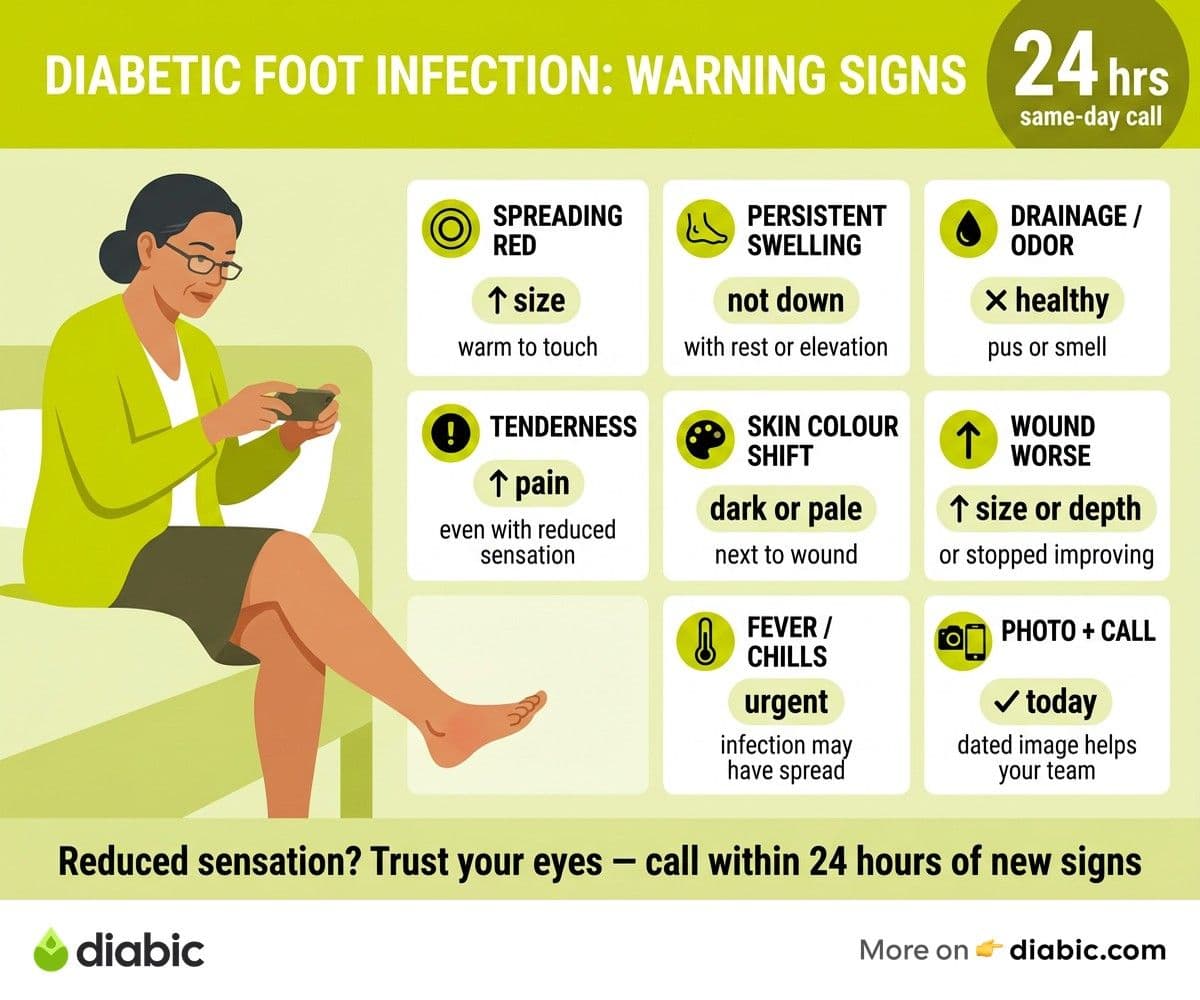
Watch for any of the following around a sore or break in the skin:
- Redness that is spreading or feels warm to the touch
- Swelling that does not go down with rest or elevation
- Drainage, pus, or a foul odor from a wound
- Increased pain or tenderness, even if pain has been minimal before
- Dark, dusky, or unusually pale skin near the affected area
- A wound that suddenly looks larger, deeper, or stops improving
- Fever, chills, or just feeling unwell along with any of the above
Even if pain is reduced because of neuropathy, deep infections can still produce a heavy, throbbing sensation. Trust new symptoms even when they are subtle. We tell readers, when in doubt, photograph the wound and call.
How fast can things change
Foot infections in diabetes can shift hour by hour. A wound that looks pink in the morning can have an expanding red border by evening. According to the Infectious Diseases Society of America clinical guidelines, prompt evaluation, ideally within twenty-four hours of new infection signs, gives the best outcomes.
If you notice any spreading redness, streaks running up the foot or leg, or systemic symptoms like fever, treat that as urgent care territory rather than next-week-appointment territory.
Why Foot Infections Are More Dangerous with Diabetes
The same warning signs can mean very different things in someone with diabetes versus someone without. The biology behind the difference comes down to four factors that often work together.
First, chronic high blood sugar dampens the immune response. White blood cells become less efficient at finding and clearing bacteria, so an infection that should resolve in days can persist or progress.
Second, peripheral artery disease is more common in long-standing diabetes, which reduces blood flow to the feet. Lower flow means antibiotics, oxygen, and immune cells reach the area more slowly. The medicine works less efficiently because it cannot get there in the right concentration.
Third, neuropathy can mute the pain warning system. People often discover an infection only when redness becomes obvious or drainage stains a sock. By then, the bacteria have had time to settle in deeper tissue.
Fourth, infections can reach bone faster than people realize. Osteomyelitis, the medical term for bone infection, is a feared complication of unmanaged diabetic foot infections, and it usually requires longer antibiotic courses and sometimes surgery. The NIDDK explains how unaddressed wounds can cascade into deeper complications.
This is not meant to alarm you. It is meant to explain why we recommend a low threshold for calling a clinician and a high commitment to daily checks.
The Diabetic Foot and Infection Risk
The diabetic foot is uniquely vulnerable because of how nerve damage and circulation problems interact. Most infections start with a small break in the skin that would be unremarkable in another body, but here it becomes an open door.
Foot ulcers are the most common entry point. An ulcer is a wound that does not heal on a normal timeline, often because pressure keeps reopening it. Once an ulcer is present, bacteria from skin, socks, or shoes can colonize the wound and trigger infection over hours to days.
Even pre-ulcer skin damage matters. Cracked heels, fungal cracks between toes, ingrown nails, and small punctures from stepping on a staple can all become entry points. Daily foot hygiene and inspection meaningfully lower the risk because they catch and clean these wounds before bacteria have time to invade.
From my experience: living with type 1 diabetes for fourteen years has taught me that the wounds I worried about least were the ones that surprised me. A tiny crack between two toes from a long pool day once turned into a stubborn fungal infection that took weeks to resolve. I now dry between my toes deliberately, and I carry an antifungal powder when I travel. Small habits beat dramatic interventions.
If you have not built a baseline routine yet, our diabetic foot care and prevention guide covers the daily steps that close most of these gaps.
When to See a Doctor About a Foot Infection
The general rule we use, and one most podiatrists agree with, is that any new sign of infection in someone with diabetes deserves a same-day or next-day call. The cost of being cautious is small. The cost of waiting can be significant.
Call your provider promptly if any of the following are present:
- An open wound that shows redness, warmth, swelling, or drainage
- A wound that has not improved within seven to fourteen days
- Red streaks moving away from the wound, which can signal cellulitis
- Fever, chills, or new fatigue along with a foot wound
- Sudden swelling, color change, or a foot that feels much warmer than the other
If you cannot reach your primary clinician quickly, urgent care or an emergency department is the right choice for spreading redness, fever, or any wound that has changed significantly in less than twenty-four hours. It is not an overreaction. It is appropriate care for a condition that rewards speed.
What treatment usually involves
Treatment depends on the depth and severity of the infection. For mild superficial infections, a clinician may clean the wound, debride dead tissue, take a culture, and prescribe oral antibiotics. They will also offload pressure on the area with a special boot, modified shoe, or in some cases a total contact cast.
Deeper infections, infections involving bone, or those with poor circulation may require IV antibiotics, hospitalization, imaging like an MRI, and a vascular evaluation. Early treatment usually means simpler treatment.
Diabetic Foot Ulcer and Infection Connection
Most serious diabetic foot infections start as ulcers that became infected. Understanding the path from ulcer to infection helps you intervene earlier.
A diabetic foot ulcer typically forms over a pressure point, often the ball of the foot, the side of the big toe, or the heel. It begins as a callus that quietly breaks down underneath because the underlying tissue cannot keep up with the repeated pressure. By the time the surface skin gives way, an open wound is already present.
Without treatment, that wound can deepen and pick up bacteria from socks, shoes, or environmental contact. Once infected, the wound's edges may turn red, drainage starts, and the floor of the wound can develop yellow or gray slough. This is why early offloading and wound care matter so much; they prevent the ulcer from ever reaching the infected stage.
For the full picture on prevention and treatment of these wounds, see our deeper guide on diabetic foot ulcer treatment and prevention. A wound care nurse or podiatrist with diabetes experience is the right team for an active ulcer.
Why infected ulcers cannot wait
Infected ulcers progress along several axes at once. The infection itself spreads outward and downward; the wound bed deteriorates; and the surrounding tissue can lose viability if blood flow is poor. Each of these accelerates the others.
Prompt intervention with culture-guided antibiotics, debridement, offloading, and sometimes vascular procedures can interrupt that loop. Time is tissue, as wound care specialists often say.
Diabetes Skin Infection Awareness
Beyond foot ulcers, several diabetes skin infection patterns are worth recognizing. They can occur on the feet or elsewhere, and some of them act as warning signs that blood sugar has been running high.
Cellulitis is a deep skin infection that causes a red, warm, tender area with poorly defined borders. It often starts at a small wound or crack and spreads outward. Cellulitis on the foot or lower leg is a common reason people with diabetes end up in urgent care or the hospital.
Fungal infections are also common, especially between the toes (athlete's foot) and under the toenails (onychomycosis). They cause itching, scaling, redness, and thickened, discolored nails. Fungal infections are not just cosmetic; they create cracks that bacteria can exploit.
Bacterial folliculitis, boils, and carbuncles can also occur more frequently when blood sugar is elevated. The Mayo Clinic notes that skin infections often improve when blood sugar comes back into a healthier range.
Our deeper article on diabetes skin infection prevention covers these conditions in more detail. The short version is that any new red, painful, draining, or rapidly changing skin patch deserves a clinician's eyes.
Prevention Strategies
Most diabetic foot infections start as preventable wounds. The four habits below are the ones that make the biggest difference.
Inspect daily and clean carefully
Daily foot inspection finds wounds while they are still small enough to clean and watch. Wash with warm water and mild soap, dry thoroughly between toes, and apply unscented moisturizer to the tops and soles. Skip lotion between the toes, where moisture invites fungus.
When you find a small cut or blister, clean it with soap and water, apply a thin layer of plain petroleum jelly or a clinician-recommended ointment, and cover with a sterile bandage. Recheck twice a day for the first three to four days.
Protect your feet at all times
Closed-toe, well-fitted shoes inside and outside the house prevent most of the cuts and punctures that lead to infection. Diabetic socks with seamless construction reduce friction. Replace worn shoes regularly so support and cushioning stay where you need them.
Manage blood sugar to support immunity
Higher average blood sugars correlate with reduced immune function. You do not need perfect numbers to benefit; even modest improvements in glucose patterns help your body fight bacteria more effectively. Work with your care team on goals that fit your life and your medications.
Schedule regular professional foot exams
A comprehensive foot exam by a podiatrist or trained clinician at least once a year, more often if you have neuropathy or prior wounds, catches risk factors before they become emergencies. They can identify deformities that need offloading, prescribe diabetic footwear, and treat calluses and nails safely.
A Practical Wrap-Up
Diabetic foot infection symptoms reward attention. Redness, warmth, swelling, drainage, and any wound that is changing quickly all deserve a same-day call. The body's usual alarms can be quieter when you have diabetes, so your eyes and your routine fill the gap. Build a daily habit, replace worn shoes, and treat small wounds like they matter, because in this context they do.
If you have a story about a wound you almost missed, we would love to hear it in the comments. Sharing helps the next person catch theirs sooner.
FAQ
What are signs of a foot infection with diabetes?
Watch for redness that is spreading or warm to the touch, swelling that does not subside, drainage or pus, foul odor, increased tenderness around a wound, and any darkening or paling of the skin nearby. Fever, chills, or feeling unwell alongside a foot wound suggest the infection may have spread, and that warrants urgent evaluation.
When should a person with diabetes see a doctor for a foot infection?
See a healthcare provider promptly, ideally the same or next day, if a foot wound shows any signs of infection, has not improved within seven to fourteen days, or is accompanied by fever or red streaks. Spreading redness, sudden swelling, or any change in foot color or temperature should be treated as urgent.
Can a diabetic foot infection heal on its own?
Most diabetic foot infections need professional treatment because reduced immune response and slower circulation make self-resolution unreliable. Even small infections can progress to deeper tissue or bone if untreated. A clinician can clean the wound, prescribe appropriate antibiotics, and offload pressure to support healing.
What does the start of a diabetic foot infection look like?
Early diabetic foot infection symptoms often show as a small zone of redness or warmth around a cut, blister, ingrown nail, or callus crack. There may be slight swelling, a feeling of fullness, or new tenderness. Drainage and odor usually appear as the infection progresses, so do not wait for those signs to act.
Shahriar P. Shuvo is the founder of Diabic. He has lived with diabetes for over 14 years, and built Diabic to deliver the practical, evidence-based self-management tools he wished existed when he was first diagnosed. By trade, Shahriar is a senior design and frontend engineer with 6+ years shipping products at Agora, Timescale (now Tiger Data), and ShareTrip. He writes from the intersection of lived diabetes experience and product craft, focused on what works in daily management rather than what sounds good in a textbook.
Medically reviewed by
Dr. Rezwana Parvin Rumpa is an obstetrics and gynaecology specialist with clinical focus on gestational diabetes, PCOS, and fertility. She holds the MRCOG (Final Part) from the Royal College of Obstetricians and Gynaecologists in London, the MRCPI (Final Part) from the Royal College of Physicians of Ireland, and an MBBS from Shaheed Monsur Ali Medical College under Dhaka University. Dr. Rumpa serves as a Senior Medical Officer in the Obs and Gynae department at BRB Hospitals Ltd, where she has spent three years managing prenatal care, emergency obstetric cases, and women's-health surgery. On Diabic, she medically reviews content for women living with diabetes, with particular attention to pregnancy, PCOS, and reproductive-health intersections.
More from Health & Complications
View all
Diabetes and Dental Implants: What to Know First
Diabetes dental implants guide covering safety, A1C targets, recovery expectations, gum health prep, and what to ask your oral surgeon before surgery.

Burning Mouth Syndrome and Diabetes Explained
Burning mouth syndrome diabetes link explained, including neuropathy, dry mouth, and thrush causes plus treatment options that may bring real relief.

Dental Care for people with diabetes: Tips That Help
Practical dental care diabetics need, with real tips for protecting teeth and gums when diabetes raises your risk for oral health problems.
Clinician-reviewed habits, plain-language guides, and honest answers - the small shifts that make living with diabetes feel lighter, every day.