Fatty Liver Disease and Diabetes: What Really Helps
Fatty liver disease affects up to 70% of people with type 2 diabetes. Learn the connection, warning signs, and lifestyle strategies that actually work.

In this article(14)
Fatty liver disease is one of the most common and least-discussed diabetes complications. Research published in The Lancet Diabetes & Endocrinology suggests that up to 70% of people with type 2 diabetes have some degree of non-alcoholic fatty liver disease, often without knowing it. The connection between NAFLD and diabetes is bidirectional, meaning each condition makes the other harder to manage.
Here is the encouraging part. Many of the same habits that improve blood sugar also reduce liver fat, sometimes faster than people expect. You do not need a separate plan for your liver and another for your diabetes. The two pull in the same direction when you focus on the right levers.
This guide covers what the condition actually is, why it shows up alongside diabetes, the symptoms worth knowing, and the lifestyle and medical strategies that hold up under research scrutiny. We will keep it practical and avoid the doom-and-gloom framing that does not help anyone.
What Is Fatty Liver Disease
Non-alcoholic fatty liver disease, often shortened to NAFLD, describes a buildup of fat inside liver cells in someone who drinks little or no alcohol. The newer clinical term you may see is metabolic dysfunction-associated steatotic liver disease, or MASLD, which reflects a better understanding of the metabolic roots. When inflammation and cell damage join the fat accumulation, the condition progresses to non-alcoholic steatohepatitis, or NASH.
The National Institute of Diabetes and Digestive and Kidney Diseases explains that NAFLD often develops silently. Fat builds up in liver cells when insulin resistance prevents the body from properly handling glucose and fats. The liver, which normally helps regulate both, ends up storing excess fat as a kind of metabolic overflow.
Why does diabetes raise the risk so much? Insulin resistance is the shared engine. When cells stop responding well to insulin, the liver receives mixed signals about when to release glucose and when to process incoming fats. Triglycerides accumulate inside liver cells, the liver becomes inflamed, and the cycle reinforces itself. Over time, untreated NASH can progress to fibrosis, cirrhosis, or liver cancer, though many people stay in the earlier reversible stages for years.
How Fatty Liver and Diabetes Fuel Each Other
Insulin resistance sits at the center of both conditions, which is why they so often appear together. When your muscles and liver cells become less responsive to insulin, your pancreas compensates by producing more of it. That extra insulin keeps blood sugar in check temporarily but encourages the liver to store more fat and the body to hold onto more weight, especially around the midsection.
Liver fat then makes the resistance worse. A fat-loaded liver releases more glucose into the bloodstream than a healthy one, even between meals. It also releases inflammatory signals that affect insulin sensitivity in muscle and fat tissue. The result is higher fasting blood sugar, higher A1C, and a body that needs more medication to achieve the same control.
Inflammation links both conditions in another way. Chronic low-grade inflammation damages blood vessel linings, raises triglycerides, and contributes to high cholesterol. That is one reason NAFLD, diabetes, and cardiovascular disease tend to cluster together. If you are already working on managing triglycerides with diabetes, the same dietary and movement strategies tend to lower liver fat in parallel.
Symptoms and Diagnosis
The frustrating reality of early NAFLD is that most people feel completely fine. There is no pain, no fatigue, no obvious sign. Many people learn they have it only after a routine blood test shows elevated liver enzymes, or an abdominal ultrasound for a different reason picks it up incidentally.
When symptoms do appear, they are often vague. Fatigue that is not explained by sleep or workload is one of the most reported. A dull discomfort in the upper right side of the abdomen, where the liver sits, can show up as the condition progresses. In more advanced disease, symptoms like jaundice, swelling in the legs, or unexpected bruising can appear, but these come later and are not typical of early NAFLD.
How Doctors Diagnose It
The Mayo Clinic notes in its overview of nonalcoholic fatty liver disease that diagnosis usually starts with blood tests and imaging. Liver enzymes ALT and AST are often elevated, though they can also be normal in someone with significant liver fat. An abdominal ultrasound can show fat deposits in the liver, and a FibroScan (a specialized ultrasound) measures liver stiffness, which correlates with how much scarring has developed.
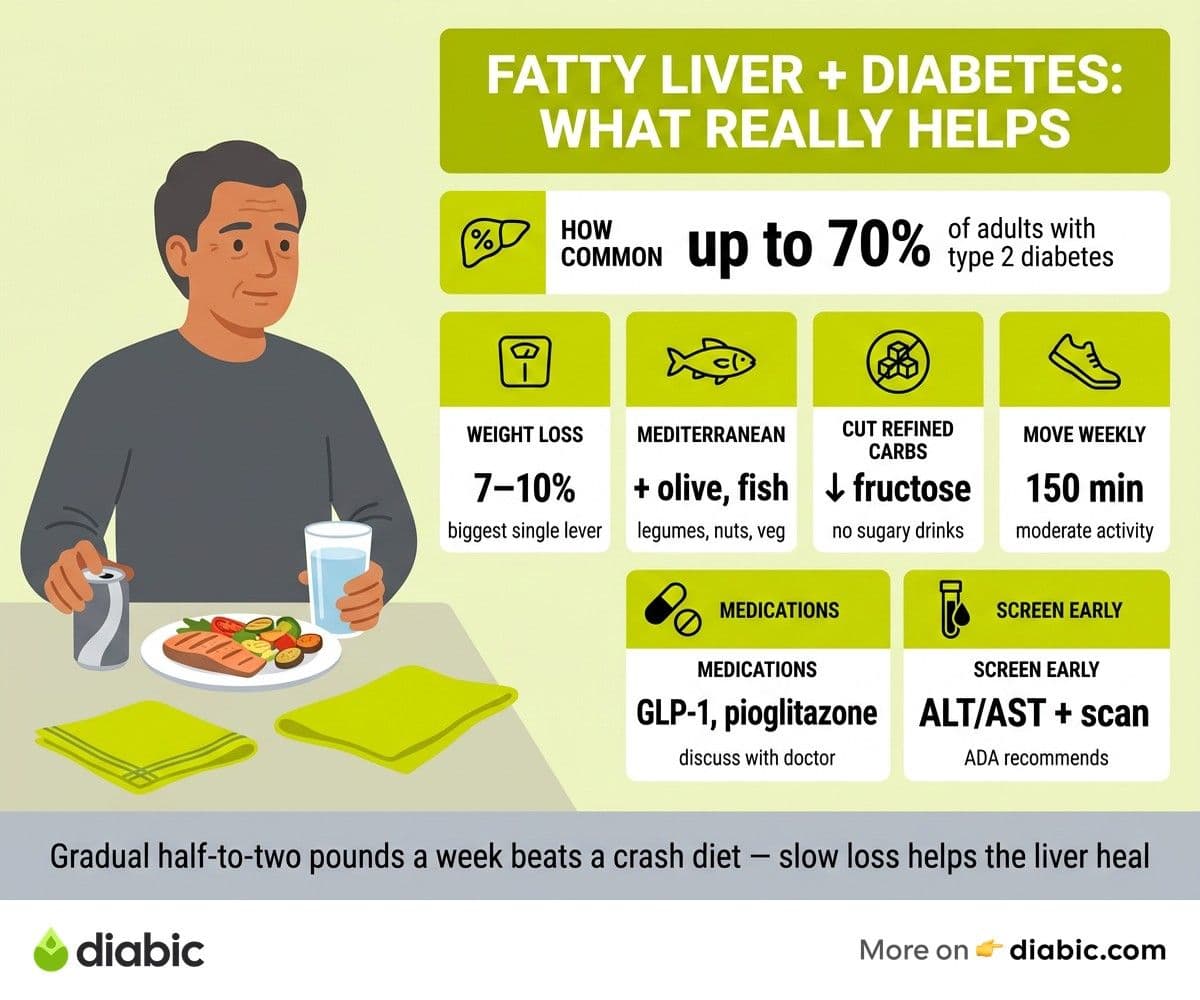
If imaging or enzyme levels suggest more advanced disease, your doctor may recommend additional tests, occasionally including a liver biopsy. The American Diabetes Association now recommends that everyone with type 2 diabetes be screened for liver disease, in line with updated Standards of Care. If your provider has not raised the topic, it is reasonable to ask about liver screening at your next appointment.
What Really Helps: Lifestyle Strategies That Work
This is the section that matters most, because lifestyle changes are still the most effective treatment for liver fat. Research consistently points to a few high-impact habits that meaningfully reduce liver fat, often within months.
Gradual Weight Loss
If you are carrying extra weight, losing 7-10% of your body weight is the single most effective intervention for liver fat. That is not a dramatic transformation. For someone weighing 200 pounds, it is 14 to 20 pounds. Studies show this level of loss can reduce liver fat substantially, decrease inflammation, and in some cases reverse early scarring.
The pace matters. Crash diets can actually worsen liver inflammation by flooding the system with rapidly mobilized fat. Aim for slow and sustainable, roughly half a pound to two pounds a week, supported by changes you can keep up for years rather than weeks.
Dietary Shifts
What you eat affects liver fat as much as how much you eat. Reducing refined carbohydrates and added sugars, especially fructose from sweetened beverages and processed snacks, has a direct effect on liver fat accumulation. The Mediterranean dietary pattern, with its emphasis on olive oil, fish, vegetables, legumes, nuts, and whole grains, has the strongest evidence for liver health alongside diabetes.
The DASH diet for blood pressure and diabetes overlaps significantly with these recommendations. Both pull added sugars and refined carbs down while pushing whole foods up. Limiting alcohol matters too, even though NAFLD is by definition not alcohol-driven, because any alcohol intake adds work for an already stressed liver.
For those also working on lowering high cholesterol with diabetes, the same dietary moves help on both fronts. High cholesterol and NAFLD share many of the same metabolic roots.
Physical Activity
Movement reduces liver fat even when weight stays the same. Both aerobic exercise and resistance training have been shown to lower liver fat in people with NAFLD, and combining the two appears to work best. The current guideline of 150 minutes of moderate aerobic activity per week, plus two strength sessions, is a reasonable target.
You do not need a gym. Brisk walking, cycling, swimming, dancing, or anything that gets your heart rate up consistently counts. The bigger predictor of success is consistency, not intensity. Three thirty-minute walks a week beats one heroic workout and four sedentary days. Pair that with the heart healthy habits for diabetes we cover elsewhere, and the liver benefits compound.
From my experience: in my fourteen years with type 1 diabetes, the habit that improved my fasting numbers most reliably was an after-dinner walk. I started doing them for blood sugar reasons, but a few years in, my hepatologist mentioned that my liver enzymes had quietly come down too. Movement is one of those rare interventions that pays you back in places you were not even tracking.
Medications and Medical Options
There is currently no FDA-approved medication specifically for early NAFLD, though the field is moving fast. In March 2024, the FDA approved resmetirom (Rezdiffra) as the first treatment specifically for NASH with fibrosis, which is a meaningful step. For most people in earlier stages, treatment focuses on managing related conditions and using medications that happen to help the liver.
Several diabetes medications appear to benefit liver health as a side benefit. Pioglitazone, a thiazolidinedione, has the longest track record and has been shown in studies to reduce liver inflammation in people with NASH. GLP-1 agonists like semaglutide and tirzepatide reduce liver fat substantially in many patients, partly through weight loss and partly through direct metabolic effects on the liver. Research published in Diabetes Care continues to refine our understanding of how these medications affect liver outcomes.
Statins, which are often prescribed for cholesterol, are safe for most people with NAFLD and may even improve liver inflammation. If you have been told to avoid statins because of liver concerns, that older guidance has shifted, and it is worth a fresh conversation with your provider.
The takeaway here is that medication decisions are highly individual. Your hepatologist or primary care doctor can weigh factors like the stage of your liver disease, your A1C, your cardiovascular risk, and what you are already taking. There is no single right answer, but there are good answers tailored to you.
When to See Your Doctor About Liver Health
If you have type 2 diabetes, you are already in the higher-risk group for NAFLD, which is reason enough to ask your provider about screening. Other risk factors that warrant a closer look include obesity, high triglycerides, low HDL cholesterol, high blood pressure, and a family history of liver disease.
Annual liver enzyme testing is reasonable for most people with diabetes, and your provider may recommend imaging or a FibroScan if enzymes are elevated, if you have multiple risk factors, or if there is concern about disease progression. People with both diabetes and chronic kidney disease should pay particular attention, as the conditions often progress together. Our diabetes and kidney disease guide covers that overlap.
When you head into your appointment, bring a few specific questions. Has my liver been screened? What were the results of my most recent ALT and AST tests? Do I qualify for a FibroScan? Are there any of my current medications that affect my liver? These questions move the conversation past general reassurance and into actionable territory.
Early detection genuinely changes outcomes. NAFLD caught at the fat-only stage is largely reversible with lifestyle changes. NASH with fibrosis is harder to reverse but can still be slowed or stabilized. Cirrhosis is the stage where treatment options narrow significantly, so the goal is to catch the disease well before it gets there.
FAQ
Why is NAFLD common with diabetes?
NAFLD is common with diabetes because both conditions share insulin resistance as their core driver. When cells become less responsive to insulin, the liver receives confusing signals about how to handle glucose and fats, leading to fat accumulation in liver cells. Excess insulin and chronic inflammation reinforce the cycle, which is why up to 70% of people with type 2 diabetes have some degree of NAFLD.
How do you treat NAFLD with diabetes?
Treatment focuses on lifestyle changes first. Gradual weight loss of 7-10% of body weight, a Mediterranean-style diet, reduced added sugars, limited alcohol, and regular physical activity have the strongest evidence for reducing liver fat. Some diabetes medications, including GLP-1 agonists and pioglitazone, may also benefit the liver. For more advanced disease (NASH with fibrosis), the medication resmetirom is now FDA-approved. Talk to your doctor about a plan tailored to your stage and other health conditions.
Can fatty liver disease be reversed?
Early-stage liver fat, where inflammation and scarring are minimal, is often reversible with consistent lifestyle changes. Even more advanced NASH may improve with sustained weight loss and the right medications. Once cirrhosis develops, full reversal becomes much harder, though disease progression can still be slowed. The earlier the condition is caught and addressed, the better the long-term outlook.
Shahriar P. Shuvo is the founder of Diabic. He has lived with diabetes for over 14 years, and built Diabic to deliver the practical, evidence-based self-management tools he wished existed when he was first diagnosed. By trade, Shahriar is a senior design and frontend engineer with 6+ years shipping products at Agora, Timescale (now Tiger Data), and ShareTrip. He writes from the intersection of lived diabetes experience and product craft, focused on what works in daily management rather than what sounds good in a textbook.
Medically reviewed by
Dr. Shanto Arian is an internal medicine physician now specializing in clinical and aesthetic dermatology, with a parallel academic focus on epidemiology and public health. He holds an MBBS, MPH, MSc (UK), MRCP (UK), MRCPI (Ireland), Diploma in Dermatology (UK), and Diploma in Aesthetic Medicine (USA). Dr. Arian trained in internal medicine, including hospital work on hematology cases such as graft-versus-host disease, before moving toward dermatology. Skin is one of the earliest places diabetes shows itself, from acanthosis nigricans and diabetic dermopathy to slow foot wound healing, and that intersection is where his clinical and Diabic-review work meet. On Diabic, Dr. Arian medically reviews content on diabetes diagnosis, complications, dermatologic manifestations, and pharmacotherapy, ensuring every claim aligns with current ADA, NICE, and peer-reviewed literature.
More from Health & Complications
View all
Diabetes and Dental Implants: What to Know First
Diabetes dental implants guide covering safety, A1C targets, recovery expectations, gum health prep, and what to ask your oral surgeon before surgery.

Burning Mouth Syndrome and Diabetes Explained
Burning mouth syndrome diabetes link explained, including neuropathy, dry mouth, and thrush causes plus treatment options that may bring real relief.

Dental Care for people with diabetes: Tips That Help
Practical dental care diabetics need, with real tips for protecting teeth and gums when diabetes raises your risk for oral health problems.
Clinician-reviewed habits, plain-language guides, and honest answers - the small shifts that make living with diabetes feel lighter, every day.