7 Heart Healthy Habits That Help with Diabetes
Build practical heart healthy habits for diabetes that protect your heart and support blood sugar at the same time, backed by research.

In this article(12)
- Why Heart Healthy Habits Diabetes Care Matters More
- Habit 1: Move Your Body for 30 Minutes Most Days
- Habit 2: Fill Half Your Plate with Vegetables
- Habit 3: Choose Heart-Friendly Fats
- Habit 4: Manage Stress Before It Manages You
- Habit 5: Prioritize Quality Sleep
- Habit 6: Stay Consistent with Medications
- Habit 7: Build a Monitoring Routine
Building heart healthy habits diabetes care can lean on does not require a complete lifestyle overhaul. Many of the same routines that support steady blood sugar also protect your heart, so each positive change pulls double duty. The Centers for Disease Control and Prevention lists the same core behaviors for heart disease prevention that show up in diabetes guidance, which makes the case for stacking habits rather than splitting them.
Here are seven habits backed by research that you can start weaving into your daily life. None of them need to be perfect to be useful, and starting with one is better than trying to start with all seven on the same Monday.
Why Heart Healthy Habits Diabetes Care Matters More
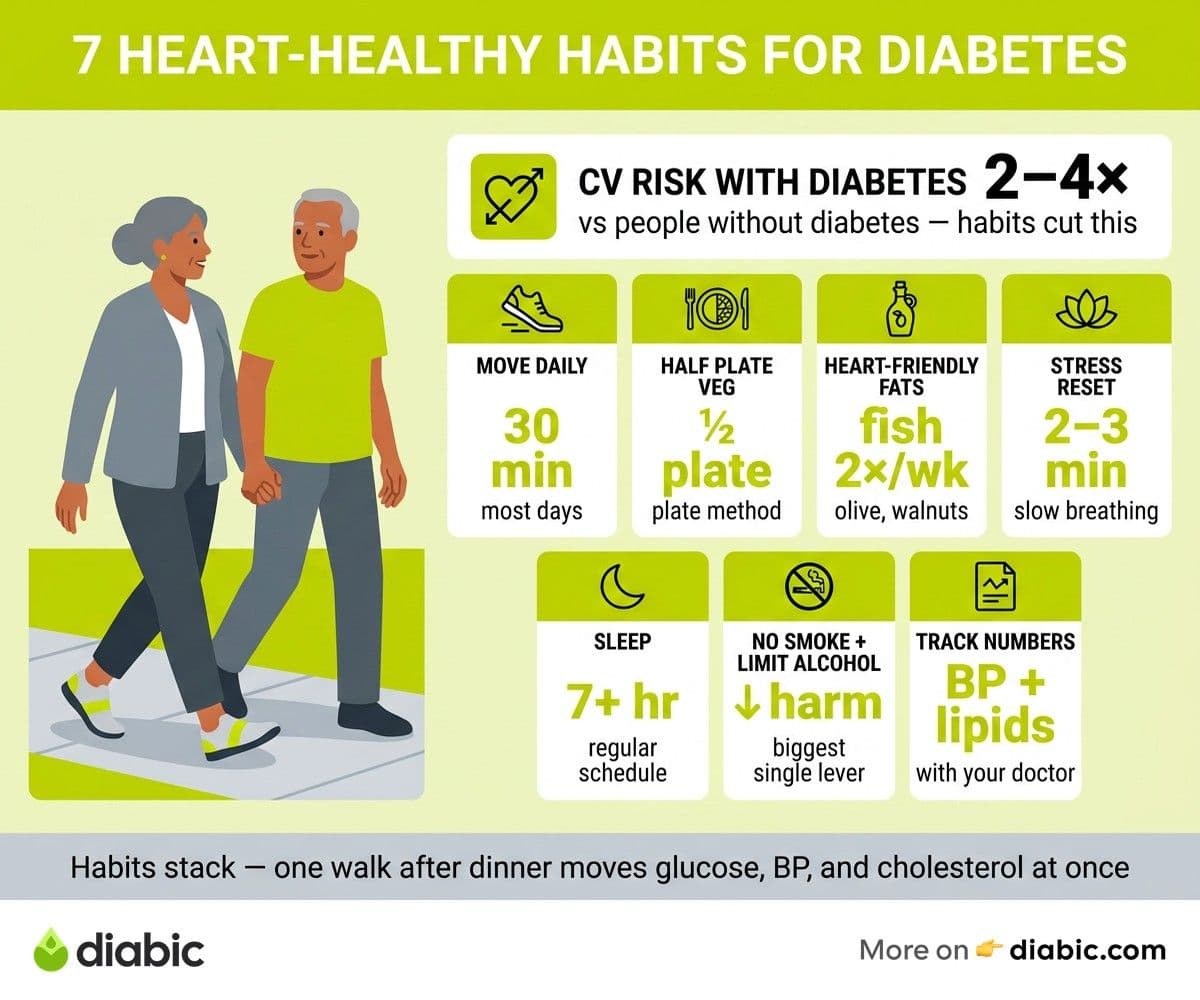
People with diabetes face two to four times the cardiovascular risk of people without it, depending on the population studied and the specific outcome being measured. The American Diabetes Association consistently emphasizes that this elevated risk is not destiny, and lifestyle factors can cut it significantly. A landmark trial published in Diabetes Care showed that intensive lifestyle intervention in people with type 2 diabetes reduced cardiovascular events meaningfully over many years.
Diabetes and heart disease share common drivers. Inflammation, insulin resistance, high blood pressure, and unhealthy lipid patterns all show up in both conditions. That overlap is good news for daily habits because the same actions move multiple needles at once. A walk after dinner lowers post-meal glucose, eases blood pressure, and improves cholesterol over time.
Prevention is the most effective strategy because once cardiovascular damage is established, reversing it is harder than preventing it. Habits that look small day to day add up over years in the best way. Our companion piece on reducing your diabetes heart attack risk covers the medical side of prevention if you want to pair lifestyle with medication strategy.
Habit 1: Move Your Body for 30 Minutes Most Days
Physical activity is one of the highest-uses habits for both heart and blood sugar. The NIDDK guidance on physical activity and diabetes recommends about 150 minutes of moderate-intensity activity per week, broken up across most days. That works out to roughly 30 minutes a day, five days a week, which most people can fit if they decide to.
Walking, swimming, cycling, dancing, and gardening all count. The best activity is the one you will actually do, and the second best is something close to it. People who pick exercise they hate tend to stop, which is why fitness culture's love of running does not work for everyone.
Exercise lowers blood sugar by helping muscles take up glucose without needing as much insulin. It also lowers blood pressure, raises HDL cholesterol, reduces triglycerides, and improves how your blood vessels respond to stress. For people who want to dig deeper into how movement specifically affects blood pressure numbers, our piece on lowering blood pressure naturally with diabetes covers the mechanisms.
Fitting movement into a busy schedule is more about strategy than willpower. Walking meetings, parking farther away, taking stairs, breaking up sitting with two-minute movement breaks, and a 10 minute walk after each main meal all count toward the total. The 10 minutes after meals is especially useful for people with diabetes because it blunts post-meal glucose spikes.
Habit 2: Fill Half Your Plate with Vegetables
Vegetables provide fiber, potassium, and antioxidants with minimal blood sugar impact, which makes them the unsung star of any diabetes-friendly heart-healthy approach. The Mayo Clinic's heart-healthy diet recommendations consistently feature vegetables as a foundation, alongside whole grains, lean protein, and healthy fats.
Leafy greens like spinach, kale, and arugula are particularly nutrient-dense. Broccoli, bell peppers, tomatoes, zucchini, and asparagus add variety and pair well with most proteins. Frozen vegetables count, are often more affordable, and lose minimal nutrition compared to fresh.
The plate method simplifies meal planning without requiring you to count anything. Half your plate is non-starchy vegetables, a quarter is lean protein, and a quarter is whole grains or starchy vegetables. The visual works at home, at restaurants, and at family gatherings without much fuss. If you want to take this further into a structured approach, our DASH diet for diabetes and blood pressure guide covers a research-backed eating pattern that builds on the same principles.
Making vegetables the default rather than the afterthought is a small mindset shift with big payoff. Build the meal around the vegetables instead of squeezing them in next to a fixed protein and starch. Roasting a sheet pan of vegetables on Sunday gives you four days of grab-and-go side dishes.
Habit 3: Choose Heart-Friendly Fats
Not all fats are equal, and the diabetes community has moved past the old advice to fear fat across the board. Replacing saturated fats with unsaturated ones from olive oil, avocado, nuts, seeds, and fatty fish is one of the most consistent heart-protective dietary patterns in the research.
Omega-3 fatty acids, found in salmon, sardines, mackerel, walnuts, and flaxseeds, support both heart and metabolic health. They reduce triglycerides, lower the risk of irregular heartbeats, and may help reduce inflammation. Two servings of fatty fish per week is a common target, though plant-based omega-3 sources work too. Our piece on managing triglycerides with diabetes covers the lipid side in more detail.
Reading nutrition labels for trans fats and hydrogenated oils is worth a few extra seconds. Trans fats have been mostly removed from the food supply but can still appear in some baked goods and fried items. Anything listing "partially hydrogenated oils" should ideally stay out of regular rotation.
Practical swaps for everyday cooking include using olive oil instead of butter for sautéing, choosing avocado on toast instead of butter, snacking on a small handful of almonds instead of chips, and adding ground flaxseed to oatmeal or yogurt. None of these need to be perfect or daily, the direction matters more than the precision.
Habit 4: Manage Stress Before It Manages You
Stress is not just a quality-of-life issue, it is a metabolic and cardiovascular issue. Chronic stress raises cortisol, which raises blood sugar and blood pressure and contributes to inflammation and insulin resistance over time. Treating stress management as a medical priority rather than a luxury is one of the more important reframes for people with diabetes.
Evidence-based stress management does not require a meditation retreat. Slower breathing, even for two to three minutes a few times a day, activates the parasympathetic nervous system and lowers heart rate and blood pressure. Mindfulness practices have shown small but real benefits in trials with people with diabetes, including modest improvements in A1C in some studies.
Social connection is one of the most reliably protective factors across cardiovascular research. Time with friends, family, or community members buffers the physiological effects of stress in ways that solo techniques cannot fully replicate. Loneliness, by contrast, has measurable cardiovascular consequences.
Finding what works for your life and routine matters more than picking the technique with the most research. Some people find walking outdoors in daylight calms them more than meditation. Others benefit from journaling, prayer, music, or simply protecting an hour of unscheduled time on weekends. The point is to actually do it.
Habit 5: Prioritize Quality Sleep
Sleep is where the body does its metabolic and cardiovascular maintenance. Poor sleep worsens insulin resistance, raises blood pressure, and increases hunger and cravings the next day. Most adults need 7 to 9 hours per night, and people with diabetes who chronically get less tend to have higher A1C and worse cardiovascular markers on average.
Sleep hygiene basics make a big difference. A consistent schedule, where you go to bed and wake up at similar times, helps your body's internal clock. A cool, dark, quiet room supports deeper sleep. Limiting screens for the hour before bed reduces blue light exposure that suppresses melatonin.
Caffeine after noon and alcohol within three hours of bed are two of the most common sleep disruptors that people overlook. Alcohol may help you fall asleep faster but degrades the quality of sleep significantly, especially the second half of the night.
Talking to your doctor about sleep disorders is worth doing if you snore loudly, gasp during sleep, or feel exhausted despite enough hours in bed. Sleep apnea is more common in people with diabetes than in the general population, and treating it often improves blood sugar, blood pressure, and overall energy in measurable ways.
Habit 6: Stay Consistent with Medications
Lifestyle is foundational, and so are medications when they are part of your care plan. Taking prescribed medications as directed supports long-term outcomes in ways that are hard to replicate with habits alone.
Why skipping doses or stopping medications without guidance can be risky comes down to the way most diabetes and cardiovascular medications work. Statins, blood pressure medications, and diabetes drugs build their effect over weeks and months, and stopping them suddenly can cause rebound issues. If side effects or cost are a problem, the right move is a conversation with your provider about alternatives, not silent discontinuation.
Using pill organizers, alarms on your phone, or medication tracking apps helps a lot. Most pharmacies now offer 90-day supplies and automatic refills, which removes a friction point. Linking your medication to a daily routine you already do, like brushing your teeth or making coffee, builds reliability without willpower.
Discussing any concerns or side effects with your provider keeps the door open for adjustments. Our piece on statin medications for diabetes walks through common questions about one of the most prescribed cardiovascular medications for people with diabetes.
From my experience: 14 years in, what shifted my consistency was not motivation. It was making my morning routine boring on purpose. Coffee, meds, and a 10 minute walk happen in the same order every day, and the predictability is what carries it through the weeks where motivation is gone.
Habit 7: Build a Monitoring Routine
Data tells you whether your habits are working, and a light monitoring routine takes the guesswork out of decisions. Regular blood pressure checks at home are one of the highest-value habits, especially since clinic readings can be misleading due to white coat effect or simply not enough data points.
A home blood pressure cuff is inexpensive, and checking two or three times a week at consistent times gives a useful trend. Bringing those readings to appointments often changes how your provider thinks about your treatment plan.
Keeping track of blood sugar trends through a glucose meter or CGM gives the same kind of feedback for your diabetes management. The goal is not to obsess over individual numbers, it is to spot patterns. Post-meal spikes, overnight trends, and the impact of activity all become visible when you have data.
Annual cholesterol and A1C testing rounds out the picture. Knowing your numbers, asking what they mean, and tracking how they shift year over year turns your health from something that happens to you into something you participate in.
Using data as a conversation starter with your care team rather than a source of stress is the right framing. Your numbers are information, not a grade. Some weeks will be tighter than others, and that is normal.
FAQ
What are heart healthy habits for people with diabetes?
The core habits include regular physical activity, a vegetable-forward eating pattern, choosing unsaturated fats, managing stress, getting enough quality sleep, staying consistent with prescribed medications, and monitoring key health numbers like blood pressure and blood sugar. Most of these support both heart health and blood sugar management at the same time.
How to build heart healthy habits with diabetes?
Start with one habit rather than trying to overhaul everything at once. Stack new habits onto routines you already have, like walking after meals or checking your blood pressure when you make morning coffee. Focus on consistency over intensity, and give each habit two to three weeks to settle before adding another. Small changes compound, and most people who succeed long term build slowly rather than all at once.
Can lifestyle changes really reduce heart risk with diabetes?
Yes, and the evidence is strong. Multiple long-term studies have shown that lifestyle interventions reduce cardiovascular events in people with diabetes meaningfully when sustained. Lifestyle changes also often allow medications to work better and may reduce how much medication you need over time. They are most powerful when combined with medical care rather than seen as a replacement for it.
The case for heart healthy habits diabetes routines builds on year after year. Pick one habit from this list, give it three weeks of honest practice, and let your numbers and your energy tell you whether it earned a permanent place. Stacking small, repeatable routines is how most of the people we hear from quietly cut their cardiovascular risk while their blood sugar settles into a steadier rhythm.
Shahriar P. Shuvo is the founder of Diabic. He has lived with diabetes for over 14 years, and built Diabic to deliver the practical, evidence-based self-management tools he wished existed when he was first diagnosed. By trade, Shahriar is a senior design and frontend engineer with 6+ years shipping products at Agora, Timescale (now Tiger Data), and ShareTrip. He writes from the intersection of lived diabetes experience and product craft, focused on what works in daily management rather than what sounds good in a textbook.
Medically reviewed by
Dr. Shanto Arian is an internal medicine physician now specializing in clinical and aesthetic dermatology, with a parallel academic focus on epidemiology and public health. He holds an MBBS, MPH, MSc (UK), MRCP (UK), MRCPI (Ireland), Diploma in Dermatology (UK), and Diploma in Aesthetic Medicine (USA). Dr. Arian trained in internal medicine, including hospital work on hematology cases such as graft-versus-host disease, before moving toward dermatology. Skin is one of the earliest places diabetes shows itself, from acanthosis nigricans and diabetic dermopathy to slow foot wound healing, and that intersection is where his clinical and Diabic-review work meet. On Diabic, Dr. Arian medically reviews content on diabetes diagnosis, complications, dermatologic manifestations, and pharmacotherapy, ensuring every claim aligns with current ADA, NICE, and peer-reviewed literature.
More from Health & Complications
View all
Diabetes and Dental Implants: What to Know First
Diabetes dental implants guide covering safety, A1C targets, recovery expectations, gum health prep, and what to ask your oral surgeon before surgery.

Burning Mouth Syndrome and Diabetes Explained
Burning mouth syndrome diabetes link explained, including neuropathy, dry mouth, and thrush causes plus treatment options that may bring real relief.

Dental Care for people with diabetes: Tips That Help
Practical dental care diabetics need, with real tips for protecting teeth and gums when diabetes raises your risk for oral health problems.
Clinician-reviewed habits, plain-language guides, and honest answers - the small shifts that make living with diabetes feel lighter, every day.