Is Your Blood Sugar in the Prediabetes Range?
Wondering if your blood sugar is in the prediabetes range? Learn the exact fasting, OGTT, and A1C numbers that define prediabetes and what to do next.

In this article(13)
If your doctor mentioned your blood sugar is "borderline" or "a little high," you may be wondering whether it falls in the prediabetes range. The numbers that define prediabetes are precise, but they are split across three different tests, which is part of why people leave appointments unsure of where they actually stand.
Knowing the exact thresholds, what each test measures, and how the numbers fit together puts you in a position to act before things escalate. This guide walks through the ranges and what they mean for your day-to-day decisions.
Prediabetes Blood Sugar Ranges Explained
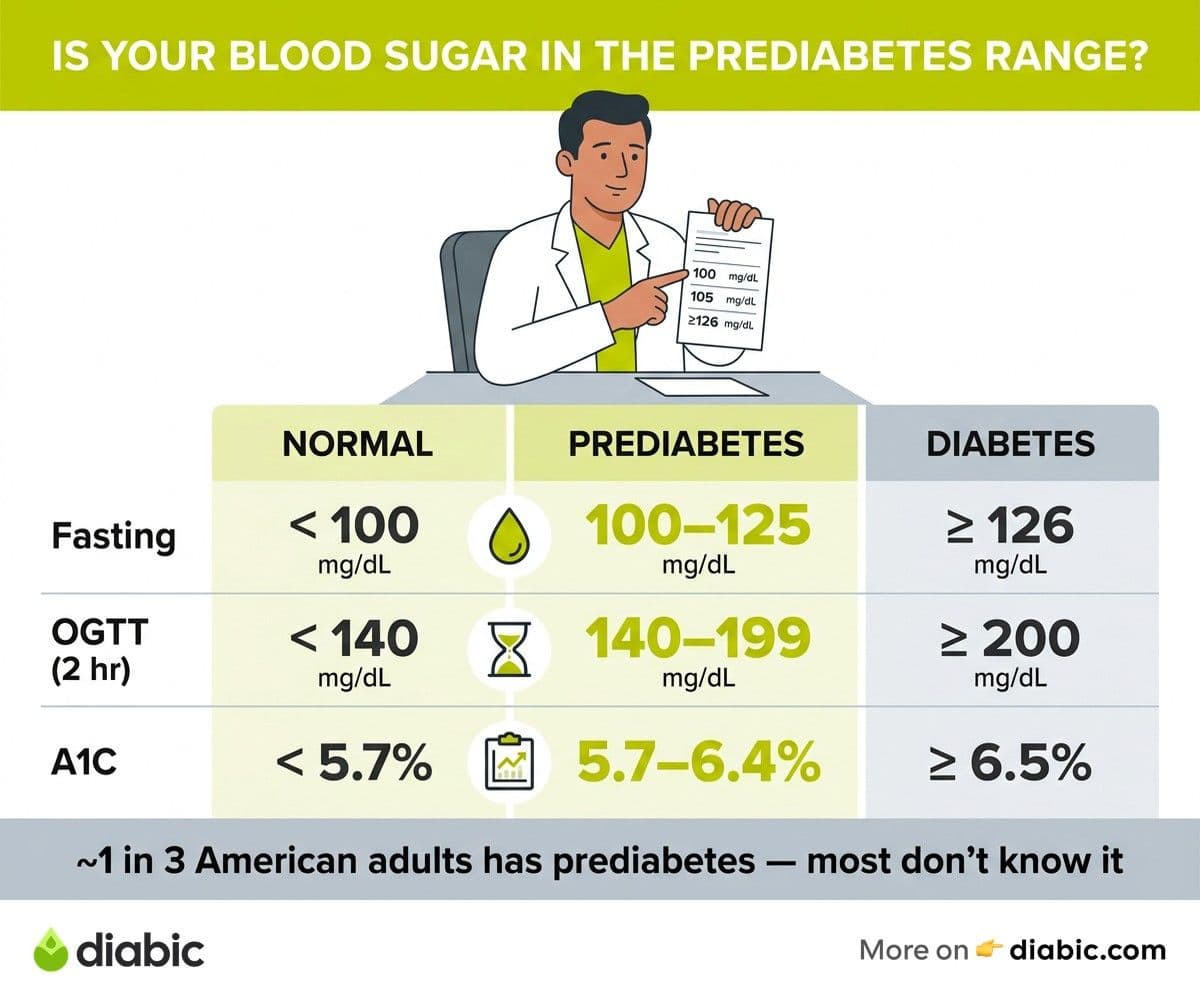
The prediabetes range is defined across three diagnostic tests, and any one of them can land you in the category. The American Diabetes Association sets the cutoffs as follows:
- Fasting plasma glucose (FPG): 100 to 125 mg/dL
- Two-hour oral glucose tolerance test (OGTT): 140 to 199 mg/dL
- A1C (hemoglobin A1C): 5.7% to 6.4%
Each test captures a different angle of blood sugar regulation. Fasting glucose tells your provider how your body manages blood sugar after at least eight hours without eating. The OGTT shows how efficiently you process a measured glucose load over two hours. A1C reflects average blood sugar over the past two to three months, including everything in between.
These tests can occasionally disagree. Some people have normal fasting glucose but elevated post-meal numbers, which is why a single test can miss prediabetes. Most providers use at least two tests when the first result lands in the borderline zone. For more on how the A1C piece fits in, see our breakdown of prediabetes A1C meaning.
If your numbers cross any of these lines, you are not alone. The CDC estimates that roughly 96 million American adults (more than one in three) have prediabetes, and most do not know it. Catching the number early gives you the most options. We cover this further in our piece on prediabetes: why catching it now matters.
Understanding Prediabetes Levels of Blood Sugar
Knowing where the diagnostic lines sit is one piece. Understanding what they mean for your physiology is another. Prediabetes levels of blood sugar describe a metabolic gray zone, not a fixed disease state.
Normal blood sugar
A normal fasting blood sugar is below 100 mg/dL. Two hours after a meal, blood sugar generally returns to under 140 mg/dL. A1C is below 5.7%. At these levels, the pancreas is producing insulin in roughly the right amount and the body's cells are responding to it well.
The prediabetes gray zone
In prediabetes, insulin resistance has started to develop. Cells (especially in muscle and liver tissue) do not respond as crisply to insulin, so the pancreas produces more to keep blood sugar in check. The system still mostly works, but it is under greater strain. Numbers begin drifting upward, often slowly enough that you feel nothing different.
The NIDDK frames prediabetes as a window of opportunity rather than a diagnosis. Roughly 5 to 10% of people with prediabetes progress to type 2 diabetes each year, but a meaningful share also returns to normal blood sugar with sustained lifestyle changes.
The diabetes threshold
Type 2 diabetes is diagnosed at a fasting glucose of 126 mg/dL or higher, an OGTT result of 200 mg/dL or higher, or an A1C of 6.5% or higher. Crossing the line on any single test does not by itself confirm diabetes. Diagnosis usually requires either two abnormal tests on separate days or one abnormal test plus clear symptoms. This is why a single high reading should be confirmed before you accept it as the final answer.
A single high reading can also be misleading in the other direction. Stress, illness, certain medications, and a heavy meal the night before can all push fasting glucose temporarily higher. One borderline result deserves a follow-up rather than a panic.
Prediabetes Glucose Ranges in Context
The prediabetes glucose ranges look tidy on paper, but blood sugar behavior across a normal day is anything but flat.
After a meal, glucose rises as carbohydrates are absorbed, peaks around 60 to 90 minutes later, and gradually returns toward baseline. In healthy metabolism, the peak rarely exceeds 140 mg/dL. In prediabetes, the peak is often higher and the return to baseline is slower. This is why some people have normal fasting glucose but elevated OGTT or post-meal numbers.
Stress hormones such as cortisol push glucose up, which is why you may see a "dawn phenomenon" of higher fasting numbers in the morning even on days when you eat well. Exercise pulls glucose into muscle cells without needing extra insulin, which is one reason regular activity is so effective for prediabetes management.
The mismatch between tests matters when you are interpreting your own numbers. Someone with a fasting glucose of 95 mg/dL might still have an A1C of 5.9%, because their post-meal spikes are pulling the average up. Someone else might have a fasting glucose of 110 mg/dL and an A1C of 5.6%, because their numbers come back down quickly between meals. Both fall on different sides of the prediabetes line depending on which test you look at, which is why providers often run more than one. The Mayo Clinic recommends confirming an abnormal test with a second test before making a diagnosis.
If you want to see the full pattern of your own blood sugar, a continuous glucose monitor (CGM) used over two weeks can reveal post-meal spikes that single fingerstick readings miss. Some providers will prescribe one for prediabetes assessment.
Blood Sugar Testing for Prediabetes
Blood sugar testing for prediabetes is straightforward, but knowing when to ask for it and which test to request makes a difference.
The CDC recommends screening for adults who meet any of these criteria:
- Age 35 or older
- Overweight or obese, especially with abdominal weight distribution
- A first-degree relative with type 2 diabetes
- A history of gestational diabetes or PCOS
- High blood pressure or abnormal cholesterol
- Physically inactive
- Black, Hispanic, Asian American, Native American, or Pacific Islander ancestry
If any of these apply, you can ask for a fasting plasma glucose and A1C at your annual physical. Both can be done with a single blood draw. If results are normal, retest every three years; if they are above the normal cutoff, retest every three to six months. Symptoms that point toward checking sooner include fatigue, increased thirst, frequent urination, slow-healing cuts, and recurring infections. Our guide to prediabetes symptoms covers what to watch for.
At-home glucose meters are useful for tracking trends but are not a substitute for lab testing for diagnosis. Consumer fingerstick meters have an acceptable accuracy range of plus or minus 15%, which is fine for spotting patterns but too imprecise for a diagnostic decision near the prediabetes line.
If your numbers are borderline, your provider may schedule an OGTT, which catches post-meal glucose intolerance that fasting tests miss. The test takes about two hours and involves drinking a measured glucose solution followed by blood draws.
From my experience: in 14 years of living with diabetes and talking with people whose numbers landed there, the most common regret I hear is "I waited too long to get retested." A borderline result is not a verdict, but it is a signal worth checking again in three to six months. Putting it on your calendar before you leave the appointment is worth more than promising yourself you will remember.
What to Do if Your Blood Sugar Is in the Prediabetes Range
Being in the prediabetes range is one of the most actionable lab findings you will receive. The Diabetes Prevention Program, a landmark NIH-funded trial, showed that structured lifestyle intervention reduced progression to type 2 diabetes by 58% over three years, more than medication did in the same study. The path forward has four parts.
Talk to your doctor about a management plan. Ask whether the result was confirmed with a second test, whether any factors might have skewed the number, and what target your provider thinks is realistic. Get a follow-up test scheduled before you leave the appointment.
Begin dietary and lifestyle modifications. The most effective changes are unglamorous: reducing refined carbohydrates and added sugars, building up to 150 minutes of weekly activity, and losing 5 to 7% of body weight if you are overweight. Each step independently lowers A1C and combined they can return many people to normal blood sugar. Our piece on prediabetes treatment options that work covers the evidence behind each approach.
Consider the Diabetes Prevention Program. The CDC-recognized DPP is a one-year structured program offered through clinics, YMCAs, and online platforms. It pairs you with a coach and a small group, builds the habits incrementally, and is covered by Medicare and many private insurance plans. People who complete it have markedly lower progression rates.
Schedule follow-up testing in three to six months. A single A1C tells you where you are. A series of A1Cs tells you where you are headed. Knowing the trend is what lets you adjust early, before numbers cross into diabetes range. If symptoms develop in the meantime, our guide to high blood sugar symptoms covers what should prompt an earlier visit.
A prediabetes result is not a small thing, but it is also not a small disaster. It is the kind of warning that, when acted on early, often leads to a healthier metabolic baseline than many people had before they were tested.
FAQ
What blood sugar level is prediabetes?
Prediabetes is indicated by a fasting blood sugar between 100 and 125 mg/dL, a two-hour oral glucose tolerance test result between 140 and 199 mg/dL, or an A1C between 5.7% and 6.4%. Values at or above 126 mg/dL fasting, 200 mg/dL on the OGTT, or 6.5% A1C indicate diabetes. Because tests can occasionally disagree, providers usually confirm a borderline result with a second test before making a diagnosis.
Is fasting blood sugar of 110 prediabetes?
Yes, a fasting blood sugar of 110 mg/dL falls within the borderline zone, which spans 100 to 125 mg/dL. It means your blood sugar is above normal but has not reached the diabetes threshold of 126 mg/dL. A single reading is not a diagnosis on its own, so your doctor may recommend a repeat test or an A1C to confirm. Lifestyle changes started at this stage are highly effective at moving the number back toward normal.
Can prediabetes go back to normal?
Yes, many people with prediabetes return to normal blood sugar through sustained lifestyle changes, especially when the condition is caught early in the range. The Diabetes Prevention Program found that structured lifestyle intervention reversed prediabetes for a substantial share of participants and delayed progression for many more.
How often should I test if my blood sugar is borderline?
If your numbers are in the prediabetes range, retesting every three to six months is the usual recommendation so you can track the trend rather than reacting to a single result.
Shahriar P. Shuvo is the founder of Diabic. He has lived with diabetes for over 14 years, and built Diabic to deliver the practical, evidence-based self-management tools he wished existed when he was first diagnosed. By trade, Shahriar is a senior design and frontend engineer with 6+ years shipping products at Agora, Timescale (now Tiger Data), and ShareTrip. He writes from the intersection of lived diabetes experience and product craft, focused on what works in daily management rather than what sounds good in a textbook.
Medically reviewed by
Dr. Rezwana Parvin Rumpa is an obstetrics and gynaecology specialist with clinical focus on gestational diabetes, PCOS, and fertility. She holds the MRCOG (Final Part) from the Royal College of Obstetricians and Gynaecologists in London, the MRCPI (Final Part) from the Royal College of Physicians of Ireland, and an MBBS from Shaheed Monsur Ali Medical College under Dhaka University. Dr. Rumpa serves as a Senior Medical Officer in the Obs and Gynae department at BRB Hospitals Ltd, where she has spent three years managing prenatal care, emergency obstetric cases, and women's-health surgery. On Diabic, she medically reviews content for women living with diabetes, with particular attention to pregnancy, PCOS, and reproductive-health intersections.
More from Diabetes Knowledge
View all
6 Safe Dessert for Gestational Diabetes Recipes You Can
Six dessert for gestational diabetes recipes that satisfy your sweet tooth without spiking blood sugar, with carb counts and pairing tips you can use.

8 High Fiber Foods That Help with Prediabetes
Add these 8 high fiber foods for prediabetes to slow glucose absorption, support steady blood sugar, and meet the daily fiber target most people miss.

Mediterranean Diet for Prediabetes: A Practical Guide
The mediterranean diet for prediabetes is one of the best-studied eating patterns for prevention. Here is what to eat, what to avoid, and how to start.
Clinician-reviewed habits, plain-language guides, and honest answers - the small shifts that make living with diabetes feel lighter, every day.