Airport Security with Diabetes Supplies: What to Expect
A practical walkthrough of airport security diabetes supplies rules, TSA procedures, and how to clear screening with insulin, pumps, and CGMs without.

In this article(14)
Walking up to airport security with a bag full of needles, insulin vials, and electronic devices can trigger real anxiety, especially if it is your first time flying with diabetes supplies. Knowing exactly what to expect before you reach the checkpoint takes most of that stress away. The good news is that airport security diabetes supplies rules are clearer than most travelers realize, and Transportation Security Administration officers see these items every single day.
This guide walks you through what is allowed, what to say at the checkpoint, how to handle pumps and continuous glucose monitors, and what to do if something goes wrong. By the end, you will have a simple mental script for security that works at any airport in the United States.
Airport Security Diabetes Supplies TSA Allows
Every diabetes supply you need on a flight is allowed through airport security in your carry-on bag. The TSA medical conditions screening page lists insulin, syringes, pens, lancets, glucagon kits, glucose meters, continuous glucose monitors, and insulin pumps as permitted items. You can bring as much as you reasonably need for your trip, including buffer supplies in case of delays.
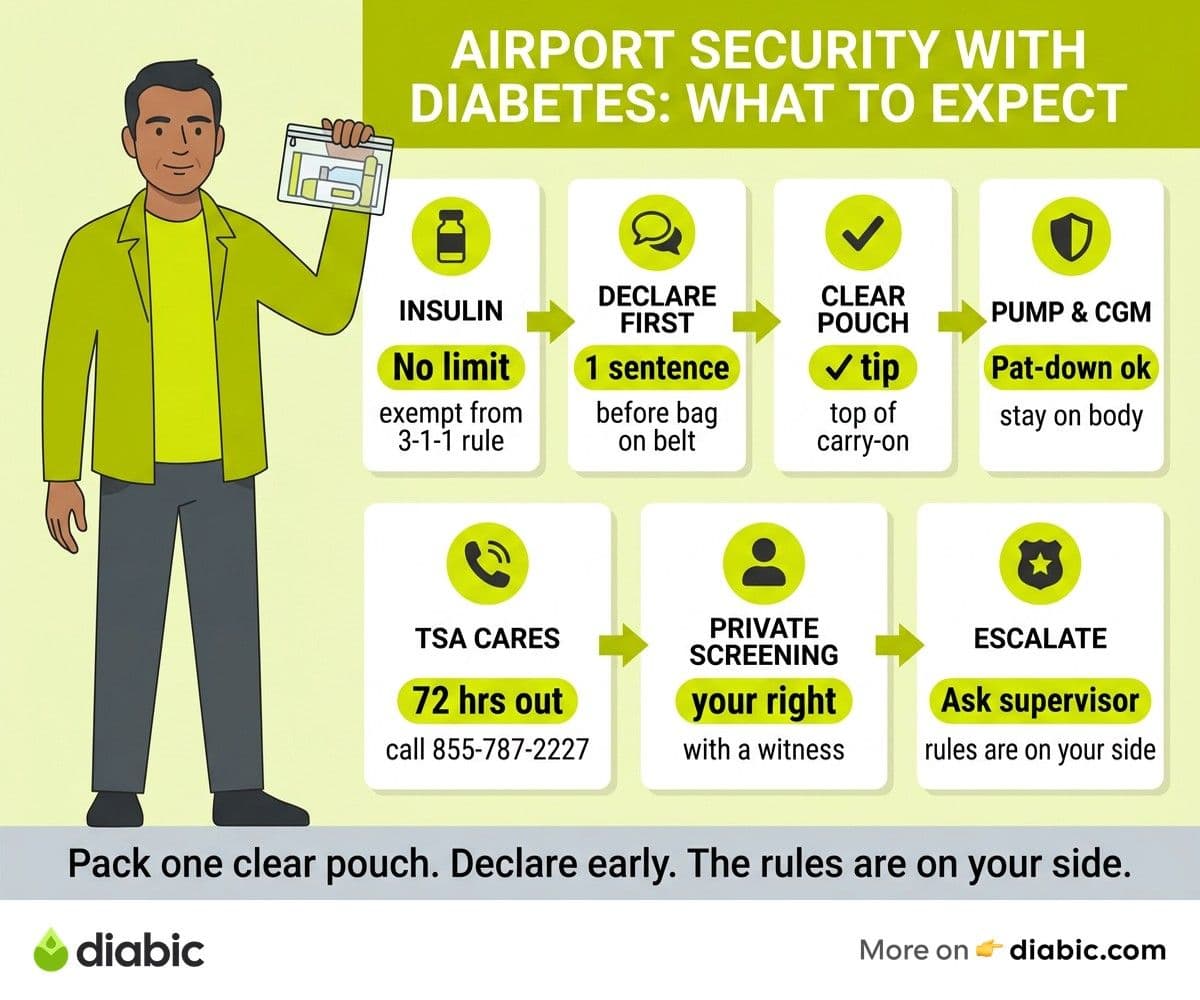
Liquid insulin gets a useful exemption from the standard 3-1-1 liquid rule, which limits most travelers to containers of 3.4 ounces or less. The TSA's "What Can I Bring" page for insulin confirms that insulin and accompanying supplies are allowed in carry-on without quantity restrictions when declared. You can bring full vials, pens, and even larger bottles, but you should declare them at the checkpoint so they can be inspected separately. Juice boxes, glucose gel, and liquid glucose tabs for treating low blood sugar fall under the same medical exemption when you tell the officer ahead of time.
Sharps and lancets travel with you in carry-on too, which surprises a lot of first-time flyers. Keep them inside a closed sharps container or the original packaging so they do not stab anyone during a bag check. The same goes for backup pen needles, pump infusion sets, and CGM applicators.
TSA rules for flying with diabetes cover the specifics of what each device looks like under the X-ray, but the short version is simple. Pack everything in one clear pouch, keep it accessible at the top of your carry-on, and be ready to point it out when you reach the belt.
Quick checklist of what to pack in your carry-on
Doctor's letter or prescription label that names you, the medication, and the prescribing physician keeps things smooth if an officer asks. A spare pump, backup vials, and twice the supplies you think you need protect you against delays and lost luggage. Snacks for low blood sugar, a small ice pack for insulin, and a printed copy of your prescriptions round out the kit.
How to Communicate with TSA Officers
The single most useful habit at security is announcing your supplies before you put your bag on the belt. A clear sentence like "I have diabetes supplies including insulin and needles in my carry-on" tells the officer everything they need in one breath. They will usually nod and either wave you through or pull your bag for a quick visual check.
Speak directly to the officer at the document check or the bag belt, not to a coworker behind them. Officers rotate through positions, and the person scanning IDs may not be the one handling your supplies. If the language barrier or background noise gets in the way, hand them a printed card that lists your conditions and supplies in writing.
You have the right to request a private screening at any point if you feel uncomfortable in the open lane. Tell the officer you would like a private screening with a witness of your choice, and they will escort you to a screening room. This is also useful if you wear a pump in a hard-to-reach spot or if you simply prefer privacy when explaining your supplies.
Insulin needs to stay cool, and a soft-sided cooler with insulin storage for travel ice packs is one of the most-asked-about items at security. The ice packs are allowed even if they are not fully frozen, as long as you declare them with your insulin. Frozen gel packs go through screening exactly like the insulin they are protecting.
A simple script that works every time
Walk up to the bin area, make eye contact with the nearest officer, and say: "I have diabetes supplies, including insulin, needles, and a pump or CGM, in this clear pouch." Place the pouch on top of the items in your bin so it is easy to inspect. Then move forward through the scanner and let them handle the rest.
From my experience: I have flown with type 1 diabetes for the better part of 14 years, and I have never had a TSA officer give me a hard time once I learned to declare clearly and early. The few stressful moments I had came from staying silent and hoping the supplies would slide through unnoticed. They almost always trigger a secondary check, and the wait is much longer than the 10-second declaration would have been.
Handling Insulin Pumps and CGMs at Security During Traveling with Diabetes
Insulin pumps and continuous glucose monitors are the part of airport security diabetes supplies that confuses people the most, mostly because the rules vary by manufacturer. Most pumps can pass through walk-through metal detectors safely, but several manufacturers, including Medtronic, recommend avoiding the full-body advanced imaging technology scanners. Medtronic's airport screening guidance suggests requesting a hand inspection or pat-down instead.
CGMs from Dexcom, Abbott Libre, and other major brands are generally cleared for both metal detectors and full-body scanners. Dexcom's airport security guidance confirms that the G6 and G7 systems are safe through metal detectors, AIT scanners, and pat-downs, though the company advises against putting sensors and transmitters through X-ray luggage screeners. The simplest rule: keep CGMs and pumps on your body, not in the X-ray bin.
If you choose a hand inspection for your pump, tell the officer at the start: "I am wearing an insulin pump that the manufacturer asks me to keep out of the body scanner. I would like a pat-down instead." They will route you to a separate lane, do a quick wand check, and clear you within a minute or two. Carry a copy of the manufacturer's airport guidance in your phone or wallet so you can show it if an officer is unsure.
Pump and CGM device cards from your manufacturer, often called airport security cards, fit in a wallet and explain the device in plain terms. Some travelers print them at home from the manufacturer website, while others request laminated versions through customer support. Either format speeds up conversations with officers who have not seen your specific brand before.
Body scanners, metal detectors, and pat-downs in plain English
Walk-through metal detectors use a magnetic field and are generally safe for pumps and CGMs. Full-body AIT scanners use millimeter-wave technology and are the type most pump makers caution against. Pat-downs are the manual alternative and the safest universal option for any device, with no electronic exposure at all.
What to Do If You Run Into Problems at Security
Most security trips with diabetes supplies are uneventful, but it helps to know your options if an officer is unfamiliar with your devices or insists on something the rules do not require. Stay calm, ask politely, and escalate through the proper channels rather than arguing at the belt. Frustration tends to slow things down further.
The first move when an officer pushes back is to ask for a supervisor. Use a simple line: "I would like to speak with a supervisor, please." Supervisors tend to know the disability and medical conditions screening rules in detail and can resolve most disputes within a few minutes. They can also override a junior officer who is asking for things outside policy.
TSA Cares is a dedicated helpline for travelers with disabilities and medical conditions, and the number 855-787-2227 is worth saving in your phone before you fly. Call them up to 72 hours before your flight to arrange a passenger support specialist who meets you at the checkpoint and walks you through screening. This service is free and especially helpful for first-time flyers, kids with diabetes, and travelers with anxiety about medical screening.
If supplies are confiscated or you feel mistreated, document everything in the moment. Note the officer's name and badge number, the time, the airport and terminal, and what was said. File a complaint through the TSA contact center afterward, and consider reaching out to advocacy organizations like Beyond Type 1 or the American Diabetes Association when patterns of poor treatment emerge.
International trips add another layer of complexity, and international travel with diabetes covers what to expect at foreign checkpoints. Many countries follow similar rules, but documentation requirements and language barriers can change the experience. Carrying travel insurance for people with diabetes protects you against the bigger problems, like a confiscated pump or a missed connection that affects your insulin schedule.
What to do if your insulin gets damaged or confiscated
Ask immediately for a written statement explaining why the item was taken. Contact your travel insurance provider before you leave the airport, since most policies require notification within hours of an incident. If you are flying domestically, locate the nearest pharmacy in the destination city and call ahead so they can prepare a replacement based on your existing prescription.
Putting It All Together Before Your Next Flight
Airport security with diabetes supplies sounds intimidating until you do it once with a clear plan. Pack everything in a single accessible pouch, declare clearly and early, request hand inspection for pumps that need it, and know that supervisors and TSA Cares are there if something goes sideways. The rules are on your side, and most officers want to move you through quickly.
Try the script next time you fly: "I have diabetes supplies including insulin, needles, and a pump, in this pouch." That one sentence does more than any printed letter or wallet card. Combine it with a calm tone, accessible packaging, and a backup plan, and the checkpoint becomes the easiest part of your trip.
If you want to keep building your travel toolkit, browse our wider traveling with diabetes library or join the Diabic community to swap real-world airport stories with other people managing diabetes on the road.
Frequently Asked Questions
Can you bring insulin through airport security?
Yes. Insulin in any form, including vials, pens, and pre-filled cartridges, is permitted through TSA security in your carry-on bag. It is exempt from the 3-1-1 liquid limit when declared, and you can bring as much as you reasonably need for your trip plus a buffer for delays. Keep it in original packaging when possible and tell the officer at the start of screening.
How do I explain diabetes supplies to TSA agents?
Use a clear, short sentence at the start of screening, such as "I have diabetes supplies including insulin and needles in my carry-on." Place the pouch on top of your bin items for easy inspection, and offer your prescription label or doctor's letter only if asked. If the officer seems unsure, ask politely for a supervisor or reference the TSA disability and medical conditions screening page on tsa.gov.
Are TSA-approved fridge packs and ice packs allowed for insulin?
Yes. Frozen and partially-frozen gel packs, ice packs, and TSA-approved fridge travel packs are allowed when used to keep insulin cool. Declare them at screening along with the insulin they are protecting, and expect a brief visual inspection. Soft-sided medical coolers tend to clear faster than rigid ones because they are easier to open.
Should I take my insulin pump off for security screening?
You should not need to remove your pump. Most pumps clear walk-through metal detectors safely, and you can request a pat-down if your manufacturer recommends avoiding full-body scanners. Always check your specific pump's airport guidance from the manufacturer and keep a printed copy with your travel documents.
The honest summary on airport security diabetes supplies is that the rules are on your side, the officers see these items every day, and a clear declaration moves the checkpoint along faster than silence ever does. Pack the pouch, rehearse the script once, and the next time you fly the security lane will feel like the routine part of the trip rather than the dreaded part.
Shahriar P. Shuvo is the founder of Diabic. He has lived with diabetes for over 14 years, and built Diabic to deliver the practical, evidence-based self-management tools he wished existed when he was first diagnosed. By trade, Shahriar is a senior design and frontend engineer with 6+ years shipping products at Agora, Timescale (now Tiger Data), and ShareTrip. He writes from the intersection of lived diabetes experience and product craft, focused on what works in daily management rather than what sounds good in a textbook.
Medically reviewed by
Dr. Shanto Arian is an internal medicine physician now specializing in clinical and aesthetic dermatology, with a parallel academic focus on epidemiology and public health. He holds an MBBS, MPH, MSc (UK), MRCP (UK), MRCPI (Ireland), Diploma in Dermatology (UK), and Diploma in Aesthetic Medicine (USA). Dr. Arian trained in internal medicine, including hospital work on hematology cases such as graft-versus-host disease, before moving toward dermatology. Skin is one of the earliest places diabetes shows itself, from acanthosis nigricans and diabetic dermopathy to slow foot wound healing, and that intersection is where his clinical and Diabic-review work meet. On Diabic, Dr. Arian medically reviews content on diabetes diagnosis, complications, dermatologic manifestations, and pharmacotherapy, ensuring every claim aligns with current ADA, NICE, and peer-reviewed literature.
More from Living with Diabetes
View all
A Gentle Chair Yoga Routine for people with diabetes
A gentle chair yoga for people with diabetes routine with safe poses, modifications for neuropathy, retinopathy, and joint pain, plus tips for older.

Shift Work and Diabetes: Managing Irregular Hours
Shift work and diabetes is a tough combination. Learn how to manage meals, sleep, medication, and blood sugar when your hours rotate or flip overnight.

Dating with Diabetes: When to Tell a New Partner
Dating with diabetes brings unique disclosure questions. Here is when to tell a new partner, what to say, and how to handle the conversation with.
Clinician-reviewed habits, plain-language guides, and honest answers - the small shifts that make living with diabetes feel lighter, every day.