Mindfulness and Diabetes Management: A Starter Guide
A practical starter guide to mindfulness and diabetes management, with simple daily practices that may help support blood sugar and emotional resilience.

In this article(8)
Diabetes asks a lot of your attention. You count carbs, scan a CGM, plan exercise, refill prescriptions, sleep with one eye on the night, and somewhere in there you also try to live your actual life. Mindfulness and diabetes management may sound like one more thing on your list, but in practice it does the opposite. Mindfulness is a small set of skills that helps you respond to stress, food, and numbers with less reactivity, and research suggests it may help support blood sugar at the same time.
The version of mindfulness we recommend is not mystical or hard to learn. It started as a clinical program for chronic pain at a teaching hospital and has been studied in adults living with type 1, type 2, gestational, and pre-diabetes. We are going to walk through what it is, what the evidence says, and a handful of techniques you can fold into a normal weekday. No incense or special cushions required.
A note before we begin: mindfulness is a practice, not a fix. It works best alongside the rest of your care plan, not as a replacement for it. Talk to your doctor about adding mindfulness or any new approach to your routine, especially if you live with depression, trauma, or anxiety, since unguided meditation can occasionally surface difficult feelings.
From my experience: The habit that actually stuck for me was three slow breaths before opening the Dexcom app. For years I would brace before checking, especially in the afternoon, and the reading itself would feel like a verdict. Around 2021 I started pairing the check with a long exhale, and over a few weeks the spike of dread softened. The number on the screen did not change. My reaction to it did, and that turned out to matter more than I expected.
What Is Mindfulness-Based Stress Reduction?
Mindfulness-based stress reduction (MBSR) is an eight-week structured program developed in 1979 at the University of Massachusetts Medical School by Jon Kabat-Zinn. It combines sitting meditation, body awareness, gentle yoga, and group discussion to teach a single skill: paying attention to the present moment, without judgment, on purpose. That sounds simple until you try it for three minutes during a stressful day.
MBSR is not religious, mystical, or a personality type. It is a clinical training that has been adapted for hospitals, clinics, and workplaces around the world, and it has been studied in dozens of conditions including chronic pain, anxiety, depression, hypertension, and diabetes. The National Center for Complementary and Integrative Health notes that mindfulness-based programs show measurable benefits for stress, mood, and several physical health markers, though effect sizes vary across studies.
For people living with diabetes, the connection matters because chronic stress and emotional load directly influence blood sugar. Cortisol and adrenaline raise glucose, while sleep loss and reactive eating add their own pressure. Our companion piece on diabetes anxiety and stress breaks down the physiology in more depth. The short version is that anything that calms the nervous system tends to make diabetes management feel less heavy, and mindfulness has the strongest evidence base of the available options.
How Mindfulness May Help with Blood Sugar
The research on mindfulness and diabetes management has grown steadily over the past 15 years. A 2018 systematic review in Diabetes Care and related journals found that mindfulness-based interventions were associated with modest A1C improvements (often in the range of 0.3 to 0.5 percentage points), reduced diabetes distress, and improved self-care behaviors in adults with type 2 diabetes. A 2020 trial published in PubMed reported similar findings for fasting glucose and stress markers when participants completed an eight-week MBSR program.
Why does sitting still help your numbers? Three pathways seem to matter. First, mindfulness reduces cortisol and adrenaline, which directly affect blood sugar. Second, it improves eating awareness, helping you notice the difference between physical hunger and emotional eating, which we explore in emotional eating and diabetes. Third, it strengthens the pause between a stressor and your response, which translates into less reactive food choices, more consistent medication timing, and better sleep.
Our piece on meditation and blood sugar digs into the mechanisms in detail, including how slow breathing influences vagal tone and the parasympathetic nervous system. The practical takeaway is that the benefits accumulate over weeks, not minutes. Most studies measure outcomes after eight weeks of regular practice, so think of mindfulness as a slow-release medicine rather than a same-day fix.
It is worth setting realistic expectations. Mindfulness will not replace insulin, oral medications, or a balanced eating pattern, and the American Diabetes Association frames it as a complementary approach to standard care, not a substitute. What it may do is make the rest of your plan easier to stick with, which is often where lasting changes come from.
Mindfulness and Diabetes Management Techniques for Daily Life
You do not need a meditation cushion or a quiet hour to practice. The techniques below fit inside the routines you already have, and they each take five minutes or less. We recommend choosing one and practicing it for a week before adding another, since stacking too many at once usually means none of them stick.
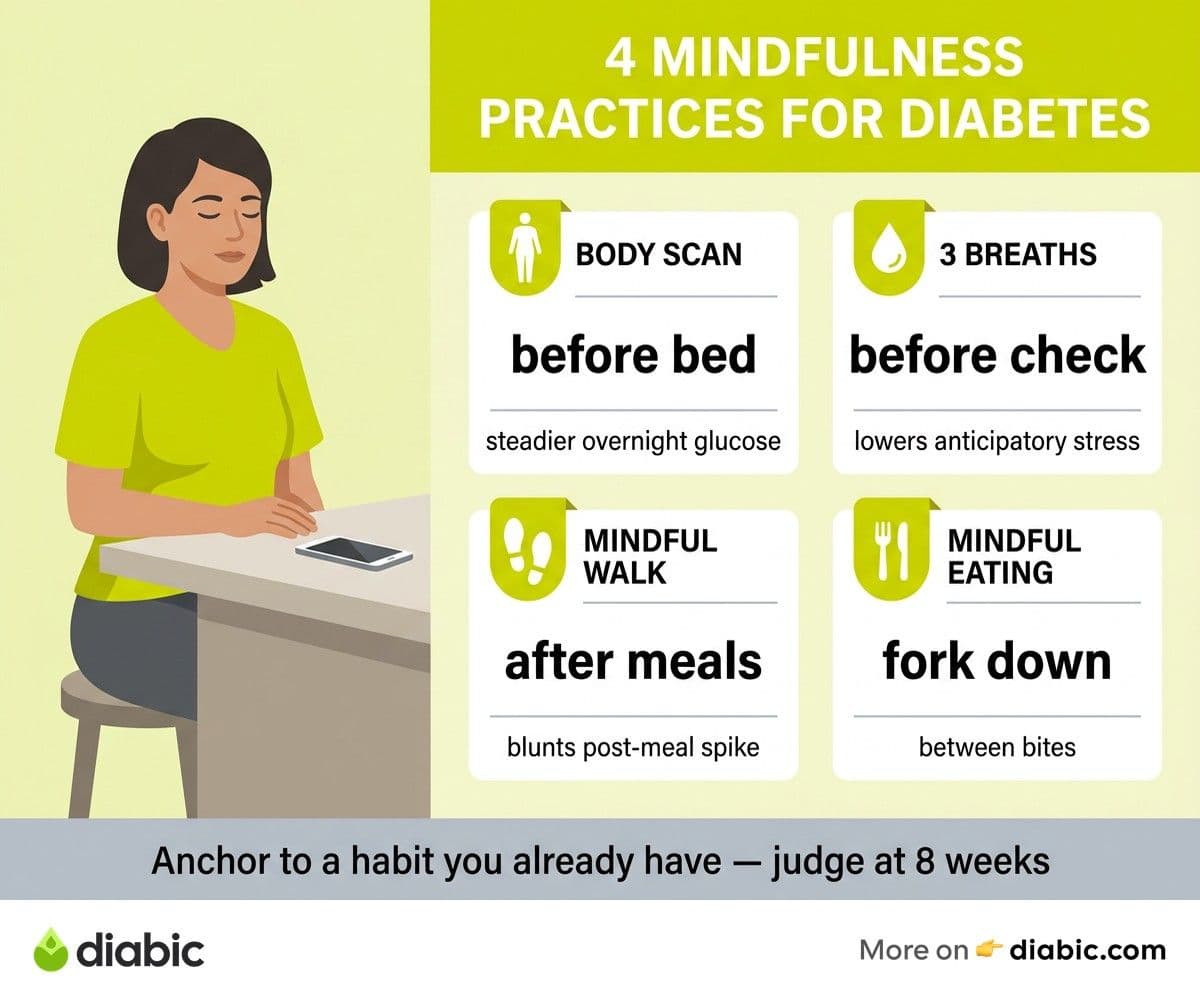
A short body scan before bed is one of the most useful starting points. Lie down, close your eyes, and slowly move your attention from your feet up to the crown of your head, noticing tension, temperature, and small sensations along the way. Many people find that sleep arrives faster, and steadier overnight glucose often follows better sleep. The body scan also gives you a chance to notice early signs of low or high blood sugar that a busy day can mask.
Breathing pauses before blood sugar checks are a small intervention with a big payoff for anyone who feels anxious about their numbers. Before you scan, prick, or open your CGM app, take three slow breaths with longer exhales than inhales. This simple sequence shifts your nervous system out of fight-or-flight, which can reduce the kind of anticipatory stress that occasionally nudges glucose higher in the moment.
Mindful walking turns your post-meal walk into a low-effort meditation. Instead of scrolling, listen to the rhythm of your feet, notice the air on your skin, and let your eyes rest on whatever is in front of you. Mindful eating works similarly: slow down by half, put the fork down between bites, and check in with hunger and fullness as you go. Both practices may help support post-meal blood sugar, and our companion guide on breathing exercises layers in specific patterns you can pair with these habits.
Starting Your Mindfulness Practice
The simplest way to start is to set aside five minutes a day for a single technique. Pair it with an existing habit (after waking, before breakfast, after your morning blood sugar check) so it has a natural anchor. Apps like Headspace, Calm, Insight Timer, and the free UCLA Mindful library all offer guided sessions in the three to ten minute range, which is plenty to start.
If you want a more structured experience, consider an eight-week MBSR course. Many hospitals, community health centers, and online programs offer them at low or no cost, and the group format adds accountability and community. The Center for Mindfulness at UMass and several universities maintain teacher directories if you want to find a certified instructor. People with depression, PTSD, or significant trauma history should mention this when enrolling so the teacher can support you appropriately.
Be patient with the process. Wandering thoughts are not a sign that you are bad at meditation; they are the practice itself. The benefit comes from noticing the wandering and gently returning to your breath, your body, or whatever anchor you chose. Most people start to feel small shifts in stress and reactivity around weeks two to four, with bigger benefits around the eight-week mark.
Building a Daily Breathing Practice
If full meditation feels like too much, start with breathing alone. A daily five-minute breathing practice can deliver real cardiovascular and stress benefits, and it doubles as a gateway into longer mindfulness sessions later. Pick one pattern and stay with it for a full week before changing it.
A simple starter pattern is 4-7-8 breathing: inhale for four counts, hold for seven, exhale for eight. Another option is box breathing: inhale four, hold four, exhale four, hold four. Both extend the exhale relative to the inhale, which research suggests activates the parasympathetic nervous system and may help support steadier blood sugar over time.
Track your blood sugar before and after a few sessions during the first two weeks to see which technique your body likes best. Some people see modest drops in stress-driven highs, while others notice better sleep and steadier morning numbers as the most reliable benefit. Either signal is a green light to keep practicing.
Consistency matters more than duration. Five minutes a day for thirty days will move the needle further than one 30-minute session per week. If you miss a day, skip the guilt and pick up the next morning. The point of mindfulness is not perfection, it is showing up gently, again and again.
FAQ
How does mindfulness help with diabetes?
Research suggests mindfulness may help with diabetes by reducing the cortisol and adrenaline that raise blood sugar, improving sleep, and strengthening the pause between a craving or stressor and your response. Studies have associated regular mindfulness practice with modest A1C improvements (around 0.3 to 0.5 percentage points), lower diabetes distress, and better adherence to self-care routines. It works best as a complement to your existing care plan, not as a replacement.
What are good mindfulness exercises for diabetes stress?
A few of our favorites: a five-minute body scan before bed, three slow breaths before any blood sugar check, mindful walking after meals, and mindful eating where you slow down and notice flavors. Each takes five minutes or less and fits inside routines you already have. Pick one, practice it daily for a week, and add another only when the first feels automatic.
The honest summary on mindfulness and diabetes management is that the practice is small, the benefits arrive slowly, and the people who stick with it usually do so because it makes the rest of their care plan easier to maintain. Pick one five-minute habit, anchor it to something you already do, and let the eight-week mark be your honest checkpoint rather than the first week.
Shahriar P. Shuvo is the founder of Diabic. He has lived with diabetes for over 14 years, and built Diabic to deliver the practical, evidence-based self-management tools he wished existed when he was first diagnosed. By trade, Shahriar is a senior design and frontend engineer with 6+ years shipping products at Agora, Timescale (now Tiger Data), and ShareTrip. He writes from the intersection of lived diabetes experience and product craft, focused on what works in daily management rather than what sounds good in a textbook.
Medically reviewed by
Dr. Rezwana Parvin Rumpa is an obstetrics and gynaecology specialist with clinical focus on gestational diabetes, PCOS, and fertility. She holds the MRCOG (Final Part) from the Royal College of Obstetricians and Gynaecologists in London, the MRCPI (Final Part) from the Royal College of Physicians of Ireland, and an MBBS from Shaheed Monsur Ali Medical College under Dhaka University. Dr. Rumpa serves as a Senior Medical Officer in the Obs and Gynae department at BRB Hospitals Ltd, where she has spent three years managing prenatal care, emergency obstetric cases, and women's-health surgery. On Diabic, she medically reviews content for women living with diabetes, with particular attention to pregnancy, PCOS, and reproductive-health intersections.
More from Living with Diabetes
View all
A Gentle Chair Yoga Routine for people with diabetes
A gentle chair yoga for people with diabetes routine with safe poses, modifications for neuropathy, retinopathy, and joint pain, plus tips for older.

Shift Work and Diabetes: Managing Irregular Hours
Shift work and diabetes is a tough combination. Learn how to manage meals, sleep, medication, and blood sugar when your hours rotate or flip overnight.

Dating with Diabetes: When to Tell a New Partner
Dating with diabetes brings unique disclosure questions. Here is when to tell a new partner, what to say, and how to handle the conversation with.
Clinician-reviewed habits, plain-language guides, and honest answers - the small shifts that make living with diabetes feel lighter, every day.