Simple Breathing Exercises for Better Blood Sugar
Try these simple breathing exercises for blood sugar: box breathing, 4-7-8, and alternate nostril practices that may calm stress and steady glucose.

In this article(9)
Breathing exercises for blood sugar sound almost too simple to take seriously, and that is exactly why most people skip them. The connection between how you breathe and how your body handles glucose runs through the stress response, and the stress response is one of the most underappreciated drivers of unstable numbers in everyday diabetes self-care. A few minutes of deliberate breathing can lower cortisol, shift your nervous system into rest mode, and may give your glucose a small but real nudge in the right direction.
We are not promising that breathing replaces medication, food choices, or movement, and it does not. What it can do is take some of the edge off the cortisol-driven spikes that show up on stressful mornings, before tough conversations, or in the middle of a sleepless night. In this guide, we walk through four breathing techniques worth knowing, what the research actually says about each, and how to fold them into a daily rhythm that does not feel like another chore on the list.
From my experience: Around 2022 I started watching my Dexcom curve climb 30 to 40 points before client calls without a single bite of food, and that was the week I took box breathing seriously. Four minutes of 4-4-4-4 before a stressful meeting does not zero out the rise, but it has shaved enough off mine to be worth keeping. After 14 years on insulin I have learned that any tool that makes the cortisol spike a little smaller is one less correction dose later.
Why Breathing Exercises for Blood Sugar Help
The link between breath and glucose runs through the autonomic nervous system. Fast, shallow breathing keeps you in a sympathetic, fight-or-flight state, where stress hormones like cortisol and adrenaline tell the liver to release more glucose. Slow, deep, diaphragmatic breathing flips the switch, activating the vagus nerve and the parasympathetic system. Cortisol production drops, heart rate slows, and the liver eases off its glucose output, which is why people sometimes see modest readings improve after a few minutes of focused breathing.
The American Diabetes Association acknowledges stress as a meaningful factor in glucose variability and recommends stress reduction as part of broader diabetes self-care. Research published in journals like the Journal of Clinical Medicine and reviewed by the NIH National Center for Complementary and Integrative Health shows that slow-paced breathing reliably lowers cortisol, blood pressure, and self-reported anxiety. The glucose effect is more variable across studies, but the mechanism is consistent: less stress hormone, less hepatic glucose output, steadier readings.
This matters more for some people than others. If you already know that diabetes anxiety and stress push your numbers up, breathing work may help where food and movement adjustments cannot reach. If your spikes are mostly food-driven, breathing will not be the primary lever, but it can still support sleep quality and recovery, which feed back into glucose stability the next day. The techniques below are simple enough that almost anyone can try them today.
4-7-8 Breathing Technique
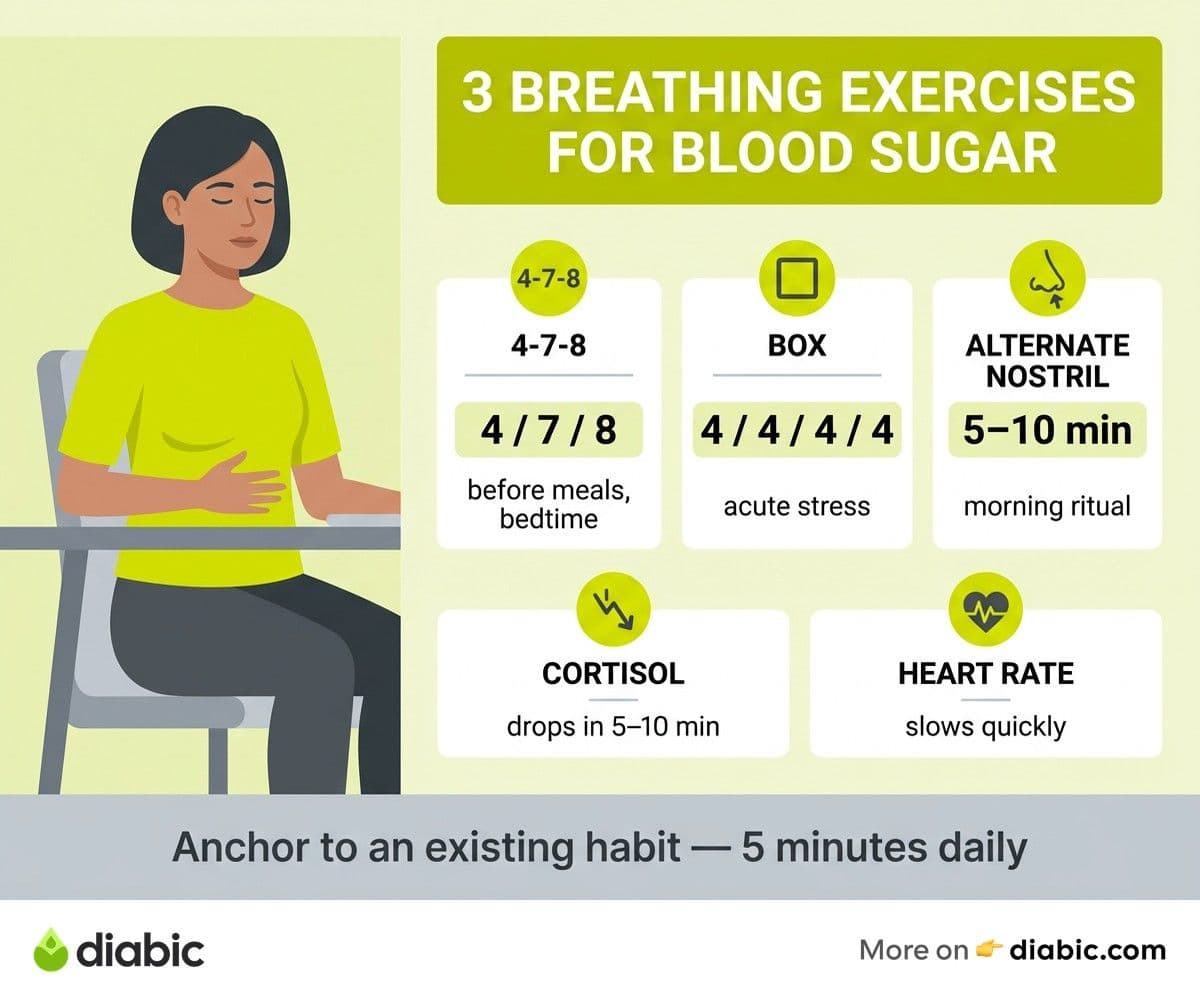
The 4-7-8 technique was popularized by Dr. Andrew Weil and is one of the most studied slow-breathing patterns. You inhale through the nose for four counts, hold the breath for seven counts, and exhale through the mouth for eight counts, repeating the cycle four times. The long exhale is the active ingredient. It engages the parasympathetic nervous system more strongly than the inhale and is what makes the technique so effective at calming acute stress.
People often find this practice especially useful before meals, because pre-meal stress, rushing, or anxiety can prime the body for a higher post-meal glucose response. A two-minute round of 4-7-8 before sitting down to eat may help take some of that pre-meal stress out of the equation. The NCCIH overview of relaxation techniques groups breathing patterns like 4-7-8 with other low-risk practices that can support stress and sleep, and growing evidence on meditation and blood sugar suggests these effects extend to glucose regulation when practiced consistently.
A few practical notes from our community. If holding the breath for seven counts feels uncomfortable at first, use shorter counts that keep the same ratio, like 2-3.5-4. The pattern matters more than the absolute length. If you feel lightheaded, stop and breathe normally. This is a sign you are forcing the breath rather than letting it slow naturally, and the technique works better when it feels easy rather than effortful.
Box Breathing for Diabetes Stress
Box breathing, sometimes called square breathing, is the technique used by Navy SEALs, first responders, and athletes for acute stress management. You inhale for four counts, hold for four, exhale for four, and hold the empty lungs for four. Each side of the box is equal, which makes it easy to remember and easy to do anywhere without anyone noticing. It works well during a stressful glucose check, before a medical appointment, or in the middle of a frustrating low or high.
Research on slow-paced breathing summarized in clinical reviews shows reductions in cortisol, blood pressure, and heart rate variability markers within five to ten minutes of practice. The glucose evidence is less direct, but the mechanism is the same one driving 4-7-8 and yogic breathing patterns: parasympathetic activation, lower stress hormone load, and reduced hepatic glucose output. For people whose blood sugar climbs around medical visits or finger sticks, box breathing is one of the simplest tools to keep in the toolkit.
A useful way to make box breathing automatic is to attach it to a specific cue. Try one round before every blood sugar check, or a two-minute round before the first email of the workday. The repetition builds the response so that under real stress, your body already knows the pattern and can drop into it quickly. Five minutes a day is a reasonable starting point, and most people notice the calming effect from the first or second session.
Alternate Nostril Breathing (Nadi Shodhana)
Alternate nostril breathing comes from the yogic tradition and has been studied in modern clinical settings for its effects on blood pressure, heart rate variability, and cortisol. You close the right nostril with your thumb, inhale through the left, then close the left with your ring finger, exhale through the right. Inhale through the right, switch, exhale through the left. That completes one round, and a typical practice runs five to ten minutes.
Studies on Nadi Shodhana, including work indexed in the Journal of Clinical and Diagnostic Research and other peer-reviewed outlets, suggest measurable drops in resting heart rate and self-reported stress after consistent practice. It pairs well with other mindfulness for diabetes tools, because the physical action of switching nostrils gives the mind something to focus on, which makes it easier than free-form meditation for beginners. The practice is also gentle enough that most people can do it daily without strain.
If you find this practice strange at first, that is normal. The unfamiliar mechanics actually help, because the small mental task of tracking which nostril is open keeps you anchored in the present. We suggest trying it for five minutes in the morning before checking your phone, when the nervous system has not yet hit the day's first stress trigger. If you have a stuffy nose or sinus issues, skip the physical nostril closure and just imagine alternating sides. The intention and rhythm carry most of the benefit.
Building a Daily Breathing Practice
The trap with breathing techniques is collecting them like trading cards and never settling into one. Pick the technique that fits the time of day where you most need it. If pre-meal stress is your issue, anchor 4-7-8 to mealtimes. If general anxiety is the issue, build box breathing into the start of your workday. If sleep is the weak link, run alternate nostril breathing or 4-7-8 in bed before lights out.
Pair the practice with an existing habit so the cue does the work for you. Brushing teeth, the first cup of coffee, sitting down at your desk, and bedtime are all reliable anchors. Five minutes daily beats thirty minutes once a week, and a small consistent practice tends to deliver more measurable change in stress and glucose than ambitious schedules that fall apart in two weeks. If you also do yoga poses for diabetes, tacking on two minutes of breathing at the start or end of the session is an easy way to layer the benefits without adding another time slot.
If you want to know whether breathing is moving the needle for you specifically, run a small experiment. Check your blood sugar before a session, do five to ten minutes of one technique, and check again twenty minutes later. Repeat across a week or two. Individual response varies a lot, and the data from your own meter is more useful than any group average. The point of the practice is not perfection. It is a small, low-cost lever you can pull when stress is loud and other tools are not enough on their own.
FAQ
Can breathing exercises lower blood sugar?
Breathing exercises may help lower blood sugar indirectly by reducing cortisol and other stress hormones that raise hepatic glucose output. Research consistently shows that slow-paced breathing lowers cortisol, blood pressure, and heart rate, and a growing body of work suggests modest improvements in glucose stability with regular practice. The effect is usually small to moderate and works best alongside food, movement, sleep, and any prescribed medication, not as a replacement for them.
What breathing techniques help with diabetes?
The most useful techniques for people managing diabetes are 4-7-8 breathing, box breathing, and alternate nostril breathing. Each one activates the parasympathetic nervous system through slow, controlled exhalation. 4-7-8 works well before meals and at bedtime, box breathing handles acute stress like medical visits or finger sticks, and alternate nostril breathing fits a calmer daily ritual. Pick one to start with, practice it for one to two weeks, and add another only after the first feels automatic.
How long does it take for breathing exercises to affect blood sugar?
Acute effects on stress hormones can show up within five to ten minutes of practice, and some people notice a small drop in glucose readings within fifteen to thirty minutes after a session, especially when the elevation was stress-driven. Longer-term changes in baseline cortisol, sleep quality, and glucose variability typically require two to four weeks of consistent daily practice. Track your own readings before and after sessions for a couple of weeks to see how your body responds.
Breathing exercises for blood sugar work best as a small, repeated tool rather than a heroic one. Pick one technique, attach it to a moment that is already in your day, and let two weeks of consistency tell you whether it is moving anything for your body. The tool is free, the downside is essentially zero, and the upside, when it lands, is a quieter nervous system at the moments your numbers used to climb.
Shahriar P. Shuvo is the founder of Diabic. He has lived with diabetes for over 14 years, and built Diabic to deliver the practical, evidence-based self-management tools he wished existed when he was first diagnosed. By trade, Shahriar is a senior design and frontend engineer with 6+ years shipping products at Agora, Timescale (now Tiger Data), and ShareTrip. He writes from the intersection of lived diabetes experience and product craft, focused on what works in daily management rather than what sounds good in a textbook.
Medically reviewed by
Dr. Shanto Arian is an internal medicine physician now specializing in clinical and aesthetic dermatology, with a parallel academic focus on epidemiology and public health. He holds an MBBS, MPH, MSc (UK), MRCP (UK), MRCPI (Ireland), Diploma in Dermatology (UK), and Diploma in Aesthetic Medicine (USA). Dr. Arian trained in internal medicine, including hospital work on hematology cases such as graft-versus-host disease, before moving toward dermatology. Skin is one of the earliest places diabetes shows itself, from acanthosis nigricans and diabetic dermopathy to slow foot wound healing, and that intersection is where his clinical and Diabic-review work meet. On Diabic, Dr. Arian medically reviews content on diabetes diagnosis, complications, dermatologic manifestations, and pharmacotherapy, ensuring every claim aligns with current ADA, NICE, and peer-reviewed literature.
More from Living with Diabetes
View all
A Gentle Chair Yoga Routine for people with diabetes
A gentle chair yoga for people with diabetes routine with safe poses, modifications for neuropathy, retinopathy, and joint pain, plus tips for older.

Shift Work and Diabetes: Managing Irregular Hours
Shift work and diabetes is a tough combination. Learn how to manage meals, sleep, medication, and blood sugar when your hours rotate or flip overnight.

Dating with Diabetes: When to Tell a New Partner
Dating with diabetes brings unique disclosure questions. Here is when to tell a new partner, what to say, and how to handle the conversation with.
Clinician-reviewed habits, plain-language guides, and honest answers - the small shifts that make living with diabetes feel lighter, every day.