Why Emotional Eating Diabetes Cycles Hit Harder
Emotional eating diabetes cycles carry extra weight. Learn why food, feelings, and blood sugar tangle together, and how to break the loop without shame.

In this article(10)
You have had a long day, the inbox refuses to empty, and a sleeve of crackers ends up on the counter without you fully deciding to put it there. An hour later your meter shows a number that stings, and the worst part is not the number; it is the wave of guilt that follows. If that scene feels too familiar, please take a breath. Nothing is wrong with you.
Emotional eating diabetes cycles can feel especially heavy because food is never just food when you have diabetes. Every bite is also a glucose decision, a memory of advice you have heard, and sometimes a quiet judgment from yourself or someone else. We want to unpack why this happens, why it tends to hit harder for people with diabetes, and what actually helps without piling on more shame.
This is not a willpower lecture. We will look at the biology, the psychology, and the real-life context, then walk through small steps that work in the messy middle of an actual day.
From my experience: Around year five with type 1, I noticed I was treating a 60 mg/dL low with way more juice than the math called for, then snacking through the rebound high out of pure frustration. Watching my Dexcom curve climb from a low I had overcorrected, knowing I had done it to myself, was its own little shame loop. What helped was a written rule taped inside the cabinet: 15 grams, 15 minutes, no negotiating with the panic. The number on the meter is data, not a verdict.
The Emotional Eating and Blood Sugar Cycle
Emotional eating starts the same way for most people, with a feeling that wants somewhere to go. Stress, sadness, boredom, loneliness, even celebration can drive a reach for something quick and comforting, often a high-carbohydrate food because carbohydrates trigger a fast hit of serotonin and dopamine. For a few minutes, the feeling softens. The catch is that the relief is short-lived, and for someone with diabetes, the aftermath has another layer.
When blood glucose climbs sharply, energy and mood often dip on the way down. You may feel foggy, irritable, or unusually tired, which can pull you back toward food again. A 2021 review in Diabetes Care noted that glucose variability can amplify negative mood, creating a feedback loop where emotional eating feeds the very feelings that triggered it. Add the guilt that often follows the spike, and the cycle picks up speed.
This is the loop that makes emotional eating with diabetes feel different. The food becomes a feeling, the feeling becomes a number, the number becomes another feeling, and the loop tightens. Naming the loop is the first step out of it, because you cannot interrupt a pattern you cannot see.
Why Diabetes Makes Emotional Eating Worse
Living with diabetes asks for a level of food awareness that most people never have to develop. You count, estimate, time, and adjust, sometimes for years on end. That hyper-awareness is useful for diabetes anxiety and stress management, but it can also turn eating into a constant evaluation. When every meal carries a grade, the emotional stakes around food rise.
A restriction mindset can make things worse. Telling yourself you cannot have something often increases the wanting and sets up a rebound when the wanting gets loud enough. Researchers studying eating behavior consistently find that perceived restriction predicts more frequent loss-of-control eating, especially under stress. People who learn to include foods flexibly tend to feel less out of control around them over time.
There is also a biological pull that has nothing to do with willpower. Low blood glucose triggers genuine hunger and a strong drive to eat fast-acting carbohydrates, which is exactly what your body is supposed to do in that moment. If lows happen often, your brain can start to associate uncomfortable feelings of any kind with the urgency of a low, which blurs the line between physical and emotional hunger. Years of being told what to eat, by clinicians, family members, or social media, also shape a complicated relationship with food long before any specific meal.
The shame layer
For many people, the hardest part of emotional eating with diabetes is not the eating itself; it is the shame that follows. Shame narrows your thinking, fuels secrecy, and makes it harder to use the very tools that could help. A practical reframe we like is this: you are not a problem to be fixed, you are a person responding to a hard situation, and your response is information.
That reframe matters because shame and self-blame are linked to worse glucose patterns over time, while self-compassion is linked to better ones. The path forward is gentler than most of us were taught to expect.
Recognizing Your Emotional Eating Diabetes Triggers
Triggers are not the same for everyone, and learning yours is a process, not a quiz. The American Psychological Association describes emotional eating as a learned response to stress that often becomes automatic, which means it can also be unlearned with patience. A simple pattern to notice is the gap between feeling and food, because the gap is where choice lives.
Common triggers we hear from the Diabic community include work pressure and looming deadlines, relationship tension or feeling unseen at home, frustration after a glucose number that did not match expectations, loneliness or isolation that often follows a new diagnosis, boredom and routine disruption like a long commute or a quiet evening, and celebration moments where food carries social meaning. Emotional eating is not always negative, and a slice of birthday cake among friends is not the same situation as a sleeve of crackers eaten alone after a hard call.
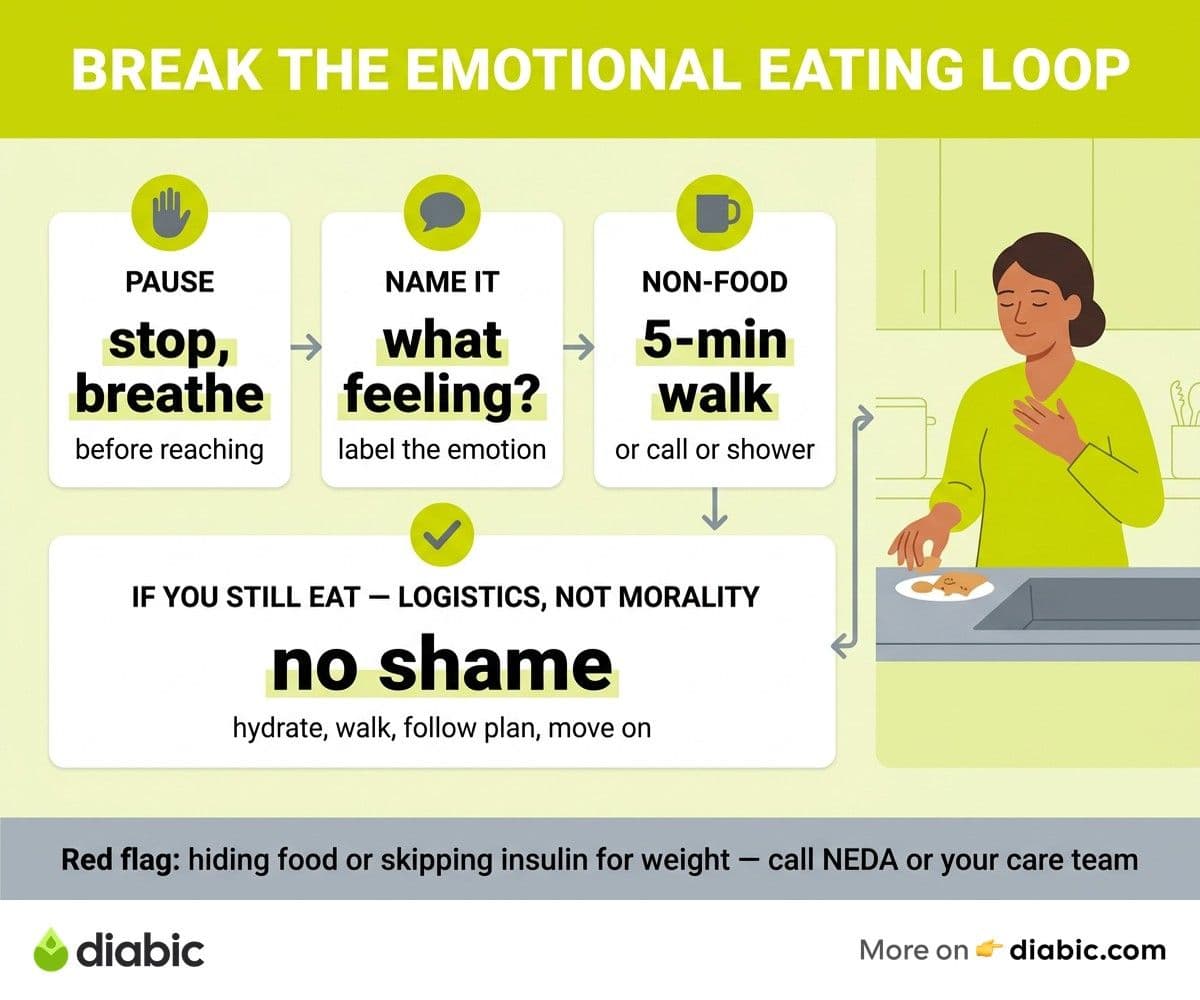
A short pause practice can help you spot your emotional eating diabetes patterns. Before reaching for food when you are not at a planned meal, ask, what am I feeling, and what do I actually need? Sometimes the answer is still food, and that is fine. Sometimes the answer is rest, water, a walk, a text to a friend, or a few minutes of quiet. Either way, you have given yourself a moment of choice.
Breaking the Cycle Without Shame
The most useful approaches we have seen are gentle, repeatable, and forgiving. Pause and name the emotion before reaching for food, even if you still eat. Naming a feeling reduces its intensity, according to studies on affect labeling, and over time it builds the gap where new responses can grow. You can find more on this approach in our piece on mindfulness and diabetes.
Build a short list of non-food comfort options that fit your real life. A five-minute walk outside, a phone call to someone safe, a warm shower, a saved playlist, a journal page, or a few rounds of slow breathing all qualify. Keep the list visible, because in a hard moment your brain will not go searching. If you find yourself stuck on rotating snacks, our list of 8 foods that won't spike blood sugar offers options that feel like a hug without the rebound.
If you do eat emotionally, treat the blood sugar impact as a logistics problem, not a moral one. Hydrate, take a walk if it is safe, follow your usual care plan, and move on. Self-punishment does not improve glucose; it just adds another layer of bad feeling. Working with a registered dietitian or a certified diabetes care and education specialist on flexible, mindful eating approaches can change the relationship over months in ways that no single meal can.
Small experiments that build trust
Try one new pause practice for a week and see what changes. Keep a brief note in your phone with the feeling, what you did, and how it landed. This is not a food log; it is a feelings log with food in it. Patterns become visible quickly, and patterns are easier to work with than a vague sense of failure.
Talk to one trusted person about what you are noticing. Saying it out loud, even once, takes power away from the shame and makes the next step easier to take.
When to Seek Professional Support
Some patterns deserve more than self-help, and reaching out is a sign of strength. The American Diabetes Association recommends screening for disordered eating as part of routine diabetes care, because eating concerns are more common in people with diabetes than in the general population. The National Eating Disorders Association also offers a confidential helpline and screening tools that you can use without a referral.
Consider professional support if emotional eating feels out of control or happens most days, if you are hiding food, eating in secret, or skipping insulin to manage weight, if guilt about food is affecting your sleep, work, or relationships, or if you suspect diabetes burnout and emotional eating are tangled together. Skipping or restricting insulin to influence weight is a serious eating disorder pattern sometimes called diabulimia, and it deserves immediate, specialized care.
Eating disorder specialists who understand diabetes do exist, and finding one matters. Ask your endocrinologist or primary care provider for a referral, or search the NEDA directory for clinicians with diabetes experience. Therapy approaches like cognitive behavioral therapy and acceptance-based work have research support for both emotional eating and disordered eating in people with diabetes.
Frequently Asked Questions
How do I stop emotional eating with diabetes?
A gentle, repeatable approach works better than willpower. Notice the feeling before the food, build a short list of non-food comfort options you can reach for in hard moments, and treat any emotional eating that does happen as information rather than failure. Working with a diabetes educator, dietitian, or therapist on mindful eating can make these shifts stick over time.
Why does diabetes cause emotional eating?
Diabetes does not cause emotional eating on its own, but it raises the stakes around food, layers in glucose-related mood changes, and adds shame and restriction that can push the cycle harder. The constant decision-making, occasional lows that demand fast eating, and years of food rules all combine to make the emotional eating diabetes loop feel especially heavy. Naming the loop is the first step toward easing it.
You did not build this pattern overnight, and you will not unbuild it overnight either. Each pause counts, each compassionate response counts, and the right support can carry the rest. We are here for the long version of that work, alongside you.
Shahriar P. Shuvo is the founder of Diabic. He has lived with diabetes for over 14 years, and built Diabic to deliver the practical, evidence-based self-management tools he wished existed when he was first diagnosed. By trade, Shahriar is a senior design and frontend engineer with 6+ years shipping products at Agora, Timescale (now Tiger Data), and ShareTrip. He writes from the intersection of lived diabetes experience and product craft, focused on what works in daily management rather than what sounds good in a textbook.
Medically reviewed by
Dr. Rezwana Parvin Rumpa is an obstetrics and gynaecology specialist with clinical focus on gestational diabetes, PCOS, and fertility. She holds the MRCOG (Final Part) from the Royal College of Obstetricians and Gynaecologists in London, the MRCPI (Final Part) from the Royal College of Physicians of Ireland, and an MBBS from Shaheed Monsur Ali Medical College under Dhaka University. Dr. Rumpa serves as a Senior Medical Officer in the Obs and Gynae department at BRB Hospitals Ltd, where she has spent three years managing prenatal care, emergency obstetric cases, and women's-health surgery. On Diabic, she medically reviews content for women living with diabetes, with particular attention to pregnancy, PCOS, and reproductive-health intersections.
More from Living with Diabetes
View all
A Gentle Chair Yoga Routine for people with diabetes
A gentle chair yoga for people with diabetes routine with safe poses, modifications for neuropathy, retinopathy, and joint pain, plus tips for older.

Shift Work and Diabetes: Managing Irregular Hours
Shift work and diabetes is a tough combination. Learn how to manage meals, sleep, medication, and blood sugar when your hours rotate or flip overnight.

Dating with Diabetes: When to Tell a New Partner
Dating with diabetes brings unique disclosure questions. Here is when to tell a new partner, what to say, and how to handle the conversation with.
Clinician-reviewed habits, plain-language guides, and honest answers - the small shifts that make living with diabetes feel lighter, every day.