How Diabetic Neuropathy Physical Therapy Can Help
Diabetic neuropathy physical therapy may help reduce pain, improve balance, and rebuild strength. Here is what sessions look like and how to start.

In this article(10)
If your feet feel unsteady, your toes burn at night, or your legs no longer trust the floor under them, you are not stuck with those sensations forever. Diabetic neuropathy physical therapy is one of the most underused tools we see in nerve care, and the research keeps pointing to real benefits for pain, balance, and daily function. The work is gradual, but it is also surprisingly hopeful once you find the right therapist and the right starting point.
Most people hear "neuropathy" and think there is nothing to do besides take medication. That framing leaves out a large body of evidence on movement-based care. The American Diabetes Association recommends regular physical activity for nearly every person with diabetes, and physical therapists translate those general recommendations into specific, safe routines built around your symptoms.
This guide walks through why physical therapy helps, what kinds of exercises a therapist might choose, what a session actually looks like, and how to find someone who knows neuropathy well. The goal is not perfection. It is steady progress, fewer falls, and feet you can rely on a little more each week.
Why Diabetic Neuropathy Physical Therapy Helps
Nerve damage from diabetes affects more than sensation. It changes how your muscles fire, how your joints move, and how your brain reads signals from your feet. Targeted movement addresses each of those layers in a way that pills alone cannot.
Research published in the Diabetes Care journal has linked structured exercise programs to improved nerve fiber density and reduced pain scores in people with diabetic peripheral neuropathy. Aerobic and resistance training appear to support small blood vessel health, which keeps oxygen and nutrients flowing to nerves that have been struggling under chronic high glucose. That circulatory boost is one reason gentle, consistent activity often softens neuropathic symptoms over weeks and months.
Physical therapy also rebuilds the muscles that compensate when nerves go quiet. When the small stabilizers in your feet and ankles weaken, your knees and hips work harder, and balance suffers. A therapist restores that chain by strengthening the right links in the right order. Many readers ask whether diabetic neuropathy can be reversed, and while full reversal is rare, function and comfort can improve meaningfully with the right plan. Catching symptoms early matters too, which is why recognizing diabetic peripheral neuropathy before it advances opens more therapy options.
There is one more layer worth naming. Pain is processed in the brain, not only at the nerve. Movement, breathing, and graded exposure to safe activity help retrain a nervous system that has become hypersensitive. That is why people who stick with PT often report less pain even when their underlying nerve damage has not changed.
Types of Physical Therapy Exercises for Neuropathy
Diabetic peripheral neuropathy exercises generally fall into four buckets, and a good therapist will mix them based on how your feet feel that week. The point is not to push through pain. It is to find the edge of what your nerves can tolerate and slowly expand it.
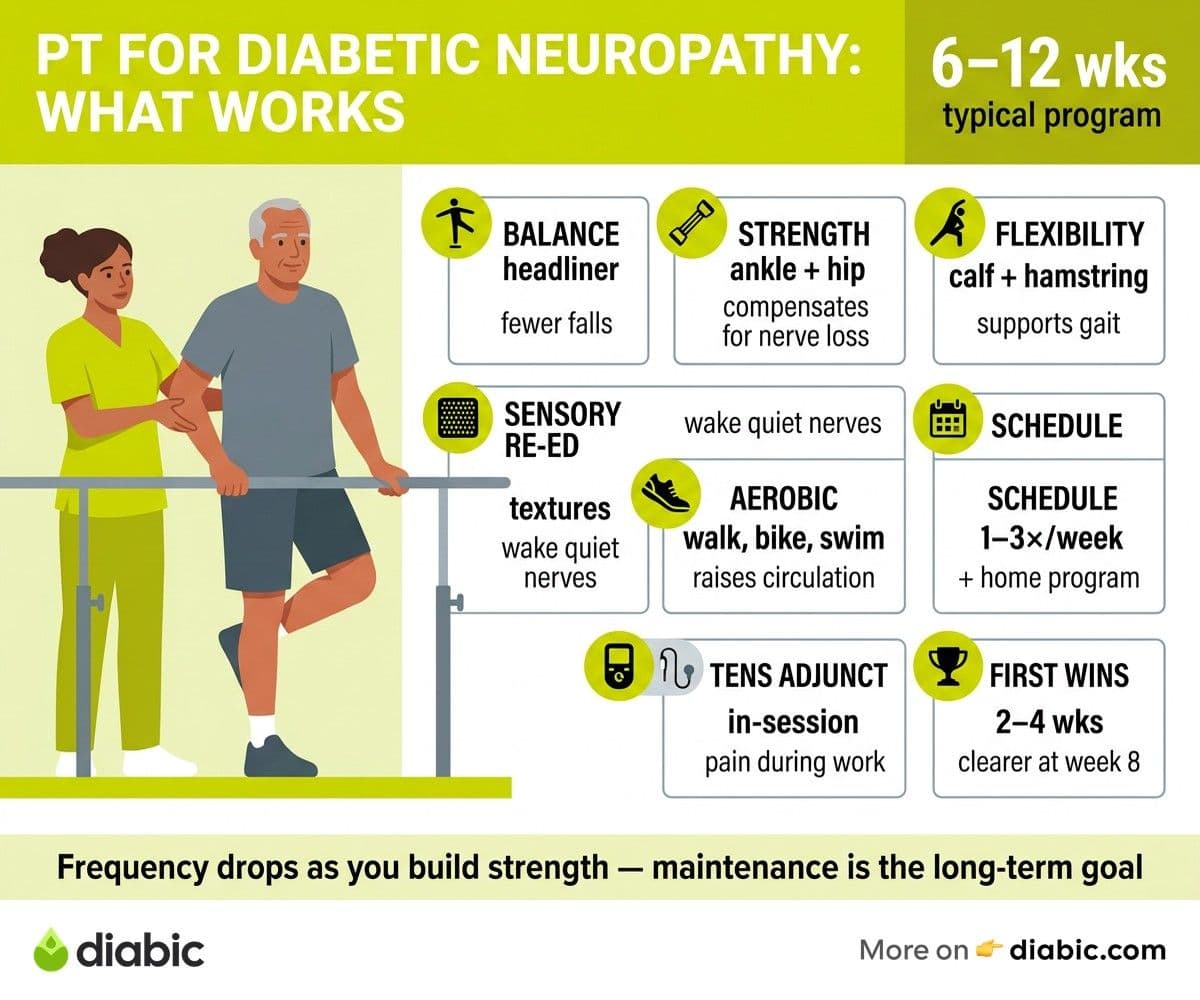
Balance training is usually the headliner. A therapist may start you with a simple feet-together stance near a counter, then progress to single-leg stands, tandem walking, foam pads, and balance boards. Falls are a major concern with neuropathy, and even short balance sessions a few times a week have been shown to reduce fall risk in older adults with nerve damage.
Strengthening exercises focus on the lower legs, hips, and core. Ankle pumps, toe raises, heel raises, seated leg presses, and resistance band work for the hips all show up frequently. When the ankle and hip muscles fire correctly, the foot has less work to do, and the brain has fewer surprises to manage during walking.
Flexibility and sensory re-education round out the program. Calf and hamstring stretches help with gait, and sensory re-education uses different textures, temperatures, and vibrations to wake up nerves that have grown quiet. A therapist may also walk you through monofilament checks so you can monitor protective sensation at home.
Aerobic activity is the foundation that ties everything together. The Mayo Clinic notes that walking, stationary cycling, and swimming are commonly used in neuropathy rehab because they raise heart rate without overloading sensitive feet. Many therapists also use TENS, a small device that delivers mild electrical pulses to the skin, as an adjunct for pain during sessions. If foot numbness has changed how you move, an aerobic plan that respects your skin and joints can be a turning point.
What a Physical Therapy Session Looks Like
The first visit is usually longer than the rest. The therapist takes a detailed history, asks about your blood glucose patterns, your fall history, and any wounds or pressure spots on your feet. Then they run hands-on tests for strength, range of motion, sensation, reflexes, and balance.
Gait analysis is a centerpiece of that first session. The therapist watches you walk, often from several angles, looking at how your foot strikes the ground, how your ankle moves through stance, and how your hip and trunk respond. Some clinics use video or pressure mats. The findings drive your plan.
After the assessment, you and the therapist agree on goals. Goals might be walking the dog without holding a wall, climbing stairs without the railing, or sleeping through a night without burning pain. Sessions typically run 45 to 60 minutes, one to three times a week, for a stretch of 6 to 12 weeks. Frequency tapers as you build independence.
Each session usually includes a warm-up, balance work, strengthening, a cardiovascular piece, and a cool-down with stretching. The therapist progresses you only when you are ready. They also send you home with a short program of three to six exercises so the gains compound between visits.
From my experience: I have lived with type 1 diabetes for 14 years, and the first time I worked with a physical therapist for nerve symptoms, I expected a list of stretches. What I got instead was someone watching me walk for ten minutes and pointing out that my left hip was doing almost no work. Six weeks of boring, specific drills later, the burning in my feet at night was noticeably quieter. I still do those drills. They are not glamorous, but they are the most useful thing in my routine.
Benefits Beyond Pain Relief
Pain reduction matters, and it is often what gets people through the door. The bigger story, though, is what a steady program does to the rest of your life. Diabetic neuropathy treatment plans that include physical therapy tend to deliver compounding wins.
Walking ability is usually first to improve. People who could only walk a block before pain set in often double or triple that distance over a couple of months of structured training. The NIDDK explains that regular movement supports nerve health and helps with the broader vascular issues that drive neuropathy in the first place.
Blood sugar management often improves too. Muscles use glucose during and after exercise, and a body that moves consistently typically shows lower fasting numbers, smaller post-meal spikes, and a meaningful drop in A1C over time. That feedback loop is part of why diabetic neuropathy treatment options increasingly include exercise as a first-line component, not an afterthought.
Other benefits show up more quietly. Mood improves with predictable movement. Anxiety about falling fades. Independence in chores, errands, and travel grows. Foot ulcer risk drops because you become more aware of pressure points, more flexible in your gait, and more attentive to the daily checks your feet need.
Getting Started with Physical Therapy
The first step is usually a referral from your primary care doctor or endocrinologist. In many states you can also see a physical therapist through direct access, but a referral helps with insurance and gives the PT a complete medical picture.
When choosing a therapist, look for someone who works with people who have diabetes regularly. The American Physical Therapy Association maintains a directory where you can search by specialty, including neurologic and geriatric care, both of which overlap with neuropathy. Therapists with a Geriatric Clinical Specialist (GCS) or Neurologic Clinical Specialist (NCS) credential are often a strong fit.
Ask a few questions before your first visit. How often do you treat people with diabetic neuropathy? How do you handle balance training and sensory re-education? Will you communicate with my endocrinologist? A therapist who answers these confidently will likely be a good partner. Pair this work with your broader diabetic foot care and prevention routine so wounds and pressure injuries do not derail your progress.
Insurance coverage varies. Most US plans cover medically necessary physical therapy with a referral, though copays and visit limits differ. Medicare covers PT for diabetic neuropathy when documented as medically necessary. If finances are tight, ask whether the clinic offers self-pay rates, sliding scale options, or group sessions. While you wait for a first appointment, gentle ankle circles, seated marches, and short walks on flat surfaces are usually safe to start, but check in with your doctor first if you have foot ulcers, balance problems, or recent cardiac issues.
Set realistic expectations. Most people notice small wins in 2 to 4 weeks and clearer changes by week 8. Progress is not linear. A bad blood sugar week, a cold, or a stressful month can stall things briefly, and that is normal. Showing up consistently is the variable that matters most.
Putting It Together
Diabetic neuropathy physical therapy is not a magic fix, and it does not replace medication or blood sugar work. It does, however, give you a way to act on your symptoms instead of waiting them out. A trained physical therapist meets you where your feet are today and helps you move toward the version of your day that feels worth getting up for.
What makes diabetic neuropathy physical therapy worth the trouble is the way small wins compound. Steadier balance lets you walk farther, walking farther helps your blood sugar settle, and steadier numbers feed back into nerve health over months. The first session may feel underwhelming, with simple drills and slow progressions. The work earns its place by week eight. Talk to your doctor about a referral this week, and bring your questions to the first visit. The smallest start counts.
FAQ
What physical therapy exercises help diabetic neuropathy?
The most useful exercises tend to be balance work like single-leg stands and tandem walking, strengthening for the ankles and hips, calf and hamstring stretches, sensory re-education with different textures, and steady aerobic activity such as walking, cycling, or swimming. A physical therapist tailors the mix to your symptoms and your fall risk.
Does physical therapy improve nerve damage from diabetes?
Research suggests that structured exercise can support nerve fiber health and reduce pain in many people with diabetic peripheral neuropathy. Reversing nerve damage entirely is uncommon, but improvements in pain, balance, strength, and walking distance are well documented. Talk to your doctor about whether a PT referral fits your care plan.
How often should you do physical therapy for neuropathy?
A typical schedule for diabetic neuropathy physical therapy is one to three sessions per week for 6 to 12 weeks, paired with a short home program done most days. Frequency drops as you build strength and confidence, and many people graduate to a maintenance routine they continue indefinitely.
Shahriar P. Shuvo is the founder of Diabic. He has lived with diabetes for over 14 years, and built Diabic to deliver the practical, evidence-based self-management tools he wished existed when he was first diagnosed. By trade, Shahriar is a senior design and frontend engineer with 6+ years shipping products at Agora, Timescale (now Tiger Data), and ShareTrip. He writes from the intersection of lived diabetes experience and product craft, focused on what works in daily management rather than what sounds good in a textbook.
Medically reviewed by
Dr. Shanto Arian is an internal medicine physician now specializing in clinical and aesthetic dermatology, with a parallel academic focus on epidemiology and public health. He holds an MBBS, MPH, MSc (UK), MRCP (UK), MRCPI (Ireland), Diploma in Dermatology (UK), and Diploma in Aesthetic Medicine (USA). Dr. Arian trained in internal medicine, including hospital work on hematology cases such as graft-versus-host disease, before moving toward dermatology. Skin is one of the earliest places diabetes shows itself, from acanthosis nigricans and diabetic dermopathy to slow foot wound healing, and that intersection is where his clinical and Diabic-review work meet. On Diabic, Dr. Arian medically reviews content on diabetes diagnosis, complications, dermatologic manifestations, and pharmacotherapy, ensuring every claim aligns with current ADA, NICE, and peer-reviewed literature.
More from Health & Complications
View all
Diabetes and Dental Implants: What to Know First
Diabetes dental implants guide covering safety, A1C targets, recovery expectations, gum health prep, and what to ask your oral surgeon before surgery.

Burning Mouth Syndrome and Diabetes Explained
Burning mouth syndrome diabetes link explained, including neuropathy, dry mouth, and thrush causes plus treatment options that may bring real relief.

Dental Care for people with diabetes: Tips That Help
Practical dental care diabetics need, with real tips for protecting teeth and gums when diabetes raises your risk for oral health problems.
Clinician-reviewed habits, plain-language guides, and honest answers - the small shifts that make living with diabetes feel lighter, every day.