Diabetes in Teenagers: How to Support Them
Diabetes in teenagers is uniquely hard. A parent guide to hormonal swings, social pressure, and supporting independence without taking over.

In this article(9)
Diabetes in teenagers collides with everything else happening in adolescence: hormonal shifts, social pressure, identity formation, and a fierce need for independence. Supporting a teen with diabetes means finding the line between keeping them safe and letting them own their health. Most parents find that line moves week to week.
The teen years are when many families see A1C climb after years of solid pediatric control. The reason is rarely lazy management. Hormones, school stress, social schedules, and a growing need for autonomy all stack up at once. Knowing what to expect makes the support easier to give.
Why Diabetes in Teenagers Is Uniquely Challenging
Adolescence is hard on its own. Adding diabetes to it multiplies the load.
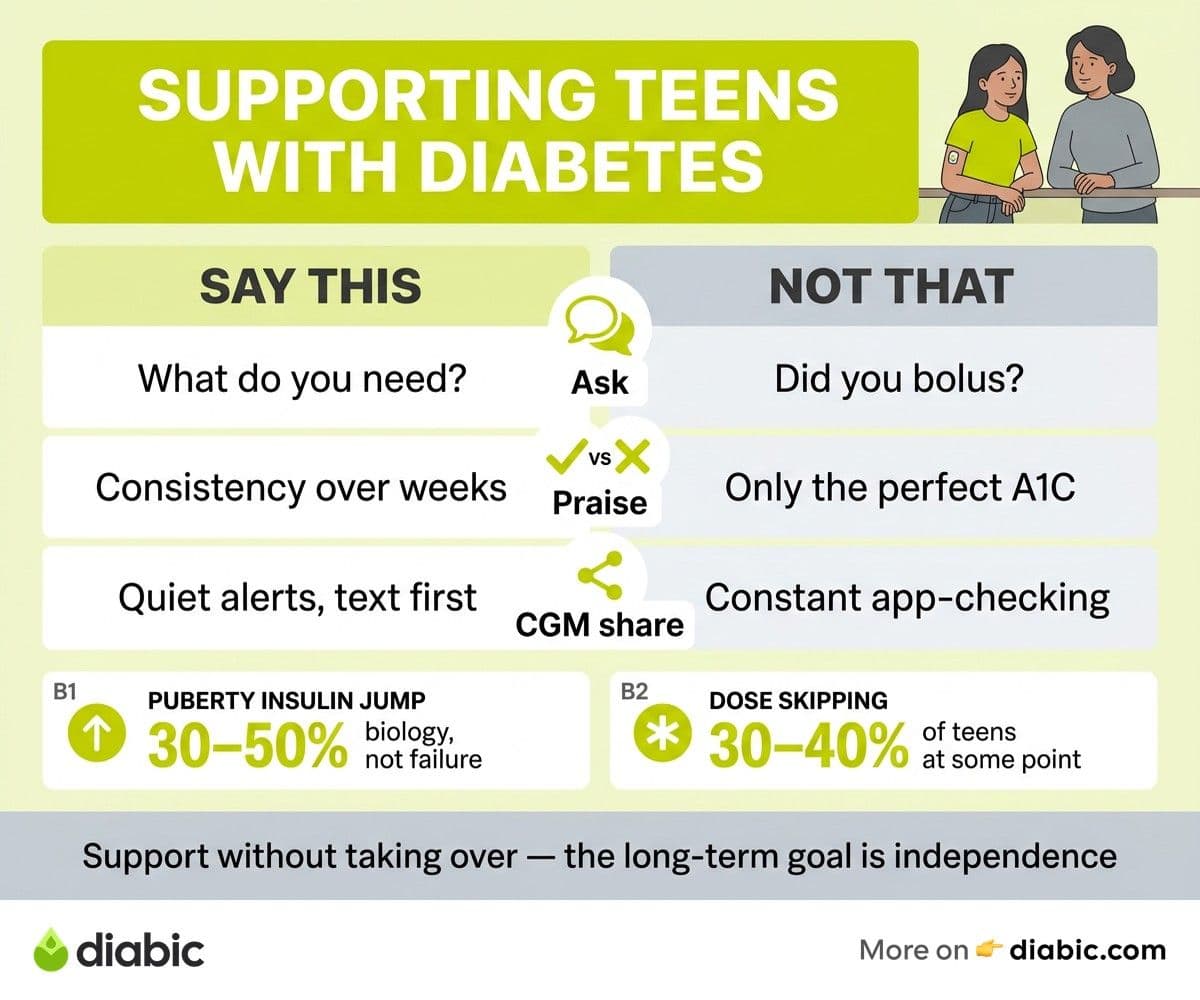
Hormonal changes increase insulin resistance. Puberty surges in growth hormone and cortisol push insulin needs up, sometimes by 50 percent or more. A teen who used to take 30 units a day might suddenly need 50, with no change in food or activity. This is biology, not a failure of management.
Social pressure around food, drinking, and fitting in. High school is full of pizza parties, late-night snacks, sports drinks, and (later) alcohol. Each one requires either dosing math, planning, or saying no in a moment when no one else is. The mental load adds up.
Independence clashes with consistency. Teens want autonomy. Diabetes demands consistency. The two collide constantly. Asking your teen "did you bolus?" can feel like a kindness or like surveillance, depending on the day.
Burnout and dose skipping. The single biggest risk in adolescent diabetes is intentional dose omission, often to lose weight or feel "normal." Studies suggest 30 to 40 percent of teens with type 1 skip insulin doses at some point. Our deeper guide to teen diabetes burnout and mental health covers warning signs and how to respond. The broader pattern of diabetes burnout shows up across age groups but hits especially hard in teens.
How Hormones Affect Blood Sugar in Adolescence
The biological piece is real and worth understanding. The American Diabetes Association and pediatric endocrinology research published in journals like Pediatric Diabetes document how puberty changes glucose dynamics.
Growth hormone and cortisol. These hormones surge during puberty, especially overnight and early morning. Both increase glucose production by the liver and reduce cellular insulin sensitivity. The result is the dawn phenomenon on steroids, many teens see fasting blood sugars climb 50 to 100 points compared to their pre-pubertal years.
Insulin needs jump during growth spurts. A growth spurt can require a 30 to 50 percent insulin increase over a few weeks, then plateau or even decrease again when the spurt ends. Pump basal rates and meal ratios often need updates every few months.
Menstrual cycles in teen girls. Estrogen and progesterone affect insulin sensitivity. Many girls see blood sugar climb in the days before their period and drop after. Tracking cycle days alongside glucose data reveals the pattern within two or three months. Some pumps allow temp basal increases for predictable cycle-related rises.
These changes are biology, not failure. This point is worth repeating to your teen and to yourself. Climbing A1C during puberty is not because they "stopped trying." When you frame diabetes in teenagers as a biological moving target, adjusting expectations and dosing helps more than judgment.
Practical Support Strategies for Parents
The American Psychological Association has published guidelines for supporting adolescents with chronic illness that come down to a single principle: support without taking over.
Let your teen lead conversations. Ask "how are you feeling about your diabetes lately?" and then actually listen. Avoid jumping to solutions or restating targets. Sometimes they need to vent, not problem-solve.
Offer help without taking over. "What do you need from me right now?" beats "Did you bolus for that?" Both questions express care, but the first respects autonomy and the second triggers eye-rolls. The first also gets honest answers.
Respect privacy around devices and data while maintaining safety. CGM share apps let you see your teen's glucose in real time. Most teens find this invasive past age 14 or so. The compromise many families settle on: alerts only for serious lows or sustained highs, no checking the app constantly, and an agreement that you will text rather than confront in the moment. Our cornerstone guide to children with type 1 diabetes covers the longer arc from early childhood to teen independence.
Celebrate consistency, not perfection. A1C is one number across three months. Time in range is a daily measure. Showing up for diabetes most days, even imperfectly, is the win. Pointing out a 280 reading after pizza without acknowledging the 60 percent time in range that week erodes trust fast.
From my experience: After more than a decade with diabetes, the moments that did the most damage to my teen self were not the high readings. They were the conversations where the high reading became the whole conversation. The teens I have talked with since echo this. What helps is the parent who remembers the dance recital, the homework, the friendship drama, and the diabetes, in that order, not the reverse.
Encouraging Peer Connection and Normalcy
Isolation makes diabetes harder. Connection makes it more bearable. Teens with diabetes who have other teens with diabetes in their lives consistently report lower distress and higher self-management.
Diabetes camps and teen meetups. Camps like Camp Sweeney, Camp Nejeda, and dozens of regional ADA-affiliated camps create a week where everyone wears a CGM and nobody is the only one bolusing at lunch. The JDRF teen resources include teen-only meetups, conferences, and online programs. Our diabetes summer camp post covers what to expect from the camp experience.
Help teens prepare for social situations. Parties, eating out, dating, school dances, each comes with planning needs. Talk through scenarios in advance. What if there is no nutrition info on the appetizer? What if a date asks about the CGM on her arm? Walk through the moves so they are not improvising at the moment.
Encourage sports and activities. Athletic kids with diabetes do well when the management plan accounts for activity. Pre-exercise carbs, temp basal reductions, and post-game checks all become routine within a season or two. Our sports and diabetes for kids post covers the specific adjustments for different activity types.
Social media communities. TikTok, Instagram, and Reddit have active type 1 teen communities. The peer connection helps; the misinformation can hurt. Talk about which accounts are reliable (often endocrinology offices, JDRF, Children with Diabetes), and which to take with skepticism (any account selling cures or claiming to "reverse" type 1).
FAQ
How do I support a teenager with diabetes?
Lead with respect for their autonomy. Ask "what do you need?" instead of doing it for them. Celebrate consistency over perfection. Watch for signs of burnout and bring in mental health support early if needed. Connect them with peers who also have diabetes. Adjust your expectations during puberty, when hormones make blood sugar harder to manage.
Why is diabetes harder for teenagers?
Three reasons. First, hormones during puberty raise insulin resistance and make blood sugar swing more. Second, social pressures around food, drinking, and fitting in add complications most adults don't face. Third, the developmental need for independence clashes with the consistency diabetes requires. The combination is uniquely tough.
When should I let my teen manage their diabetes alone?
There is no single age. Most teens take on more independence between 14 and 18, with full self-management by college age. Pace it to your child's maturity, not the calendar. Use technology (CGM data sharing) to back up independence without hovering. Stay available without intruding.
What are signs my teen is burning out on diabetes management?
Skipping insulin doses, missing finger sticks or CGM applications, withdrawing from diabetes care visits, increasing irritability around the topic, weight loss without explanation (sometimes a sign of intentional insulin restriction), and rising A1C without obvious cause. Bring up mental health support early, it is a sign of strength, not failure.
When you support diabetes in teenagers with patience and respect for their growing autonomy, the relationship usually survives the rough patches that come with adolescence. The numbers may climb and dip during puberty, but the foundation you build now carries them into adulthood with confidence.
Shahriar P. Shuvo is the founder of Diabic. He has lived with diabetes for over 14 years, and built Diabic to deliver the practical, evidence-based self-management tools he wished existed when he was first diagnosed. By trade, Shahriar is a senior design and frontend engineer with 6+ years shipping products at Agora, Timescale (now Tiger Data), and ShareTrip. He writes from the intersection of lived diabetes experience and product craft, focused on what works in daily management rather than what sounds good in a textbook.
Medically reviewed by
Dr. Shanto Arian is an internal medicine physician now specializing in clinical and aesthetic dermatology, with a parallel academic focus on epidemiology and public health. He holds an MBBS, MPH, MSc (UK), MRCP (UK), MRCPI (Ireland), Diploma in Dermatology (UK), and Diploma in Aesthetic Medicine (USA). Dr. Arian trained in internal medicine, including hospital work on hematology cases such as graft-versus-host disease, before moving toward dermatology. Skin is one of the earliest places diabetes shows itself, from acanthosis nigricans and diabetic dermopathy to slow foot wound healing, and that intersection is where his clinical and Diabic-review work meet. On Diabic, Dr. Arian medically reviews content on diabetes diagnosis, complications, dermatologic manifestations, and pharmacotherapy, ensuring every claim aligns with current ADA, NICE, and peer-reviewed literature.
More from Living with Diabetes
View all
A Gentle Chair Yoga Routine for people with diabetes
A gentle chair yoga for people with diabetes routine with safe poses, modifications for neuropathy, retinopathy, and joint pain, plus tips for older.

Shift Work and Diabetes: Managing Irregular Hours
Shift work and diabetes is a tough combination. Learn how to manage meals, sleep, medication, and blood sugar when your hours rotate or flip overnight.

Dating with Diabetes: When to Tell a New Partner
Dating with diabetes brings unique disclosure questions. Here is when to tell a new partner, what to say, and how to handle the conversation with.
Clinician-reviewed habits, plain-language guides, and honest answers - the small shifts that make living with diabetes feel lighter, every day.